
 by
by I've styled a lot of backyards, and the ones that really feel cozy don't start with a fire pit or a pergola. They start with the same question you'd ask inside: where does your eye land first, and what makes it want to stay? The outdoor spaces that pull you in are the ones built with indoor logic. Textiles that you'd happily nap against. Lighting that pools instead of blares. Corners that feel discovered, not installed. Here's the thing: most backyard advice skips straight to the big stuff and misses the part that really changes the temperature of the experience. These thirteen ideas are the moves I'd make if I were starting from a bare patio and a Saturday.
- Float a weathered oak reading bench against a low wall
- Run a linen table runner down something rough
- Build a lounge corner around one piece that doesn't apologize
- Paint a shed like you'd paint a room you'd want to enter
- Roll out a bar cart that earns its real estate
- Circle a fire pit with seating that isn't afraid of ash
- Drape a daybed like it's a room with the walls removed
- Cabana light: build a shelter that breathes
- Cook outside like you mean it: the outdoor kitchen that isn't a joke
- Hang a hammock corner that doesn't look like a vacation rental
- Add a fountain that sounds like silence
- Build a fireplace that makes the backyard the main room
- Install an outdoor shower that feels like a hidden corner
1Float a weathered oak reading bench against a low wall
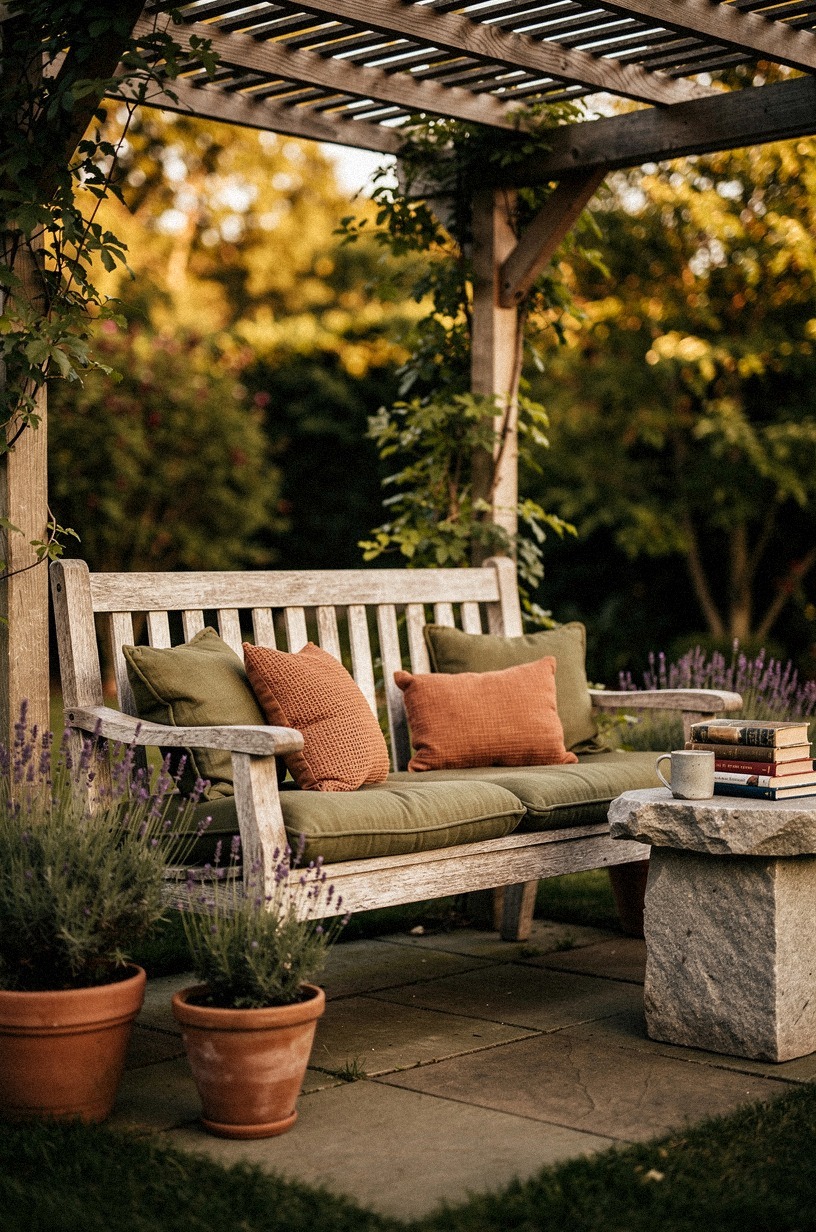
A bench doesn't need a fence to feel anchored. I've pushed a cerused white oak bench against a low plaster wall and watched the whole corner turn into a room.
The move is the cushion stack: one firm base in olive Belgian flax linen, one softer layer in terracotta cotton canvas, and a throw you really use. The stone side table matters more than you'd think.
A low slab of honed travertine at elbow height changes how you read outside. It gives your arm a place to land, which sounds small until you try reading without it.
The books aren't decoration. They're the signal that this spot is for lingering, not for passing through. The best backyard reading nooks I've built started with a bench that was slightly too deep.
Forty inches sounds generous indoors. Outside, with a pillow behind you, it's the depth that lets you tuck your legs up and stay there past sunset. If your wall is bare, check out our guide on how to make a large backyard feel cozy instead of empty.
2Run a linen table runner down something rough
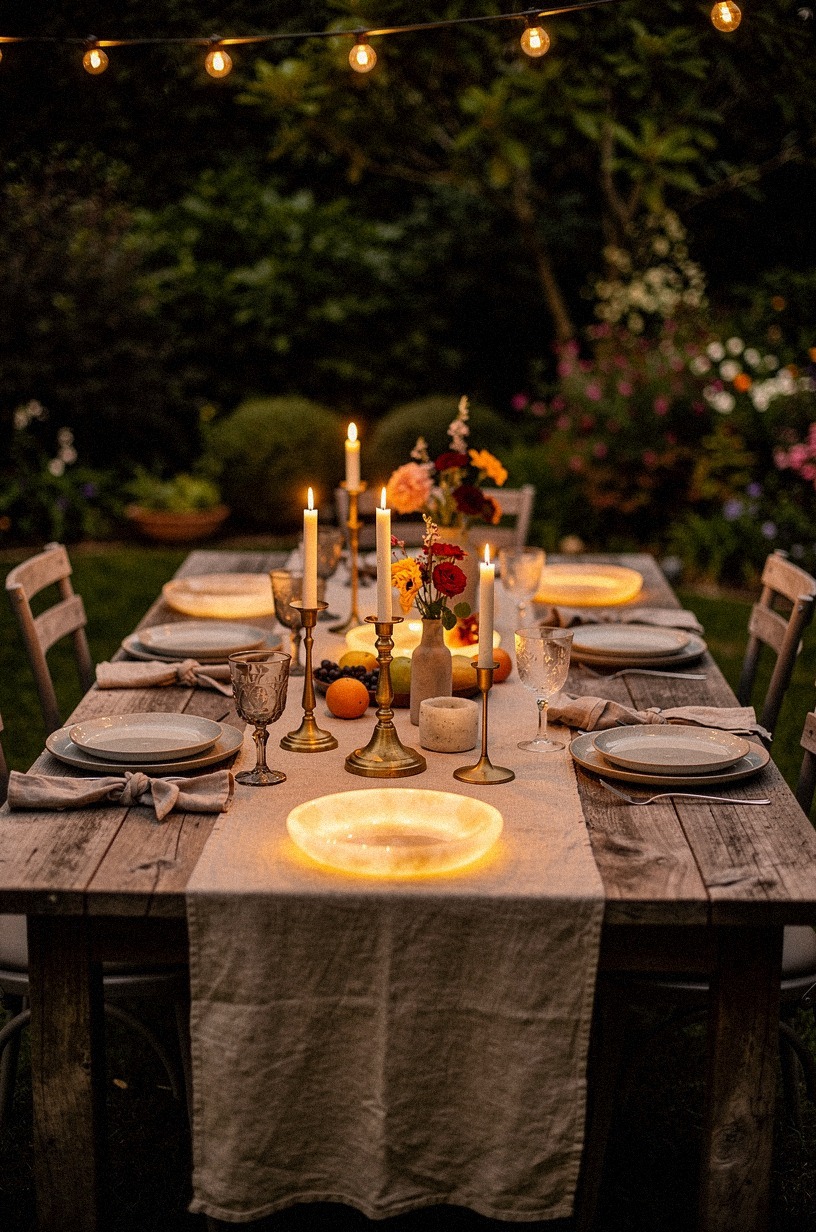
Outdoor dining gets stiff when everything matches. The move that works is pairing something refined with something raw. A long Belgian linen runner in warm oatmeal, washed soft, laid across a reclaimed teak table that still has its nail holes.
The contrast is what makes it feel gathered, not staged. I've set tables with aged brass candleholders that have started to go dark at the edges, and translucent onyx platters that glow when the light hits them from behind.
The onyx looks expensive because it is, but you only need one piece to set the tone! The rest can be everyday ceramic.
The lesson I learned after three summers of outdoor dinners: start with the table surface, not the chairs. If the table has texture, the whole meal relaxes. If it's slick and new, you're fighting the setting the whole night.
One runner, one interesting serving piece, and a set of glasses that aren't plastic. That's the foundation. For more on getting the backyard aesthetic right, our cozy backyard aesthetic guide breaks down the layering logic.
3Build a lounge corner around one piece that doesn't apologize
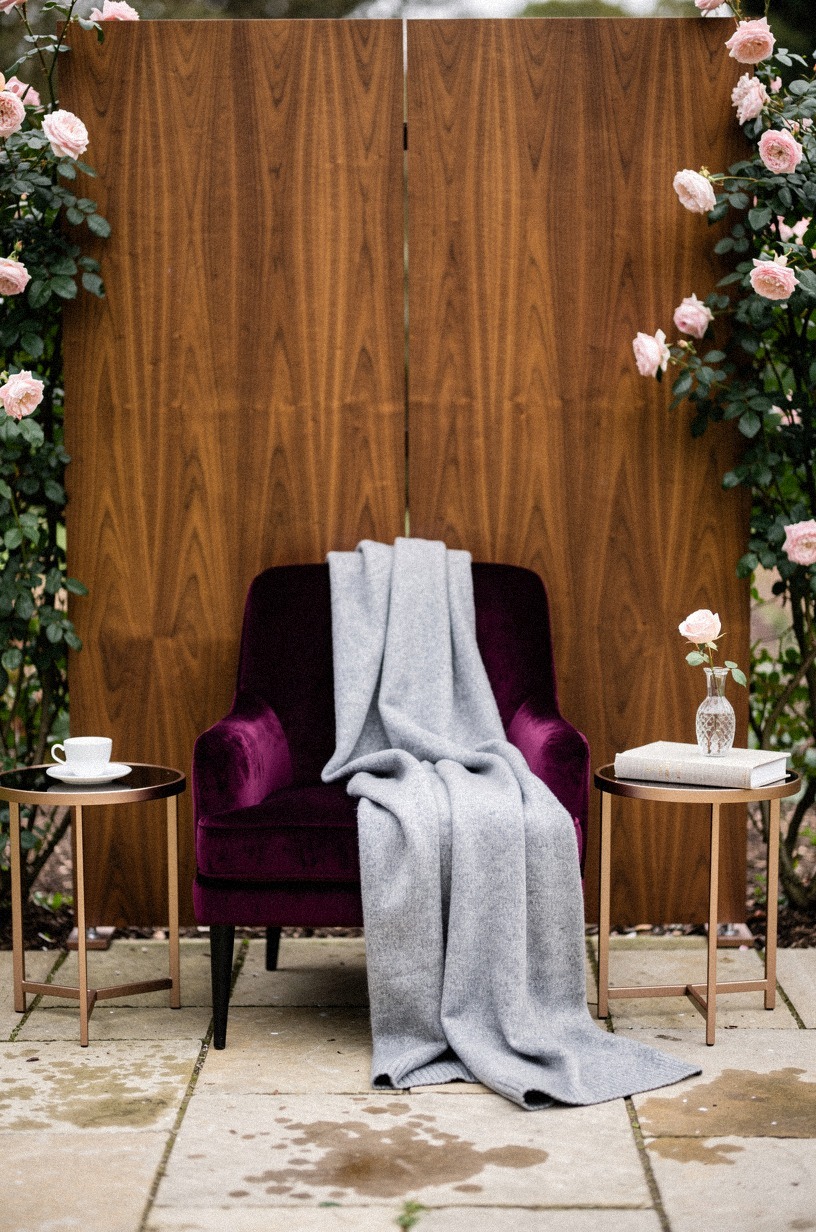
Every outdoor seating area needs a piece with some weight to it. I use a plum mohair velvet lounge chair as the anchor.
It's unexpected outside, which is exactly why it works. The color reads rich at dusk and doesn't wash out in full sun. Around it: grey wool throws folded loose, rose gold side tables with a little patina starting, and a privacy screen of book-matched walnut panels that block the sightline without looking like a fence.
The screen is the real move. It turns a wide-open yard into a room with walls.
I've built these from 3/4-inch solid walnut, oiled, not varnished, so it silvers over time. The panels need to be tall enough to block a standing eye line: sixty inches minimum, seventy better.
The chair faces inward, not out toward the yard. That's the orientation that makes it feel like a corner you'd find in a hotel lobby that happens to have breeze.
If you need a privacy screen that works, our cozy fenced-in backyard ideas have layouts worth studying. And the throws? They're not for looks.
Outdoor evenings cool fast, and a wool throw within arm's reach is the difference between a ten-minute sit and an hour.
4Paint a shed like you'd paint a room you'd want to enter
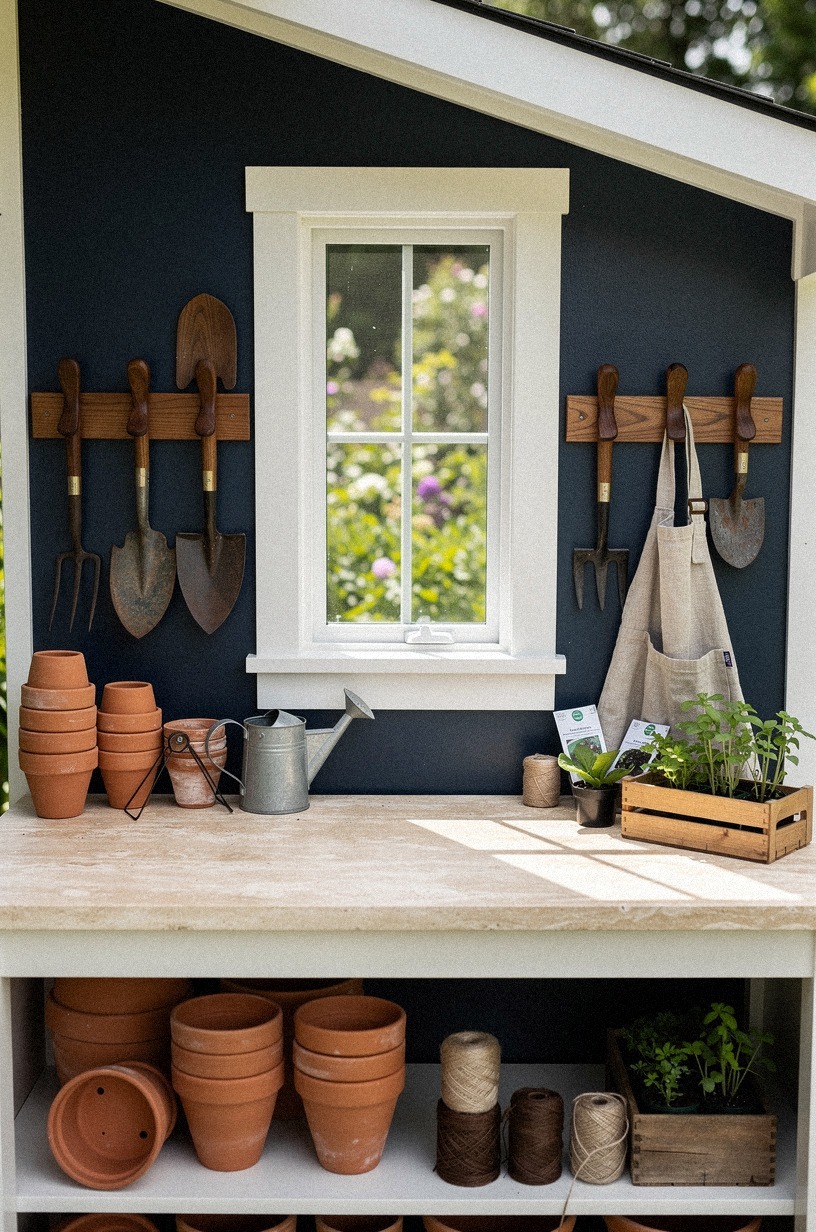
The backyard shed is usually an afterthought. That's a mistake.
A navy-painted structure with white trim and a warm travertine counter inside becomes a destination, not storage. I've hung walnut tool hooks on the back wall, kept terracotta pots stacked by size, and let morning light stream through a small window above the counter.
The paint matters: Benjamin Moore Aura Exterior in a deep tone holds up better than you'd expect, and the contrast with white trim gives it the same presence as a small cottage.
The countertop is where most people cheap out. Laminate warps. Travertine doesn't, and it gives you a surface you can really pot on, set a coffee down, or lean against while you're deciding what to plant.
The tool hooks should be at eye level, not above your head. If you can't see what you own, you won't use it. This is one of those projects that costs less than a mid-range grill and changes how the whole yard reads.
For a more storybook take, our cozy cottage backyard ideas explore the same logic with a softer palette.
5Roll out a bar cart that earns its real estate
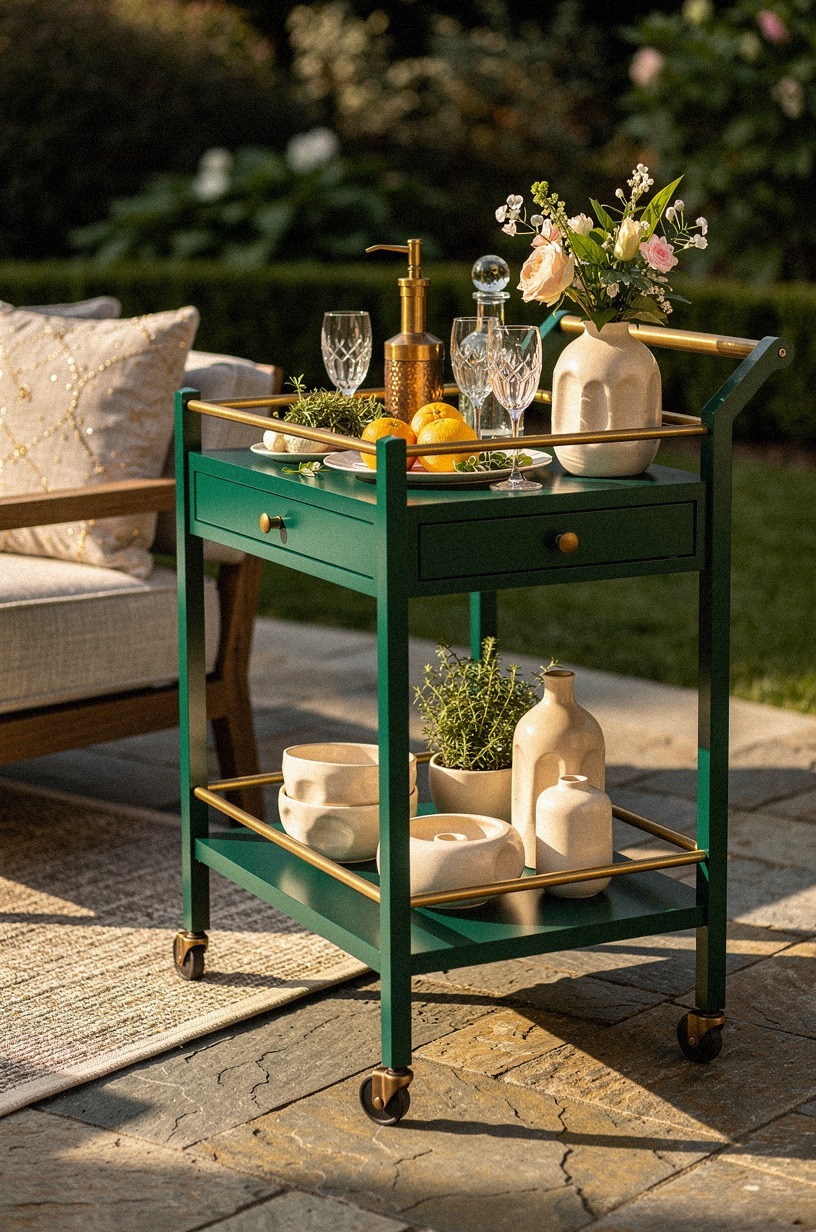
A bar cart inside is often just a bottle rack. Outside, it can be the center of the room.
I found an emerald powder-coated steel cart with unlacquered brass fixtures that are starting to turn honey-colored, and set it on a stone terrace with gold-flecked cushions nearby. The cart holds cream ceramic serveware, a pitcher, and one good ice bucket.
That's it. The restraint is what makes it feel designed!
The brass is the detail that sells it. For more on the backyard aesthetic that makes these details land, see our cozy backyard aesthetic guide.
Lacquered brass stays bright and looks like a hotel. Unlacquered brass develops a patina that says someone lives here.
The fixtures need to be solid, not plated, or the salt air will pit them in one season. The cart should lock. Stone terraces are rarely flat, and a runaway cart is a wasted cart. I keep the bottom shelf for backup glasses and the top for what's being served.
Two levels, clear roles, no clutter. That's the whole system.
6Circle a fire pit with seating that isn't afraid of ash
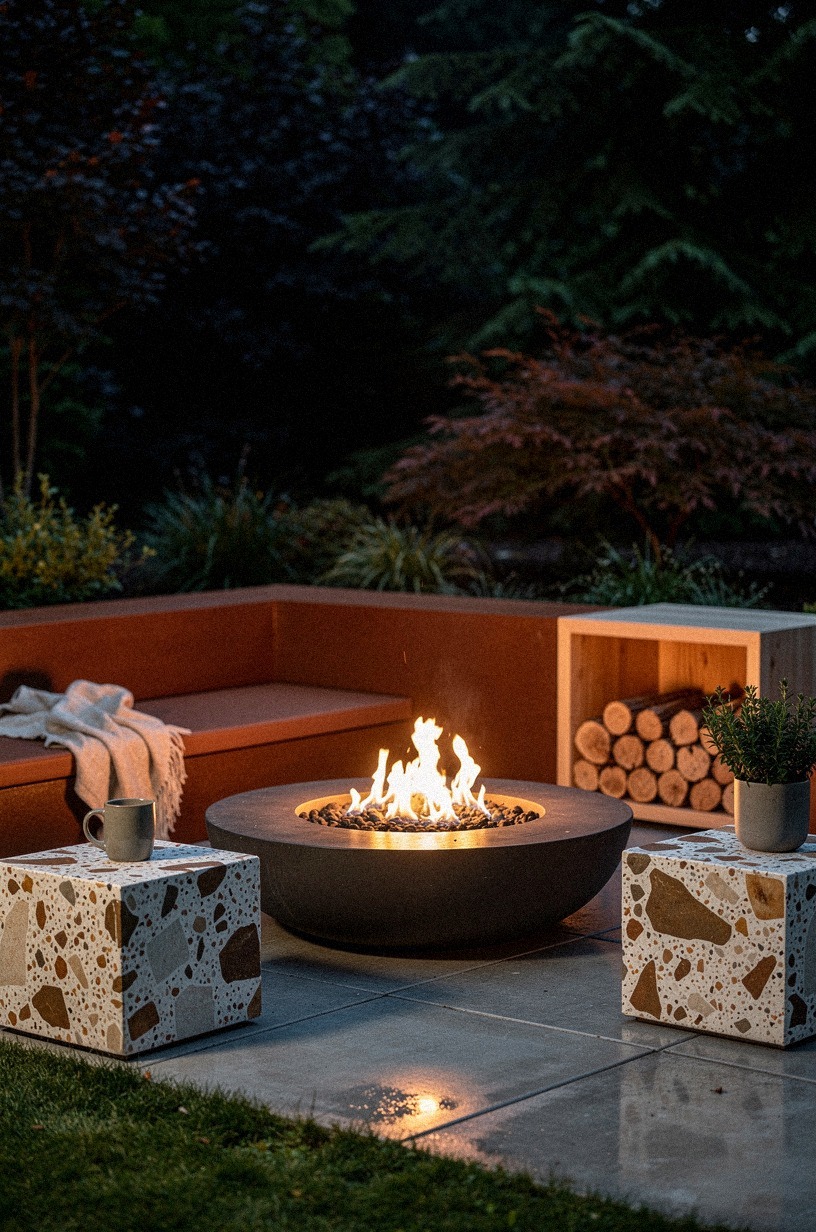
Fire pits fail when the seating is too precious.
7Drape a daybed like it's a room with the walls removed
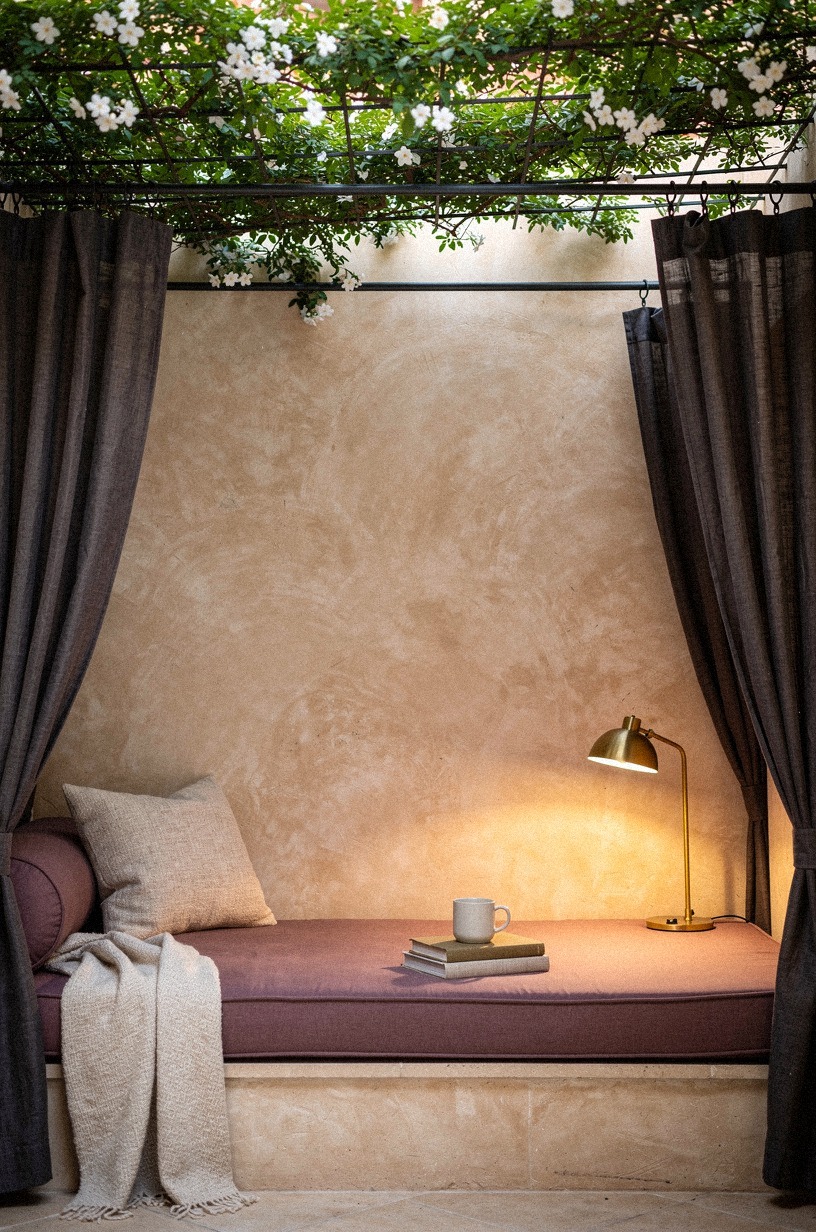
A daybed outside is a statement. I built one in dusty rose linen with charcoal linen drapes on a brass rail overhead.
The backdrop is hand-applied Venetian plaster in a warm white, done by a local artisan who left the trowel marks visible. Climbing jasmine is trained up the wall, and the scent in late afternoon is the reason you stay.
A brass reading lamp on a swivel arm means this corner works at ten in the morning and ten at night.
The plaster is the investment. Everything else is manageable. The drapes need to be outdoor-weight linen, not sheers, or they'll shred in the first wind. I use a Belgian flax in a heavy ounce weight that moves like sailcloth.
The daybed itself is white oak, slatted for drainage, with a down-alternative cushion wrapped in sunproof canvas. The real move is the height: eighteen inches off the ground, not twelve. Low enough to lounge, high enough to get up from without gracelessly rolling. The jasmine takes two seasons to climb.
Plant it early and wait. It's worth it!
For a softer take on this same logic, our cozy cottage backyard ideas explore the romantic side of outdoor rooms.
8Cabana light: build a shelter that breathes
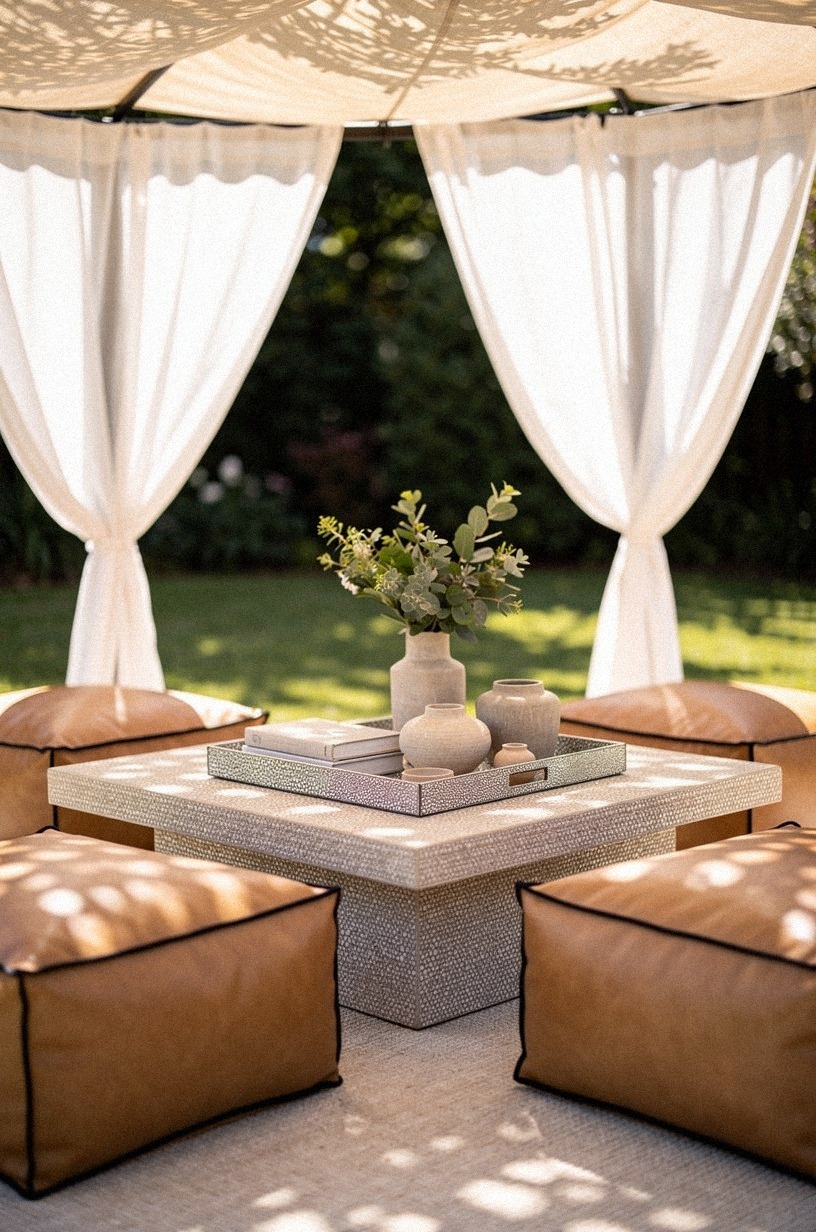
A cabana doesn't need walls. It needs a roof and a sense of enclosure.
I put up a warm white canvas canopy on black steel poles and filled the space with camel leather poufs that have black accent piping. The low table is shagreen-textured in a pale grey, and the trays on it hold glasses, a deck of cards, nothing else. Sheer curtains in ivory billow at the edges, and dappled sunlight comes through the tree canopy above.
The poufs are the flexible seating that makes the space work. Four people can sit on the ground without it feeling like a picnic. The leather is full-grain camel, and it darkens where it gets the most sun, which gives each pouf a memory of use.
The canopy needs to be pitched with a slight angle so water doesn't pool. I've seen flat canopies sag after the first rain.
The steel poles should be powder-coated, not painted, or you'll be touching up rust every spring. The whole setup breaks down into a bag and two poles. It's not permanent, and that's the point.
It feels discovered. If you're building a retreat zone, our cozy backyard hot tub ideas show how to layer comfort around water.
9Cook outside like you mean it: the outdoor kitchen that isn't a joke
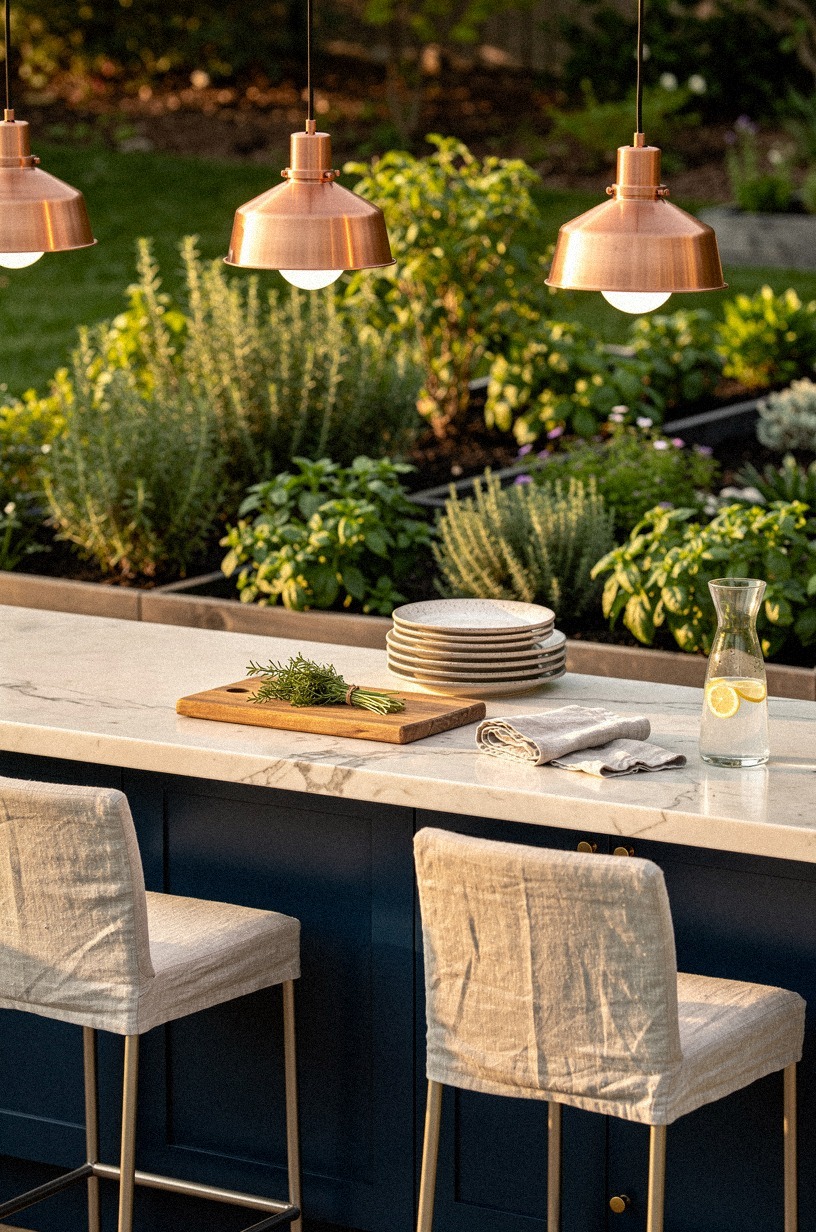
Most outdoor kitchens are a grill and a fantasy. I built one with a midnight blue painted cabinet base, copper pendant lights that will verdigris over time, and ivory marble countertops with soft grey veining. The bar stools are washed Belgian linen in a natural tone, already lived-in.
Behind the counter, a backyard herb garden in terracotta and zinc planters gives you something to cook with and something to look at.
The marble is honed, not polished, so it doesn't glare and it doesn't etch the way you'd expect. The copper lights need to be real copper, not plated steel, or the salt air will spot them unevenly.
The cabinet paint is Sherwin-Williams Emerald Exterior in a custom deep navy. It holds up to grease splatter and pressure washing.
The stools are counter height, twenty-four inches, not bar height. You're cooking, not perching. The herb garden is the detail that makes it feel like a kitchen, not a patio with appliances.
I keep basil, rosemary, and thyme in the front row, and let the mint fight it out in a contained pot where it can't escape.
10Hang a hammock corner that doesn't look like a vacation rental
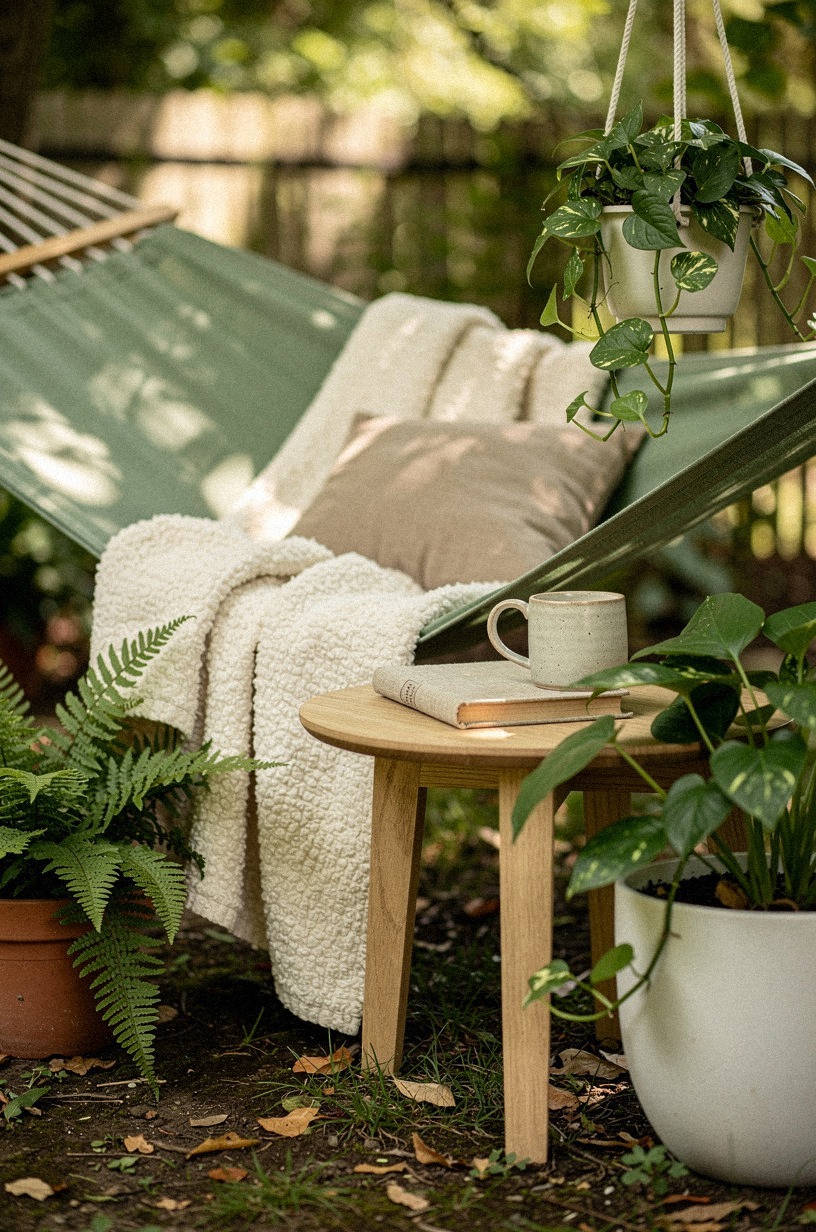
The problem with most hammock setups is they look like an afterthought. I built a corner with a sage green woven hammock and warm cream organic bouclé blankets that are thick enough to be the only layer you need on a seventy-degree evening. The natural wood side table is white oak, live-edge, with a single drawer for a book and a glass.
Potted ferns and trailing pothos surround the space, and the shade is filtered, not full.
The hammock needs to hang with a deep sag. A tight hammock is a backache. I use braided nylon rope through stainless steel eye bolts set into a pressure-treated 4x4 beam, not trees. Trees move, and a hammock that sways with the trunk is a hammock you'll fall out of.
The side table is low, fourteen inches, so you can reach it from the hammock without sitting up. The ferns are Boston ferns in unglazed terracotta, and they like the humidity of a shaded corner.
The bouclé blankets are the detail that makes it feel like a room. If you're designing a space that works for everyone, our cozy backyard play area ideas have layouts that balance adult calm with kid energy.
Most hammock corners stop at the hammock. Add the blanket, the table, the plant, and it becomes a place.
11Add a fountain that sounds like silence
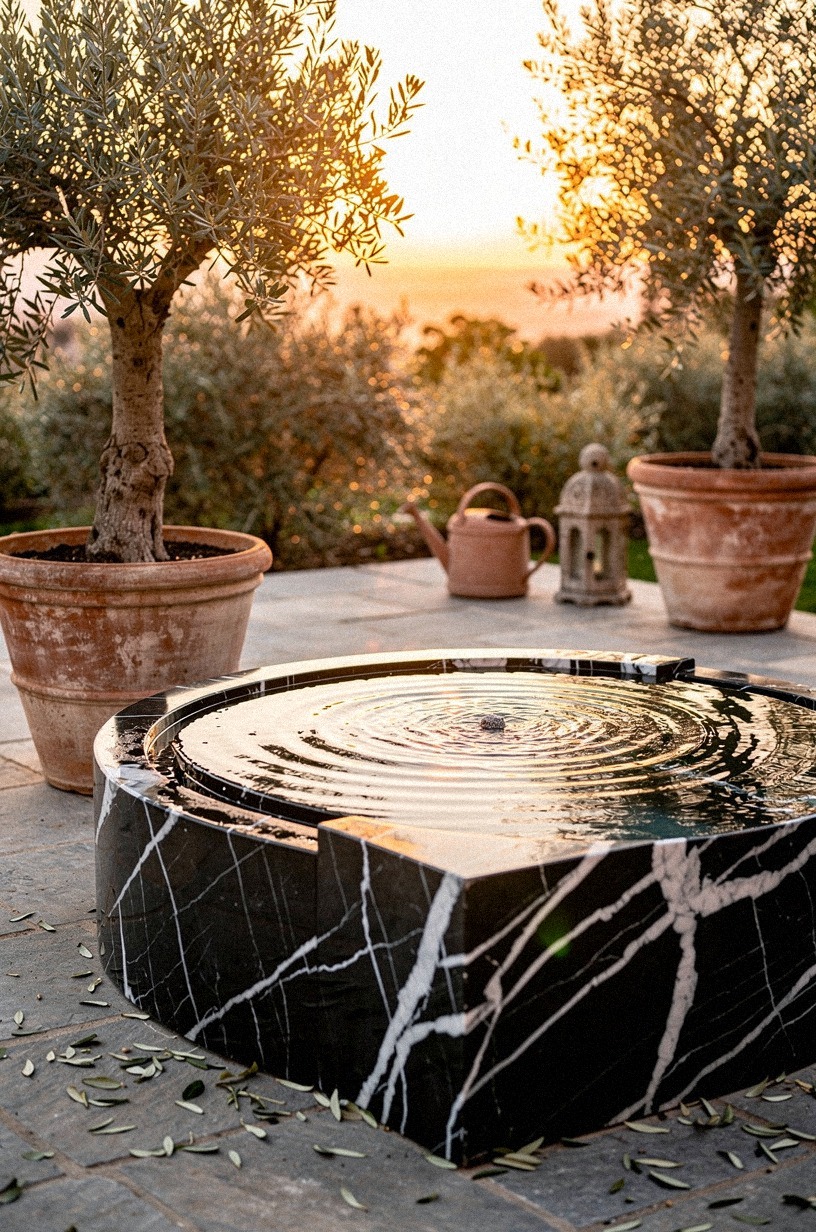
Water features usually try too hard. I installed a terracotta fountain with a Nero Marquina black marble basin that has white veining running through it like a map.
The water spills over a low edge, not a dramatic drop, and the sound is a murmur, not a splash. Olive trees in stone planters flank the basin, and the patio underfoot is honed limestone in large format tiles.
The warm sunset light hits the terracotta and makes the whole corner glow.
The basin is the key. A wide, shallow basin sounds better than a tall, narrow one.
The water has more surface to break on, and the sound is lower, more like rain on a roof than a faucet. The Nero Marquina is polished inside and honed outside, so the water line doesn't stain the visible face.
The olive trees are Arbequina, compact varieties that stay under eight feet. They need sun, so this setup only works in a corner that gets afternoon light. The fountain pump is solar, hidden in the basin, and the whole thing runs without a cord. It's the lowest-maintenance water feature I've installed, and the one I really like sitting near.
For a backyard that feels alive, our cozy backyard chicken setup guide adds another layer of purposeful charm.
12Build a fireplace that makes the backyard the main room
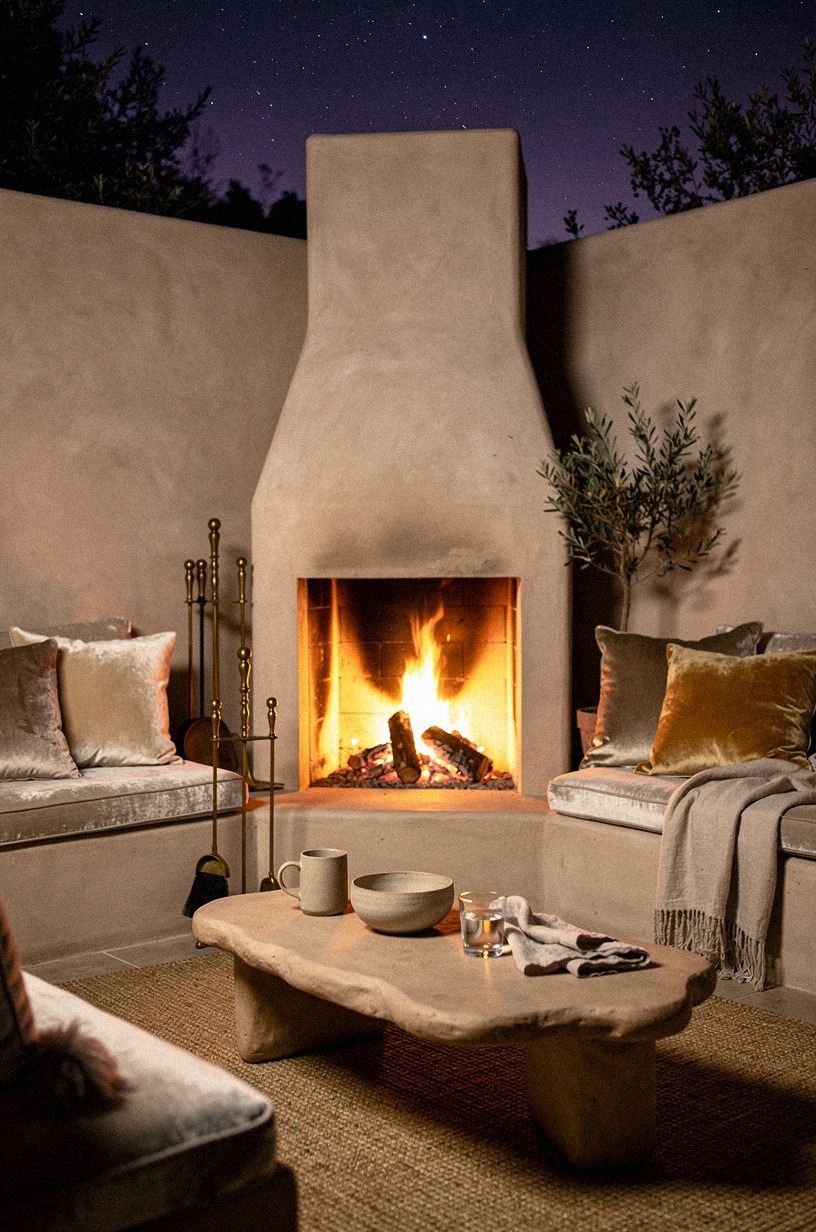
An outdoor fireplace is the move that changes how you use the whole house.
13Install an outdoor shower that feels like a hidden corner
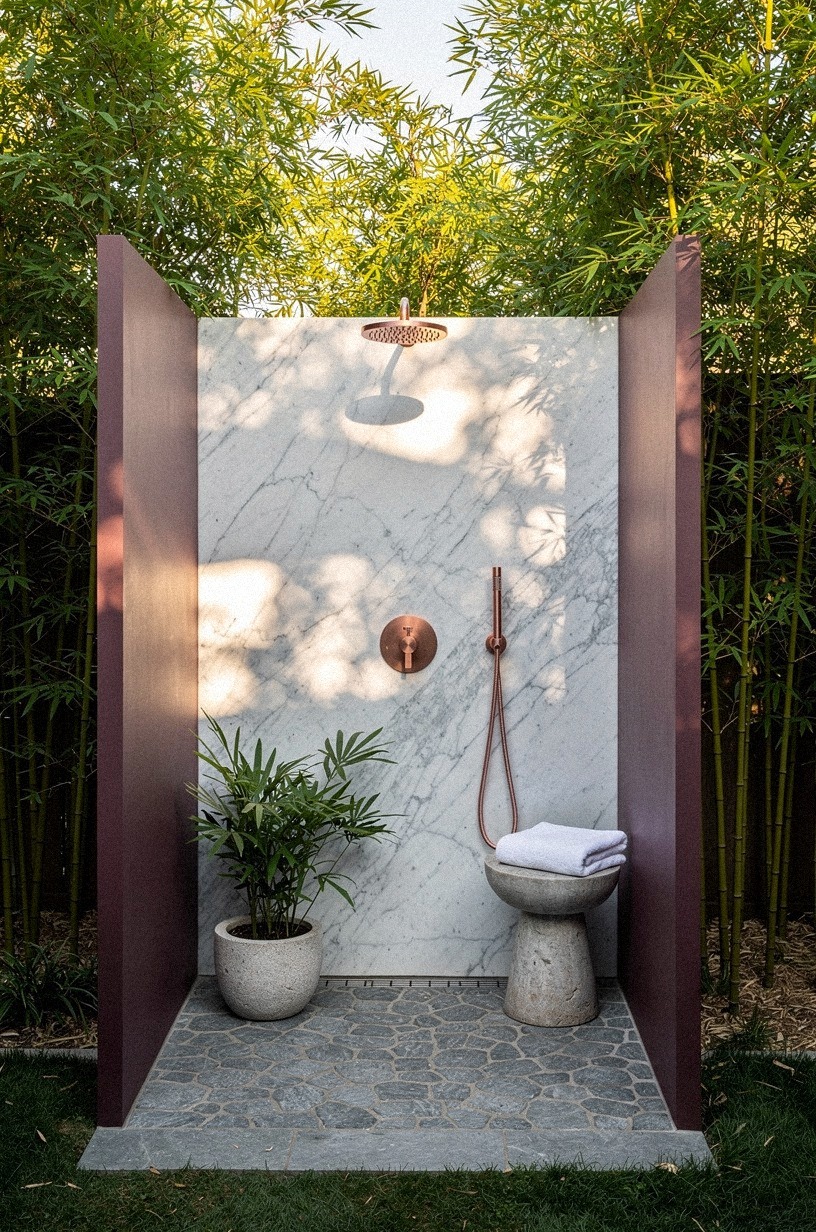
The outdoor shower is usually a utilitarian pipe. I built an enclosure with Carrara marble walls and subtle grey veining, rose gold fixtures that haven't started to spot yet, and grey stone flooring with a linear drain.
The walls are book-matched, so the veining flows from panel to panel. Outside the enclosure, backyard bamboo is planted in a dense screen that gives privacy without a fence.
The marble is honed Carrara, sealed with a penetrating sealer made for exterior stone. The rose gold is PVD-coated, not plated, so it holds up to salt if you're near the coast.
The floor slopes to the drain at one percent, barely noticeable but enough to keep water from pooling. The bamboo is Phyllostachys aurea, running bamboo contained in a HDPE root barrier buried thirty inches deep. It grows fast enough to give you a green wall in two seasons.
The shower itself is on a thermostatic valve, so the temperature doesn't spike when someone flushes inside. It's the detail that makes it feel like a room, not a hose. The marble walls reflect light, the rose gold warms it, and the bamboo makes it feel like a place you stumbled on in a garden you'd never visited before.
If privacy is your priority, our cozy fenced-in backyard ideas have screens and plantings that work without hardscaping.
What Outdoor Rooms Cost If You're Starting from a Blank Patio
Before you pick a single idea, it helps to know what the tiers really look like. These are real ranges I've seen across dozens of backyard projects, not fantasy numbers.
The budget tier is where most people should start. A polypropylene rug at eighty dollars, LED string lights at thirty, and a few Sunbrella cushions at forty each will change the feel of a patio before you touch a wall. The mid tier is where you buy the furniture that lasts: a teak set at one to four thousand, a proper outdoor rug, and hardwired lighting instead of solar.
The high tier is the outdoor kitchen, the masonry fireplace, the paved courtyard. That's not where most people begin, and it shouldn't be.
The best backyards I've seen started with textiles and lighting, then added structure as the use proved itself.
The Real Reason Backyards Feel Cold (And It Isn't the Temperature)
I've walked into backyards that had every right element and still felt like display sets. The furniture was expensive.
The plants were mature. The lighting was professional.
And the space felt like a catalog, not a room. The difference is almost always the same thing: nobody made a decision that cost them anything.
A backyard that feels lived-in has a story. The bench with the stain where someone spilled wine and didn't panic.
The throw that's faded on one side because it's always draped the same way. The plant that grew too big for its pot and nobody fixed it because it looked happy. These are the marks of use that make an outdoor space feel like an extension of the house instead of an addition to it.
And they don't happen by accident. They happen when you build for use first and appearance second.
The mistake I see most often is treating the backyard as a stage for entertaining instead of a room for living. You don't need seating for twelve.
You need seating for four that makes you want to stay. You don't need a full outdoor kitchen. You need one good surface where you can set a drink and a plate without balancing.
You don't need a lawn that looks like a golf course. You need a corner that feels like a discovery.
The other mistake is speed. A backyard that looks finished on day one is a backyard that will look dated by year three.
The best ones evolve. The tree you plant this year is the shade you sit under in five.
The vine you train now is the green wall that defines the space later. The furniture you buy this season is the baseline you replace piece by piece as you figure out how you really use the yard. I've never seen a great backyard that was designed in a weekend.
I've seen plenty that were started with one good corner and grew from there.
The last thing I'll say is about maintenance. An outdoor room that needs constant upkeep becomes a burden, not a refuge. I choose materials that age gracefully: unlacquered brass that darkens, white oak that silvers, linen that softens.
These are materials that look better with use, not worse. The fountain basin develops a patina. The leather poufs darken where you sit. The marble shower walls etch slightly and start to look like a Roman bath.
That's the goal. Not perfection.
Patina. Proof that someone lives there.
A Few Things Worth Answering
What is the best backyard decor for a small backyard?
The short answer: start with a defined corner, not scattered pieces. A single seating zone with a polypropylene rug at eighty dollars, a compact teak loveseat, and string lights overhead will read as a room. Scatter the same budget across the whole yard and nothing lands.
If you're working with a tight footprint, our small backyard ideas have layouts that make twenty feet feel like forty. For privacy-focused layouts, see cozy fenced-in backyard ideas.
Where can I buy backyard decor pieces on a budget?
IKEA for the basics: the GURLI throw in off-white, the NÄMMARÖ bench in acacia. Target Threshold and Studio McGee lines for textiles that don't look disposable.
Wayfair for the mid-range furniture you'll keep. And Facebook Marketplace for the one piece with age: a stone side table, a brass lamp, something that didn't come from a box.
The mix is what makes it feel gathered. For the aesthetic framework that ties these pieces together, our backyard aesthetic guide breaks down the layering logic.
How much does a backyard decor makeover cost?
A refresh that changes the feel without changing the structure runs about $200 to $900. That's paint, textiles, plants, and lighting.
A mid-range overhaul with new furniture and a rug lands around $1,500 to $6,000. The outdoor kitchen or fireplace territory starts at $10,000 and climbs.
Most people don't need the high tier to get a backyard they want to live in. For inspiration on the storybook end of the spectrum, our cozy cottage backyard ideas prove that charm doesn't require a big budget.
Can I create a cozy backyard on a budget?
Yes, and the free moves matter most. Rearrange what you own into a single corner instead of spreading it.
Move a floor lamp outside for the evening. Cut branches from your yard and put them in a vase. Paint a wall or a fence in a deep tone: Farrow & Ball Hague Blue or Benjamin Moore Midnight Oil.
The paint costs sixty dollars and changes the light more than any furniture purchase. For more color strategies, our backyard aesthetic guide has the full palette logic.
Is a backyard makeover worth it in a small space?
Worth it, and small is really an advantage. A large backyard needs to be zoned to feel intimate. A small backyard becomes a room naturally if you define one corner.
The key is vertical interest: a privacy screen, a tall planter, a hanging light. These draw the eye up and make the footprint feel larger.
The rug defines the floor, the light defines the ceiling, and the screen defines the wall. That's a room. For more small-space strategies, see how to make a large backyard feel cozy.
Is backyard decor a good idea for a rental?
Yes, with the right swaps. Use peel-and-stick tile on a concrete patio instead of pouring new stone.
Hang curtains on a tension rod between posts instead of installing hardware. Use portable planters instead of built-in beds.
And buy furniture you can take with you: the IKEA NÄMMARÖ bench, a folding bistro set, a roll-up outdoor rug. The investment is in pieces that travel, not in structures that stay. For family-friendly setups that move with you, our cozy backyard play area ideas have flexible layouts worth copying.
Where I'd Start First
If I had to pick one, I'd start with the reading bench and the wall behind it. You can't fake a corner that invites you to sit down. Get the seating right first.
The rest follows. Pin this for later and check out our backyard aesthetic guide.