
 by
by GhostBed and Sleep Number solve different problems. Sleep Number wins for couples who need per-side firmness control, its DualAir system lets each partner dial their own number on a 0–100 scale, which no foam mattress can match. GhostBed is the pick for solo sleepers who want a reliable all-foam feel at a lower price. Neither is our top recommendation overall: the Saatva Classic offers a better balance of quality construction, pressure relief, and value than either brand.
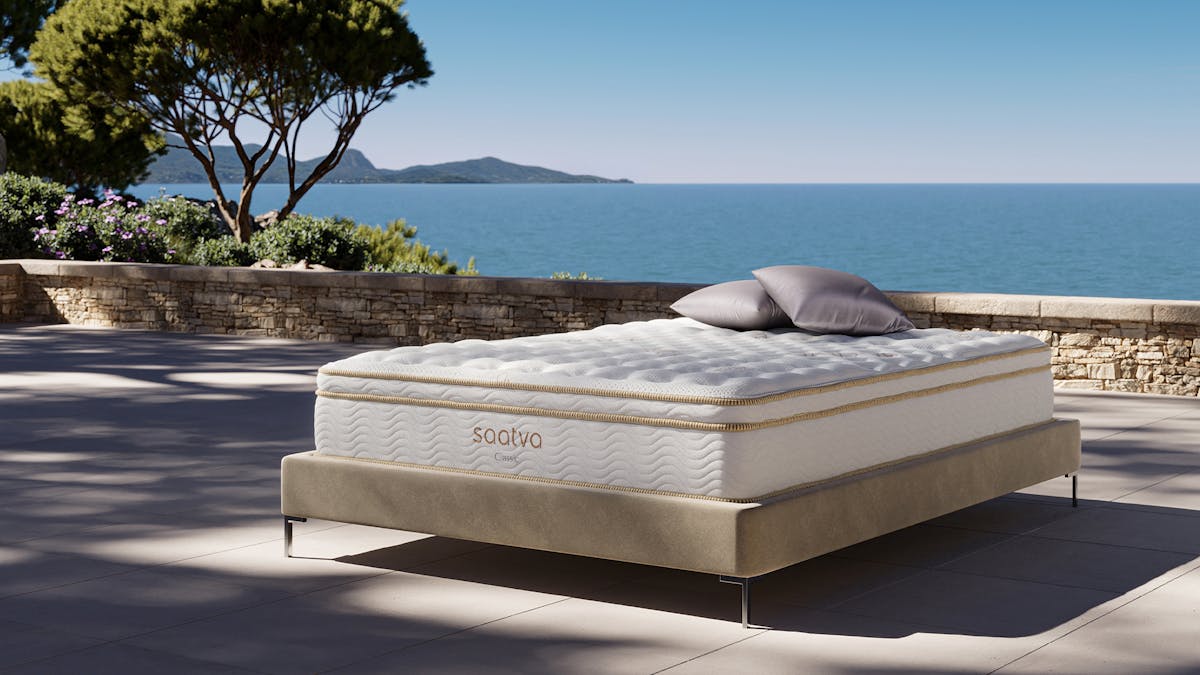
Saatva Classic
9.2/10
- Dual-coil construction with a reinforced lumbar zone, better spinal support than either GhostBed or Sleep Number comfort layers
- White-glove delivery with setup and old mattress removal included
- 365-night trial, the longest in the category
- Lifetime warranty, Sleep Number offers 15 years, GhostBed 20 years
- Three firmness options (Plush Soft, Luxury Firm, Firm) let you match your sleep style without electronics
- Requires an appropriate foundation, not compatible with all bed frames without a box spring or slatted base
- $99 return processing fee during the trial period
If you are cross-shopping GhostBed and Sleep Number and want the best-built mattress in the price range, the Saatva Classic is the stronger buy. It delivers hotel-quality innerspring support with a proper Euro pillow top, genuine zoned lumbar support, and a trial window that gives you more than a year to decide.
GhostBed vs Sleep Number: the core difference
GhostBed and Sleep Number represent two fundamentally different mattress philosophies. GhostBed builds straightforward foam mattresses that you order online and unbox yourself. Sleep Number builds adjustable air-chamber beds paired with a smartphone app. The right pick depends almost entirely on whether you need that adjustability, and are willing to pay for it.
Sleep Number's DualAir system lets each side of a queen or king be independently pressurized on a 0–100 firmness scale. A 40 on one side is completely separate from a 75 on the other. No foam mattress, including GhostBed, can replicate this. If you and your partner have significantly different firmness preferences, Sleep Number is the only category that solves it natively.
GhostBed keeps things simple. The Classic is an 11-inch all-foam mattress: 1.5 inches of aerated latex on top, 2 inches of gel memory foam in the middle, and 7.5 inches of high-density polyfoam as the support core. There are no electronics, no pump, no app. The feel is consistent, medium-firm, and fairly cooling for an all-foam mattress, thanks to the latex and gel layers.
Specs comparison
| Spec | GhostBed Classic | Sleep Number (360 m7) |
|---|---|---|
| Construction | All-foam (latex + gel memory + HD polyfoam) | Air chamber + 5" memory/Energetex foam |
| Height | 11 inches | 11 inches |
| Firmness | Fixed medium-firm | Adjustable 0–100 per side |
| Cooling | Gel + aerated latex (passive) | SmartTemp layer (passive + optional DualTemp) |
| Motion isolation | Moderate (foam absorbs, latex adds some bounce) | Excellent (individual air chambers) |
| Trial period | 101 nights | 100 nights |
| Warranty | 20 years | 15 years |
| Queen price (approx.) | ~$945–$1,295 | ~$3,099–$4,599 (m7 range) |
| Delivery | Bed-in-a-box | In-home professional setup |
| App / smart features | None | SleepIQ, ResponsiveAir (select models) |
Who GhostBed is best for
Solo sleepers who run hot: the aerated latex top layer and gel memory foam keep surface temperatures lower than most all-foam beds. If you sleep alone and don't need per-side customization, GhostBed delivers solid cooling at a reasonable price.
Budget-conscious buyers: GhostBed Classic queen pricing typically starts under $1,000 during sale periods, which is significantly less than any Sleep Number model. The brand runs discounts year-round and includes a 101-night trial.
Combination sleepers who want consistent support: the medium-firm feel from the latex and memory foam blend works reasonably well for back sleepers and most combination sleepers. Heavier sleepers (over 200 lb) get added cushioning from the gel memory foam layer.
Not ideal for: strict side sleepers who spend the whole night on one side may find the latex layer supportive but not pressure-relieving enough over a long night. The mattress also has no motion isolation edge over foam-only alternatives, the latex introduces some bounce that transfers movement.
Who Sleep Number is best for
Couples with different firmness needs: this is Sleep Number's defining advantage. Each side of the bed is pressurized independently. A back-pain sleeper who needs firm support at 65 can share the same bed as a side sleeper who prefers soft at 35, with zero compromise on either side.
Tech-forward buyers who want sleep data: SleepIQ tracks heart rate, respiration rate, and movement throughout the night. Some models add ResponsiveAir, which adjusts firmness automatically based on your real-time sleep data. GhostBed has no equivalent tracking.
Long-term buyers willing to invest: Sleep Number's in-home professional setup and service infrastructure suit buyers who view the bed as a 15–20 year investment. The air chamber system can be serviced and parts replaced over time.
Not ideal for: buyers on a budget, Sleep Number's entry models start above $1,600, and the premium models with DualTemp climate and SleepIQ tracking reach $4,500 or more. Air chamber systems also require electricity and can develop leaks over time, which GhostBed's foam construction avoids entirely.
Construction: how each mattress is built
The GhostBed Classic layers work from top to bottom. The 1.5-inch aerated latex surface is porous and responsive, it pushes back against pressure rather than conforming deeply, which keeps you feeling "on" the mattress rather than "in" it. Below it, the 2-inch gel memory foam handles pressure relief and temperature: the gel slows heat buildup, a common issue with traditional memory foam. The 7.5-inch HD polyfoam base provides durability and prevents the upper layers from compressing permanently over time.
The Sleep Number 360 m7 is structured differently. The air chamber runs the length of the bed on each side and is the primary support mechanism, you inflate or deflate it via the SleepIQ app or the remote to change firmness. Above the chamber sits 5 inches of layered foam, including Energetex foam, which provides the contouring and body conforming feel. The SmartTemp technology in the comfort layers absorbs and releases heat based on your body temperature. The result feels more like a memory foam mattress than a traditional airbed, but the adjustability underneath is always there.
Temperature and cooling
GhostBed has a genuine cooling advantage among all-foam beds. The aerated latex structure allows airflow that solid memory foam blocks entirely, and the gel memory foam slows heat absorption. Most owners report a neutral to slightly cool sleeping temperature. It is not as cool as a hybrid with coils, but it outperforms a standard memory foam mattress.
Sleep Number's basic models rely on SmartTemp passive cooling similar in principle to GhostBed's approach. The higher-tier i7 and Climate360 models add DualTemp, active heating and cooling via water-cooled layers, which is a different league entirely. If temperature regulation is the primary concern and the budget allows, Sleep Number's premium lineup is the most capable active cooling solution in the mattress market. GhostBed has no active cooling equivalent.
Price and value
The price gap between GhostBed and Sleep Number is substantial. GhostBed Classic queen pricing runs roughly $945–$1,295 depending on the sale. Sleep Number's m7 queen, the model most directly comparable in terms of memory foam comfort, lists around $3,099–$3,799. The flagship i8 and i10 models push past $4,500.
That gap reflects the cost of the adjustable air system, the in-home delivery, the SleepIQ tracking infrastructure, and the brand's premium positioning. Whether it is worth it depends on whether you actually need the adjustability. Couples who genuinely cannot agree on mattress firmness will find it worthwhile. Solo sleepers almost certainly will not.
| Size | GhostBed Classic | Sleep Number 360 m7 |
|---|---|---|
| Twin XL | ~$767 | ~$2,649 |
| Full | ~$907 | ~$2,924 |
| Queen | ~$977 | ~$3,099 |
| King | ~$1,187 | ~$3,799 |
| California King | ~$1,204 | ~$3,799 |
| Split King | ~$1,533 | ~$4,599 |
Which should you choose?
The decision is simpler than the spec sheet suggests. Sleep Number is built for adjustability, specifically the per-side firmness that couples with different sleep preferences need. If that's your situation, Sleep Number solves the problem and nothing else does it as well. If you're a solo sleeper, or a couple who already knows what firmness you both want, the adjustability advantage evaporates and the price premium becomes hard to justify.
GhostBed is a solid all-foam mattress at a reasonable price. It cools reasonably well for an all-foam bed, it has a long warranty, and it doesn't require any setup beyond unboxing. Its limitations are the same as any fixed-firmness foam mattress: no customization, moderate motion isolation, and no smart features.
For most buyers who find themselves comparing these two brands, and who don't have a compelling reason to need the DualAir system, the Saatva Classic is worth considering as a third option. It offers better coil construction, genuine lumbar zoning, a 365-night trial, white-glove delivery, and a lifetime warranty, all at a price closer to GhostBed than to Sleep Number's premium models. It's the pick we'd make if we were spending our own money in this comparison.
Choose Sleep Number if you and your partner have different firmness needs and the budget supports it. Choose GhostBed if you want a simpler all-foam mattress at a lower price. For the best combination of build quality, support, and trial protection, the Saatva Classic outperforms both.
Air chambers, foam slabs — and the bed that needs neither gimmick
This duel is really a question of philosophy: Sleep Number sells adjustability — a number to dial, an app, an air chamber per side — while GhostBed sells simple foam at a simple price. One is machinery you’ll manage; the other is a slab you’ll settle for.
As we said up top, our overall pick sits outside both philosophies: the Saatva Classic gets its comfort from coil-on-coil engineering and a plush euro top — no pump, no app, no firmware — and arrives white-glove. If dialing your bed nightly sounds like a chore and plain foam sounds like a downgrade, price the Classic today.
Frequently asked questions
What is the biggest difference between GhostBed and Sleep Number?
Sleep Number uses air chambers that adjust firmness on a 0–100 scale, independently on each side of the bed. GhostBed uses fixed foam layers, latex, gel memory foam, and HD polyfoam, with no adjustability. Sleep Number is built for customization; GhostBed is built for simplicity.
Which mattress sleeps cooler, GhostBed or Sleep Number?
GhostBed sleeps cooler than most Sleep Number models at a comparable price. Its aerated latex and gel memory foam layers reduce heat buildup without any active system. Sleep Number's higher-end i7 and Climate360 models include active DualTemp cooling that surpasses GhostBed, but those models cost significantly more.
Which has better motion isolation, GhostBed or Sleep Number?
Sleep Number's individual air chambers do a better job of isolating motion than GhostBed's foam-plus-latex construction. The latex in GhostBed adds some bounce that transfers movement, which can disturb a light-sleeping partner. Sleep Number's chambers on each side move independently, so one partner shifting doesn't affect the other.
Is GhostBed worth the price compared to Sleep Number?
For solo sleepers or couples who agree on firmness, GhostBed offers solid value. Sleep Number's premium is justified primarily by the per-side DualAir adjustability. If you don't need that, GhostBed, or a better-constructed alternative like the Saatva Classic, delivers more mattress for the money.
Can Sleep Number mattresses develop problems over time?
Air chamber systems have more mechanical components than foam mattresses and can develop leaks over time. Sleep Number provides service and replacement parts, but repairs may involve cost and scheduling. GhostBed's all-foam construction has no mechanical parts and no failure modes beyond normal foam compression.