
 by
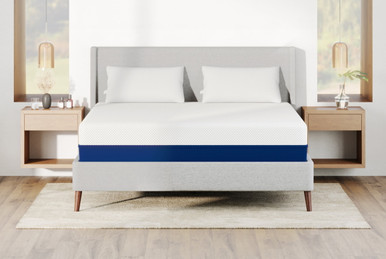
by Purple's Smart Grid and memory foam are genuinely different technologies. For most sleepers, memory foam wins on motion isolation, pressure relief, and value. Our top pick is the Amerisleep AS3: its partially plant-based Bio-Pur foam and HIVE 5-zone support give a more responsive, cooler-than-average foam feel (NapLab cooling 9/10), at a lower price than Purple's thicker-grid models.
Amerisleep AS3
9.1/10
- Partially plant-based Bio-Pur open-cell foam sleeps cool for all-foam (NapLab cooling 9/10)
- HIVE 5-zone construction firms under the back while staying softer at the shoulders and hips
- CertiPUR-US certified, made in the USA
- Instant pressure relief without the "stuck" sensation of traditional memory foam
- Softer edge support than a coil hybrid
- Sleepers over 230 lb may prefer the AS3 Hybrid, which adds a coil base
For buyers comparing Smart Grid and memory foam, the AS3 is the answer: open-cell foam that sleeps cool for all-foam, zoned support that adapts to your body, and a lower price than Purple's thicker-grid models.
What is Purple's Smart Grid?
The Hyper-Elastic Polymer grid inside Purple mattresses is not foam. It is a stretchy, rubber-like material formed into a grid of open columns. This architecture creates a dual-response system: when a small, concentrated load, like the pressure of a knee or shoulder, pushes down on a column, it collapses, eliminating pressure buildup at that point. When a broader, distributed load, like the full weight of a torso, pushes across multiple columns, the grid firms up and provides support.
This behavior is fundamentally different from foam, which compresses uniformly in response to weight regardless of how that weight is distributed. The grid is designed to solve a specific problem in foam mattresses: the trade-off between pressure relief and support. Traditional foams that are soft enough to relieve pressure at bony contact points often allow the body to sink too deeply, creating spinal misalignment. Foams that are firm enough to maintain alignment often create too much pressure at contact points.
Purple's grid attempts to address both simultaneously by responding differently to different types of load. Whether it succeeds depends on the individual sleeper, and that is part of what this comparison addresses.
What is memory foam?
Further reading: Best memory foam mattresses 2026. Our full roundup with detailed picks, firmness guidance, and current pricing.
Memory foam, technically viscoelastic polyurethane foam, was originally developed by NASA in the 1960s for aircraft seat cushioning. Its defining properties are temperature sensitivity and slow recovery. The foam softens when exposed to body heat, conforming closely to the shape pressing into it. When the pressure is removed, it slowly returns to its original shape rather than springing back immediately.
This slow-recovery behavior is what gives memory foam its "memory", the brief impression left in the surface after you move. It is also what makes memory foam so effective at pressure relief: because the foam conforms and does not immediately push back, it eliminates the counter-pressure that creates discomfort at the hips and shoulders.
Memory foam became one of the dominant mattress materials of the 2000s and 2010s because it solved a real problem for side sleepers and pressure-sensitive individuals. The major criticisms, heat retention and slow response, have been addressed to varying degrees by gel infusions, open-cell foam formulations, and ventilated designs. Amerisleep's Bio-Pur takes the open-cell approach: a partially plant-based foam; NapLab scores the AS3 9/10 for cooling.
Quick comparison: Smart Grid vs memory foam
| Category | Purple Smart Grid | Memory Foam (AS3) |
|---|---|---|
| Feel | Bouncy, floating, responsive | Contouring, cradling, Medium |
| Temperature | Excellent, open grid ventilates | Good (Bio-Pur open-cell), not as airy as grid |
| Motion isolation | Good | Excellent |
| Pressure relief | Excellent | Excellent |
| Responsiveness | High, springs back fast | Medium (Bio-Pur faster than standard foam) |
| Edge support | Average | Average |
| Entry price (queen) | ~$999 (entry 2-inch grid model) | $1,249 sale / $1,749 regular (AS3) |
| Best for | Hot sleepers, combination sleepers | Side sleepers, couples, joint pain |
Feel: how each material behaves under your body
The most immediate difference between Smart Grid and memory foam is how they feel when you first lie down, and how that feel changes as you settle in.
Memory foam produces an unmistakable sensation. The surface feels moderately firm at first contact. As your body weight and heat transfer into the foam, it begins to soften and conform. Within a few minutes you are lying in a body-shaped impression, with the foam pressing back evenly across all the contact points. This is the "hug" or "cradling" sensation that memory foam enthusiasts describe. The counter-pressure is minimal because the foam has already displaced to match your shape.
The Smart Grid feels different from the first contact. The surface does not warm up and soften over time, it responds immediately based on load distribution. Under pressure points, columns collapse; under broader loads, the grid firms. The resulting sensation is often described as floating or hovering. You are getting pressure relief at contact points without the sinking feeling that memory foam produces.
Neither sensation is objectively better. Sleepers who love the enveloping, cocooned feeling of memory foam often find the Purple grid feels unfamiliar or too "springy." Sleepers who have never been comfortable on memory foam, those who feel trapped or too warm, frequently find the grid far more comfortable.
Temperature: where the grid has a structural advantage
Temperature is the category where the Smart Grid wins most clearly, and the reason is structural rather than additive. Memory foam manufacturers add gel beads, copper infusions, phase-change materials, and open-cell formulations to address heat retention. These modifications help but do not solve the underlying issue: dense foam blocks airflow.
Purple's grid is open by design. The columns that make up the grid leave significant air space throughout the material, much of the grid's volume is air. Body heat does not accumulate at the sleep surface the way it does in foam.
That said, Amerisleep's Bio-Pur sleeps cool for a foam: NapLab measured an 85.4°F peak surface temperature on the AS3. The open-cell structure allows air to move through the foam rather than trapping it. For most sleepers who run warm, Bio-Pur is a practical solution. For those who have always run hot on every mattress they have tried, the grid's structural ventilation is the cleaner fix.
Motion isolation: foam's strongest category
Memory foam wins motion isolation, and the reason comes down to material physics. Dense foam absorbs and contains energy. When a partner moves, the motion is absorbed before it travels across the sleep surface. This is the same property that makes memory foam effective at pressure relief, it does not push back, and it does not transfer force laterally.
Purple's grid is more responsive and elastic, which means it does transmit some motion across the surface. The grid springs back after compression rather than absorbing energy, and this spring can transfer to adjacent areas. For couples where one partner is a very light sleeper and motion sensitivity is high, this is a meaningful trade-off.
Pressure relief: both perform well, through different mechanisms
Both the Smart Grid and memory foam deliver strong pressure relief, but they achieve it differently. Memory foam distributes weight over a large surface area by conforming to the body's shape. The grid achieves pressure relief at specific contact points by collapsing the columns beneath them, eliminating the upward counter-pressure at those points.
The practical result is similar for most sleepers in most positions. Side sleepers get shoulder and hip pressure relief from both materials. Back sleepers get lower back support from both. For the general population, both materials deliver excellent pressure relief relative to traditional innerspring mattresses, and the difference between them is smaller than the difference between either and a firm coil mattress.
Responsiveness and ease of movement
Responsiveness, how quickly the mattress returns to shape after compression, is one of the more practically significant differences between these materials for combination sleepers.
Memory foam is slow to recover by design. When you shift positions, the foam beneath you retains your previous impression for a moment before slowly rebounding. For combination sleepers who change positions throughout the night, this creates a brief resistance each time they move. Bio-Pur's open-cell structure recovers faster than standard memory foam, but it is still slower than the Smart Grid.
The Smart Grid springs back essentially instantly. When you shift, the grid underneath you immediately adjusts to your new position without lag. Combination sleepers often find it more accommodating of their natural movement patterns.
Best products: grid and foam options worth considering
Amerisleep AS3 (memory foam)
The AS3 is the most direct answer to the smart grid debate for buyers who prefer foam. Bio-Pur's open-cell structure addresses the main foam weakness, heat retention, while HIVE's 5-zone construction addresses support. At $1,249 queen with a 100-night trial and 20-year warranty, it costs less than any Purple model with a meaningful grid layer. For side sleepers, couples, and anyone who prefers the body-cradling feel, the AS3 is the stronger value proposition.
Purple 3 and Purple 4 (Smart Grid)
The Purple 3 ($1,399 queen) and Purple 4 ($1,699 queen) offer 3-inch and 4-inch grid layers respectively. The thicker grid amplifies all the characteristic properties, more pressure relief, more bounce, more airflow, and the choice between them comes down to how much of the floating sensation you want. The Purple 4 is the brand's flagship and the benchmark for grid technology in consumer mattresses. Justified if temperature regulation or combination-sleeping responsiveness are your primary concerns.
Nectar Classic and Premier (memory foam, budget)
Nectar Classic ($699 queen, according to Nectar) is the most accessible high-quality memory foam option, with strong motion isolation, deep pressure relief, and a 365-night trial. For budget-conscious buyers who want the classic memory foam experience, Nectar is a strong value proposition.
For buyers who want a responsive innerspring feel rather than foam or polymer grid, the Saatva Classic (Luxury Firm) is a solid coil hybrid alternative, though it sits at a higher price point ($2,229 queen) and transfers more motion than either the AS3 or the Purple grid.
Price comparison
Memory foam spans the widest price range of any mattress category, from around $300 for low-density budget options to over $5,000 for Tempur-Pedic's top configurations. Quality memory foam in the mid-range falls between $700 and $1,500 for a queen.
Purple's Smart Grid mattresses start higher. The entry-level Purple mattress with a 2-inch grid runs around $999 for a queen, while the Purple 3 and Purple 4 that represent the full grid experience start at $1,399 and $1,699 respectively. You pay a premium for the proprietary material and engineering.
For the same dollar spent, a quality memory foam mattress typically provides a more established and tested sleep experience. The Smart Grid premium is justified if temperature regulation or combination sleeping responsiveness are high priorities for you specifically.
Who should choose the Smart Grid
Hot sleepers who have struggled with foam are the clearest match for the Smart Grid. If temperature has been your primary complaint about previous mattresses, the grid's structural ventilation addresses the problem at its source rather than working around it.
Combination sleepers who find memory foam's slow response creates friction during position changes will also find the grid more natural. The instant rebound removes the "stuck" sensation entirely.
Sleepers who dislike the enveloping, cocooned sensation of memory foam but still want pressure relief, the "on top of" rather than "in" the mattress preference, typically find the Purple grid's floating feel more comfortable over the course of a night.
Who should choose memory foam
Side sleepers with shoulder or hip sensitivity often find memory foam's deep contouring more precisely targeted. The slow, even conforming of foam distributes pressure across a larger surface area in a way that many side sleepers describe as more comfortable than the grid's column-collapse mechanism.
Couples where one partner is a very light sleeper prioritizing motion isolation are better served by memory foam's superior movement absorption. The difference can be significant when one partner regularly wakes at odd hours.
Budget-conscious buyers get more mattress for the money in the memory foam category. Nectar's $699 queen price, according to Nectar, with a lifetime warranty and 365-night trial is among the strongest value propositions in the mattress industry. There is no equivalent Smart Grid option at that price point.
Final verdict
Smart Grid and memory foam are both legitimate technologies with distinct strengths. The Smart Grid wins on temperature and the unique floating feel it provides. Memory foam wins on motion isolation, value at lower price points, and the deeply contouring experience that a significant segment of sleepers actively prefers.
For most buyers, the decision comes down to two questions: do you sleep hot, and do you change positions frequently? If yes to either, the Smart Grid is worth the premium. If no to both, memory foam remains the more established, better-priced choice, and the Amerisleep AS3 is the one to start with.
For the smart grid versus memory foam debate, the Amerisleep AS3 is our top pick: open-cell Bio-Pur foam, HIVE 5-zone support, 100-night trial, 20-year warranty. It sleeps cool for all-foam and costs less than Purple's thicker-grid models.
Our Pick
Amerisleep AS3
100-night trial · 20-year warranty · Free shipping
Related guides
Frequently asked questions
Can Purple's Smart Grid sag or break down over time like foam?
The Hyper-Elastic Polymer used in Purple's grid is designed for long-term durability. Unlike foam, it does not compress permanently under sustained weight. Purple says the grid is built for long-term use; check its warranty terms for the current models. The foam support layers beneath the grid are subject to normal wear, but the grid itself is the most durable layer in the assembly.
Is the Smart Grid good for people with back pain?
The grid's dual-response mechanism, collapsing under pressure points but firming under distributed load, can be very effective for certain types of back pain, particularly lower back pain associated with inadequate support from foam mattresses. However, back pain has many causes and the right mattress depends on the specific issue. If possible, use a trial period rather than buying without testing. Zoned memory foam like the Amerisleep AS3 addresses back support through a different mechanism, HIVE's 5-zone construction, and performs well for most back-pain sufferers.
Does memory foam off-gas badly, and is it safe?
Memory foam does off-gas during the first few days after unboxing, releasing VOCs that create a chemical smell. Modern memory foam, including Amerisleep and Tempur-Pedic, meets CertiPUR-US certification standards, meaning it is tested for harmful emissions and found to be within safe limits. The smell can be unpleasant; low-emission certification does not guarantee that every sleeper will tolerate it. Ventilating the room during the first 48 to 72 hours resolves it for most people.
How does the Purple grid feel different from a latex mattress?
Both latex and the Smart Grid are more responsive than memory foam, but they feel differently. Latex has a gentle bounce and a consistent firmness throughout, it does not have the column-collapse mechanism of the grid. The grid's dual response creates a more unusual sensation that is harder to compare to any traditional material. Latex sleeps warm compared to the grid but cooler than memory foam.
Is memory foam good for heavier sleepers?
Heavier sleepers, generally above 230 pounds, often find that standard memory foam compresses unevenly over time, creating premature sagging in high-weight zones. Premium memory foam with higher density ratings holds up better. For heavier sleepers interested in the Smart Grid, the Purple 4 with its thicker grid layer is the better option, as it maintains the pressure-collapse benefit even under higher body weight. Among Amerisleep options, the AS3 Hybrid, with a pocketed coil base, is the better choice for heavier sleepers.