
 by
by Between Lull and Leesa, Leesa Original edges ahead for most sleepers: its aerated polyfoam top sleeps cooler and the layered construction relieves pressure better at the shoulders and hips. Lull wins on price (~$779 vs ~$999) and trial length (365 nights vs 100 nights), which makes it hard to beat for back sleepers on a budget. Neither matches the durability or build quality of a coil hybrid, which is why our top overall recommendation is the Saatva Classic.
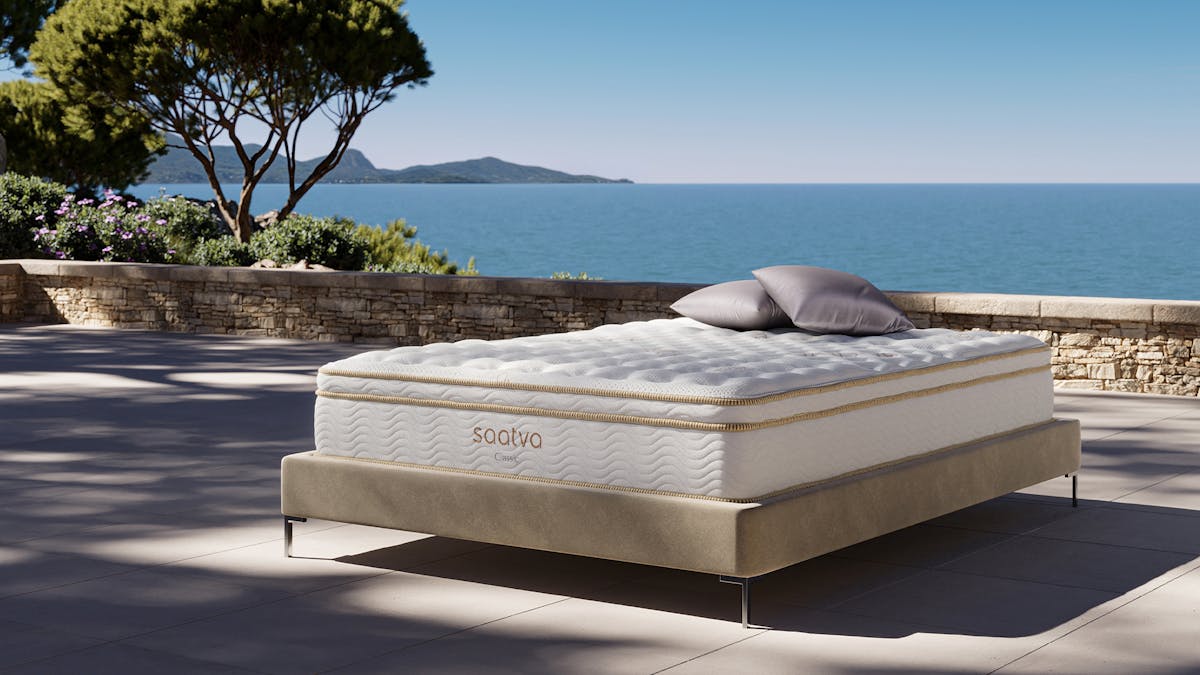
Saatva Classic
9.2/10
- Dual coil construction (individually wrapped coils over tempered steel base) breathes far better than any all-foam bed
- Three firmness options: Plush Soft, Luxury Firm, and Firm, so you pick what works for your body
- Free white-glove delivery: set up in your room, old mattress hauled away
- 365-night home trial, lifetime non-prorated warranty
- Reinforced lumbar zone and strong perimeter edge support
- Higher upfront cost than Lull or Leesa
- Ships flat, not compressed in a box
- $99 return fee during the trial period
If you're weighing two budget foam beds, the Saatva Classic is worth considering as an alternative: better airflow, better edge support, and a build that routinely outlasts all-foam designs by 3 to 5 years. The cost-per-year of sleep is competitive once you factor in longevity and free white-glove delivery.
Lull vs Leesa: What the comparison actually comes down to
Lull and Leesa are both all-foam bed-in-a-box mattresses competing for the same mainstream audience. They share a 10-inch profile and a compressed-box delivery format. Beyond that, the differences are meaningful.
Lull puts memory foam directly against your body. The gel-infused top layer gives you slow, contouring sink, which back sleepers tend to prefer. It runs firmer, around 7/10, and at roughly $779 for a queen it undercuts most competitors at this profile. The 365-night trial is unusually generous for this price tier.
Leesa takes a different construction approach. The top layer is a proprietary aerated polyfoam, not memory foam, which responds faster and traps less heat. Memory foam sits in the second layer where it handles pressure relief without direct body contact. The result is a slightly softer feel (around 6/10) with better shoulder and hip pressure relief for side sleepers. It sleeps noticeably cooler than Lull in lab testing, with NapLab reporting a surface temperature of 92.1°F, a figure that puts it among the better-performing foam beds. The trade-off is price: closer to $999 on sale, and a shorter 100-night trial window.
Lull vs Leesa: specs compared
| Spec | Lull Original | Leesa Original |
|---|---|---|
| Price (queen) | ~$779 | ~$999 (sale) |
| Type | All-foam, memory foam top | All-foam, aerated polyfoam top |
| Height | 10 in | 10 in |
| Firmness | 7/10 (medium-firm) | 6/10 (medium) |
| Layers | Gel memory foam / transition foam / base foam | Aerated polyfoam / memory foam / HD base foam |
| Trial period | 365 nights | 100 nights |
| Warranty | Lifetime (limited) | Lifetime (prorated after 10 yrs) |
| Cooling | Gel-infused foam, moderate | Aerated top layer, better airflow |
| Motion isolation | Good | Excellent (10/10 NapLab) |
| Edge support | Mediocre (typical for all-foam) | Mediocre seated, better lying down |
| Delivery | Free shipping, self-setup | Free shipping, self-setup |
| Best for | Back sleepers, budget shoppers | Side sleepers, couples, hot sleepers |
Firmness and feel
The construction difference is the most important thing to understand about these two mattresses. Lull leads with traditional gel memory foam, so you feel the characteristic slow sink and contouring from the moment you lie down. It sits at around 7/10 on the firmness scale. Back and stomach sleepers generally find it supportive through the midsection without feeling like they're swallowed by the mattress.
Leesa inverts that logic. Its aerated polyfoam top layer is more responsive, closer to the feel of latex than traditional memory foam. It rebounds in under a second, which makes repositioning easier and gives side sleepers better pressure relief at the shoulders and hips. The memory foam underneath still provides contouring, just without the direct-contact heat buildup that foam-on-top designs produce. The softer overall feel at 6/10 suits people who change positions through the night.
Neither mattress offers firmness options. You get one level, and if it's wrong for your body, you're looking at a return. This is one area where a mattress with multiple firmness configurations has a structural advantage.
Cooling performance
All-foam mattresses have an inherent thermal disadvantage compared to coil hybrids. Foam blocks airflow; coils create it. Both Lull and Leesa will sleep warmer than a hybrid with an open coil layer, but they differ from each other.
Lull's gel-infused layer helps moderate surface temperature, but the memory foam construction still tends to retain body heat. Hot sleepers report warmth building up over the course of the night rather than immediately.
Leesa performs meaningfully better here. The punched aeration holes in the top polyfoam layer allow air movement that standard foam cannot replicate. NapLab's thermal testing put Leesa in the top tier for all-foam beds. If you run warm at night and have ruled out a hybrid, Leesa is the more defensible choice between these two.
Motion isolation
Both mattresses excel at absorbing motion, a consistent strength of all-foam beds. Leesa's lab numbers are particularly strong: NapLab measured 2.06 m/s acceleration transfer, placing it among the lowest-motion beds tested. For couples sharing a bed, or anyone whose partner moves frequently through the night, either mattress will do well, and Leesa does it slightly better.
Durability and longevity
This is the area where the most honesty is needed. All-foam mattresses compress and lose support faster than coil designs. Both Lull and Leesa are reasonably well-constructed for their price points, but realistic lifespan estimates sit at 6 to 7 years before noticeable body impressions and reduced support. Leesa's denser base foam may extend that slightly, but the difference is months, not years.
Both carry lifetime warranties, but Leesa's becomes prorated after year 10, meaning you cover a portion of replacement cost. Lull's stays non-prorated. If you plan to keep a mattress for more than a decade, that fine print matters.
Edge support
Neither mattress will impress you here. All-foam beds compress significantly at the perimeter under seated weight. Both Lull and Leesa follow that pattern. Leesa scores better in lying-down edge position because the higher-density base foam provides more resistance, but sitting on the edge of either mattress produces noticeable compression. For couples who use the full sleeping surface, or anyone with mobility concerns who relies on a stable edge to get in and out of bed, this is worth factoring in.
Price and value
At around $779, the Lull Original is one of the more affordable quality foam beds at this profile. The 365-night trial gives you a full year to evaluate the mattress across seasons and sleep patterns, which is rare at this price point.
The Leesa Original at roughly $999 on sale costs $220 more for a queen. Whether that gap is justified depends on what you value. Leesa sleeps cooler, isolates motion better, and suits side sleepers more reliably. Lull gives you a longer trial and a lower barrier to entry. Neither brand includes white-glove delivery or old mattress removal, which is a setup cost you'll need to handle yourself.
Who should buy Lull, who should buy Leesa
Buy the Lull Original if: you primarily sleep on your back, you want the longest trial period in this price range (365 nights), and budget is a real constraint. At $779 it delivers solid foam construction without frills.
Buy the Leesa Original if: you sleep on your side or shift positions often, you tend to run warm at night, or motion transfer is a priority because you share the bed. The $220 premium buys meaningfully better cooling and pressure relief.
Consider the Saatva Classic if: you want a mattress that lasts longer, sleeps cooler by design, comes with free white-glove setup, and gives you actual firmness choices. The coil construction addresses the structural limitations that all-foam beds share.
Budget foam fine print, and the bed above it
Leesa edges this duel on feel; Lull fights back with price, a year-long trial and — as the warranty fine print above showed — coverage that doesn’t thin out after a decade. Sensible arguments on both sides, all of them arguments about limits.
Because that was this page’s real conclusion: neither matches the durability of a coil build. The Saatva Classic is our top overall for exactly that reason — coil-on-coil structure that outlasts foam compression, plush euro top, white-glove delivery. Before you optimize within the budget bracket, price the bed above it.
Frequently asked questions
Is Lull or Leesa better for back pain?
Lull's firmer feel and medium-firm support tend to work better for back sleepers with general back pain. Leesa's softer profile and better pressure relief make it more appropriate for side sleepers whose pain is concentrated at the hips and shoulders. If back pain is a primary concern, a zoned coil hybrid offers more targeted lumbar support than either foam design.
Which mattress sleeps cooler, Lull or Leesa?
Leesa sleeps cooler. The aerated polyfoam top layer allows meaningful airflow, and lab testing confirms lower surface temperatures than the Lull's gel-memory-foam construction. Neither approaches the cooling performance of a coil hybrid, but between these two, Leesa has a clear advantage.
Does Lull or Leesa have a better warranty?
Both offer lifetime warranties, but the terms differ. Lull's warranty stays non-prorated for its full duration. Leesa's becomes prorated after year 10, meaning you pay a share of the replacement cost if something goes wrong after that threshold. For long-term ownership, Lull's terms are slightly more favorable on paper.
Which is better for couples?
Leesa performs better for couples. Its motion isolation numbers are among the best in the all-foam category, and the softer feel accommodates side sleepers better, which covers most of the population. If one partner runs warm, Leesa's thermal advantage is also relevant.
Are Lull and Leesa fiberglass-free?
Leesa is fiberglass-free and CertiPUR-US certified. Lull also carries CertiPUR-US certification. Check the current product pages for up-to-date material disclosures before purchasing.
Saatva Classic
9.2/10
Coil-on-coil hybrid with three firmness options, free white-glove delivery, 365-night home trial, and a lifetime non-prorated warranty. Addresses the cooling, edge support, and durability limitations that Lull and Leesa share.