
 by
by Leesa vs Tempur-Pedic: Tempur-Pedic wins on motion isolation and pressure relief for pain sufferers; Leesa wins on value, temperature neutrality, and ease of movement. For most buyers comparing these two, the Saatva Classic is also worth a direct look: a luxury innerspring hybrid with a reinforced lumbar zone, 365-night trial, and white-glove delivery at a price that competes directly with Tempur-Pedic's entry models.
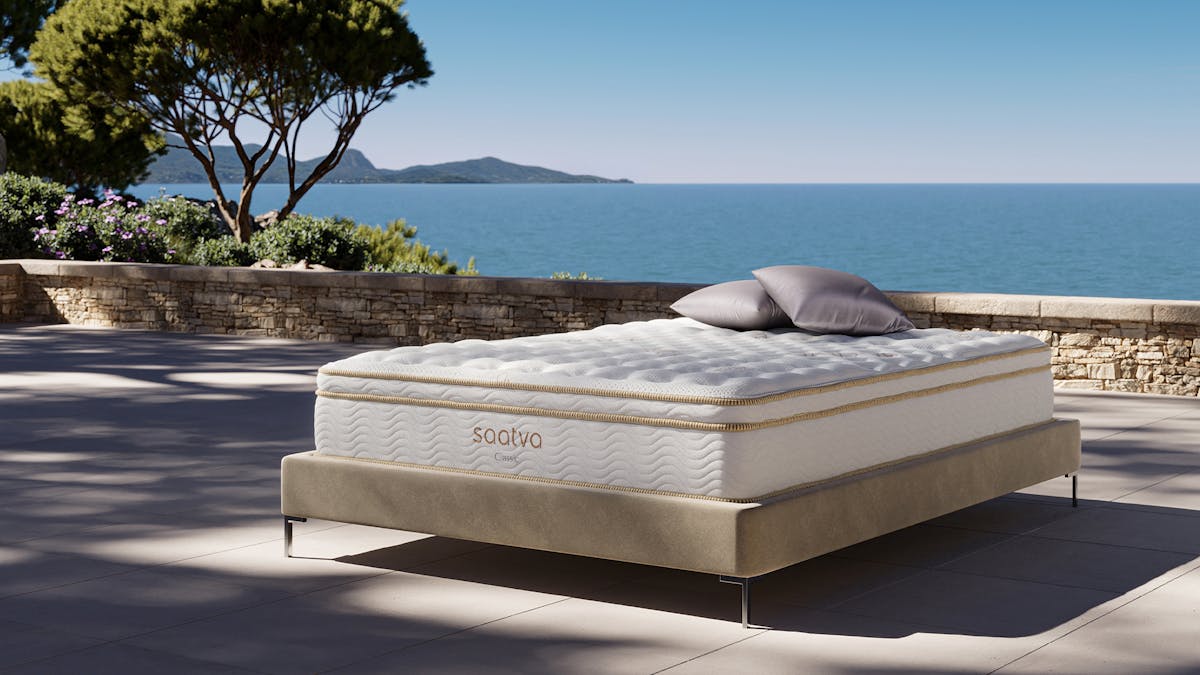
Saatva Classic
9.2/10
- Dual-coil construction with a dedicated lumbar zone pad
- Significantly stronger edge support than either all-foam option here
- Sleeps noticeably cooler than dense Tempur-Pedic foam
- Free white-glove delivery, setup, and old-mattress removal
- 365-night trial and a lifetime warranty
- Heavy and ships flat, not compressed in a box
- $99 fee if you return during the trial
If you are weighing Leesa and Tempur-Pedic, you are already comparing quality foam beds. The Saatva Classic adds the one thing both lack: responsive coil support, firmer edges, and better airflow, at a price that undercuts Tempur-Pedic's mid-tier models.
Amerisleep AS3
8.9/10
- HIVE 5-zone support reinforces the lumbar without stiffening shoulders
- Plant-based Bio-Pur foam sleeps cooler than traditional memory foam
- CertiPUR-US certified, made in the USA
- 20-year warranty, the longest in its price range
- Softer edge support than a coil hybrid
- Sleepers over 230 lb may prefer the AS5 Hybrid for more support
If an all-foam feel is what you want but Tempur-Pedic's price is too high, the AS3 gives you genuine lumbar zoning and superior temperature neutrality for roughly half the Tempur-Pedic TEMPUR-Cloud's price.
Quick Comparison Table
| Category | Leesa Original | Tempur-Pedic TEMPUR-Cloud |
|---|---|---|
| Queen Price | ~$1,099 | ~$2,199 |
| Construction | All-foam (memory foam + support foam) | All-foam (proprietary TEMPUR material) |
| Firmness | Medium (5-6/10) | Soft-Medium (4-5/10) |
| Trial Period | 100 nights | 90 nights |
| Warranty | 10 years | 10 years |
| Motion Isolation | Good | Excellent |
| Temperature | Neutral to cool | Runs warm (except Breeze models) |
| Edge Support | Moderate | Moderate |
| Best For | Side/combo sleepers, value buyers | Pain relief seekers, couples, long-term investment |
Construction and Materials
Leesa Original
The Leesa Original is a three-layer foam mattress. The top layer is a 2-inch quilted foam cover that provides an immediate soft feel on contact. Below that sits a 2-inch layer of memory foam designed to contour to the body and relieve pressure at the shoulders and hips. The base is a 4-inch support foam core that keeps the mattress from collapsing under sustained weight.
Leesa positions the Original as a medium-feel mattress, landing around a 5 to 6 out of 10 on the firmness scale. The foam used meets CertiPUR-US certification standards, meaning it has been tested for harmful chemicals and off-gassing emissions. The cover is breathable and soft to the touch, and the whole package ships compressed in a box with free delivery.
The construction is clean and functional. Leesa uses well-understood foam formulations combined effectively for a mattress that works for a wide range of sleepers. Leesa also sells hybrid versions, the Leesa Hybrid and Leesa Sapira Hybrid, that add pocketed coils to the base, delivering more bounce and airflow than the Original.
Tempur-Pedic TEMPUR-Cloud
Tempur-Pedic's construction story begins with a single proprietary material: TEMPUR foam. Originally developed from NASA research on pressure-absorbing materials, TEMPUR is a viscoelastic, high-density memory foam that reacts to both temperature and weight. It conforms slowly and deeply to the body's curves, then returns to its original shape after pressure is removed. No other mattress brand manufactures this material; it is exclusive to Tempur-Pedic.
The TEMPUR-Cloud uses a SmartClimate dual cover system over a TEMPUR comfort layer and a dense TEMPUR support layer. There are no springs, no coils, and no latex. The entire sleep experience is controlled by TEMPUR foam layers of varying density, making for a consistent, enveloping feel that is immediately distinct from conventional foam mattresses.
Moving up the Tempur-Pedic lineup: the TEMPUR-Adapt (approximately $2,799 Queen) adds a TEMPUR-ES layer for a more pronounced slow-conforming feel. The TEMPUR-ProAdapt (approximately $3,299 Queen) is available in soft, medium, firm, and medium hybrid configurations. Breeze variants incorporate phase-change materials to address the brand's known heat-retention issue, but they start above $3,500.
The key takeaway: Tempur-Pedic is fully committed to proprietary dense foam technology. Leesa uses conventional but well-implemented foam layers. The materials explain both the price gap and the feel difference between these two brands.
Feel and Firmness
Leesa Original delivers what most people describe as a balanced, universally comfortable feel. It has a slight hug from the memory foam layer, but it does not swallow you. You rest mostly on top of the mattress rather than deeply inside it. Side sleepers get cushioning at the shoulder and hip without excessive sinkage. Back sleepers find adequate support without the mattress feeling rigid. The feel is approachable and easy to adjust to within the first night or two.
Tempur-Pedic mattresses feel distinctly different. TEMPUR material is dense and slow-moving. When you first lie down, you feel yourself settling into the foam over several seconds as it responds to your body heat. The sensation is sometimes described as being cradled from all sides; the foam does not just compress under you, it wraps around you. For sleepers with chronic pain or joint issues, this deep contouring is often exactly what they need. For sleepers who prefer moving freely across the mattress surface, it can feel restrictive.
The TEMPUR-Cloud is the softest Tempur-Pedic model, landing around a 4 to 5 on the firmness scale, slightly softer than the Leesa Original. If you want a gentler foam feel that still lets you move freely, Leesa is the better match. If you are coming from a traditional innerspring and want a dramatic shift toward body-hugging foam, Tempur-Pedic is as far in that direction as any mattress goes.
Most Tempur-Pedic owners report needing one to three weeks to fully adjust to TEMPUR material. Leesa Original typically requires little to no adjustment period, which is worth factoring in when using either brand's sleep trial.
Pressure Relief
Both mattresses perform well at pressure relief, but they arrive at that outcome differently and to different degrees.
Leesa uses its memory foam middle layer to cushion pressure points. Side sleepers, who experience the highest concentration of pressure at the shoulder and hip, typically find the Leesa Original very comfortable. The foam softens under pressure zones while the support core maintains spinal alignment. Most sleepers under 250 lbs who sleep on their side or back report no pressure issues.
Tempur-Pedic takes pressure relief further than any conventional foam. The TEMPUR material is purpose-built to distribute body weight across a larger surface area by conforming precisely to the body's shape. People with fibromyalgia, arthritis, hip pain, or chronic lower back problems regularly report that a Tempur-Pedic provided relief they could not find on other mattresses. For average healthy sleepers, the pressure relief difference between Leesa and Tempur-Pedic is real but modest. For sleepers with documented pain conditions, the Tempur-Pedic's targeted pressure distribution can be meaningfully better.
Temperature Regulation
Temperature is one of the clearest performance gaps between these two brands.
Leesa Original sleeps at a neutral to slightly cool temperature. The foam layers do not trap significant heat, and the quilted cover allows decent airflow. Hot sleepers who have struggled on traditional dense memory foam generally find Leesa a non-issue.
Standard Tempur-Pedic models, the TEMPUR-Cloud, TEMPUR-Adapt, and TEMPUR-ProAdapt without Breeze designation, run warm. Dense TEMPUR foam retains body heat as a byproduct of how it responds to temperature. This is a well-documented limitation consistently noted in long-term owner reviews. Breeze models add $500 to $1,000 or more to an already elevated base price.
If you are a hot sleeper considering Tempur-Pedic, budget for a Breeze model from the start. If staying cool is a firm priority and price is a constraint, Leesa Original is the safer and significantly cheaper choice.
Motion Isolation
Both mattresses are all-foam designs, which means both absorb motion transfer better than a traditional innerspring or hybrid. The difference between them is real, though.
Leesa Original offers good motion isolation. If a partner turns over or gets out of bed, most of the movement is absorbed before reaching the other side. For most couples, Leesa's motion isolation is more than adequate.
Tempur-Pedic's TEMPUR material is arguably the best motion-isolating material available in any consumer mattress. The density and slow response of the foam absorbs movement almost entirely. Couples where one partner is a restless sleeper regularly report that switching to a Tempur-Pedic eliminated nighttime sleep disruption completely. If motion isolation is a top priority, Tempur-Pedic is the stronger choice and the performance gap over Leesa is noticeable.
Edge Support
Edge support is one area where neither mattress stands out.
Leesa Original has moderate edge support. Sitting on the perimeter or sleeping near the edge produces some compression, but not so much that it becomes a practical problem for most sleepers.
Tempur-Pedic's all-foam construction also produces moderate edge support. The dense foam provides some natural resistance to compression, but without a reinforced foam perimeter or a coil system, the edges do compress under seated weight.
For sleepers who prioritize firm, consistent edge support, hybrid mattresses with reinforced perimeter coils are a better structural fit. The Saatva Classic delivers notably better edge support than either all-foam option here.
Price and Value
The price difference between Leesa and Tempur-Pedic is large enough that it is often the primary deciding factor.
Leesa Original has a Queen list price of approximately $1,099. Leesa runs regular sales that bring the effective price down to the $800 to $950 range. For the construction and performance delivered, the value proposition is strong.
Tempur-Pedic TEMPUR-Cloud starts at approximately $2,199 for a Queen, roughly double the Leesa. Moving up the lineup, TEMPUR-Adapt runs around $2,799, TEMPUR-ProAdapt around $3,299, and Breeze variants add another $500 to $1,000 on top.
A healthy side sleeper who wants a quality foam mattress gets most of what they need from Leesa at half the cost. A sleeper with chronic pain or someone who wants a mattress to last 15 or more years gets significantly more from Tempur-Pedic. These mattresses frequently outlast conventional foam mattresses by years, which changes the per-year cost calculation when amortized over the full lifespan.
Trial Periods and Warranties
Leesa offers a 100-night sleep trial with free returns. The mattress comes with a 10-year limited warranty covering manufacturing defects and sagging greater than 1 inch.
Tempur-Pedic offers a 90-night home trial, ten nights shorter than Leesa, which is still enough time to adjust to the TEMPUR feel. The 10-year warranty covers sagging greater than 0.5 inches, a tighter threshold than many competitors, reflecting the brand's confidence in how long TEMPUR foam holds its shape.
Both brands handle returns without requiring you to repackage or ship the mattress yourself. Tempur-Pedic also has physical showrooms where you can test mattresses in person before committing, which is genuinely valuable given the price point and the distinctiveness of the TEMPUR feel.
Verdict by Sleep Position
Side Sleepers
Side sleepers need pressure relief at the shoulder and hip without excessive sinkage. Leesa Original is excellent for most side sleepers under 230 lbs. Tempur-Pedic may be the better choice for heavier side sleepers or those with documented hip and shoulder pain, since TEMPUR material distributes pressure more precisely. For average side sleepers, Leesa does the job at half the cost.
Back Sleepers
Back sleepers need lumbar support and even spinal alignment. Leesa Original's medium firmness works well for most back sleepers in the average weight range. The TEMPUR-Cloud may allow heavier back sleepers to sink too deep; back sleepers considering Tempur-Pedic should look at the TEMPUR-Adapt or TEMPUR-ProAdapt in a medium or firm configuration for better lumbar support.
Stomach Sleepers
Stomach sleeping requires a firmer surface to prevent hip sinkage. Neither the Leesa Original (medium) nor the Tempur-Pedic TEMPUR-Cloud (soft-medium) is well suited for primary stomach sleepers. A hybrid or innerspring with solid lumbar support is generally the better category for dedicated stomach sleepers.
Combination Sleepers
Combination sleepers who shift between positions during the night benefit from a mattress that responds quickly to repositioning. Leesa Original performs better here. Its balanced foam feel allows easy movement without the sensation of being held in place. Tempur-Pedic's dense TEMPUR material creates more friction against repositioning; some owners describe needing to consciously push out of a sleeping position rather than rolling freely.
Couples
For couples who prioritize motion isolation above everything else, Tempur-Pedic is the clear winner. For couples who want a comfortable, well-performing shared mattress at a reasonable price, Leesa is an excellent and much more affordable choice.
Who Should Buy the Leesa Original
- Sleepers who want a quality foam mattress without spending over $1,200
- Side and combination sleepers who want pressure relief without deep sinkage
- Sleepers who tend to run warm and want temperature neutrality
- Buyers who prefer a longer home trial, 100 nights gives more time to decide
- First-time foam mattress buyers who want an approachable, easy-to-sleep-on feel
- Couples who want solid motion isolation at a fraction of Tempur-Pedic pricing
Who Should Buy a Tempur-Pedic
- Sleepers with chronic pain, fibromyalgia, arthritis, or significant pressure point issues
- Couples where one partner is a light sleeper or restless mover
- Buyers who have tried TEMPUR material before and know the feel works for them
- Sleepers willing to invest in a mattress that may last 15 years or more
- Those who specifically want the deep-contouring, body-cradling sensation that TEMPUR foam delivers
Leesa and Tempur-Pedic serve different buyers. Leesa is the smarter buy for the budget-conscious sleeper who wants reliable foam comfort. Tempur-Pedic is the right choice for sleepers with medical needs, restless couples, or anyone who wants the specific feel that TEMPUR foam provides. For most people comparing these two, the Saatva Classic is also worth a direct look: it undercuts Tempur-Pedic on price while delivering the coil responsiveness, edge support, and temperature neutrality that neither all-foam option can match.
At Tempur’s entry price, the real fight changes
If motion isolation for a pain-suffering, restless-partner household is the absolute priority, this page gave Tempur-Pedic its due — the dense TEMPUR feel is unmatched there. Leesa’s counterpunch is value and a surface you can actually move on. Both true; neither complete.
Here’s the twist the intro flagged: at the money Tempur-Pedic’s entry models ask, the Saatva Classic enters the ring — a luxury innerspring with a reinforced lumbar zone and white-glove delivery, a feel that’s neither dense foam nor budget foam but the hotel bed both sides of this page are circling. Compare its price today against the Tempur quote before you decide.
Frequently Asked Questions
Is Leesa as good as Tempur-Pedic?
Leesa is a well-built mattress that performs strongly for its price range. For most average sleepers without specific pain conditions, it delivers excellent comfort and pressure relief. Tempur-Pedic uses proprietary foam technology that offers superior motion isolation and targeted pressure distribution. Whether one is better than the other depends entirely on what you need: Leesa is the smarter buy for the budget-conscious sleeper, Tempur-Pedic is the better choice for sleepers with medical needs or couples managing motion transfer.
Why is Tempur-Pedic so much more expensive than Leesa?
Tempur-Pedic manufactures its own proprietary TEMPUR foam in-house rather than buying from third-party foam suppliers. The material is denser and more expensive to produce than conventional memory foam or polyfoam. The brand invests heavily in ongoing research and product development and maintains deliberate premium market positioning. These mattresses routinely last 15 years or more, which means the per-year cost amortizes more favorably than a cheaper mattress replaced every five to seven years.
Does Leesa sleep cooler than Tempur-Pedic?
Yes. Leesa Original sleeps at a neutral temperature and does not trap significant body heat. Standard Tempur-Pedic models, Cloud, Adapt, and ProAdapt without Breeze designation, are known to sleep warm due to the density of TEMPUR foam. Hot sleepers who want a Tempur-Pedic should look specifically at the Breeze sub-lineup, but those models add substantially to an already high price.
Which is better for back pain, Leesa or Tempur-Pedic?
For most people with mild or occasional back discomfort, both mattresses perform well. For sleepers with chronic back pain, disc problems, or conditions like sciatica, Tempur-Pedic's precise TEMPUR contouring often delivers relief that other mattresses cannot match. The important variable is matching the firmness level to the sleep position; a back sleeper with lower back pain generally needs a medium or medium-firm Tempur-Pedic model rather than the soft TEMPUR-Cloud.
Can I test both before buying?
Yes. Leesa offers a 100-night home trial with free pickup returns. Tempur-Pedic offers a 90-night home trial and additionally has physical retail showrooms where you can try the mattress in person. Given how distinctive the TEMPUR feel is and how much these mattresses cost, in-person testing before committing is worthwhile if there is a Tempur-Pedic location accessible to you.
Related reading: Saatva vs Tempur-Pedic and Leesa Mattress Review