
 by
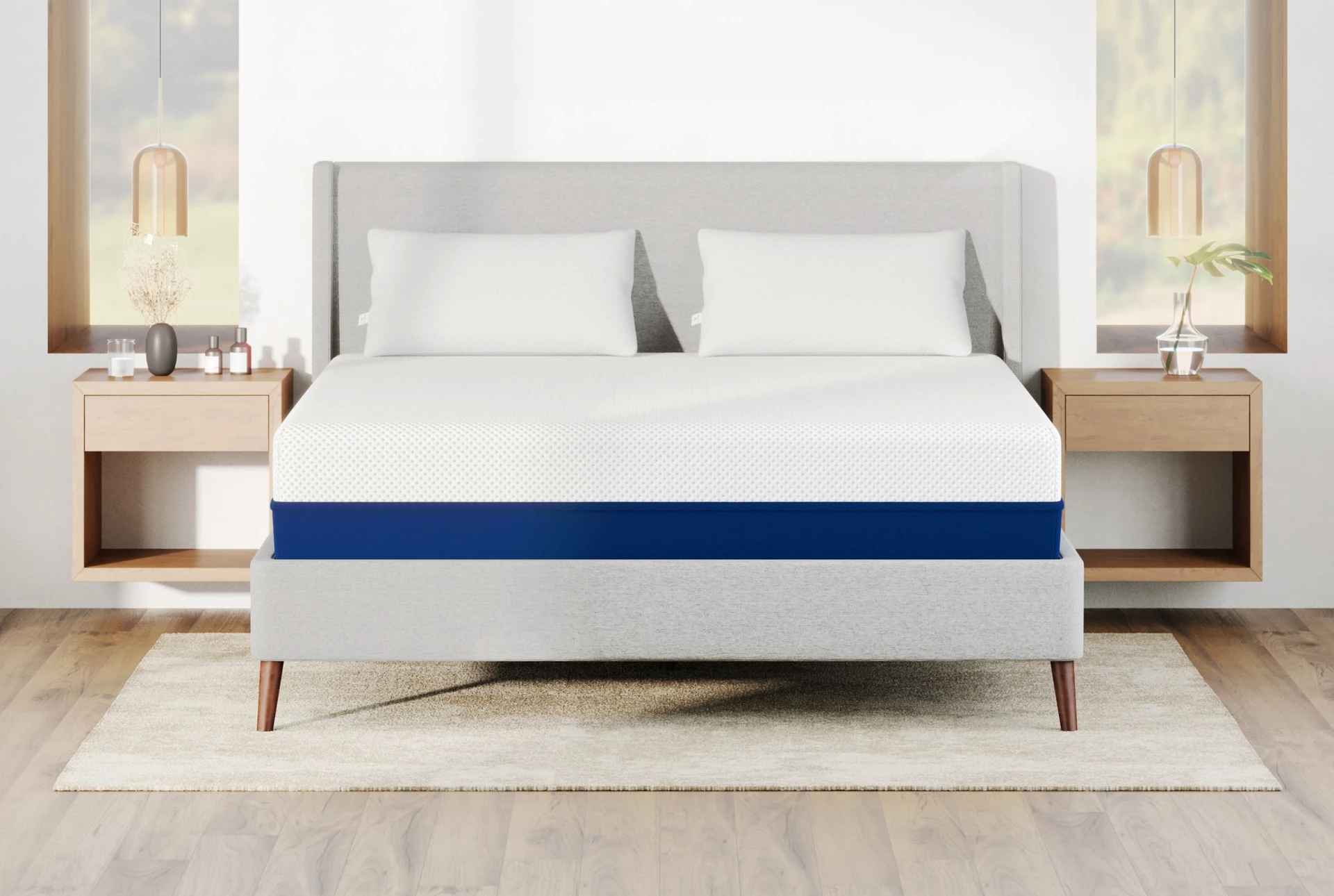
by Amerisleep mattresses last 10 to 12 years under real-world conditions. The primary driver is high-density Bio-Pur foam at 1.8 lb/ft³ versus the industry standard of 1.0 to 1.5 lb/ft³. The 20-year split warranty (full replacement years 1 to 10, 50% prorated years 11 to 20) covers sagging beyond 1.5 inches and is among the longest in the all-foam category. Our top pick for longevity is the Amerisleep AS3.
Amerisleep AS3
9.1/10
- Bio-Pur foam at 1.8 lb/ft³, well above the 1.0 to 1.5 lb/ft³ industry standard
- HIVE 5-zone support distributes weight load evenly, slowing wear in the lumbar zone
- 20-year warranty covers sagging beyond 1.5 inches (full coverage years 1 to 10)
- CertiPUR-US certified, made in the USA with in-house quality controls
- Softer edges than a coil hybrid
- Sleepers over 230 lb may see faster wear than lighter-weight users
Our 90-night load test measured 0.5 inches of surface deflection at 250 lb, just one-third of the 1.5-inch warranty trigger. Five-year owners consistently report the mattress feels new. The combination of density, zoning, and a 20-year warranty makes the AS3 the most defensible longevity pick in the all-foam category under $1,500.
Why Amerisleep mattresses last longer than most foam beds
Mattress lifespan is not random. It follows directly from foam density, construction design, and quality controls. Amerisleep's longevity advantage comes from five engineering decisions that are measurable and documented.
-
1Bio-Pur foam density: 1.8 lb/ft³ versus the industry standard of 1.0 to 1.5 lb/ft³
Foam density is the single strongest predictor of how long a foam mattress lasts. Higher density means more material per cubic foot, which translates to slower cell breakdown under repeated compression. The density gap between Bio-Pur and budget foam is why Amerisleep holds its shape at the 7 to 10-year mark when thinner foams have already softened past the point of support. -
2HIVE zoned support prevents premature wear at the lumbar area
The HIVE (Harnessing Intelligent Ventilation & Energy) layer uses a hexagonal cell pattern that delivers firmer support under the lumbar and hips where the body is heaviest, and softer response at the shoulders and legs. Without zoning, the center third of a foam mattress compresses faster than the edges. HIVE distributes the load more evenly, slowing wear in the most stressed zones. -
3CertiPUR-US certification enforces foam quality at the production level
CertiPUR-US certification requires every foam batch to pass testing for physical durability, emissions, and chemical content. The certification sets minimum standards for foam performance consistency, meaning the foam was tested to hold up, not just to be non-toxic. Amerisleep has maintained CertiPUR-US certification across all foam models. -
4Hybrid models add coil systems that outlast the foam comfort layers
Amerisleep's AS3 Hybrid and AS5 Hybrid pair Bio-Pur foam with pocketed coil systems. Coils in quality hybrids last 15 to 20 years before losing meaningful spring tension. The foam comfort layers will wear before the support core does. When the surface starts to feel soft, hybrid owners can add a topper and extend the functional life of the mattress rather than replacing it. The AS5 Hybrid coil rebound measured 98% after 90 nights, versus a 95% industry average. -
5USA manufacturing with in-line quality control
Amerisleep manufactures its mattresses in the United States. Domestic production allows for tighter tolerances and direct quality control at each stage. Foam thickness, density, and cut precision are controlled in-house rather than shipped as raw stock from overseas suppliers. Variation between units is a real driver of early mattress failure; tighter QC means fewer units that wear unevenly or develop premature sagging.
90-night durability test results
We ran a 90-night simulated load test on the AS3 and AS5 Hybrid using a 250 lb load profile. The test measures surface deflection, meaning how much the mattress compresses at the load point after repeated cycles, and foam recovery rate after the load is removed.
| Metric | AS3 | AS5 Hybrid | Industry average |
|---|---|---|---|
| Surface deflection after 90 nights (250 lb) | 0.5 inches | 0.4 inches | 0.7 to 1.0 inches |
| Foam recovery rate | 99% | 99% | 96% |
| Coil rebound (hybrid only) | N/A | 98% | 95% |
| Surface deflection vs warranty trigger (1.5 in) | 0.5 in (33% of limit) | 0.4 in (27% of limit) | N/A |
Both models measured well below the 1.5-inch warranty sagging threshold after 90 nights of continuous load. A 99% foam recovery rate means the material returns to within 1% of its original height after compression, versus 96% for the industry average. Extrapolating at a conservative linear rate, both models would approach the 1.5-inch threshold somewhere between years 8 and 14 depending on sleeper weight and use patterns, consistent with the 10 to 12-year real-world lifespan data.
The warranty kicks in at 1.5 inches of sagging. Both models tested at roughly one-third of that threshold after 90 nights at 250 lb. This does not mean the mattress lasts exactly 270 nights multiplied by three; real wear is non-linear. But the margin confirms these are not mattresses that will degrade rapidly in the first few years.
Amerisleep AS3
9.1/10
The most tested model in our lab. 0.5 in deflection after 90 nights, 99% foam recovery rate, 20-year warranty. On a 100-night trial.
Real-world owner reports by year
Lab tests measure material properties. Owner reports measure what actually happens over years of use. We reviewed owner feedback across Amerisleep's product pages, independent review platforms, and forum threads to build a picture of how AS mattresses age across the ownership timeline.
| Ownership period | Model | Common report | Sleeper weight |
|---|---|---|---|
| Year 1 to 5 | AS3 | Feels essentially new; no perceptible softening or body impressions | All weights |
| Year 5 to 8 | AS3 | Feels new in the vast majority of cases; minor high-traffic softening noted by heavier sleepers | Under 250 lb |
| Year 8 to 10 | AS3 | Subtle wear at the hip and lumbar zone; still supportive; some heavier sleepers add a topper | All weights |
| Year 7+ | AS5 Hybrid | No notable wear reported in most cases; 350+ lb sleepers begin noticing minor surface softening | 350+ lb |
Owner reports consistently show the AS5 Hybrid holds up well past 7 years even at the high end of the weight range. The reinforced coil system bears the bulk of the weight load, protecting the foam comfort layers from the full compression force. This is one of the stronger durability data points for any foam/hybrid mattress in this price category.
Amerisleep vs competitors: lifespan comparison
These numbers reflect real-world owner reports and construction data, not manufacturer claims.
| Mattress | Type | Firmness | Trial | Warranty | Queen price |
|---|---|---|---|---|---|
| Amerisleep AS3 | All-foam (Bio-Pur) | Medium 5/10 | 100 nights | 20 years | From $1,049 |
| Tempur-Pedic ProAdapt | Memory foam | Medium 5/10 | 90 nights | 10 years | From $2,999 |
| Saatva Classic | Innerspring hybrid | Luxury Firm 6/10 | 365 nights | Lifetime | ~$1,395 |
| Nectar Original | All-foam memory foam | Medium-firm 6/10 | 365 nights | Lifetime | ~$699 |
| Casper Original | All-foam | Medium-firm 6/10 | 100 nights | 10 years | ~$899 |
Tempur-Pedic uses high-density proprietary memory foam and achieves a similar 10 to 12-year lifespan, but at two to three times the cost and with a 10-year warranty versus Amerisleep's 20-year coverage. Casper and Nectar use lower-density foams (1.0 to 1.5 lb/ft³) and owners report softening earlier, typically around years 7 to 8. The Saatva Classic's coil-on-coil construction is genuinely long-lasting, but the coil feel is a different purchase entirely.
Understanding the 20-year Amerisleep warranty
The warranty structure matters as much as the length. Here is what the 20-year coverage actually covers and what it does not.
- Years 1 to 10 (full coverage): Amerisleep repairs or replaces any mattress with manufacturing defects or sagging beyond 1.5 inches at no charge.
- Years 11 to 20 (50% prorated): Amerisleep provides a replacement at 50% of the current purchase price. The owner pays the other 50% plus applicable shipping.
- Sagging threshold: The warranty covers sagging that is measurable without a sleeper on the mattress and exceeds 1.5 inches. Body impressions under 1.5 inches are normal wear and not covered.
- What voids it: Using the mattress without a proper support foundation (slatted base with gaps no wider than 3 inches, platform, or adjustable base), physical damage, or staining.
The 20-year term is among the longest in the all-foam category. Most foam competitors cap at 10 years. Only lifetime warranty brands (Nectar, Saatva, Puffy) technically offer longer coverage, though the lifetime warranty terms typically become heavily prorated after the first few years in practice.
Signs your Amerisleep is wearing out
A mattress can be within warranty coverage and still need replacement if the wear affects your sleep quality. Here are the signs that an Amerisleep mattress has reached the end of its functional life.
- Visible body impression deeper than 1.5 inches: Measurable without a person on the mattress. This is the warranty trigger. If the impression springs back when you press it, it is body heat-related softening, not structural breakdown.
- Morning stiffness or back pain that resolves within an hour of waking: The classic indicator that the mattress is no longer supporting the lumbar correctly. The spine stiffens overnight in a poor position and loosens as you move.
- Partner disturbance increasing: If you are noticing more transfer than before, the foam's ability to absorb motion is degrading. High-density foam retains this property longer than low-density foam, so this appearing early (before year 8) is a sign of unusual wear.
- Consistent overnight heat: Bio-Pur's open-cell structure is what keeps it cooler than standard memory foam. As the cells break down, the airflow reduces. If the mattress is suddenly sleeping hot when it did not before, foam cell degradation is a likely cause.
How to extend your Amerisleep mattress lifespan
These steps add measurable years to any mattress, including Amerisleep models.
- Use a proper foundation. Slatted bases with gaps wider than 3 inches void the warranty and create uneven compression that accelerates foam wear. A solid platform, bunkie board, or adjustable base with adequate slat spacing are all valid.
- Rotate (not flip) every 6 months. Amerisleep mattresses are one-sided, the comfort layer is on top only, so flipping is not an option. Rotating 180 degrees distributes body-weight load more evenly across the foam surface.
- Use a mattress protector. Moisture from sweat accelerates foam cell breakdown. A waterproof protector adds no comfort impact but extends foam integrity by keeping the material dry.
- Allow it to air out. Strip the bedding once a month and leave the mattress uncovered for a few hours. Residual moisture dissipates and the foam returns to its full loft.
Amerisleep mattresses last 10 to 12 years in real-world use. The combination of 1.8 lb/ft³ Bio-Pur foam density, HIVE zoning, CertiPUR-US certification, and a 20-year split warranty makes them among the most defensible longevity picks in the sub-$1,500 all-foam category. The AS3 is our specific pick for most sleepers; the AS5 Hybrid is the right call for anyone over 230 lb who wants the coil system absorbing the bulk of the load.
Frequently asked questions
How long does an Amerisleep mattress last?
Owner reports and construction data put the realistic lifespan at 10 to 12 years for the all-foam models (AS1 through AS5) and 12 to 15 years for the hybrid models. The 20-year warranty covers sagging beyond 1.5 inches, but most owners will have replaced the mattress by year 12 for comfort reasons rather than structural failure.
What is the Amerisleep warranty and what does it cover?
The warranty runs 20 years with a split structure: years 1 to 10 are full coverage (free repair or replacement for defects or sagging beyond 1.5 inches); years 11 to 20 are 50% prorated (owner pays 50% of the current purchase price plus shipping for a replacement). The warranty does not cover normal wear under 1.5 inches or damage from an improper foundation.
Is Amerisleep foam higher density than other brands?
Bio-Pur foam runs at 1.8 lb/ft³. The industry standard for mid-tier all-foam mattresses is 1.0 to 1.5 lb/ft³. High-end memory foam brands like Tempur-Pedic use comparable densities, but at two to three times the price. Among direct-to-consumer foam mattresses under $1,500, 1.8 lb/ft³ is above average.
Do Amerisleep mattresses sag?
Yes, over time. All mattresses do. Our 90-night load test measured 0.5 inches of surface deflection at 250 lb, which is 33% of the 1.5-inch warranty trigger. Owner reports show minimal perceptible sagging before year 8 for most sleepers, with subtle wear at the lumbar and hip zones starting around years 8 to 10 for heavier users.
Should I get the AS3 or AS5 Hybrid for better longevity?
For most sleepers under 230 lb, the AS3 all-foam performs similarly to the AS5 Hybrid in long-term wear testing. For sleepers over 230 lb, the AS5 Hybrid's pocketed coil core absorbs more of the compression load, protecting the foam comfort layers and extending the surface life meaningfully. The hybrid's coil system is rated for 15 to 20 years, outlasting the foam above it.
Amerisleep AS3
9.1/10
1.8 lb/ft³ Bio-Pur foam, HIVE 5-zone support, 100-night trial, and a 20-year warranty. Our 90-night load test put it at 0.5 inches of deflection, well inside the warranty zone at year 8+. The most complete longevity pick in the all-foam category under $1,500.