
 by
by A standard King (76 x 80 in / 193 x 203 cm) has more total surface area than a California King (72 x 84 in / 183 x 213.5 cm). The Cal King is longer, not larger. Choose Cal King if a sleeper is 6'4" or taller, or your bedroom is narrow and long. Choose standard King in every other case. Either way, the mattress matters more than the size: the Saatva Classic is our top pick for King-size buyers, available in both King and California King at identical pricing with a 365-night trial and lifetime warranty.
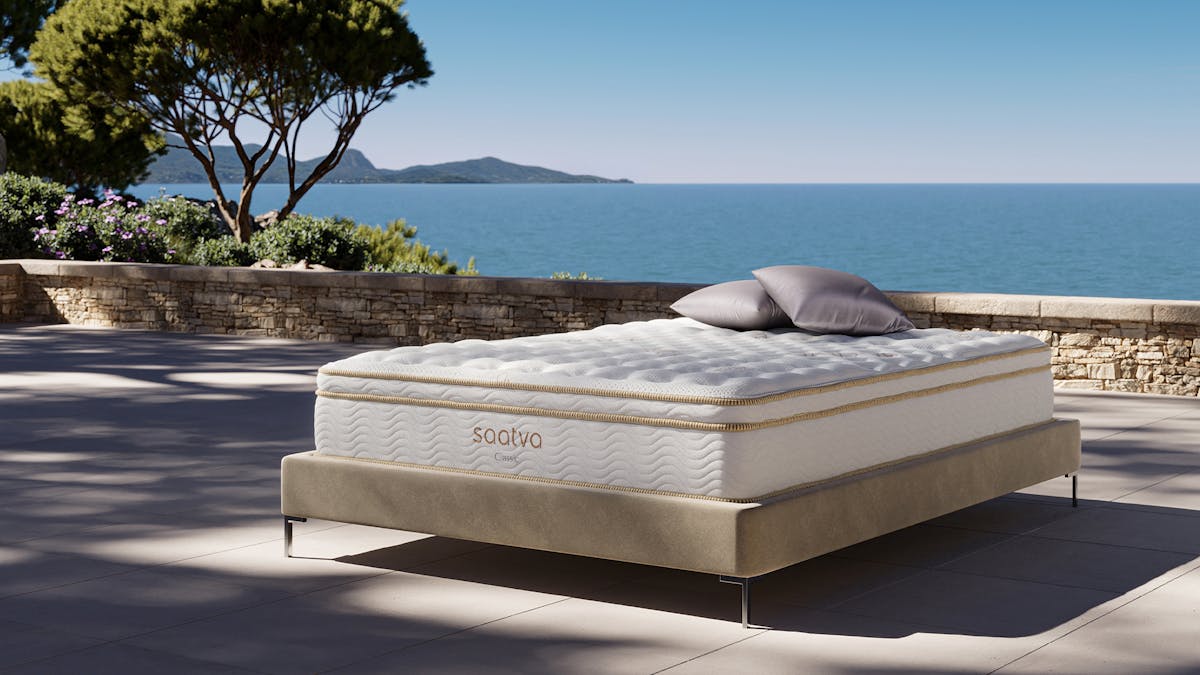
Saatva Classic
9.4/10
- Available in King, California King, and Split King at identical pricing
- Dual-coil construction with reinforced lumbar zone pad for back support
- Outstanding edge support (10/10, NapLab) - use the full mattress surface
- Free white-glove delivery, setup, and old mattress removal
- 365-night trial, lifetime warranty, zero off-gassing on arrival
- Higher motion transfer than all-foam alternatives
- $99 return fee if you decide to send it back during the trial
For anyone stepping up to King or Cal King size, the Saatva Classic is the clearest recommendation. The pricing is identical across both sizes, white-glove delivery makes the logistics of a large mattress painless, and the 365-night trial is long enough to confirm the size choice was right.
California King vs King 2026: Which Is Actually Bigger (And Which Should You Buy)?
Short answer: A standard King (Eastern King) is 76 inches wide by 80 inches long (193 x 203 cm). A California King is 72 inches wide by 84 inches long (183 x 213.5 cm). The standard King has 6,080 square inches of surface area; the California King has 6,048 square inches. The King is slightly larger by total area but narrower per partner by 2 inches. Pick California King if a sleeper is taller than 6'4". Pick standard King in every other case where you have the bedroom width to accommodate it.
Most brands price both sizes identically. Bedding selection favors the standard King. Frame and headboard availability favors the standard King. The California King's only true advantages are length and a long-narrow room footprint. We pull from Mattress Clarity's 2026 size guide (May 14, 2026 update), Mattress Nerd's California King vs Eastern King comparison (May 13, 2026), and direct manufacturer pricing from Saatva, Amerisleep, Tempur-Pedic, Helix, Purple, and Nectar.
Quick Verdict
- One of you is 6'4" or taller: California King. The extra 4 inches of length is non-negotiable.
- Bedroom is 11 feet wide or less, 16+ feet long: California King. The proportions fit the room better.
- You both want maximum side-by-side width: Standard King. 38 inches per partner vs 36 on Cal King.
- You want easier bedding shopping and resale value: Standard King. Wider selection, broader buyer pool.
- One partner is a tosser/turner: Standard King. The extra 4 inches of width measurably reduces motion transfer-style disturbance.
- You want different firmness on each side: Split King (two Twin XLs at 38x80 each, totaling King dimensions) with an adjustable base.
US Mattress Sizes 2026: The Full Reference Table
| Size | Width x Length (in) | Width x Length (cm) | Total Area | Per Partner |
|---|---|---|---|---|
| Twin | 38 x 75 in | 96.5 x 190.5 cm | 2,850 sq in | n/a (solo) |
| Twin XL | 38 x 80 in | 96.5 x 203 cm | 3,040 sq in | n/a (solo) |
| Full | 54 x 75 in | 137 x 190.5 cm | 4,050 sq in | 27 in |
| Queen | 60 x 80 in | 152.5 x 203 cm | 4,800 sq in | 30 in |
| King (Eastern) | 76 x 80 in | 193 x 203 cm | 6,080 sq in | 38 in |
| California King | 72 x 84 in | 183 x 213.5 cm | 6,048 sq in | 36 in |
| Split King | 38 x 80 in (x2) | 96.5 x 203 cm (x2) | 6,080 sq in | 38 in |
| Wyoming King | 84 x 84 in | 213.5 x 213.5 cm | 7,056 sq in | 42 in |
| Texas King | 80 x 98 in | 203 x 249 cm | 7,840 sq in | 40 in |
| Alaskan King | 108 x 108 in | 274.5 x 274.5 cm | 11,664 sq in | 54 in |
The most widely misunderstood fact in this table: King beats Cal King by 32 square inches of total surface area, despite being shorter. The California King's "bigger" reputation comes from length, not area.
Decision Matrix: Which One for Your Situation
Choose Standard King If
- Your bedroom is approximately 13x13 feet or larger.
- You and your partner want the maximum personal space side-by-side (38 inches each, equivalent to each of you sleeping on a Twin XL).
- You want the easiest time finding fitted sheets, comforters, headboards, and bed frames.
- You ever plan to resell the mattress. Standard King has a far larger buyer pool than California King in most regions outside the West Coast.
- One partner moves around in their sleep. The extra 4 inches of width reduces edge crowding and motion-feel transfer at the perimeter.
Choose California King If
- Either sleeper is 6'4" or taller. The extra 4 inches of length keeps feet on the mattress.
- Your bedroom is narrow and long, for example 11x16 feet. The Cal King's 72-inch width fits proportionally better than a 76-inch King.
- You live on the West Coast, where Cal King has historically been more common and bedding/frame selection is broader locally.
- You accept narrower per-partner width (36 inches vs 38) in exchange for the length.
Pricing Truth: King vs Cal King Across Top Brands
| Brand | Model | King Price | Cal King Price | Difference |
|---|---|---|---|---|
| Amerisleep | AS3 Hybrid | ~$1,899 | ~$1,899 | Same |
| Saatva | Classic | $1,995 | $1,995 | Same |
| Nectar | Premier | ~$1,299 | ~$1,299 | Same |
| Helix | Midnight | ~$1,199 | ~$1,199 | Same |
| Tempur-Pedic | Tempur-Adapt | ~$2,999 | ~$2,999 | Same |
| Purple | Purple Hybrid | ~$2,199 | ~$2,199 | Same |
Nearly every major US mattress brand prices King and California King identically. A handful of local retailers and warehouse clubs show a $50 to $100 spread, usually with King slightly cheaper due to inventory turnover. Promotional pricing is identical across both sizes at every direct-to-consumer brand we checked.
If you are shopping for a King or Cal King mattress right now, the Saatva Classic is available in both sizes at the same price, with free white-glove delivery and a 365-night trial. Amerisleep's AS3 Hybrid is also available in both sizes at identical pricing with a 100-night trial and 20-year warranty.
Bed Frame and Headboard Compatibility
This is where the Cal King hidden tax shows up.
- Cal King bed frames are less common in mainstream retail. IKEA, Wayfair, and most furniture stores stock more Standard King frames than Cal King. Specialty bedroom retailers stock both.
- Headboards do not interchange. A King headboard (76 inches wide) on a Cal King bed (72 inches) leaves a 2-inch gap on each side. Some buyers accept this; many do not.
- Box springs are different sizes and not interchangeable. If you already own a King box spring, switching to Cal King requires a new one.
- Adjustable bases: Saatva Lineal, Tempur-Ergo, Reverie, Amerisleep adjustable bases all offer Cal King variants at the same price as King. No frame penalty for adjustable buyers.
Bedding: What Actually Fits
The bedding fit question is one of the most common sources of post-purchase regret on Cal King mattresses.
- Fitted sheets: Cal King fitted sheets are dimensionally distinct from King fitted sheets. They are not interchangeable. Always match the mattress size.
- Comforters: Many comforters are labeled "King/Cal King" and fit both because they are oversized to drape. Some King-specific comforters will not have enough length for a Cal King.
- Duvet inserts: Usually fit both. Duvet covers vary; check the size label.
- Mattress protectors: Cal King specific is required. The fitted pocket on a King protector will not reach the Cal King's longer corners.
- Sheet availability: King fitted sheets exist in roughly twice as many SKUs across Amazon, Target, Macy's, and direct-to-consumer brands. Cal King is well-supplied but the selection is narrower.
Couple Sleep Science: How Much Space Each Partner Needs
The conventional benchmark is 30 inches of personal space per partner as the minimum for comfortable couple sleeping. Below 30 inches, partner motion and edge crowding become more disruptive.
- Queen (30 inches each): minimum comfortable for couples. Tight.
- King (38 inches each): premium. Equivalent to each partner sleeping on a Twin XL.
- Cal King (36 inches each): comfortable with the bonus of 4 extra inches of length.
The 2-inch difference per partner between King and Cal King sounds small on paper. In practice, partners who move a lot, partners with a meaningful height/weight differential, or anyone sharing the bed with a pet or child intermittently will feel the extra width on the standard King.
Room Layout: What Fits Where
| Bedroom Size | Best Fit |
|---|---|
| 10x10 ft | Queen with walking space, no nightstands flanking |
| 11x12 ft | King or Cal King; minimal walking space |
| 12x14 ft | King with side furniture (dresser, nightstands) |
| 12x16 ft | Cal King with full furniture; the long-narrow proportion case |
| 14x16 ft and larger | Wyoming, Texas, or Alaskan King options become viable |
The general rule: leave at least 24 to 30 inches of walking space on each side of the bed for nightstand access, and 30 to 36 inches at the foot of the bed.
A Brief Historical Note on Why Both Exist
The California King originated, as the name suggests, in California. The longer-than-wide proportions suited post-war West Coast lifestyles and larger master bedrooms. The Eastern King became the East Coast standard, and over time it absorbed national defaults under the simpler label "King." Both are now nationally available, but the regional baggage persists: bedding selection on the West Coast skews more Cal King-friendly; bedding selection in the Midwest, South, and East Coast skews King-friendly.
Split King: The Underrated Option
For couples with different firmness preferences or different adjustable-base needs, the Split King is worth a serious look. If you are already leaning toward two mattresses, see our best mattress for couples guide.
- Two Twin XL mattresses (38x80 inches each) placed side by side equal the dimensions of a standard King (76x80).
- Each partner picks their own firmness. Saatva offers Split King in the Classic, Loom & Leaf, and Latex Hybrid lines.
- Adjustable bases (Saatva Lineal, Amerisleep adjustable, Tempur-Ergo) support independent head and foot elevation per side. An adjustable bed frame paired with either size is also worth considering for back-pain relief.
- The trade-off: a gap between the two mattresses, which most owners bridge with a "split-king bridge" foam wedge or a fitted sheet that spans both. Some couples find the gap a non-issue; others find it a deal-breaker.
Resale Value: The Hidden Cost of Cal King
For buyers who plan to own a mattress for the full 8 to 10 year lifespan and never resell, this section does not matter. For everyone else, the resale gap is one of the largest hidden costs of Cal King ownership.
Standard King mattresses move on Facebook Marketplace, Craigslist, and local resale platforms at substantially higher velocity than Cal King. The reason is buyer pool size. Most US bedrooms accommodate a Standard King; fewer accommodate a Cal King without rearrangement. A used Saatva Classic King will typically sell for 30 to 40 percent of original retail within 60 days. A used Saatva Classic Cal King in the same condition often sits for 90 to 120 days at 25 to 30 percent.
The same dynamic plays out on frames and headboards. Standard King bed frames clear the secondary market faster than Cal King frames at the same condition and price.
If you are confident you will keep the mattress for its full life, this is irrelevant. If you anticipate moving cross-country, downsizing, or upgrading within 3 to 5 years, the resale gap is real money.
Adjustable Base Considerations
The adjustable base market has expanded significantly in 2024 to 2026, with brands like Saatva (Lineal), Amerisleep (Adjustable Bed+), Tempur-Pedic (Tempur-Ergo), and Reverie all offering full lineups in both King and Cal King.
A few practical considerations for adjustable buyers:
- King adjustable bases are typically Split King by default. A "King adjustable base" is usually two Twin XL bases that move independently. This is by design, because moving 76 inches of mattress in one unified piece is mechanically harder.
- Cal King adjustable bases are sometimes single-unit. Some manufacturers offer a single-piece Cal King adjustable base; others offer Split Cal King (two Cal King-half bases, 36x84 each). Verify the configuration on the product page before ordering.
- Mattresses must be adjustable-base-compatible. Most foam, hybrid, and latex mattresses are. Traditional innerspring with rigid edges can crack under repeated articulation. Saatva Classic, Amerisleep AS3, Tempur-Pedic, Nectar, and Helix are all explicitly adjustable-base-compatible.
- Mattress retention straps on adjustable bases hold the mattress in place when the base is elevated. Without straps, the mattress can slide. Most premium bases include these as standard.
Saatva Classic
9.4/10
Available in King, Cal King, and Split King at identical pricing. Free white-glove delivery, 365-night trial, lifetime warranty, and zero off-gassing make it the lowest-friction path to upgrading to either king-size format.
Mattress Shopping Right Now
For the King vs Cal King decision in 2026, the mattress itself matters more than the size choice. Both Saatva and Amerisleep sell their full lineups in both sizes at identical pricing.
The Saatva Classic runs on a dual-coil construction with a reinforced lumbar zone pad, ships uncompressed via white-glove delivery (no off-gassing on arrival), and carries a lifetime warranty with a 365-night trial. It is the hotel-luxury option for buyers who want an innerspring feel. Amerisleep's AS3 Hybrid runs cooler (plant-based Bio-Pur foam vs traditional innerspring with memory foam), is made in Indiana, and offers a 100-night trial with a 20-year warranty. Both are available in King, California King, and Split King.
Beyond King: Wyoming, Texas, and Alaskan Sizes
For buyers whose bedroom can fit it and whose budget can absorb it, the market does extend past Standard King and California King. These oversized formats are niche products with limited brand availability and require custom or boutique bedding.
Wyoming King (84 x 84 in)
A perfect square. Common with couples sharing the bed with children or large dogs, where the extra width matters more than length. Per-partner space lands at 42 inches, slightly more than a Standard King. Frame and bedding options are limited to specialty retailers. Pricing typically runs 40 to 80 percent more than a Standard King at the same brand.
Texas King (80 x 98 in)
Adds 18 inches of length to a Standard King while keeping similar width. The right size for very tall sleepers (6'8" and up) and for couples who want the room to sleep diagonally on hot nights. Frame availability is even more limited than Wyoming King; bedding is custom or specialty.
Alaskan King (108 x 108 in)
9 feet by 9 feet. A specialty product for entire families or buyers with very large primary bedrooms. Pricing starts around $3,500 to $5,000 for the mattress alone before frame, base, and custom bedding. Realistic audience is narrow.
For 99 percent of US bedrooms, the choice remains between Standard King and California King. The oversized formats are worth mentioning so buyers know they exist, not because they apply to most decisions.
A Three-Question Decision Framework
If you are deadlocked between Standard King and California King, three questions usually resolve it:
- How tall is the taller sleeper? 6'4" or taller, Cal King. Under 6'4", height is a non-factor.
- Measure your bedroom: which dimension is the limiting factor? If width is the constraint, Cal King (72 inches vs 76). If length is the constraint, Standard King (80 inches vs 84). If both have room, the next question decides it.
- Do you have an existing King-size headboard, bed frame, or set of fitted sheets? If yes, the switching cost favors Standard King. If no, both are equally fresh starts.
Most buyers who run through these three questions land on Standard King unless one specific factor (a 6'5" partner, a long-narrow bedroom) decisively flips the answer. The Cal King is a specialty choice, not a default upgrade.
Three Mistakes Buyers Make on This Decision
- Assuming Cal King is "bigger" because of the name. The total surface area is virtually identical, with Standard King actually 32 square inches larger. Cal King is longer; nothing more.
- Forgetting to measure the bedroom before ordering. Both sizes are large. A 76 or 72-inch-wide bed in a 10x10 bedroom leaves no walking space and no room for a dresser. Measure first, decide second.
- Buying Cal King because the West Coast retailer recommended it. If you live east of the Mississippi, bedding selection and frame availability lean Standard King. The Cal King will work fine but the secondary-market and replacement-bedding friction is real over the mattress lifespan.
Frequently Asked Questions
King vs California King dimensions?
King (Eastern King): 76 inches wide by 80 inches long (193 x 203 cm). Total area 6,080 square inches. California King: 72 inches wide by 84 inches long (183 x 213.5 cm). Total area 6,048 square inches.
Is a California King bigger than a regular King?
No. The standard King has more total surface area (6,080 vs 6,048 square inches). The California King is longer by 4 inches but narrower by 4 inches. Cal King is bigger in length only.
Is a King or California King better for tall people?
California King for anyone 6'4" or taller. The 84-inch length keeps feet on the mattress. The standard King's 80-inch length leaves the toes of a 6'4" sleeper at the edge.
Do King sheets fit a California King?
Fitted sheets do not. King fitted sheets and Cal King fitted sheets are different sizes. Some comforters labeled "King/Cal King" fit both because they are oversized to drape. Always check the size label on the specific product.
California King vs Queen?
Cal King is 12 inches wider (72 vs 60) and 4 inches longer (84 vs 80) than a Queen. Total surface area is 6,048 square inches vs 4,800 square inches, a 26% area increase.
Cheapest California King mattress 2026?
Budget options start around $500 to $700 for the Cal King size from Linenspa, Zinus, and similar Amazon-tier brands. Mid-tier direct-to-consumer Cal Kings from Nectar and Helix run $1,199 to $1,299. Premium Cal Kings from Saatva, Amerisleep, and Tempur-Pedic range from $1,899 to $2,999.
Is a Split King the same as a regular King?
By total outside dimensions, yes (38x80 inches twice equals 76x80 inches). Functionally, no. A Split King is two separate mattresses placed side by side, each with its own firmness and (when paired with an adjustable base) independent elevation. The gap between mattresses is the main practical difference from a one-piece King.
Fact-checked against Mattress Clarity 2026 size guide (May 14, 2026 update), Mattress Nerd California King vs Eastern King comparison (May 13, 2026), and direct manufacturer pricing from Saatva, Amerisleep, Tempur-Pedic, Helix, Purple, and Nectar (May 2026). Reviewed and updated May 18, 2026. MattressNut maintains editorial independence from brands featured in this guide.