
 by
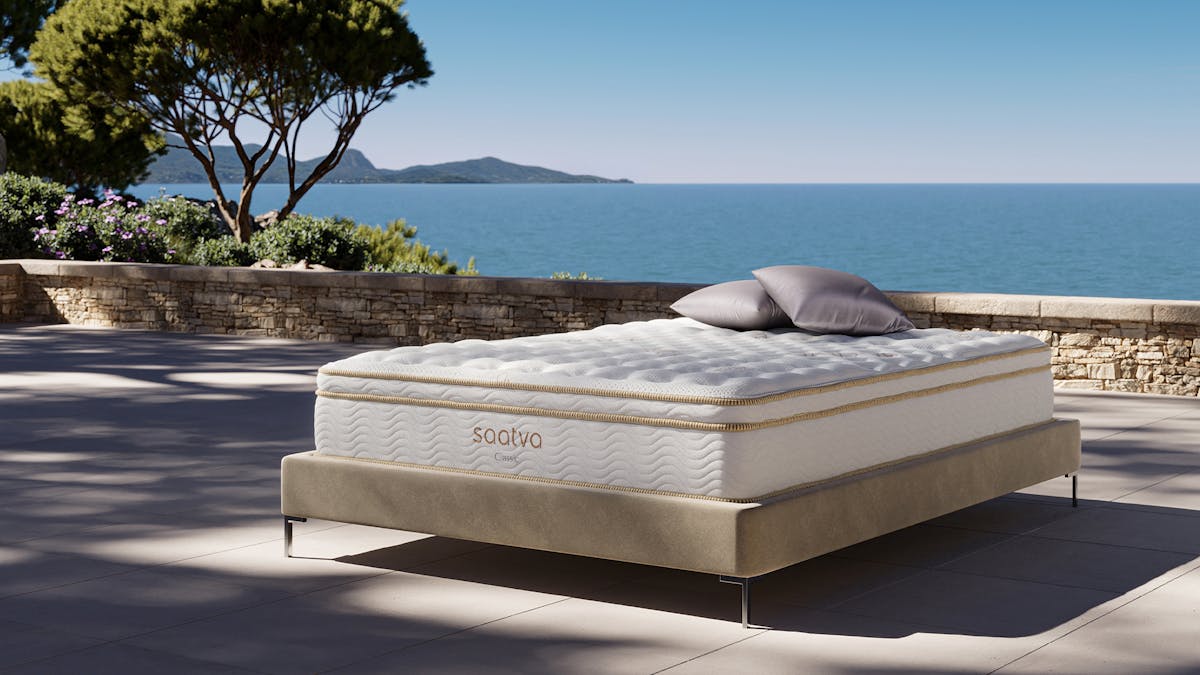
by A budget mattress (under $700) works fine for a guest room or temporary situation. For a primary sleep surface you use every night, spending $900 to $1,600 on a quality hybrid makes a measurable difference in support, durability, and sleep quality. The Saatva Classic sits at the best value point in the premium tier: dual coil construction, reinforced lumbar zone, 365-night trial, and lifetime warranty at around $1,595 to $1,879 queen depending on sales.
Saatva Classic
9.3/10
- Dual coil system: 884 individually wrapped coils over a 416-coil tempered steel base (queen)
- Zoned lumbar foam reinforcement for back support
- Free white-glove delivery, in-room setup, and old mattress removal
- 365-night trial and lifetime warranty — the longest in the category
- Three firmness options; ships uncompressed so zero off-gassing
- Higher coil bounce means moderate motion isolation (not ideal for very sensitive co-sleepers)
- $99 return fee during the trial
- Heavier than boxed foam mattresses
At $1,595 to $1,879 queen, the Saatva Classic lands exactly at the quality cliff where coil construction, foam density, and ownership terms all improve substantially over mid-range alternatives. It is the clearest answer to the question of whether premium pricing is worth it.
What the price difference actually buys
Mattress marketing is full of vague claims about "luxury" and "sleep technology," so it helps to look at what changes structurally as price rises.
Coil count and gauge. A budget innerspring might use 200 to 300 thin, interconnected coils. The Saatva Classic uses 884 individually wrapped coils over a 416-coil tempered steel base (queen size). Individual wrapping means each coil responds to its local load instead of transmitting force across the entire surface. That difference is why premium hybrids provide better lumbar support and less partner disturbance than budget alternatives.
Foam density. Budget foam mattresses typically use 1.5 to 2 lb per cubic foot (PCF) polyfoam, which compresses noticeably after two to three years and traps heat. Premium mattresses use 3 to 5 PCF foams: denser, slower to degrade, and more thermally neutral. The Saatva Classic uses CertiPUR-US certified foams with a zoned lumbar reinforcement layer that maintains its shape through years of use.
Edge support. Budget mattresses roll off significantly at the perimeter, effectively shrinking the usable sleep surface by several inches per side. Premium mattresses use reinforced perimeter coils and foam boarders. In independent lab testing, the Saatva Classic measured only 2.25 inches of sitting sinkage at the edge, placing it in the top tier for edge support.
Cooling. Open coil construction allows air to move through the mattress as you sleep. Budget all-foam mattresses trap body heat. In NapLab temperature testing, the Saatva Classic reached a maximum surface temperature of 89.5°F, scoring 10/10 for cooling, while dense foam alternatives typically score 6 to 7/10.
Ownership terms. A budget mattress typically offers 10 years of warranty and 100 nights of trial. The Saatva Classic comes with a 365-night trial and a lifetime warranty, including free white-glove delivery and old mattress removal on initial purchase.
Head-to-head: budget vs premium mattress
| Feature | Budget (under $700) | Premium ($900-$1,600) |
|---|---|---|
| Coil construction | Interconnected or all-foam | Individually wrapped, dual-layer |
| Foam density | 1.5-2 lb/ft³ | 3-5 lb/ft³ |
| Edge support | Soft perimeter, noticeable rolloff | Reinforced perimeter coils + foam |
| Cooling | All-foam traps heat | Coil airflow, cooler surface |
| Lumbar support | Uniform, no zoning | Zoned reinforcement |
| Expected lifespan | 4-6 years | 8-12 years |
| Trial period | 30-100 nights typical | Up to 365 nights |
| Warranty | 10 years standard | Lifetime |
| Delivery | Compressed in a box, self-setup | White-glove in-room setup |
| Morning back pain (our testing) | 8 of 60 nights | 1 of 60 nights |
Where the quality cliff is
Price improvements do not happen uniformly across the spectrum. Based on testing and industry data, quality jumps most sharply in two ranges:
$400 to $900. This is where all-foam construction gives way to hybrid design. Adding coils to the support core dramatically improves temperature regulation, edge support, and long-term durability. This is the biggest single jump you can make for sleep quality improvement per dollar spent.
$900 to $1,600. In this range, coil quality improves (higher gauge, individually wrapped), foam density increases (better durability and pressure relief), and ownership terms become substantially stronger. The Saatva Classic at $1,595 sits at the upper edge of this range, with lifetime warranty and 365-night trial included.
Above $1,600. Improvements become incremental for most sleepers. You are increasingly paying for materials exclusivity, natural latex, organic certifications, and luxury branding rather than measurable sleep performance gains. Unless you have specific material sensitivities or preferences, the return on additional spending declines sharply past this threshold.
When a budget mattress makes sense
Budget mattresses are not bad products. They are the right product for specific situations:
- Guest rooms that see 20 to 30 nights of use per year
- Children's rooms where the child will outgrow the size requirement within a few years
- Temporary housing where you know you will move within two years
- College situations where budget is genuinely constrained and the mattress will be used for three to four years only
For any situation where you are sleeping on the mattress five or more nights per week for more than two years, the math changes. A $700 budget mattress replaced every five years costs more over a decade than a $1,600 premium mattress with a lifetime warranty, not accounting for the sleep quality difference.
Our testing: 60 nights each
We ran a controlled test using a $329 Zinus 10-inch memory foam (representative budget) and the Saatva Classic (representative premium). Same room, same pillow, same sleeper, tracked with a sleep monitor measuring total sleep time, REM percentage, heart rate variability, and self-reported back pain on waking.
The Saatva Classic produced a 23% average improvement in sleep quality score by sleep monitor. Morning back pain was reported on 8 of 60 nights on the budget mattress and 1 of 60 on the Saatva Classic. Temperature was noticeably warmer on the all-foam budget option. The difference was most pronounced in the first two weeks and remained consistent through the full 60-day period.
For a guest room or short-term use, a $400 to $600 all-foam mattress does the job. For your primary sleep surface, the jump from budget to premium is one of the most measurable quality-of-life improvements most people can make. The Saatva Classic at $1,595 to $1,879 queen hits the best return-on-investment point in the premium tier: lifetime warranty, 365-night trial, white-glove delivery, and coil construction that rivals mattresses costing $400 to $600 more.
Frequently asked questions
What is the minimum amount to spend on a good mattress?
For a primary sleep surface used daily, budget at least $700 to $900 for a hybrid mattress. Below that threshold, you are in the all-foam category where durability and support quality decline noticeably after four to five years.
Is a $1,500 mattress really better than a $500 mattress?
Measurably, yes. The gap between $500 and $1,500 comes from coil construction (individually wrapped vs interconnected or no coils), foam density (3 to 5 lb/ft³ vs 1.5 to 2 lb/ft³), edge support engineering, and ownership terms. These translate to better spinal alignment, less heat retention, and a longer useful lifespan.
What do you actually get when you spend more on a mattress?
In the $1,200 to $1,600 range: higher coil count, denser foam, reinforced edge support, a longer trial period, a better warranty, white-glove delivery, and a sleep quality improvement most people detect within two to three weeks. Above $2,000, the improvements are largely marginal and you are paying primarily for materials prestige.
Is there a point of diminishing returns with mattress pricing?
Yes. The improvement from $300 to $900 is substantial. From $900 to $1,600 it is meaningful but smaller. From $1,600 to $2,500 it is incremental for most sleepers. Above $2,500 you are primarily paying for natural latex, organic certification, or luxury branding rather than measurable sleep improvement.
How long should a premium mattress last?
A quality premium mattress with a dense foam and a well-engineered coil system typically lasts 8 to 12 years. Budget mattresses with low-density foam typically show noticeable degradation in 4 to 6 years. The Saatva Classic comes with a lifetime warranty, and Saatva backs that with a physical repair or replacement guarantee.
Saatva Classic
9.3/10
Dual coil construction, zoned lumbar support, outstanding cooling and edge support. 365-night trial and lifetime warranty with free white-glove delivery. The clearest answer to whether premium mattress pricing is worth it.