
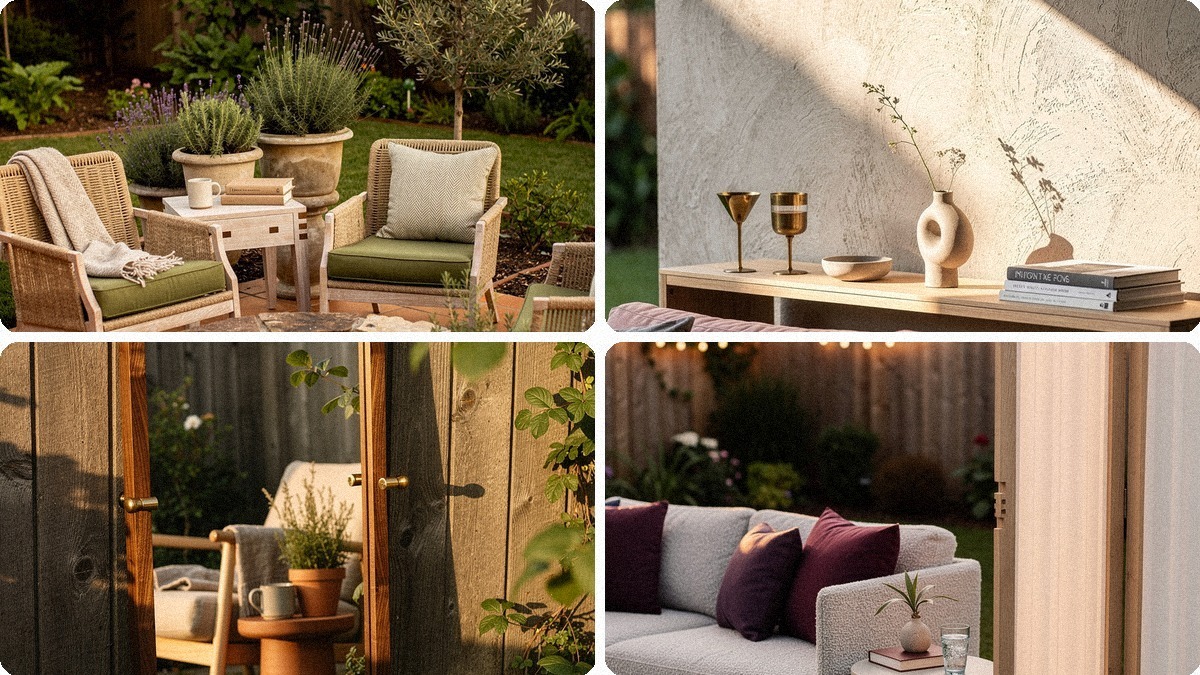
 by
by The short answer: a seating arrangement that faces inward, not the fence. I've spent three summers rearranging the same patio, and the difference between a backyard people pass through and one they settle into isn't the furniture budget. It's where you point the chairs. Most backyards are designed like living rooms pushed outside, sofa against the wall, coffee table in the middle, done. That layout works inside because the walls hold the room together. Outside, walls are air. The move is building a pocket that feels enclosed without building anything. These 18 ideas start with that principle and layer from there. (And yes, some of them cost nothing.)
- Circle a low fire pit with mismatched woven chairs
- Step into the seating circle from a gravel path
- Drape a chunky knit throw over every armchair
- Set a weathered teak bench against a living wall
- Layer two outdoor rugs to define the conversation zone
- Hang string lights in a loose canopy above the seating
- Tuck a narrow console behind the sofa for drinks
- Paint a pergola ceiling in deep Farrow & Ball Green Smoke
- Float a daybed on the patio for afternoon lounging
- Stack terracotta pots as a sculptural side table
- Line the edge with lavender for scent while you sit
- Lean a tall mirror against the fence to double the garden
- Prop a folding screen to block the neighbor's view
- Choose a single oversized sectional and skip the clutter
- Add a rolling bar cart stocked for sundown cocktails
- Build a low stone wall that doubles as extra seating
- Swap the coffee table for a vintage galvanized trough
- Why the best backyards feel discovered, not decorated
1Circle a low fire pit with mismatched woven chairs
The best backyard conversations happen in a circle. Not a U-shape facing the house.
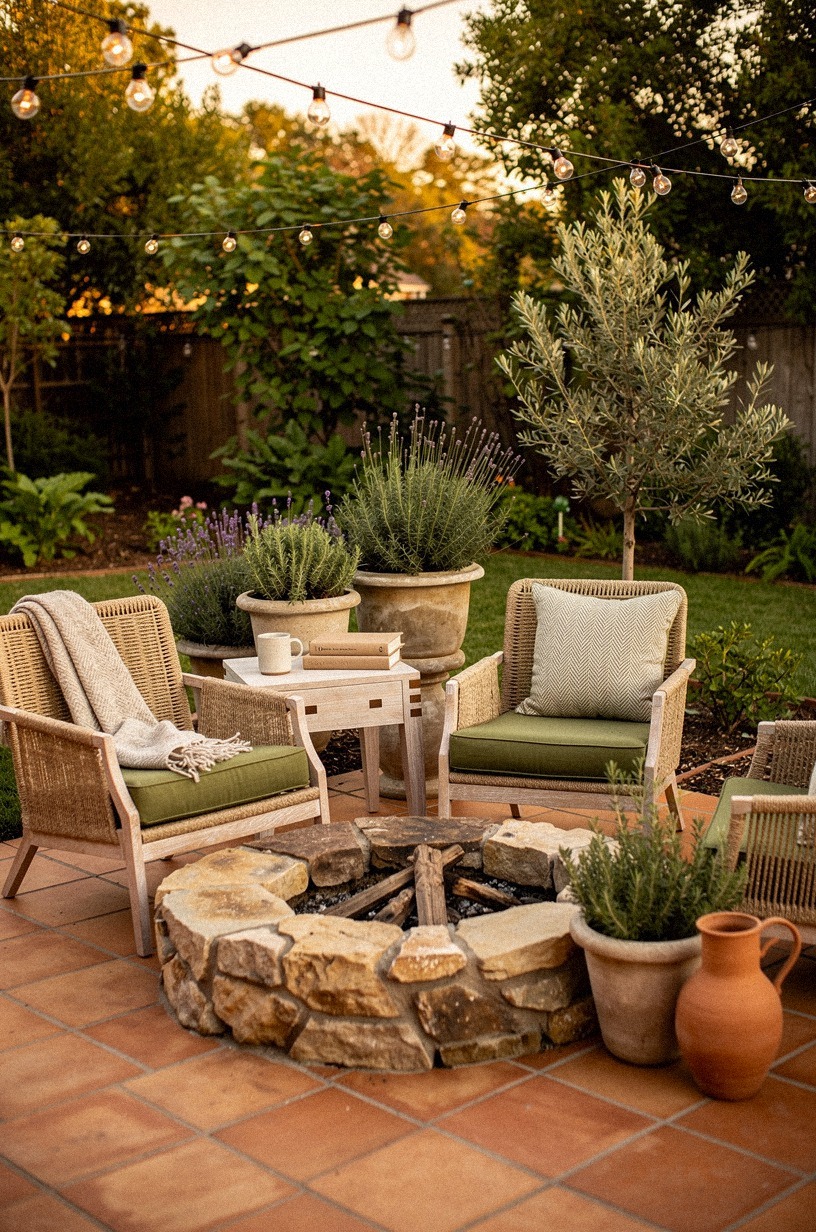
A real circle where you can see everyone without turning your head. A low stone fire pit, think fieldstone or reclaimed brick, not a metal bowl on legs, anchors the middle.
Around it, four to six woven chairs in different weaves but the same warm tone: two in seagrass, one in rattan, one in bamboo. The mismatch is intentional. It keeps the eye moving and stops the setup from looking like a catalog spread.
The fire pit should sit low. Twelve to fourteen inches off the ground is the sweet spot. Any higher and it becomes a table people lean on instead of a hearth they gather around.
I've seen setups where the chairs are too far out, six feet from the flames, and the whole thing feels like a waiting room. Pull them in.
Twenty-four to thirty inches from edge to edge. Close enough to feel the heat, far enough that you're not dodging sparks.
A cerused white oak side table between two chairs gives you a place for a drink without breaking the circle. The exposed dovetail joint in the oak catches the light at dusk.
That's the detail people notice. Not the fire.
The wood.
2Step into the seating circle from a gravel path
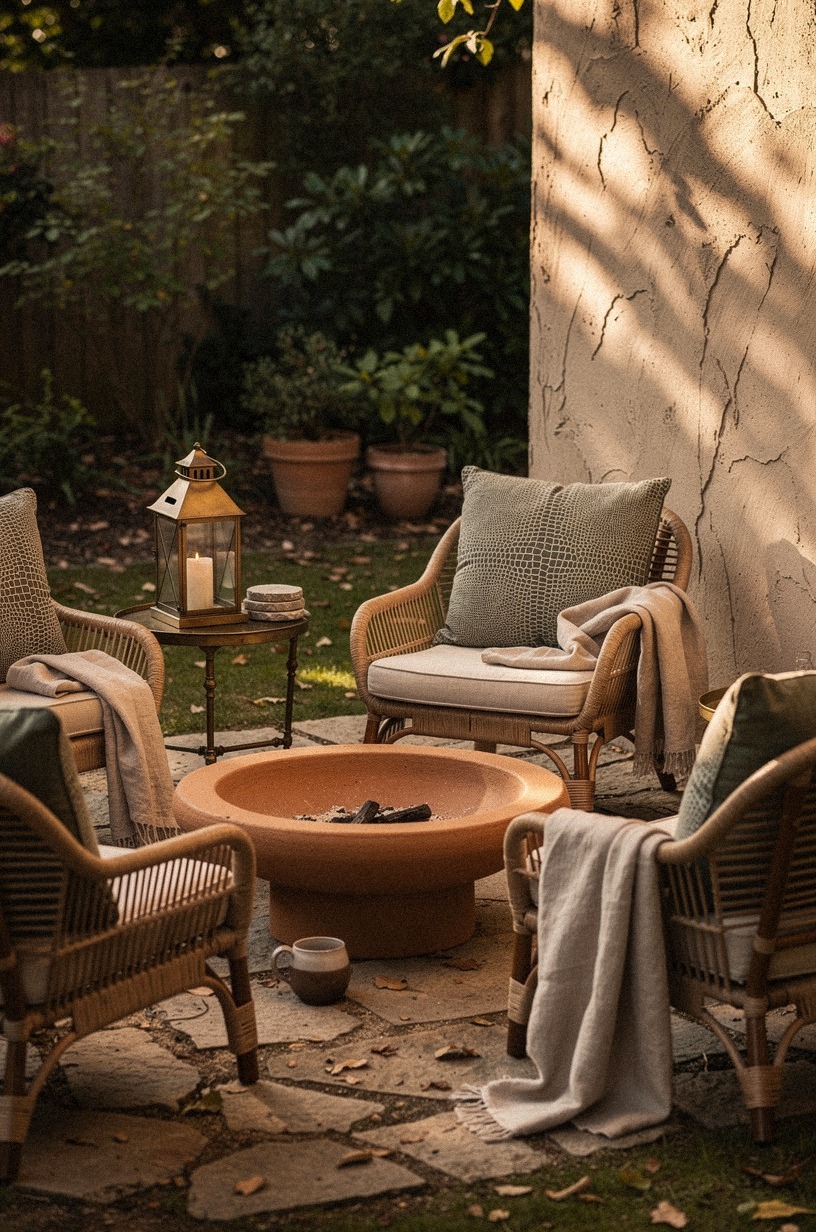
The approach matters. A gravel path, crushed limestone or pea gravel, not mulch, leading straight to the seating circle tells guests where to go. It removes the hesitation of "where do I sit?" The sound of gravel underfoot is part of the experience.
It signals that you've left the lawn and entered the room.
The path should be thirty to thirty-six inches wide. Narrow enough to feel like a corridor, wide enough for two people side by side.
Line it with lavender or thyme if you're in a dry climate. The scent hits when people walk through, not when they're sitting.
That's the timing you want. A sensory cue on arrival, not a constant perfume.
At the end of the path, the seating circle should open up suddenly. One step from gravel to terracotta patio or bluestone. The change in material underfoot is the threshold.
I've been to backyards where the transition is gradual, grass to mulch to patio, and it kills the moment. Make it sharp.
One step, you're in.
3Drape a chunky knit throw over every armchair
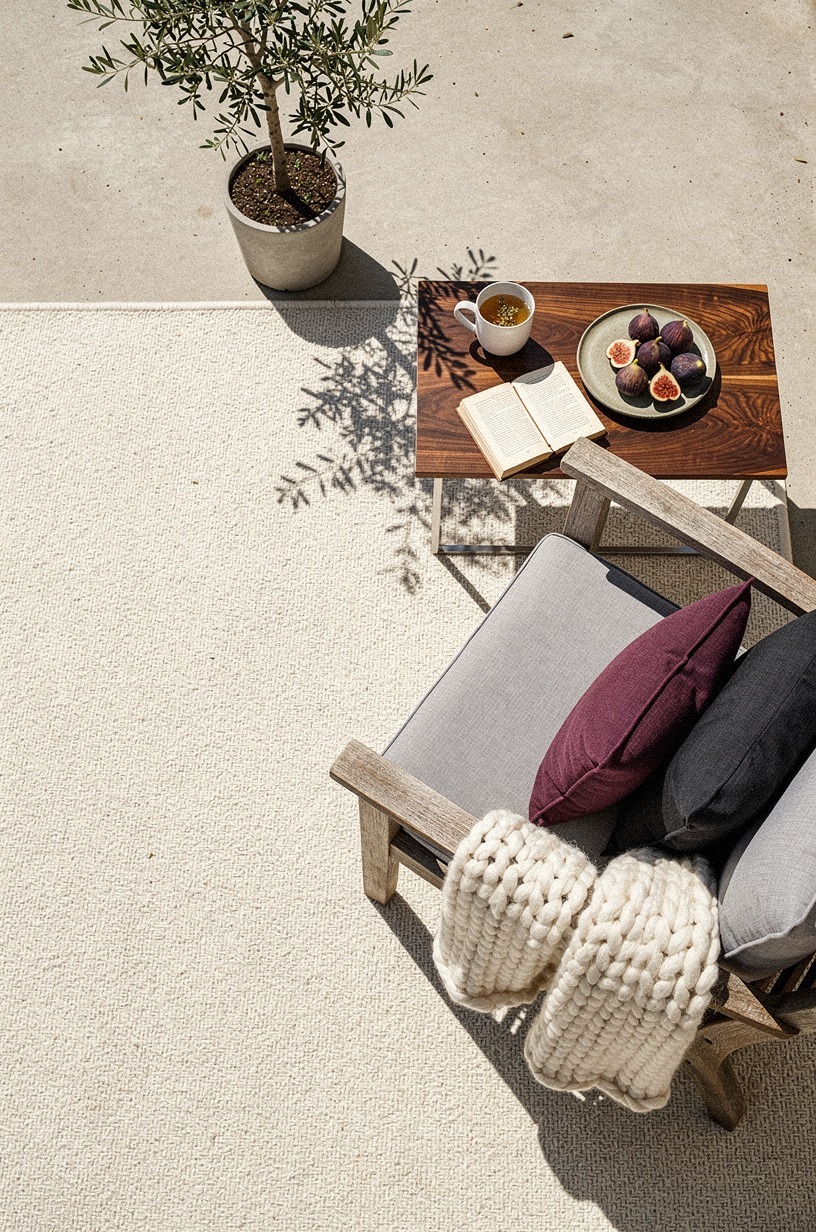
This is the cheapest move on the list and the one people comment on most.
4Set a weathered teak bench against a living wall
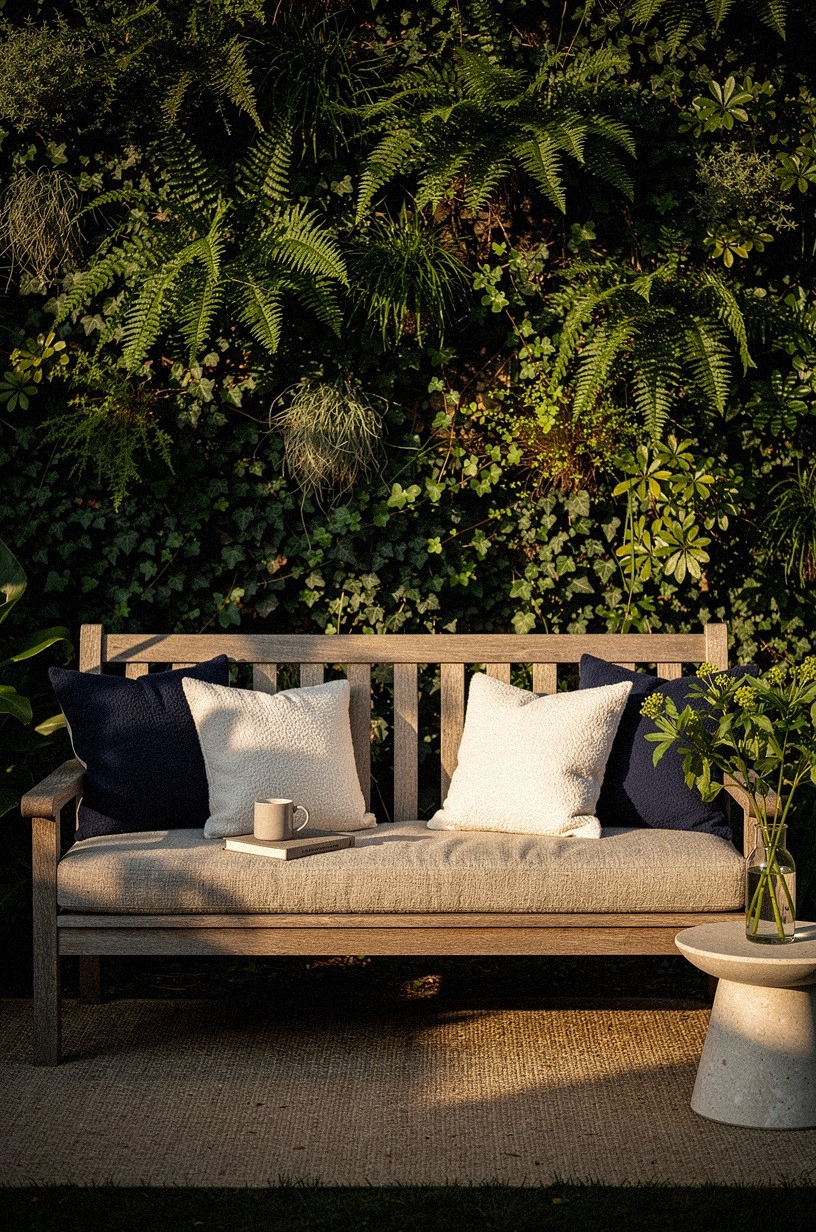
A bench alone is a waiting area. A bench against a wall of green is a destination.
The wall doesn't need to be elaborate. Ferns, ivy, and pachysandra in a raised planter box, twelve to eighteen inches deep, will fill in within a season.
The key is density. Sparse planting looks like a hedge.
Dense planting looks like architecture.
The bench should be weathered teak, not oiled, not sealed. The silver-grey patina that develops after two seasons is the color you're after.
It reads as old money without the old money price tag. Cushions in organic bouclé or Belgian linen in a warm white or oatmeal keep the bench from feeling like a park seat.
The texture should be nubby, not smooth. Smooth says indoor. Nubby says outdoor and meant to be there.
Place the bench so the living wall is behind you when you sit. The green becomes a backdrop, not a view. I've seen setups where the bench faces the wall and it feels like a meditation corner.
Fine if that's the goal. But for conversation, the wall should be behind.
The view, fire pit, garden, sunset, should be in front.
5Layer two outdoor rugs to define the conversation zone
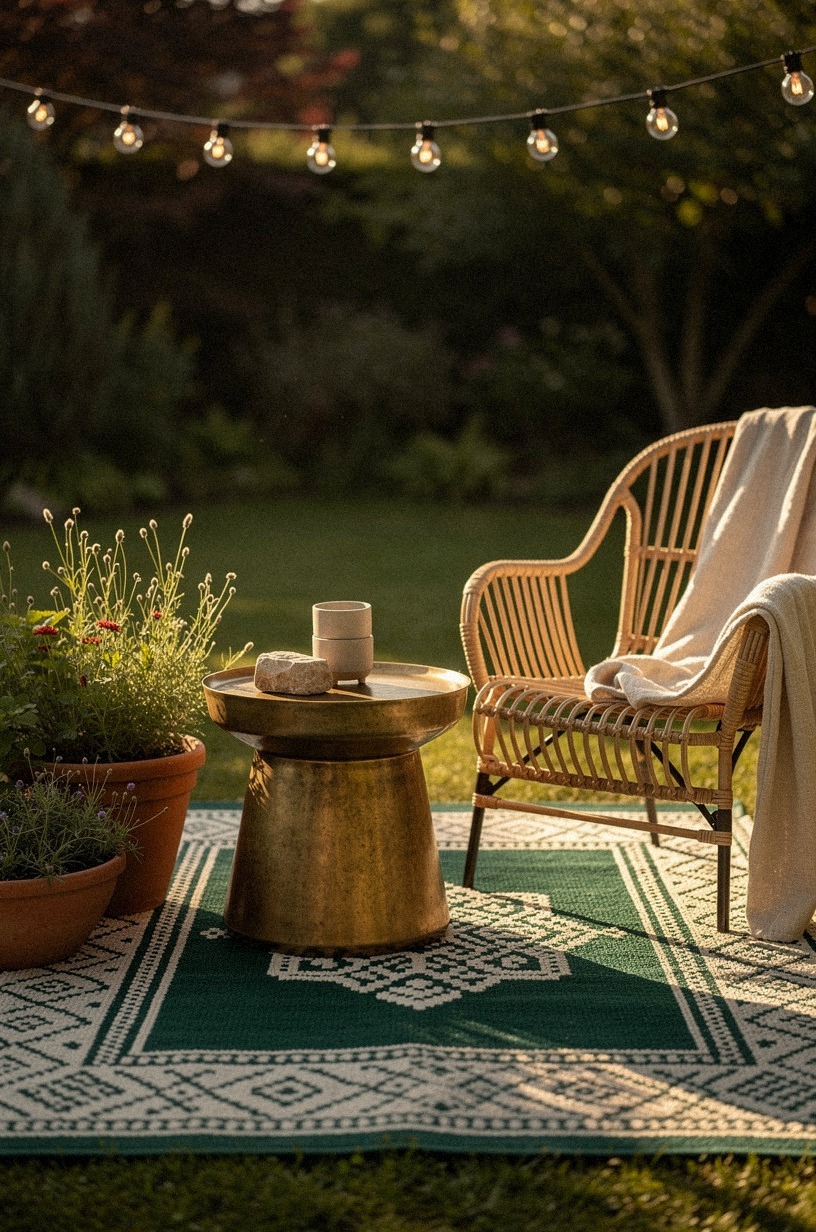
One rug is a mat. Two rugs, layered, is a room.
Start with a large base rug, jute or sisal, eight by ten feet or nine by twelve, that covers the whole seating area. Then add a smaller rug on top, offset by twelve to eighteen inches.
The top rug should have color or pattern: emerald and cream stripes, geometric Moroccan, faded Persian reproduction. The offset creates a visual frame that says "this space is intentional."
The base rug handles the dirt and the weather. The top rug handles the style. When the top rug gets stained, it will, you can flip it, rotate it, or replace it without losing the whole setup.
I've had the same jute base for four years and three different top rugs.
An unlacquered brass side table with a developing patina sits well on the layered rugs. The warm metal echoes the warm tones in the weave. A wabi-sabi woven rattan chair, imperfect, hand-shaped, not machine-round, next to the table completes the triangle.
The chair should look like it was found, not bought. That's the aesthetic. Gathered over time, not ordered in a set.
6Hang string lights in a loose canopy above the seating
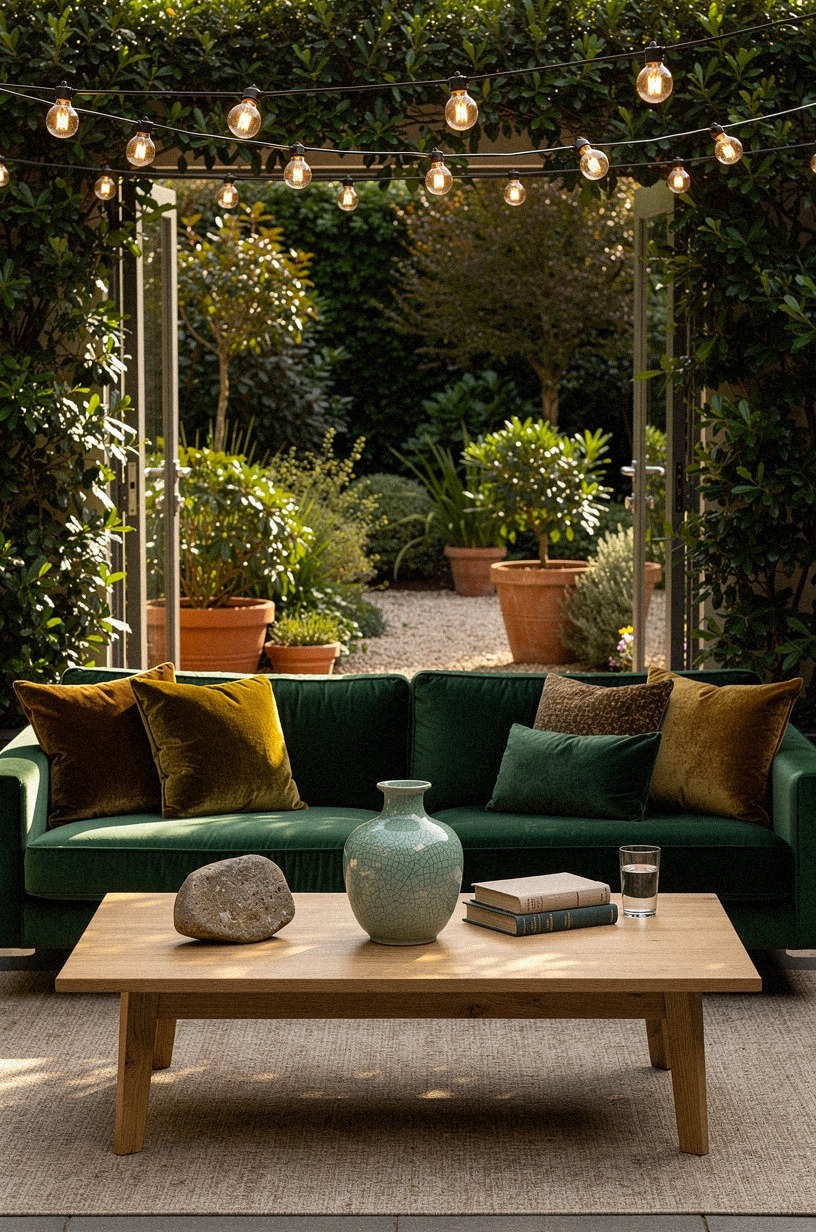
Overhead lighting is the difference between a patio and a lounge. String lights, LED filament bulbs on black cord, not white, hung in a loose canopy above the seating area create a ceiling where there isn't one.
The canopy should be low enough to feel intimate, high enough to walk under. Eight to ten feet is the range.
Lower than that and tall people duck. Higher and the effect disperses.
The pattern matters. A straight grid is a parking lot.
A loose V or gentle zigzag, anchored at four corners with black iron hooks or stainless steel cable, feels like a tent without the canvas. The bulbs should be warm, 2200K to 2700K, not daylight.
Daylight bulbs make everyone look like they're in a dentist's office.
Under the canopy, a forest green sofa with deep-pile mohair velvet cushions becomes the anchor. The green absorbs the light instead of reflecting it, which makes the glow feel deeper.
A cracked celadon glaze ceramic vessel on a natural stone side table catches the bulb light and throws it back in patches. The imperfection of the glaze is the point. Perfect surfaces don't hold light the same way.
7Tuck a narrow console behind the sofa for drinks
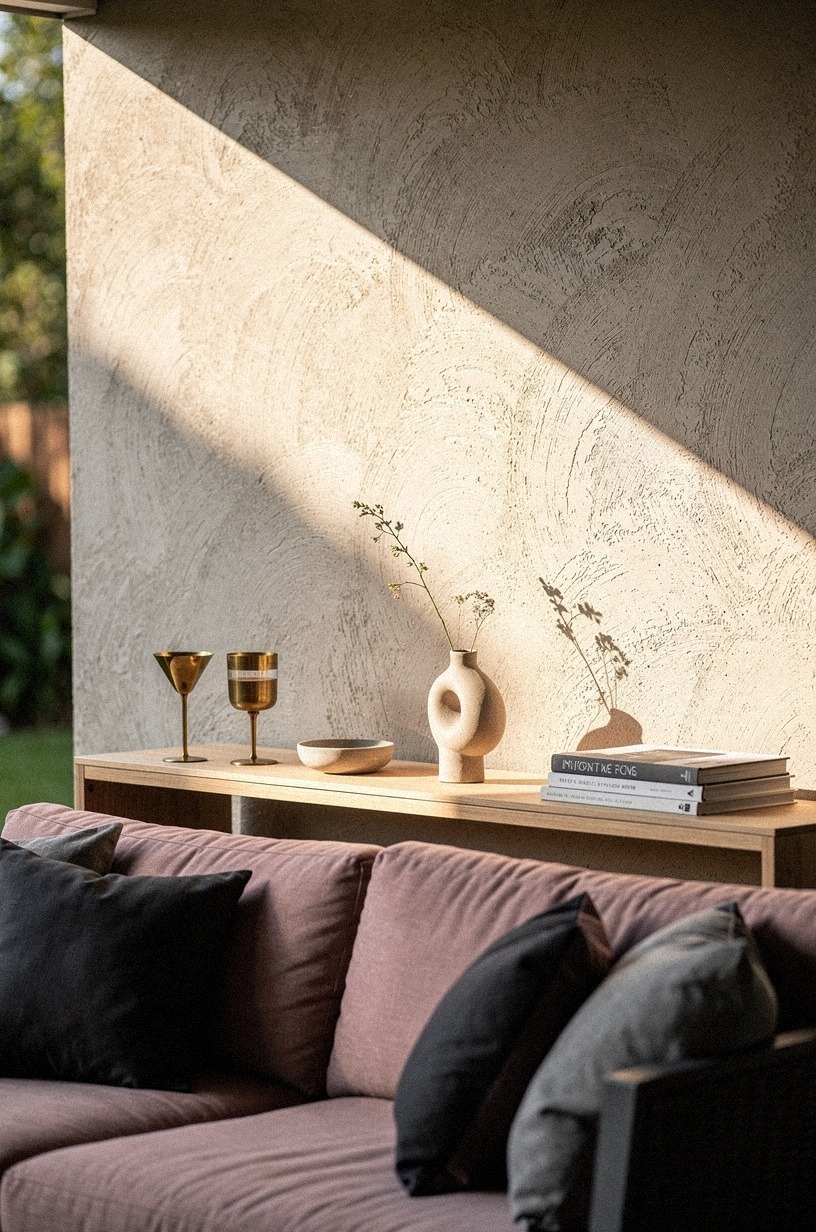
Every seating area needs a surface within arm's reach.
8Paint a pergola ceiling in deep Farrow & Ball Green Smoke
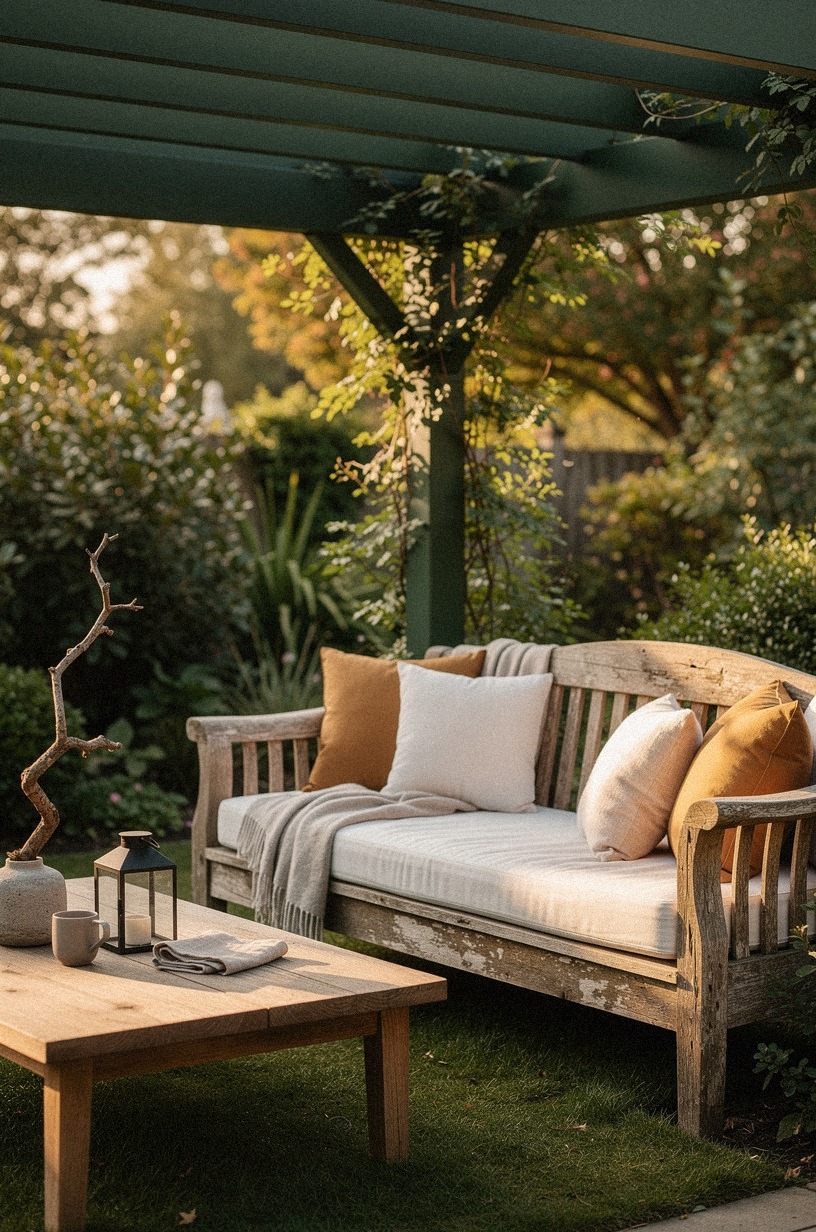
A pergola without a painted ceiling is a skeleton. Paint the underside, the ceiling, not the beams, in Farrow & Ball Green Smoke and the whole structure becomes a room.
The dark color recedes visually, which makes the space feel larger and more enclosed. It also throws a green tint onto everything below, which makes skin look better and white cushions look creamier.
The paint should be exterior-grade matte, not gloss. Gloss reflects light in patches and looks like a gymnasium.
Matte absorbs it. The beams can stay natural wood, reclaimed weathered teak or white oak, for contrast. The combination of dark ceiling and light beams is the classic porch formula, and it works because it's been tested for a hundred years.
Under the painted ceiling, a daybed with warm white and camel cushions becomes the focal point. The wire-brushed oak frame of the daybed should be simple. No carving, no turned legs.
The green ceiling is the ornament. Everything else should be quiet.
I've seen pergolas where the furniture fights the ceiling and both lose. Let one thing speak.

9Float a daybed on the patio for afternoon lounging
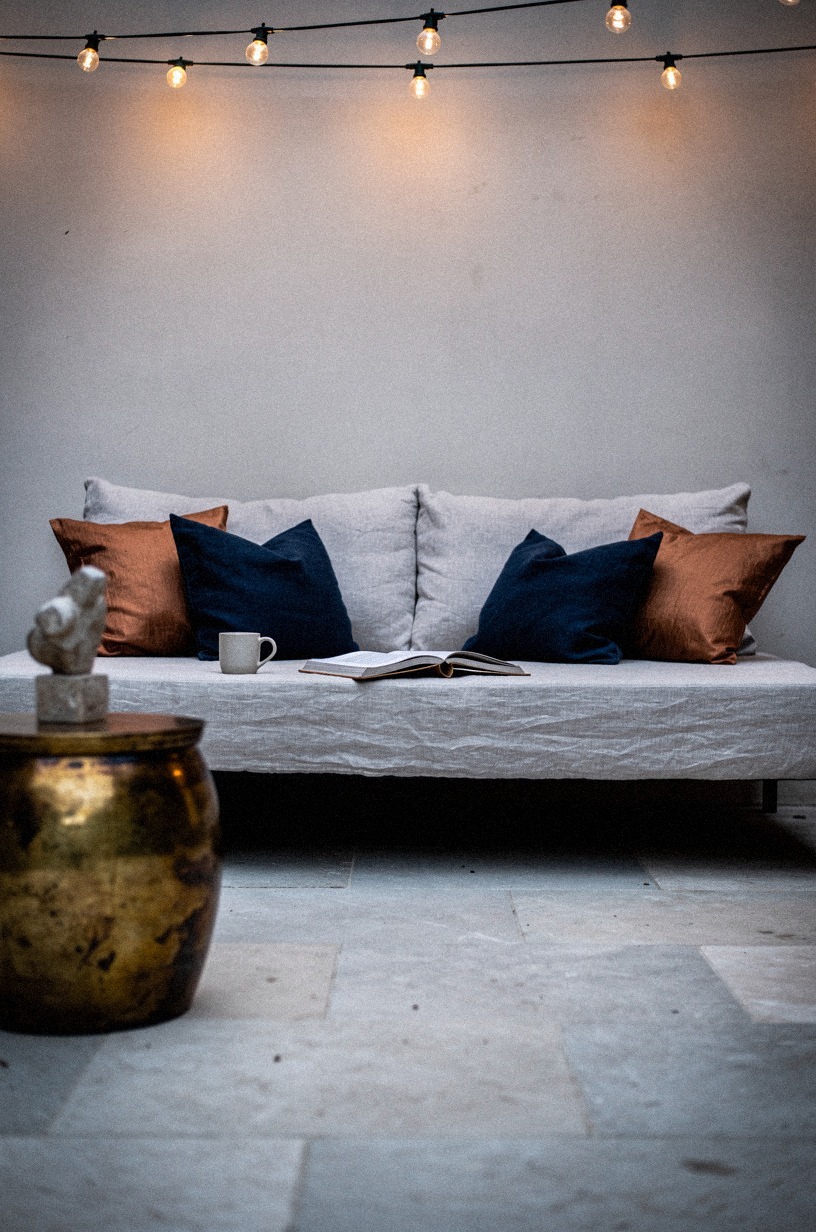
A daybed is a sofa you can lie down on.
10Stack terracotta pots as a sculptural side table

Three terracotta pots, large, medium, small, stacked upside down and glued with construction adhesive become a side table that costs less than thirty dollars and looks like a sculpture. The terracotta should be unglazed and weathered. New pots are too orange.
Leave them outside for a season or rub them with yogurt to accelerate the patina. (Yes, really. The bacteria in yogurt ages terracotta faster than time alone.)
The top pot becomes the surface. A cerused white oak armchair next to the stacked pots creates a contrast between rough clay and smooth wood.
The chair should be visible in the background, not the foreground. The pots are the subject.
The chair is the context. A sage green ceramic cup or a copper candle on top of the pots completes the composition.
This is the idea guests ask about. Not the expensive sofa. The thirty-dollar pots.
That's the lesson. The memorable detail is often the cheapest one, if it's unexpected.
11Line the edge with lavender for scent while you sit
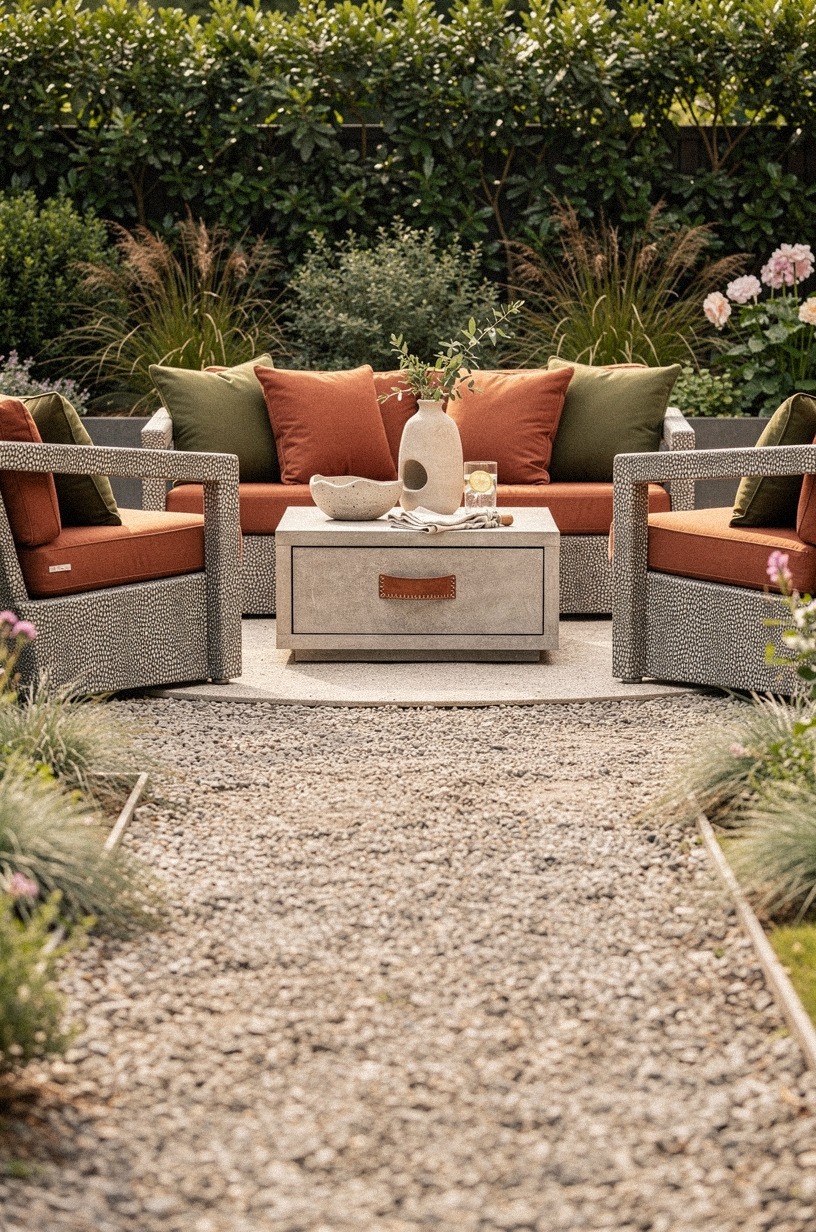
Scent is the most neglected sense in backyard design. Lavender, English lavender or phenomenal lavender for colder climates, planted in a line along the edge of the seating area releases its oil when brushed against. The scent should hit when people arrive, not when they're sitting.
Plant it along the path, not the chairs.
The line should be dense. Twelve to eighteen inches wide, plants spaced eight to ten inches apart.
Sparse lavender looks like an herb garden. Dense lavender looks like a hedge.
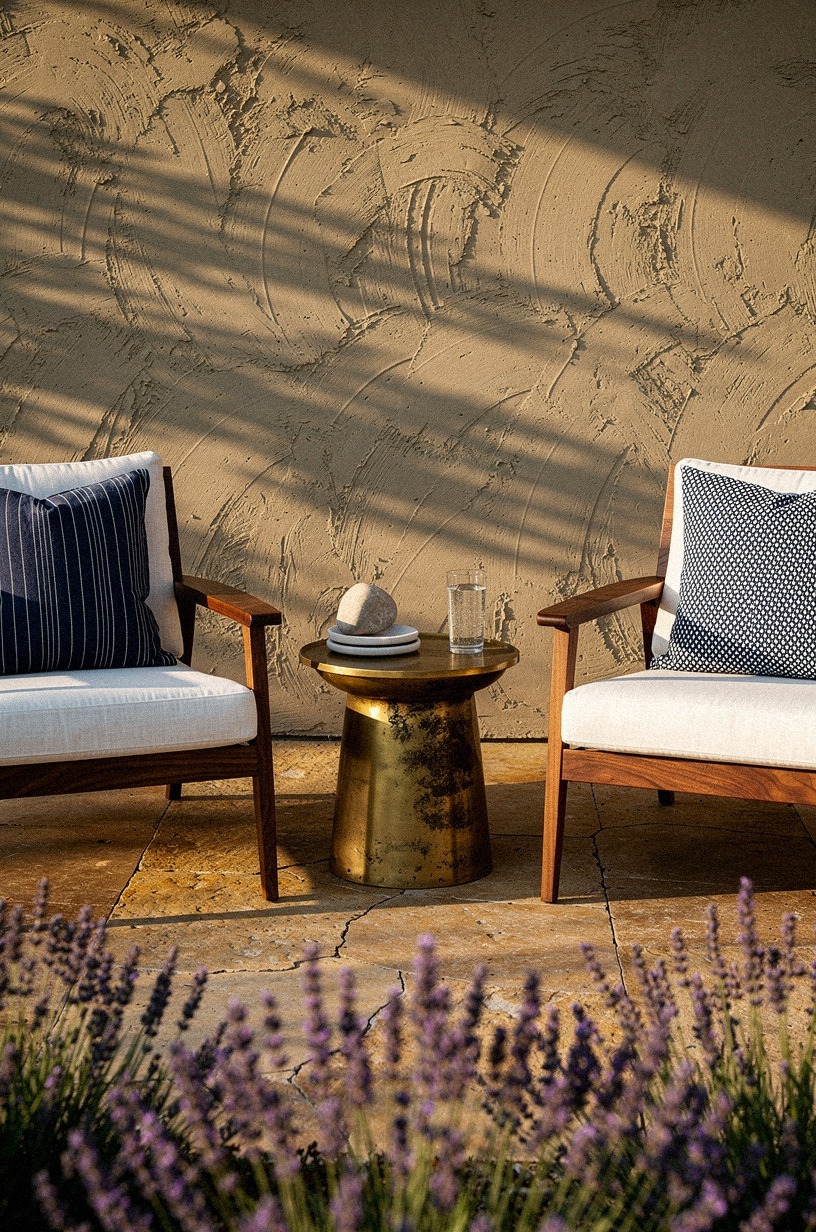
The flowers are a bonus, purple in June, silver-green the rest of the year, but the scent is the reason. A navy and white cushion on a walnut chair next to the lavender line creates a color story that feels coastal without being nautical.
The unlacquered brass side table with developing patina next to the chair catches the afternoon light and throws it back onto the lavender. The combination of warm metal, cool flower, and deep cushion is the kind of layering that reads as designed.
I brush the lavender with my hand when I walk past. The oil stays on my fingers for an hour. It's a small pleasure that costs nothing and happens every time.
12Lean a tall mirror against the fence to double the garden
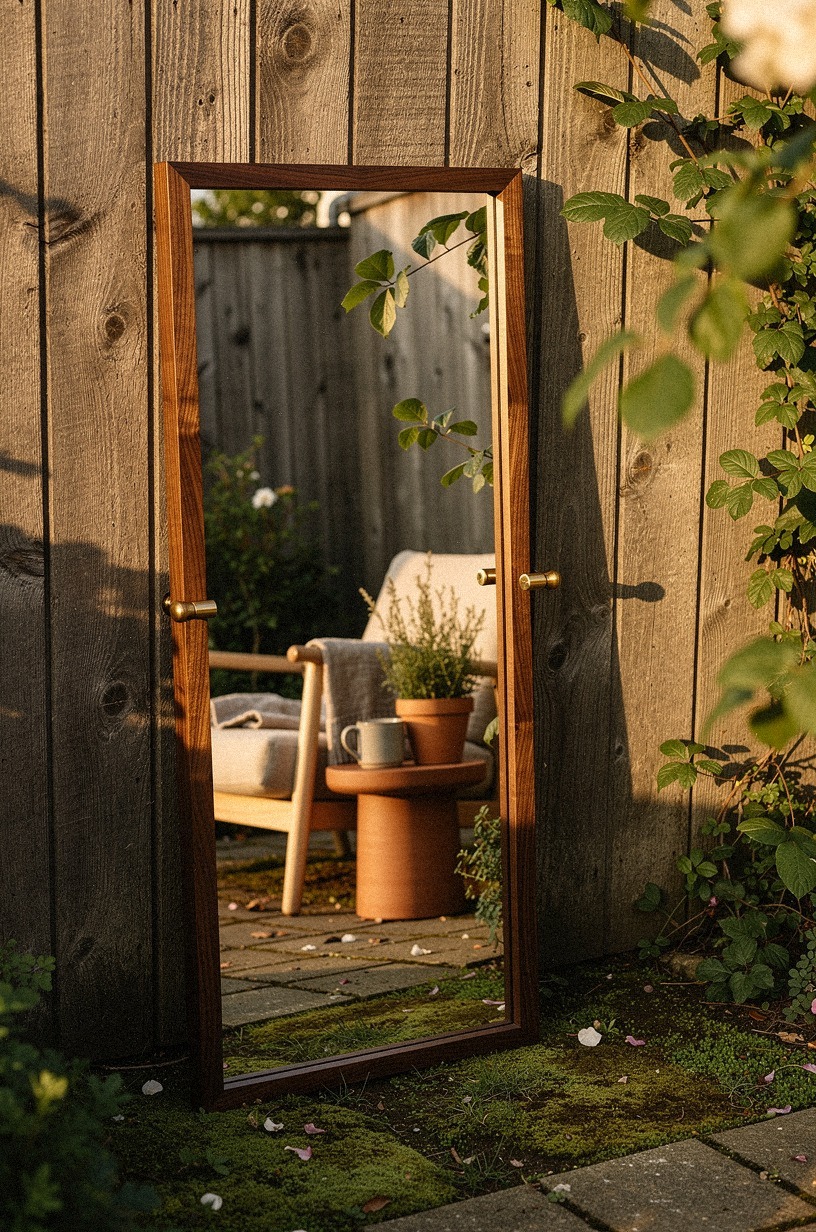
A mirror outdoors is unexpected. That's why it works.
A tall mirror, book-matched walnut frame, unlacquered brass arm catching afternoon light, leaned against a wooden fence reflects the garden back at itself. The space feels twice as deep.
The move is placement. The mirror should reflect green, not the house.
Angle it so it catches the planting bed, the tree canopy, or the sky. A reflection of the siding is a mistake.
The frame should be substantial. Two to three inches wide in solid wood.
A thin frame disappears. A thick frame reads as furniture.
The walnut should be oiled, not sealed, so it ages to a soft grey. The brass arm, a decorative hinge or bracket, should be unlacquered so it develops patina.
The combination of weathered wood and aged metal is the aesthetic.
A clay and linen cushion on a chair near the mirror extends the color palette into the reflection. The mirror doesn't just double the garden.
It doubles the color. I've seen setups where the mirror reflects a blank fence and it looks like a mistake.
Always check the reflection before you commit.
13Prop a folding screen to block the neighbor's view
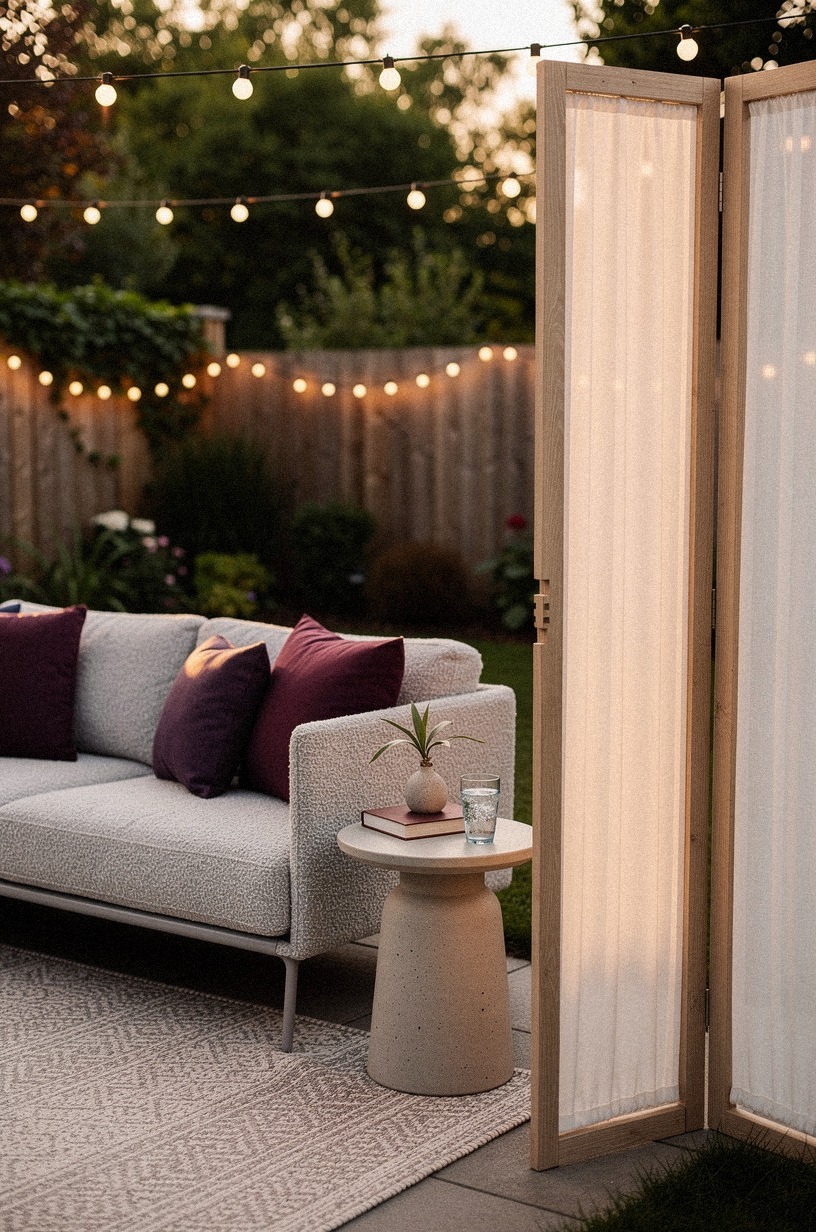
Privacy without a fence. A folding screen, three panels, each twenty-four to thirty inches wide, propped at an angle to the seating area blocks the sightline from the neighbor's deck without blocking the light. The screen should be white oak with an exposed dovetail joint visible at the corners.
The joint is the detail that makes it look built, not bought.
The panels can be solid wood, cane webbing, or linen stretched on a frame. Cane webbing filters light and creates shadow patterns on the ground. Linen blocks light and creates a backdrop.
Solid wood blocks everything. I prefer cane for afternoon seating and linen for evening.
The shadow patterns from cane are part of the atmosphere.
On the seating side of the screen, a plum and grey sofa with organic bouclé cushions creates a color story that feels rich without being dark. The plum picks up the warmth of the oak.
The grey keeps it grounded. A washed Belgian linen throw in warm white across the back of the sofa softens the line between furniture and screen. The screen isn't a wall.
It's a suggestion of a wall. That's the difference.
14Choose a single oversized sectional and skip the clutter
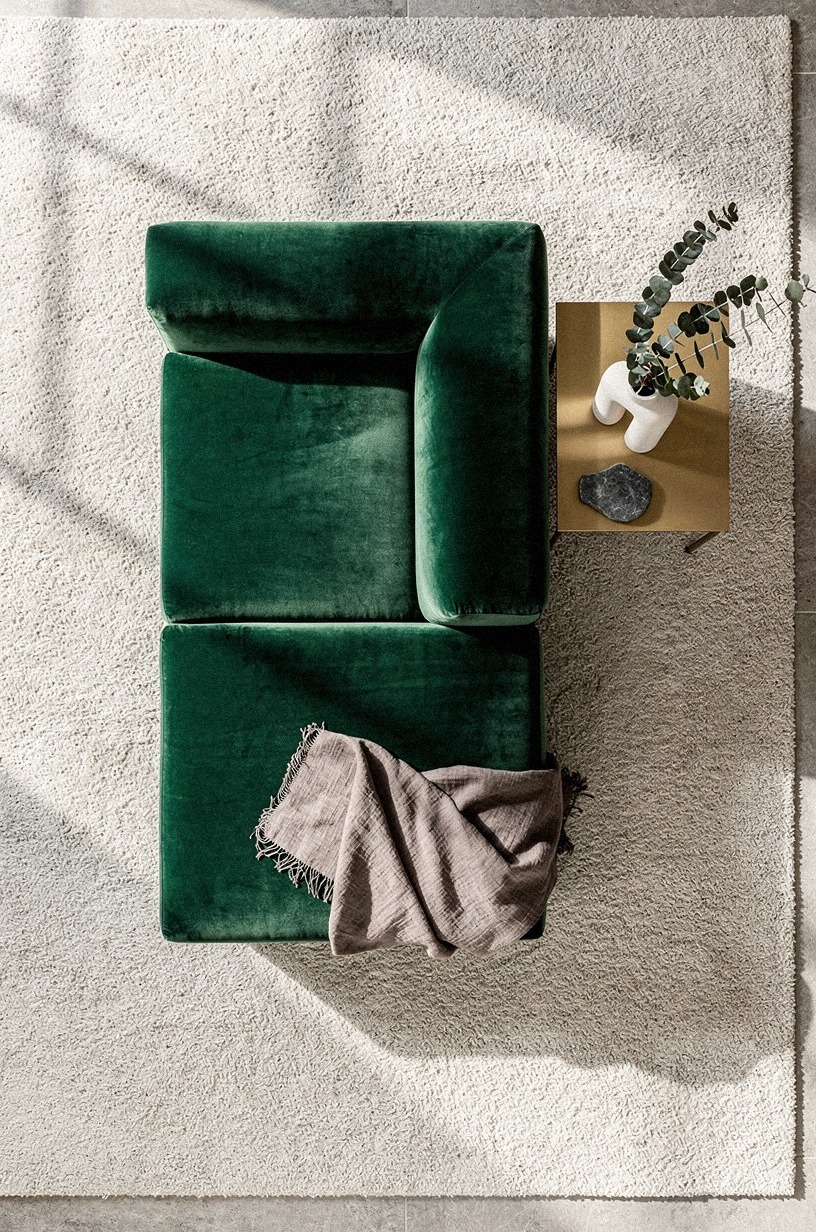
Sometimes the best choice is less. One oversized sectional, eight to ten feet long, deep enough to lie down on, replaces four chairs, a sofa, and a coffee table. The sectional should be emerald and cream in a deep-pile mohair velvet or performance linen.
The emerald is the color. The cream is the relief.
The combination reads as intentional, not accidental.
The sectional should float in the space. Not against the wall, not in a corner.
Floating. With a single gold side table, hand-hammered copper bowl on top, within arm's reach.
That's it. No coffee table, no rug, no extra chairs. The emptiness around the sectional is what makes it feel luxurious.
I've been in backyards where every inch is filled and it feels like a storage unit. Negative space is the most expensive material. Use it.
The sectional should face the view. Garden, fire pit, sunset.
Never the house. And it should be deep, thirty-six to forty inches, so people can sit with their legs curled under or lie flat.
A shallow sectional is a sofa. A deep sectional is a bed you don't sleep in.
That's the feeling you want.
15Add a rolling bar cart stocked for sundown cocktails
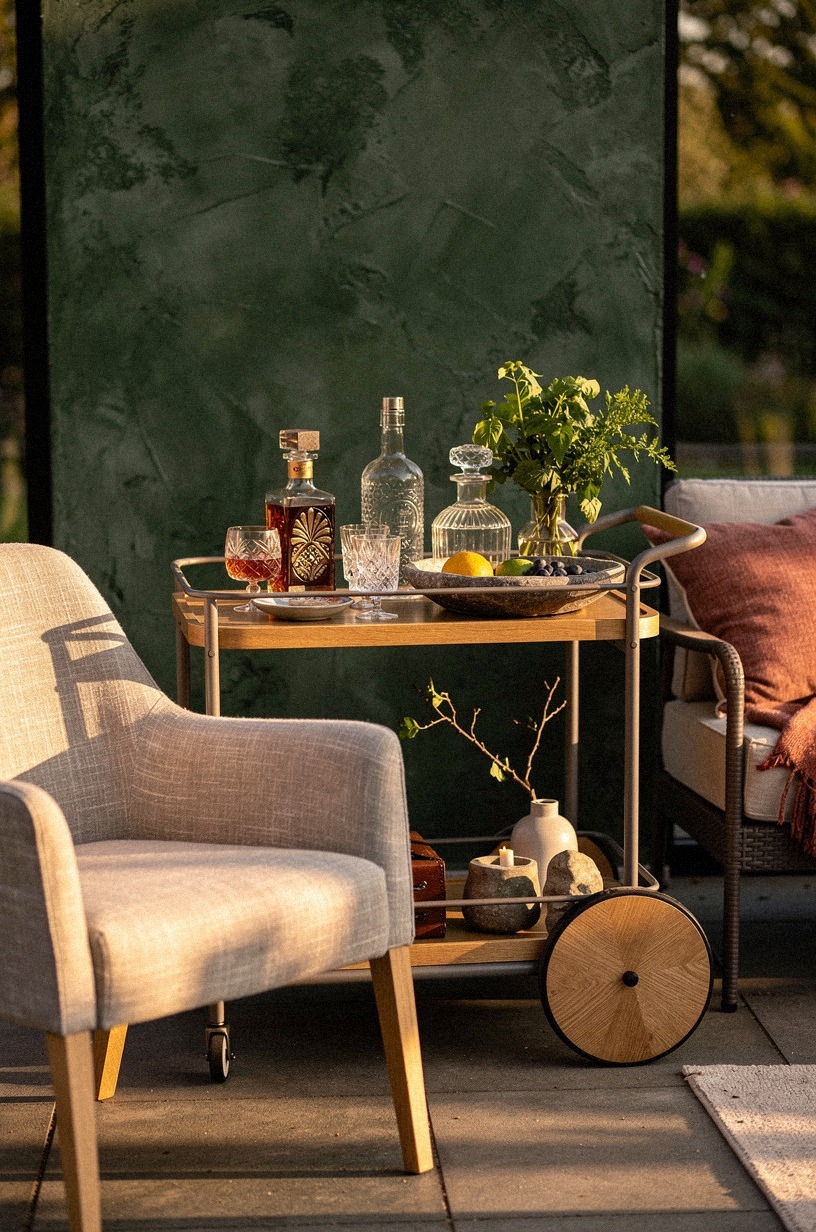
A rolling bar cart, brass frame, glass shelves, raw linen weave on the lower tier, next to the seating area signals that the evening has a plan. The cart should be stocked before guests arrive.
Not after. Gin, tonic, a bowl of limes, a pitcher of something pink.
The visual of a full cart is part of the hospitality. A cart you have to fill in front of people is a performance, not a welcome.
The cart should roll smoothly on cast iron wheels with rubber tread. Not plastic. Plastic wheels catch on gravel and scratch stone.
The hand-applied Venetian plaster wall behind the cart, if your patio has a wall, in forest green and rust creates a backdrop that makes the bottles glow. The green absorbs the light.
The rust warms it. The bottles become the decoration.
I keep a stack of linen coasters and a silver ice bucket on the lower shelf. The coasters are for guests who care about rings.
The ice bucket is for me, because warm gin is a crime. The cart should be close enough to reach from the sofa but not so close that it blocks the walkway. Three feet is the right distance.
16Build a low stone wall that doubles as extra seating
A low stone wall, eighteen to twenty inches high, twelve to fourteen inches deep, built around the edge of the seating area becomes a bench when chairs run out. The stone should be fieldstone or bluestone, not concrete block. The irregular edges of fieldstone make it comfortable to sit on without a cushion.
Concrete block requires a cushion, which means storage, which means hassle.
The wall should be long enough for three people. Six to eight feet minimum.
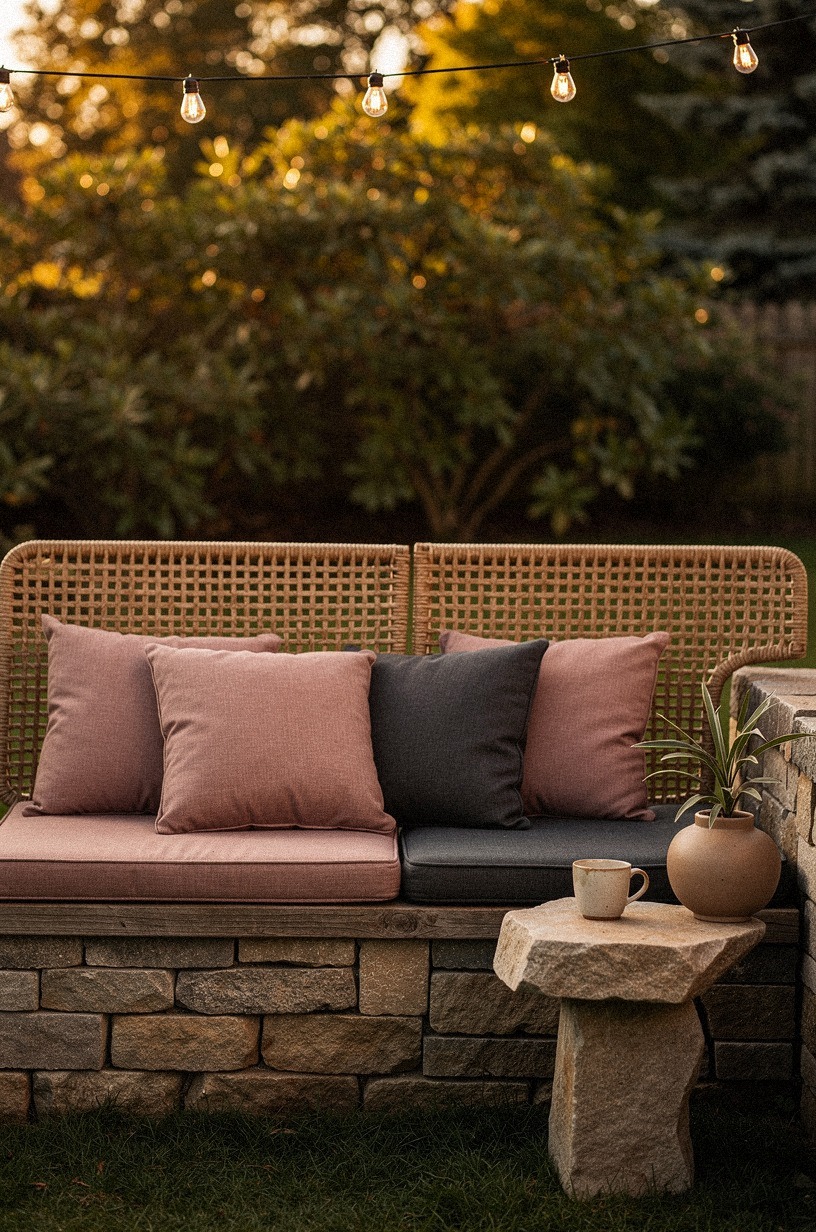
Shorter than that and it's a ledge, not seating. A reclaimed weathered teak cushion in dusty rose and charcoal on top of the wall softens the stone without hiding it.
The cushion should be outdoor-grade foam with a Sunbrella cover. Not a throw pillow.
A real cushion, four to six inches thick, that stays outside all season.
A wabi-sabi woven rattan backrest leaning against the wall behind the cushion gives people something to lean into. The rattan should be hand-woven, not machine-made.
The irregularities are the point. They catch the light and cast shadows that change throughout the day.
The wall isn't just seating. It's architecture that happens to be sit-able.
17Swap the coffee table for a vintage galvanized trough
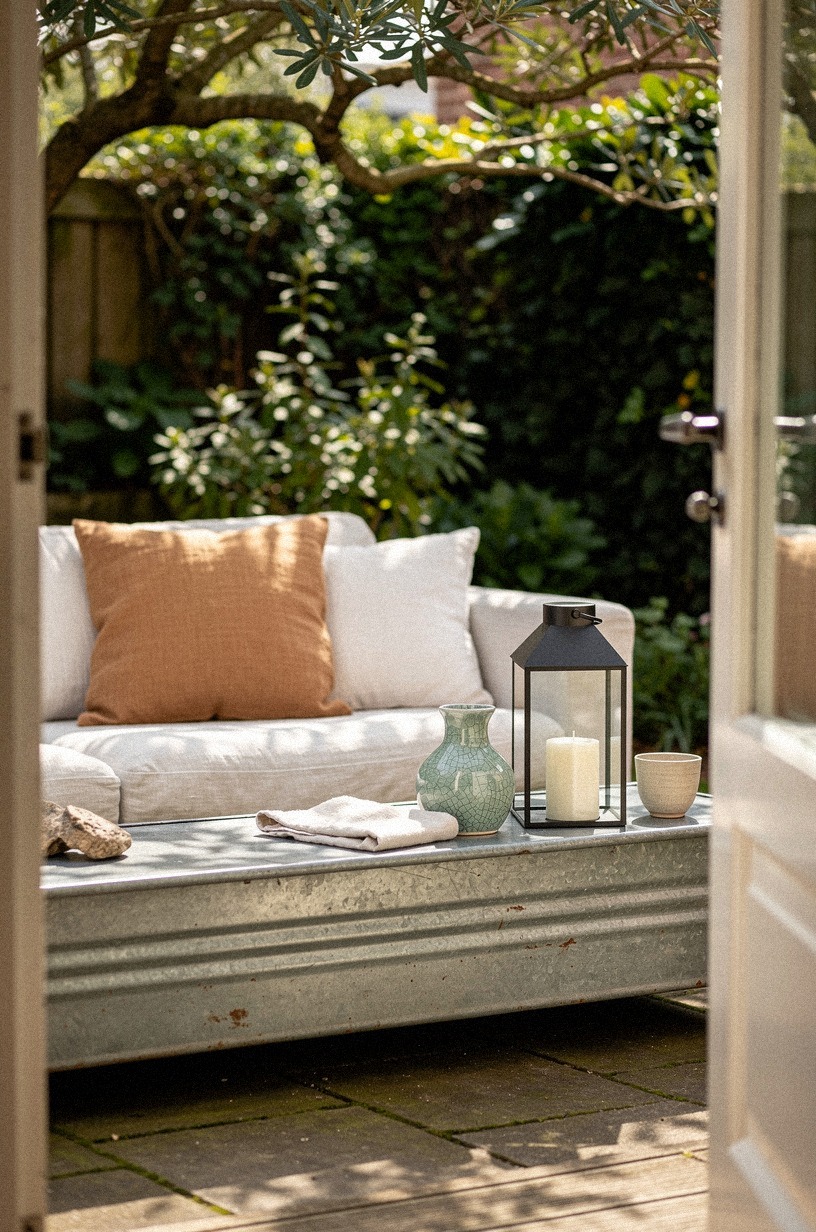
A vintage galvanized trough, the kind used for watering horses, filled with ice and bottles becomes a coffee table that works harder than any flat surface. The galvanized metal is already weathered.
The dents and scratches are the history. Don't polish them. The trough should be twenty-four to thirty inches long and twelve to sixteen inches wide.
Any larger and it dominates. Any smaller and it's a tray.
A washed Belgian linen sofa in warm white and camel next to the trough creates a palette that feels farmhouse without being themed. The cracked celadon glaze ceramic vessel on the edge of the trough, empty or holding a single stem, connects the metal to the garden. The celadon green picks up whatever planting is nearby.
In winter, the trough becomes a planter. Fill it with mums or ornamental kale. In summer, it's the bar.
The dual use is what makes it worth the space. A regular coffee table does one thing.
A trough does two. That's the math of small backyards.
Every object should earn its footprint.
18Why the best backyards feel discovered, not decorated
The backyards people remember have a quality that's hard to name but easy to recognize.
What does a backyard seating refresh actually cost?
Most people overestimate the cost of a comfortable backyard and underestimate the cost of a impressive one. The gap between those two is where the best work happens. Here's what the numbers look like in practice.
The budget tier is where I'd start if I were doing this for the first time. A $600 refresh, new pillows, a jute rug, string lights, and a chunky knit throw, changes the feeling of a backyard more than a $6,000 furniture set that arrives all at once. The reason is pacing.
A backyard that comes together over a season feels lived-in. A backyard that arrives in a truck feels like a showroom.
The mid-range tier is where most people end up after a few years of tinkering. A performance-fabric sofa at $1,200 to $4,000, a wool rug at $600 to $2,500, and an oak coffee table at $300 to $1,200.
These are investments, not splurges. The sofa should last ten years.
The rug should last fifteen. The table should last forever.
That's the math.
The high-end tier is for people who know what they want. Custom millwork, a built-in fireplace, bluestone paving.
These projects start at $12,000 and climb fast. The fireplace alone, masonry, flue, hearth, can run $8,000 to $15,000.
But it's also the single addition that changes how you use the backyard. A fireplace makes November possible.
Without it, you're packing up in September.
The honest answer to "how much" is that the money matters less than the sequence. Spend $300 on the right things, seating position, lighting, texture, and the backyard feels complete.
Spend $3,000 on the wrong things, a matching set, a too-large umbrella, a water feature nobody asked for, and it feels empty. Start with the circle.
Everything else follows.
What People Always Want to Know
What is the best backyard seating for a small space?
A single oversized sectional and a low stone wall for overflow seating. The sectional does the work of four chairs without the visual clutter. The wall gives you extra spots when people come over.
In a small backyard, every piece should do at least two jobs. A Target Threshold sectional in a performance fabric works well at this scale.
The key is depth, thirty-six inches minimum, so the piece feels generous even in a tight space.
Where can I buy backyard seating pieces on a budget?
IKEA for the basics: APPLARO folding chairs, RUNNEN deck tiles, GURLI throws. Wayfair for mid-range sofas and sectionals, search "performance fabric" and filter by depth.
Facebook Marketplace for the finds: vintage galvanized troughs, teak benches that need refinishing, mirrors with good frames. The best pieces in my backyard came from Marketplace, not stores.
A $30 trough and a $15 mirror changed the space more than any retail purchase.
How much does a backyard seating makeover cost?
A refresh with pillows, throws, and lights runs about $300 to $1,200. A mid-range setup with a quality sofa, rug, and lighting lands around $2,500 to $8,000.
A full custom build with millwork and a fireplace starts at $12,000 and climbs. The free moves, rearranging what you own, pruning for sightlines, brushing the lavender, often matter more than the expensive ones.
Start with the free stuff. You'll be surprised how far it goes.
Can I create a cozy backyard seating area on a budget?
Yes, and the cheap moves are often the best ones. Rearrange your chairs into a circle. Hang string lights you already own.
Drape a chunky knit throw over every seat. Plant lavender from nursery stock, $4 a plant, six plants, $24 total.
The terracotta pot side table costs less than $30. The mirror from your bedroom, leaned against the fence, costs nothing. The budget isn't the constraint.
The willingness to try is.
Is a backyard seating area worth it in a small space?
Worth it. A small backyard forces good decisions. You can't hide bad choices behind square footage.
Every piece has to earn its place. A small space also feels intimate faster.
A circle of four chairs in a twelve-by-twelve patio feels like a room. The same circle in a forty-by-forty yard feels lost. The constraint is the feature. Small backyards are the reason the best outdoor seating ideas exist.
Is a backyard seating area a good idea for a rental?
Yes, if you choose removable everything. A folding screen instead of a fence.
A rolling bar cart instead of a built-in bar. Layered rugs instead of poured concrete. String lights on hooks that unscrew.
The daybed floats, so it leaves no mark. The mirror leans, so it needs no hardware.
When you move, you pack the atmosphere and take it with you. The next tenant gets a blank patio. You get a head start on the next one.
Where I'd Start First
If I had to pick one, I'd start with the seating circle. You can't layer warmth on top of a broken layout, the throws, the lights, the lavender will all fight the geometry instead of building on it.
Get the chairs facing each other first. Everything else lands.
Pin the fire pit idea for later and check out our cozy rustic backyard ideas for a warm lived-in look if you want the same feeling with a rougher edge.