
 by
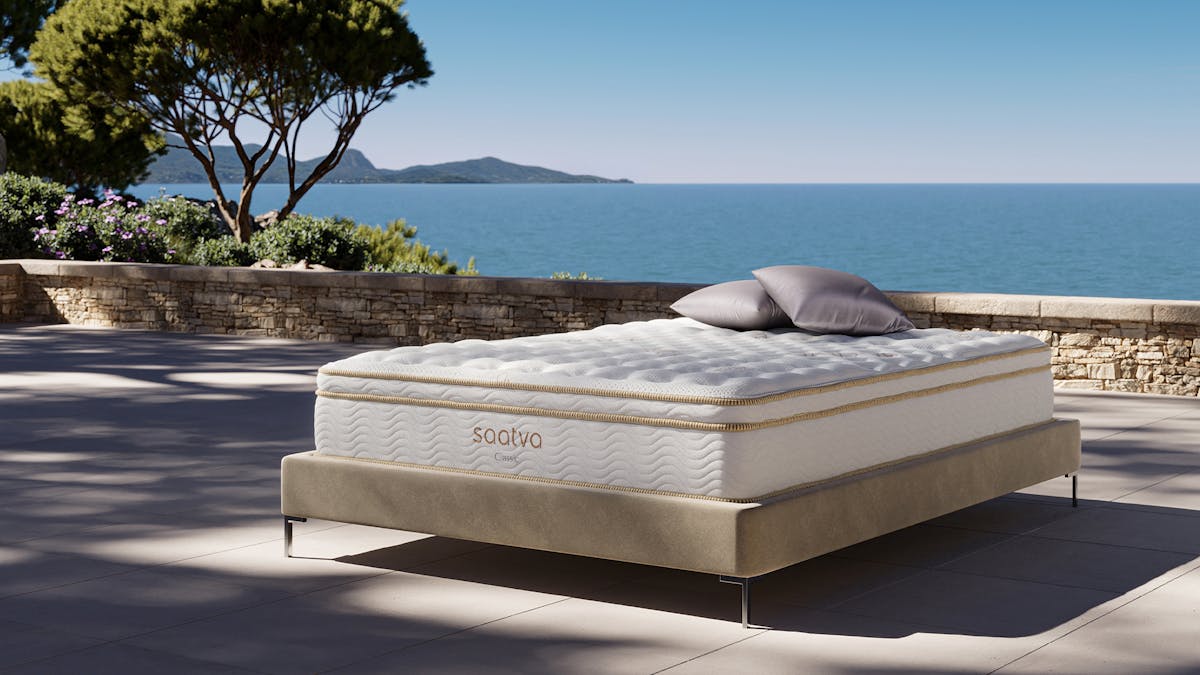
by Hybrid construction means a pocketed coil support core topped with foam or latex comfort layers. The Saatva Classic is the clearest benchmark for quality coil-on-coil hybrid engineering: dual tempered-steel coil tiers, zoned lumbar reinforcement, and organic cotton cover, with a 365-night trial and lifetime warranty. The Amerisleep AS3 Hybrid is the best foam-over-coil hybrid for pressure relief with outstanding motion isolation.
Saatva Classic
9.4/10
- Coil-on-coil: 884 individually wrapped comfort coils over 416 tempered base coils (queen)
- Zoned lumbar foam pad in the center third for targeted back support
- Outstanding edge support (10/10 lab score), perimeter coils hold firm
- Free white-glove delivery with in-room setup and old mattress removal
- 365-night trial, lifetime warranty, ships uncompressed, zero off-gassing
- Moderate motion isolation, coil bounce transfers partner movement
- $99 return fee applies during the trial window
- Heavy (approx. 110 lb queen) and difficult to move or rotate solo
The Saatva Classic is the most direct demonstration of quality hybrid engineering: two coil tiers with different gauges, a dedicated lumbar reinforcement zone, and an organic cotton cover, all the construction details this guide covers, executed at a high standard.
The layer architecture of a hybrid mattress
A hybrid mattress is defined by one thing: a pocketed coil support core topped with foam or latex comfort layers. Everything else, the number of layers, the foam densities, the coil gauge, the transition construction, is where quality diverges sharply. Here is how each layer works and what the specs actually mean.
Layer 1: The cover and quilted panel
The surface cover is typically a woven or knit fabric, Tencel, organic cotton, or a performance polyester blend. Many mid-to-premium hybrids add a quilted panel: a thin layer of foam sewn into the cover that affects the initial feel before the comfort layers engage.
Cover quality signals: fiber type matters more than thread count. Tencel wicks moisture well. Organic cotton breathes. Performance polyester is durable but retains more heat. The Saatva Classic uses an organic cotton quilted pillow top with Guardin antimicrobial treatment. The Amerisleep AS3 Hybrid uses a removable zippered cooling refresh cover.
Layer 2: Comfort layers (2 to 4 inches total)
Comfort layers sit above the coils and provide contouring and pressure relief. Common materials:
- Memory foam (viscoelastic): High contouring, slow response, temperature-sensitive. Density should be 4.0 lb/ft or higher in quality hybrids.
- Polyfoam (high-resilience): Springs back immediately, more breathable than memory foam. Common in medium-firm and firm hybrids.
- Latex (natural or synthetic): Highly resilient, durable, naturally breathable. Talalay is softer and more consistent; Dunlop is denser and firmer. Used in premium hybrids like the Saatva Latex Hybrid and PlushBeds Botanical Bliss.
- Transitional foam: A denser 1 to 2 inch polyfoam layer between the comfort foam and the coils, preventing coil feel-through as the comfort layer thins over years.
Total comfort layer thickness: 2 inches is minimal. 3 inches is standard. 4 or more inches is characteristic of plush and luxury models.
Layer 3: The pocketed coil core (6 to 8 inches)
Pocketed coils, also called wrapped coils or Marshall coils, are individual springs wrapped in fabric pockets. Each pocket compresses independently, which is why hybrids isolate motion better than traditional innersprings.
Coil gauge
Gauge is the wire thickness. Lower gauge means thicker wire and a firmer coil. Typical range in hybrids:
| Gauge | Wire thickness | Feel | Typical use |
|---|---|---|---|
| 12 gauge | Thickest | Very firm | Orthopedic, firm models |
| 13 to 14 gauge | Medium | Firm to medium | Standard support cores |
| 15 to 16 gauge | Thin | Soft, bouncy | Plush models, transition zones |
The Saatva Classic uses 14.5-gauge comfort coils (884 queen) over 13-gauge base coils (416 queen), a deliberate gauge pairing that produces a graduated compression response.
Coil-on-coil construction
Some premium hybrids use two coil tiers rather than one. The Saatva Classic uses a full-gauge tempered base coil for primary support, while a second tier of individually wrapped comfort coils above provides a graduated second compression stage. This creates a more responsive feel than a single-tier coil system at the same gauge.
Layer 4: Base foam
Below the coils, 1 to 2 inches of high-density polyfoam provides a stable foundation and protects the coil system from the platform surface. In lower-cost hybrids, this layer is thin and compresses quickly.
What separates a quality hybrid from a cheap one
Five construction differences account for nearly all the performance and longevity gap between a $400 hybrid and a $1,500 one:
- Comfort layer density: 4.0 lb/ft or higher for memory foam versus 2.0 to 3.0 lb/ft in budget builds. The difference appears in years 3 to 5 as cheap foam craters and develops body impressions.
- Coil gauge and steel quality: Dual-tempered, high-carbon steel versus standard wire. Quality coils support a full seated position without significant deflection at the edge.
- Transition layer presence: Without a denser transitional foam between the comfort layer and the coils, coil feel-through accelerates as the comfort foam thins. This is the most common failure point in mid-range hybrids by year 4.
- Cover construction: Quilted panel versus a simple woven top. The Saatva Classic quilted euro pillow top is stitched, not bonded.
- Edge support system: Encased perimeter coils or a foam rail. Absent in nearly all budget hybrids, present in quality ones.
Why hybrids sleep cooler than all-foam
The pocketed coil core creates continuous passive airflow: air moves freely between coil pockets and through the base, forming a ventilation channel beneath the comfort layers. This is why even a hybrid with no gel infusion in the comfort foam typically sleeps cooler than a comparable all-foam mattress. The Saatva Classic runs at about 89.5 degrees F surface temperature in lab testing. The AS3 Hybrid ended sleep simulation at 79.9 degrees F. Both outperform all-foam builds on thermal neutrality without relying on active cooling additives.
Hybrid versus all-foam: where each wins
| Attribute | Hybrid (coil+foam) | All-foam |
|---|---|---|
| Cooling | Better, coil airflow | Relies on foam additives |
| Edge support | Better, perimeter coils | Foam rail only, compresses over time |
| Motion isolation | Good (pocketed coils) | Better, foam absorbs transfer |
| Durability | Better, coil core lasts 10-15 years | Foam degrades faster without coil support |
| Responsiveness | Better, coil bounce aids repositioning | Slow recovery |
| Pressure relief | Good, depends on comfort layer | Excellent, foam conforms to body curves |
| Noise | Minimal (pocketed coils) | Silent |
For most adults, hybrid is the safer default, particularly for hot sleepers, people who sit on the edge of the bed, and those who share a bed and change positions frequently.
Best hybrid mattresses by construction type
PlushBeds Botanical Bliss
9.1/10
- GOLS-certified organic Dunlop latex comfort layers (3 to 6 inches configurable)
- Pocketed coil base (8 inches) with encased perimeter for strong edge support
- GOTS-certified organic cotton cover and organic wool fire barrier
- Adjustable firmness: swap latex layers at home
- 25-year warranty, made in California
- Heavier than foam-over-coil competitors due to natural latex density
- Higher price point than comparable non-organic hybrids
The Botanical Bliss demonstrates latex-over-coil construction at its best: certified organic latex that resists compression over time, a durable coil base, and a fully organic cover. The adjustable firmness system is a genuine differentiator for couples or sleepers whose preferences change.
Puffy Lux Hybrid
8.8/10
- Cloud-infused memory foam comfort layer with cooling gel beads
- Individually wrapped coil support core (1,000+ queen) with zoned support
- Lifetime warranty, ships compressed in a box for easy delivery
- Strong motion isolation for a coil-based mattress
- Softer feel than competitors at the same price point, heavier sleepers over 250 lb may want a firmer build
- Edge support softer than perimeter-coil designs
The Puffy Lux Hybrid delivers foam-in-a-box convenience with the longevity benefits of a coil core. The cloud foam comfort layer works well for side sleepers and couples; the coil base adds airflow and durability that all-foam designs miss.
Amerisleep AS3 Hybrid
9.2/10
- 3 inches of Bio-Pur foam comfort layer (4.0 PCF density) over 8-inch pocketed coil core
- Outstanding motion isolation (10/10 lab), 49% better than average, ideal for couples
- Excellent cooling performance and strong edge support (9.6/10)
- 20-year warranty, CertiPUR-US certified, made in the USA
- Off-gassing can take up to 8 days, longer than the hybrid average
- Thinner comfort layer than luxury competitors; heavier sleepers over 300 lb may prefer a firmer model
The AS3 Hybrid shows how quality foam-over-coil construction differs from budget alternatives: high-density Bio-Pur foam that holds its shape past year 3, reinforced perimeter coils that hold at the edge, and a coil core that delivers actual airflow rather than relying on gel additives.
Quality hybrid construction means dual-tempered coils with adequate gauge, a comfort layer at 4.0 PCF or higher, a transition layer, encased perimeter coils, and a cover that is stitched not glued. The Saatva Classic is the benchmark for coil-on-coil construction; the PlushBeds Botanical Bliss leads in organic latex-hybrid; the Amerisleep AS3 Hybrid delivers outstanding motion isolation and cooling in the foam-over-coil category.
Frequently asked questions
How many coils should a good hybrid mattress have?
Coil count matters less than coil gauge and steel quality. For a queen, 800 to 1,000 quality pocketed coils is a solid specification. Higher coil counts with thin-gauge wire do not outperform lower counts with quality-gauge wire on either support or durability.
What is coil-on-coil construction?
Two coil layers: a full-gauge base coil providing primary support, and a smaller comfort coil directly above providing a second compression stage. The Saatva Classic uses this construction, 13-gauge base coils under 14.5-gauge comfort coils, for a more graduated, responsive feel than a single coil tier.
How thick should a hybrid mattress be?
Quality hybrids are typically 12 to 15 inches total: 1 to 2 inches base foam, 6 to 8 inch coil core, 3 to 4 inches comfort layers, 1 inch quilted cover. Thinner than 11 inches on a hybrid usually indicates cost-cutting on coil height or comfort layer depth.
Do hybrid mattresses sag more than innerspring?
The coil core of a quality hybrid is as durable as a traditional innerspring. Sagging in hybrids typically occurs in the comfort foam layers above the coils, which is why comfort layer density is the most important quality indicator for long-term performance.
Is a hybrid mattress better than memory foam for back pain?
Both can work well for back pain. Hybrids have an edge on edge support and cooling; all-foam has an edge on motion isolation and deep contouring. For most back pain sufferers, a zoned hybrid like the Saatva Classic (lumbar pad) or Amerisleep AS3 Hybrid addresses lumbar support more directly than an unzoned mattress of either type.