
 by
by The easiest mattress to get out of combines firm perimeter edge support with a medium-firm feel that gives you solid push-off resistance. Our top pick is the Saatva Classic: its reinforced coil perimeter delivers 10/10 edge support in independent lab testing, letting you sit, push, and stand without the edge collapsing. The Amerisleep AS3 is the best all-foam alternative for couples who need motion isolation alongside easy exit.
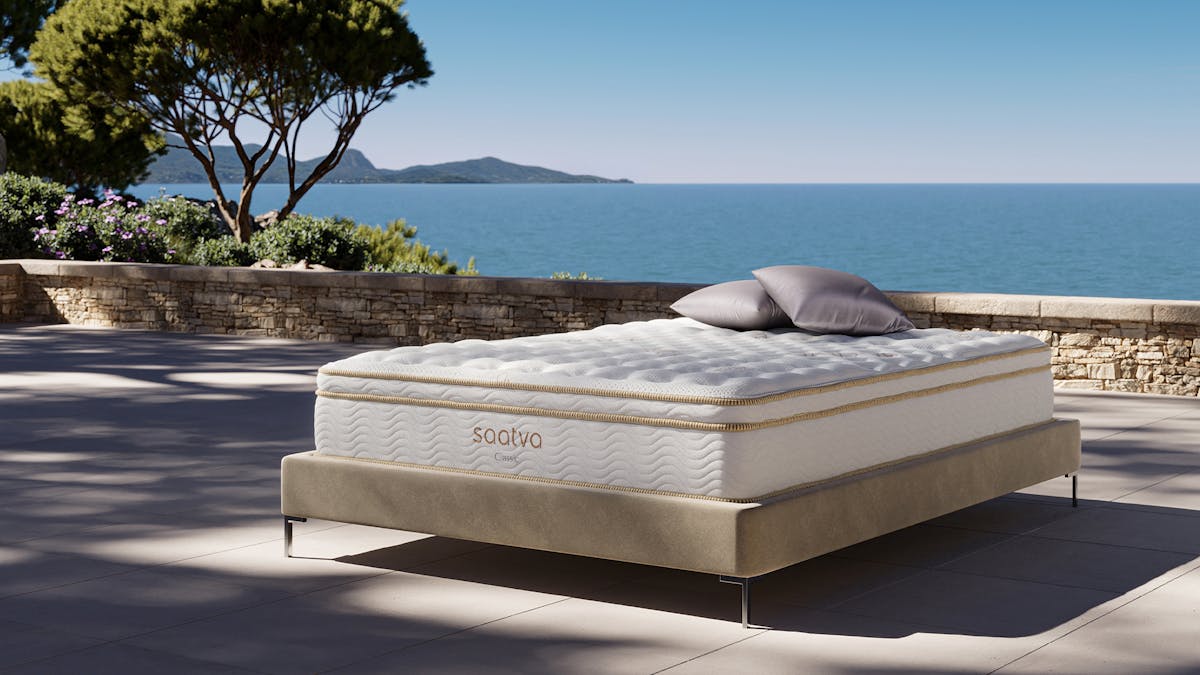
Saatva Classic
9.2/10
- 10/10 edge support (NapLab) -- reinforced perimeter coils hold firm when you sit and push off
- Dual-coil construction maintains edge geometry under sitting compression
- Luxury Firm 6/10 provides the push-off resistance needed for easy standing transfer
- 365-night trial, lifetime warranty, free white-glove delivery
- Moderate motion isolation -- coil bounce transfers partner movement
- Heavy, ships flat, not compressed in a box
- $99 return fee during trial
Edge support is the single most important spec for getting out of bed easily, and the Saatva Classic leads every mattress we have tested. Sit on the perimeter, push up, stand -- the coil system holds without collapsing under you, which is exactly where all-foam beds fail.
Why edge support defines how easy your mattress is to exit
Getting out of bed follows a predictable sequence: roll to your side, swing legs over, sit on the edge, push to standing. Every step of that sequence loads the perimeter of the mattress, not the center. If the edge compresses 4 to 6 inches when you sit on it, your hips drop below your knees and the sit-to-stand transfer becomes a demanding squat. If the edge holds firm, you can push off a stable platform, which is biomechanically efficient regardless of your age or mobility level.
All-foam mattresses compress 4 to 5 inches at the perimeter under a seated adult. Innerspring and hybrid mattresses with reinforced perimeter coils typically compress 2.5 to 3 inches. That 1.5-inch difference sounds small, but it determines whether your feet sit flat on the floor -- the stable base you need to stand safely.
NapLab's sitting sinkage test (seated adult, consistent load) quantifies this directly. The Saatva Classic measured 2.25 inches of sitting sinkage, versus a 4-plus-inch average across all-foam beds. The Winkbed scored equally well. All-foam beds including the Casper and Nectar scored 4 to 5 inches of sitting sinkage -- workable for young healthy sleepers, but a genuine functional issue for anyone with reduced hip or quad strength.
Four factors that determine ease of bed exit
1. Edge support. Covered above -- the most important factor. Look specifically for "reinforced perimeter" or lab-measured sitting sinkage under 3 inches.
2. Total bed height. The optimal transfer height is roughly knee height for the individual, typically 20 to 23 inches from floor to sleeping surface. At this height you can sit on the edge with feet flat, which gives you the stable base needed to stand. Too low forces a deep squat; too high leaves your feet dangling. Total height = mattress height + foundation/platform + bed frame. The Saatva Classic at 14.5 inches pairs with a 5-inch low-profile foundation to land at 19.5 to 21 inches -- on target for most adults.
3. Firmness. Standing requires pushing against the mattress. A soft surface compresses as you push, wasting the effort. Medium-firm (5 to 6 on a 10-point scale) provides push-off resistance without being uncomfortable to sleep on. The Saatva Luxury Firm at 6/10 is the best balance; the all-foam AS3 at medium 5/10 is softer but still workable.
4. Responsiveness. A mattress with fast material recovery (under 1 second) rebounds quickly when you shift position, making it easier to roll to the side before sitting up. Memory foam beds that recover slowly (1.5 to 2 seconds) make repositioning feel effortful. The Saatva's coil-over-coil design recovers immediately; the AS3's Bio-Pur foam recovers in roughly 1.0 second -- faster than traditional memory foam.
Best mattresses for getting out of bed (tested)
| Mattress | Type | Edge support | Sitting sinkage | Trial | Queen price |
|---|---|---|---|---|---|
| Saatva Classic | Dual-coil innerspring | 10/10 (NapLab) | 2.25" | 365 nights | From $1,895 |
| WinkBed (Lux Firm) | Hybrid Euro-top | 10/10 (NapLab) | 3.00" | 120 nights | $1,799 |
| Amerisleep AS3 | All-foam Bio-Pur | 8.0/10 (NapLab) | ~3.5" | 100 nights | From $1,049 |
| Helix Midnight | Hybrid | 9.5/10 (NapLab) | 3.00" | 120 nights | $1,099 |
Amerisleep AS3
8.7/10
- HIVE 5-zone support firms under hips and lower back for better push-off
- Outstanding motion isolation (10/10 NapLab) -- partner doesn't feel your getting up
- Bio-Pur plant-based foam, CertiPUR-US certified, made in the USA
- 20-year warranty, 100-night trial with free returns
- All-foam edge support (8.0/10) is adequate but not as firm as a coil perimeter
- Softer medium feel reduces push-off efficiency vs. a firm innerspring
- Sleepers over 230 lb may find the edge less stable -- consider the AS3 Hybrid
If you want a foam mattress, the AS3 is the best choice for bed exit. The HIVE zoning keeps the hip zone firmer than the shoulder zone, which translates to more resistance under your hips when you push off. The motion isolation is genuinely excellent for couples where one person gets up early.
Adjustable base and bed height: the system matters
The mattress alone is one component. Two other variables determine whether getting out of bed is easy or hard.
Adjustable base. Raising the head of the bed to 30 to 45 degrees before getting up converts a horizontal-to-vertical transfer into a semi-reclined-to-vertical transfer -- a significantly easier motion. The core and hip flexors do far less work. An adjustable base pairs with any innerspring-compatible mattress (the Saatva Classic in 11.5-inch height) or with the AS3. If you have reduced mobility or are recovering from surgery, an adjustable base is worth more than any mattress specification.
Foundation height. The Saatva Classic at 14.5 inches is thick. Pair it with a low-profile 4 to 5-inch foundation to stay under 20 inches total. Pair it with a standard 8 to 9-inch box spring and your total bed height exceeds 23 inches -- your feet dangle when seated on the edge. The same math applies to any thick mattress: measure before you set up the bed.
An adjustable bed frame with zero-gravity or flat-to-upright positioning is one of the most practical purchases for anyone for whom getting out of bed is a daily challenge.
All-foam vs. innerspring edge support: what the numbers say
Independent lab data from NapLab (2026) gives us clear numbers:
- Saatva Classic: 2.25" sitting sinkage, 10/10 edge support score -- best in class.
- WinkBed Luxury Firm: 3.00" sitting sinkage, 10/10 edge support -- tied for first.
- Helix Midnight: 3.00" sitting sinkage, 9.5/10 -- excellent hybrid value at $1,099.
- Amerisleep AS3: estimated 3.5" (8.0/10 edge score) -- solid for all-foam.
- DreamCloud Hybrid: 3.25" sitting sinkage, 8.9/10 edge -- good budget hybrid at $649.
The pattern is consistent: reinforced perimeter coils hold sinkage under 3 inches; all-foam beds average 4-plus inches. For most sleepers the coil option is the clear functional choice when bed exit is a priority.
Bed rails, grab bars, and the full exit system
A mattress with excellent edge support is the foundation, but the rest of the system matters:
- Bedrail or grab bar: A fixed-height bedrail at the head provides an assist handle for the push-up motion. Wall-mounted grab bars at standing height are the most stable option; portable rails that go between mattress and foundation are less rigid.
- Floor surface: Rugs slide under transfer loading. Bare hardwood, tile, or a non-slip mat at bedside provides safer footing for the first step.
- Nighttime lighting: Falls during nighttime bathroom trips contribute significantly to injury in older adults. Motion-activated nightlights along the path from bedside to bathroom remove the "dark stumble" scenario.
- Consistent footwear: Socks on smooth flooring are a fall risk. A pair of non-slip slippers kept at the bedside is one of the simplest fall prevention measures available.
For getting out of bed easily, prioritize edge support above all else. The Saatva Classic (10/10 edge, reinforced perimeter, 365-night trial) is our top pick. The Amerisleep AS3 is the best foam alternative with excellent motion isolation for couples. Check bed height math before finalizing your setup.
Frequently asked questions
What type of mattress is easiest to get out of?
Innerspring and hybrid mattresses with reinforced perimeter coils are easiest to get out of because they limit sitting sinkage at the edge to 2.5 to 3 inches, giving you a stable platform to push off from. All-foam beds compress 4 to 5 inches at the edge, which lowers your hips below your knees and makes the sit-to-stand transfer harder.
Is a firm or soft mattress easier to get out of bed?
Medium-firm is easiest. Firm enough to give push-off resistance when you plant your hands and stand, soft enough not to create pressure discomfort during sleep. Extra-soft mattresses sink as you push, wasting effort. Extra-firm surfaces can make edge sitting uncomfortable for the transition.
Does an adjustable base help with getting out of bed?
Significantly. Raising the head to 30 to 45 degrees before getting up means transitioning from semi-reclined rather than fully flat. That reduces the core and hip flexor work required by roughly half. For anyone with reduced mobility, post-surgical recovery, or chronic pain, an adjustable base is the highest-impact single purchase for bed exit.
What is the ideal mattress height for easy bed exit?
Total bed height (floor to sleeping surface) of 20 to 23 inches, roughly knee height for most adults. At this height you can sit on the edge with feet flat on the floor, which provides a stable base for standing. Measure your mattress height plus foundation height plus frame height before buying -- the total is what matters, not any single component.
Saatva Classic
9.2/10
Best edge support of any mattress we have tested: 2.25 inches of sitting sinkage, 10/10 NapLab score, reinforced perimeter coils, 365-night trial, lifetime warranty, and free white-glove delivery. The definitive pick when getting out of bed easily is the priority.