
 by
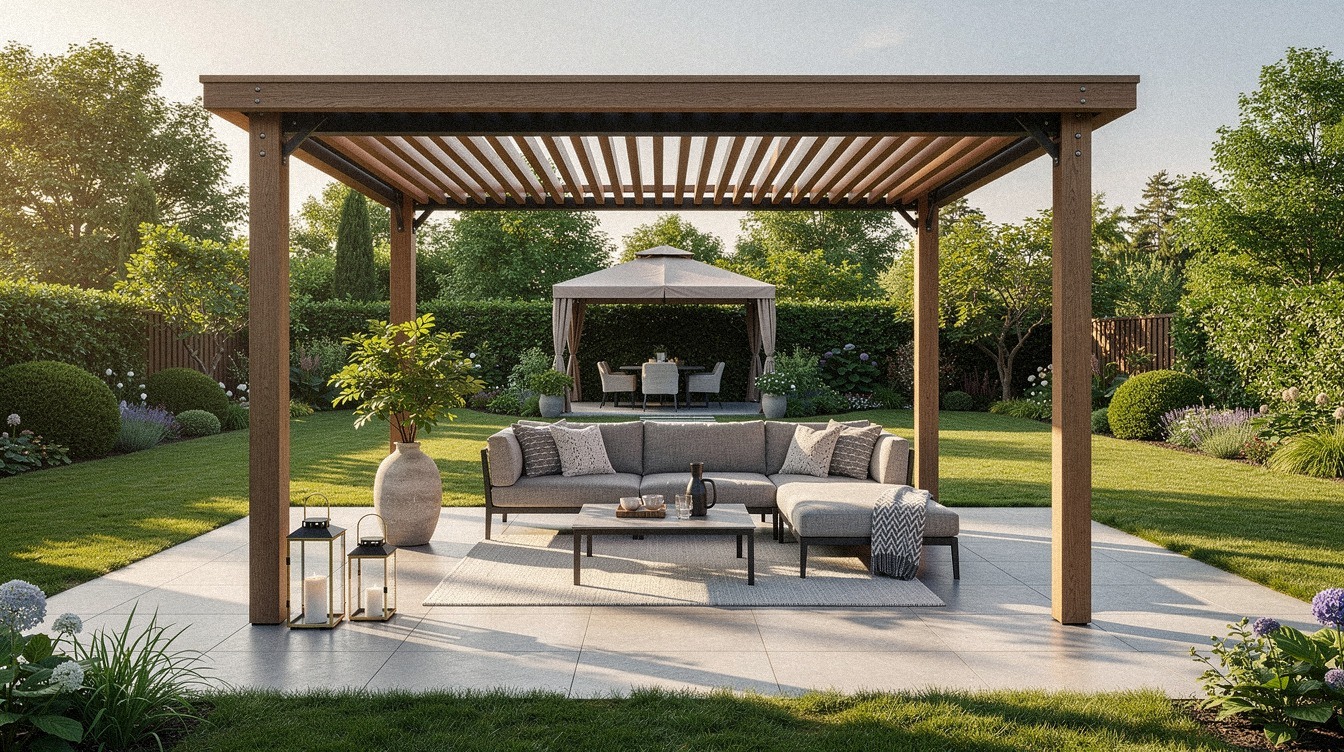
by Pergola vs gazebo comes down to this: pick a pergola if you want air, light, and a patio extension, and pick a gazebo if you want a defined room with real cover. I learned that the hard way after treating them like the same thing and wondering why my own backyard never felt settled. One gave me flow. The other gave me finish. If your yard feels close but not right, that difference is probably what you're missing.
- Extend the patio with a slatted pergola
- Crown the dining pad with a cedar gazebo
- Frame the sofa zone under freestanding rafters
- Curtain a pergola corner for soft shade
- Screen a gazebo wall with climbing vines
- Match the porch roofline beside the door
- Float a fire table beneath open beams
- Wrap string lights around chunky gazebo posts
- Build a garden room with lattice sides
- Should you add a ceiling fan under the pergola?
- Panel the patio with clear weather screens
- Anchor the lawn with a square pavilion
- Could an IKEA KALLAX build work as outdoor storage?
- Run a stone path to anchor a freestanding pergola
- What if your HOA caps structure height?
- Layer two zones with pergola-then-gazebo
- Light the path between the two
- Add a water bowl at the gazebo threshold
- Why pergolas are winning some backyards while gazebos still beat them in others
1Extend the patio with a slatted pergola
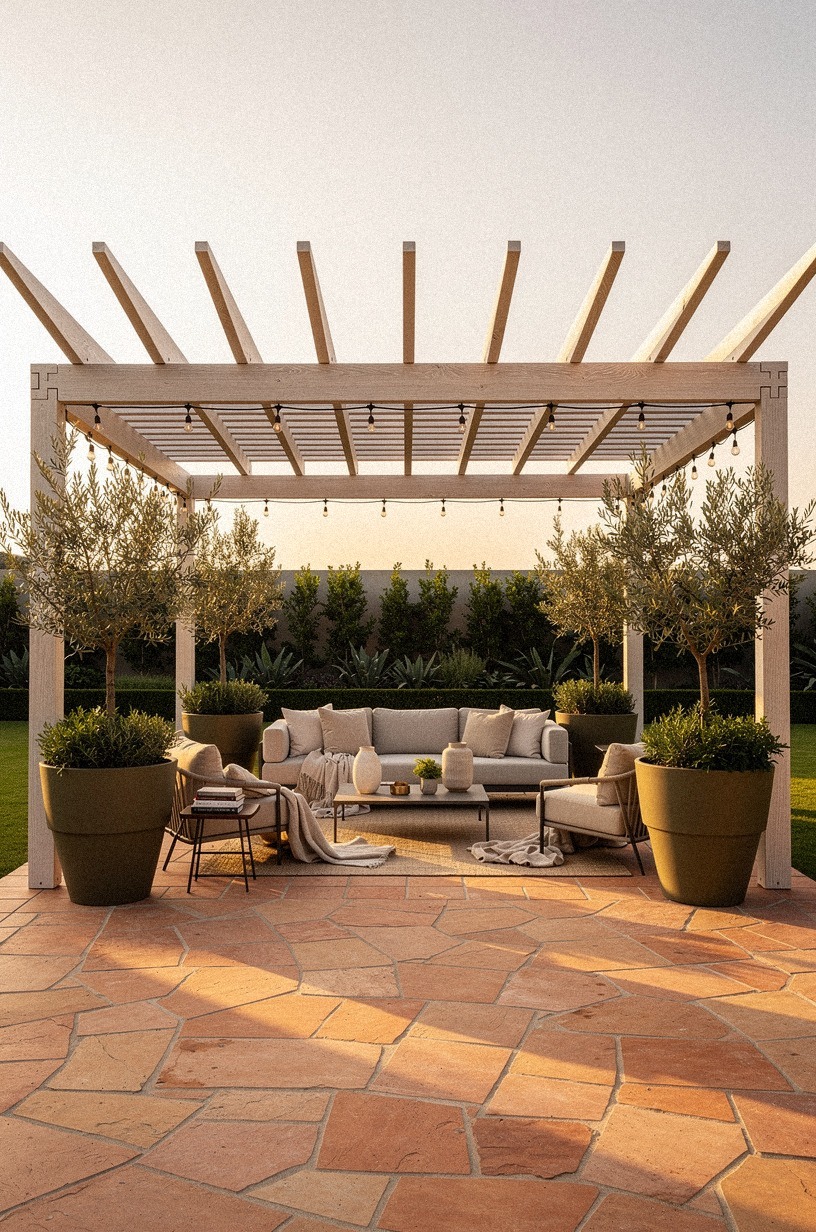
Start with a pergola when your patio already works and you just need it to reach farther into the yard. In the photo, the cerused white oak rafters feel like an extension line, not a standalone destination, and that's why this move works so well for a pergola patio extension.
You keep the sky, you keep the breeze, and you still give your eye a clear place to land. If your pavers run in a straight path, hold that rhythm under the structure so the whole space reads as one decision.
I like terracotta stone pavers here because they warm up all that open air without making the yard feel heavy. Give yourself at least 36 in of walkway clearance so you aren't squeezing past chairs, and let the structure sit wide enough to cover the traffic lane rather than only the seating.
But don't overfill it with planters right away. You want the slats, the shadow lines, and the symmetry to do the work first. If you want more ways to stretch a patio without losing warmth, these pergola ideas for shade and ambiance are a smart next stop.
2Crown the dining pad with a cedar gazebo
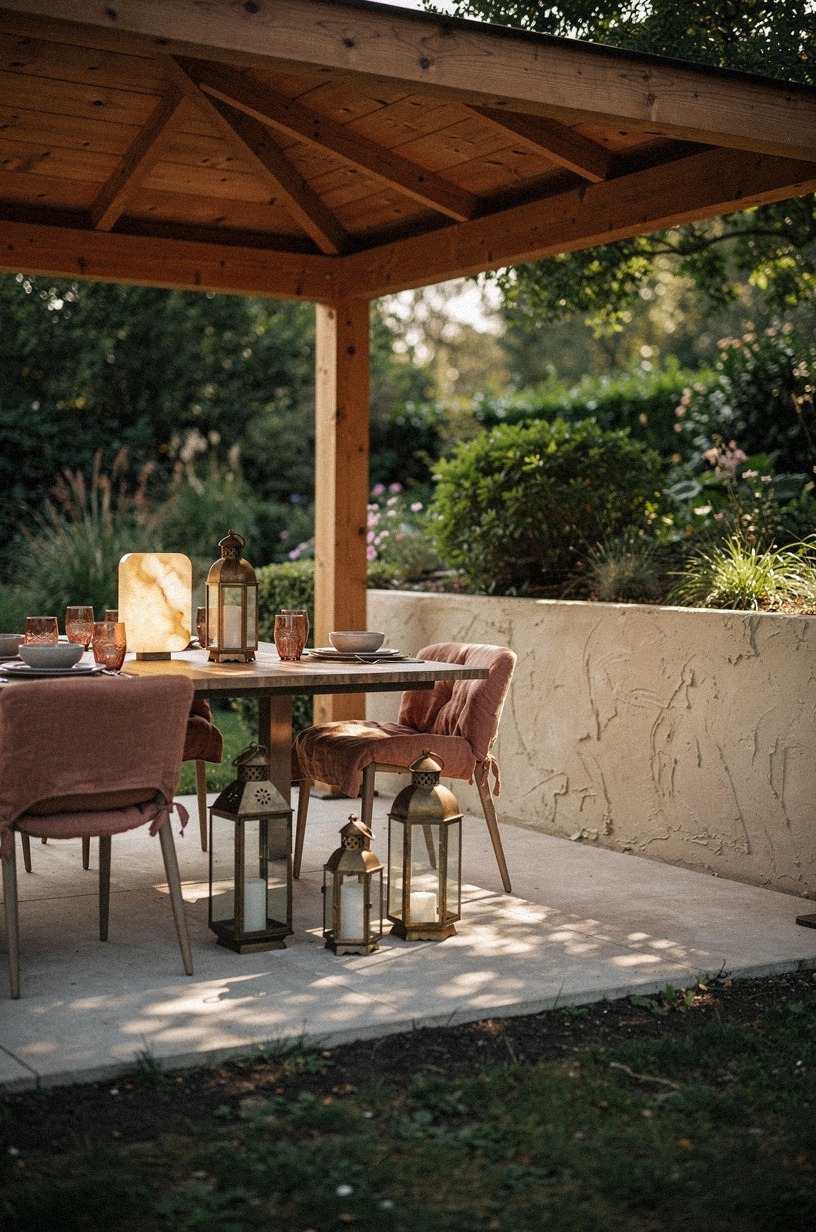
Choose a gazebo when you want the dining spot to feel finished the second someone steps outside. That's the big difference in this image. The cedar gazebo isn't just covering the table, it's crowning the whole dining pad so your eye reads it as a room with a roof and purpose.
If you host even a few times each season, that sense of arrival matters more than people think.
Keep your table close to the center and make sure the top sits at the standard 28 to 30 in height so the chairs, lanterns, and place settings don't look underscaled. I love the way aged brass lanterns and clay linen cushions soften cedar, because too much wood on wood can start to feel campy fast.
And if you're styling the table, think in short layers. One bowl.
One lantern. One low vase. That's enough!
For more ideas on making an outdoor meal feel warm instead of fussy, this backyard dinner party guide is full of useful cues.
3Frame the sofa zone under freestanding rafters
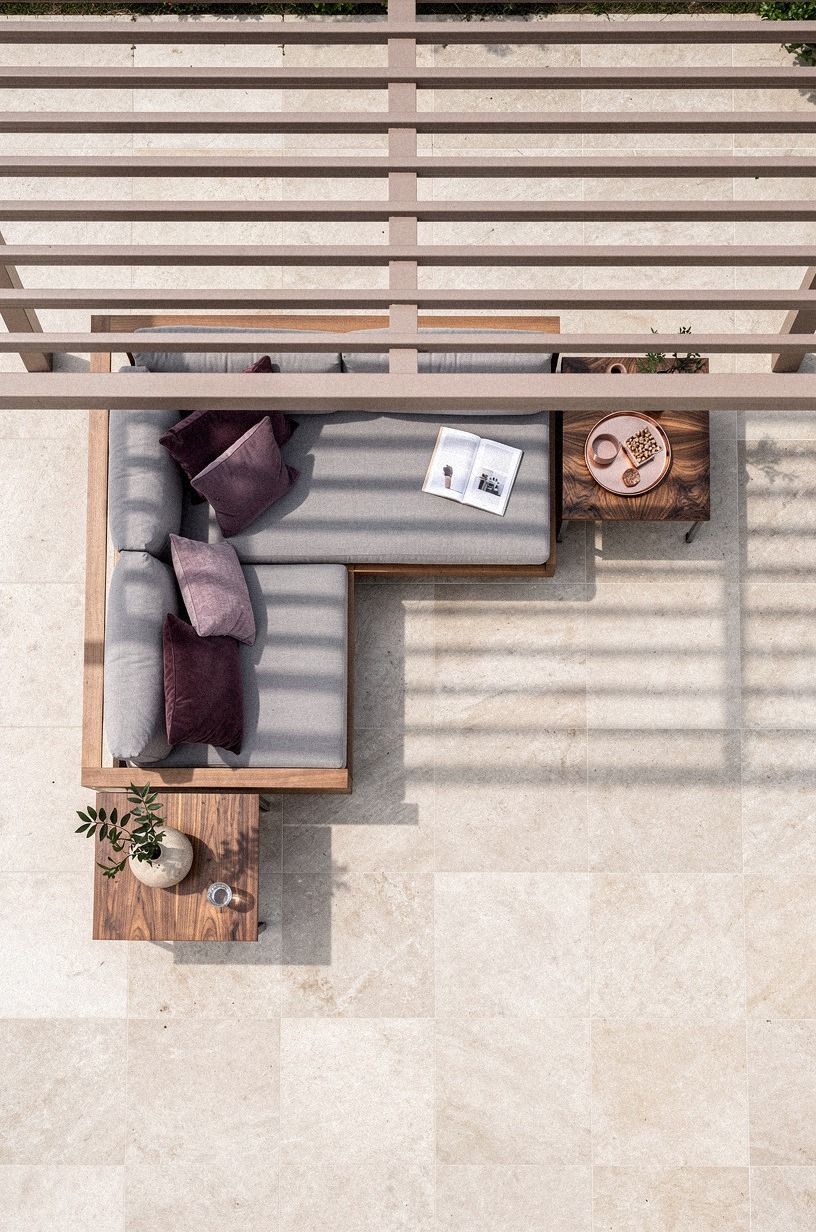
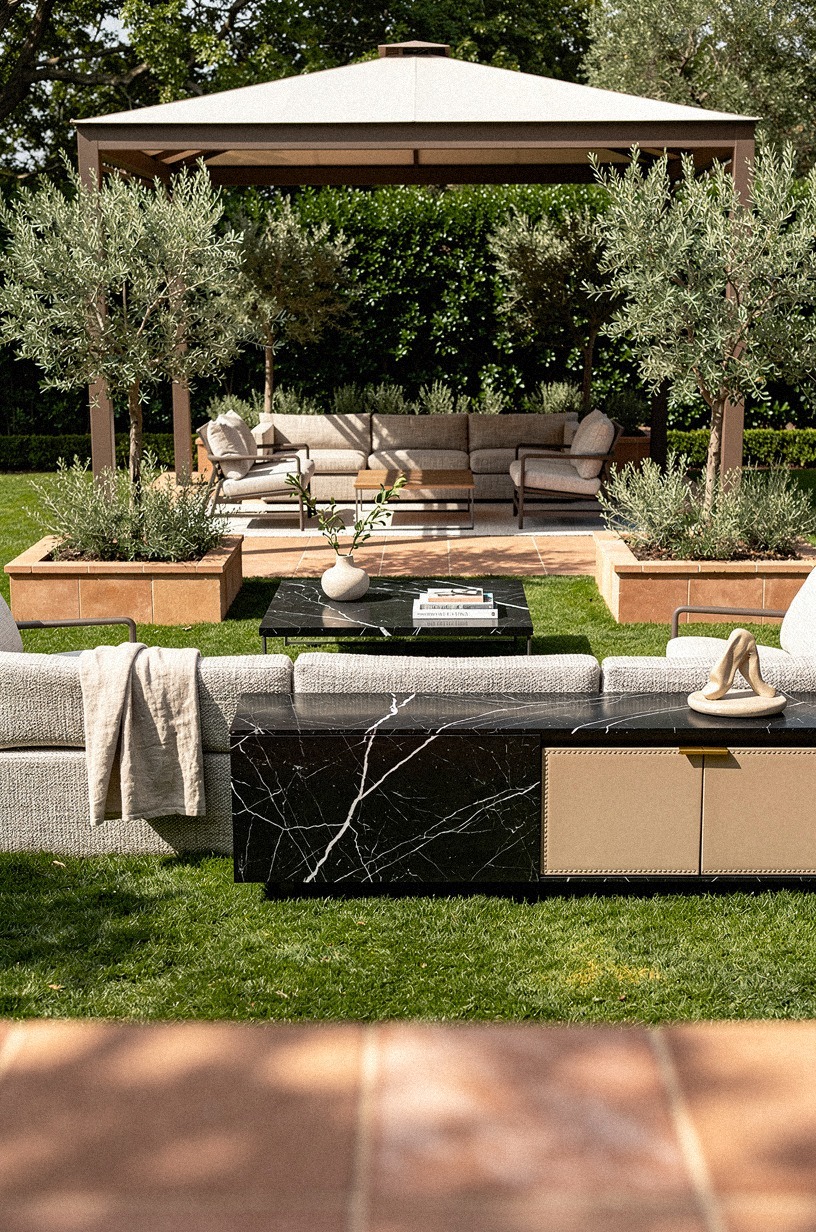
Use freestanding rafters when you want structure without the visual weight of a full roof.
4Curtain a pergola corner for soft shade
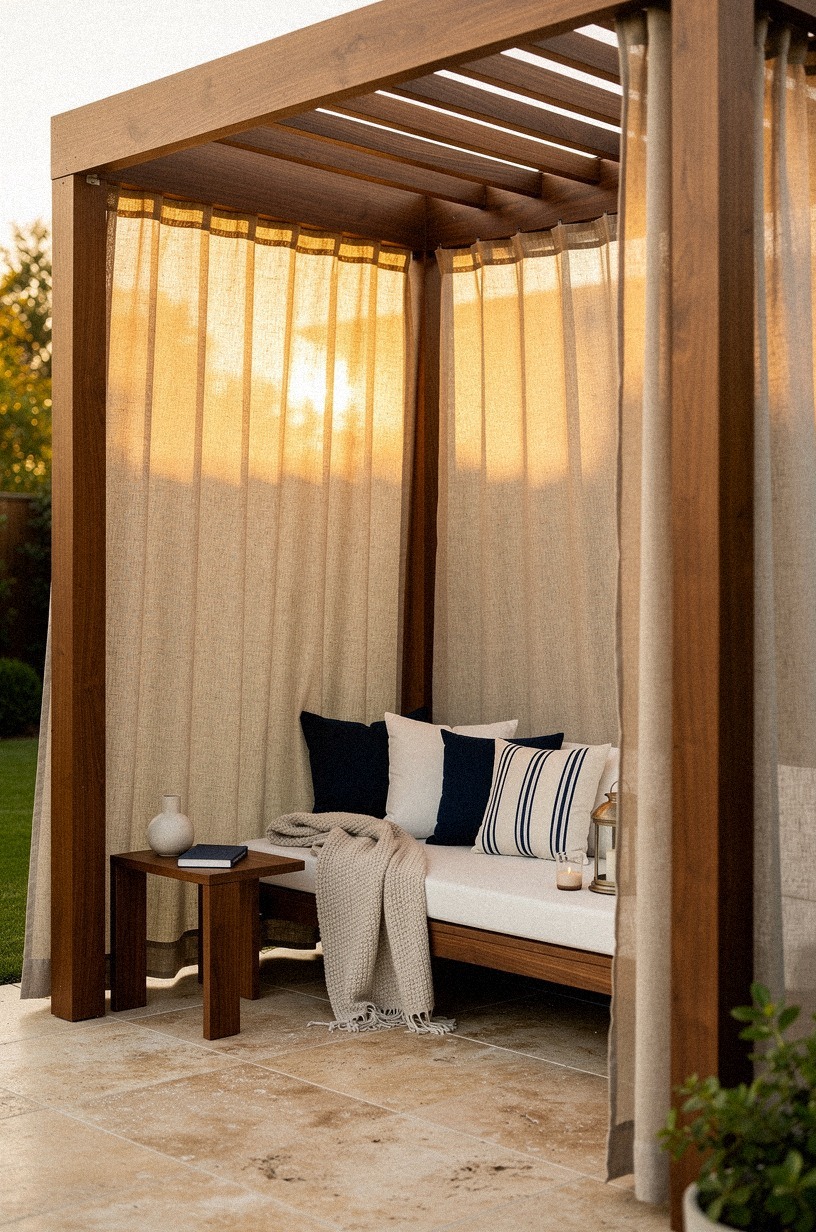
Add curtains when your pergola looks handsome but still feels a little exposed in afternoon sun. In this scene, the walnut-toned pergola gives you the bones, while the fabric softens the edges and turns one corner into a real retreat.
You don't need to curtain every side. One or two panels, placed where the light bites hardest, usually gives you the right amount of cover without killing the airy part that makes a pergola worth having.
I prefer outdoor panels in Sunbrella Canvas Natural or a similar warm neutral, especially next to navy accents and travertine flooring. They age better than stark white, and they don't scream for attention when the breeze hits.
But hang them high and let them skim, not puddle, or the whole thing starts feeling staged (and a little damp, honestly). If your yard leans polished, this cozy backyard aesthetic guide helps you keep the softness without turning sweet.
5Screen a gazebo wall with climbing vines
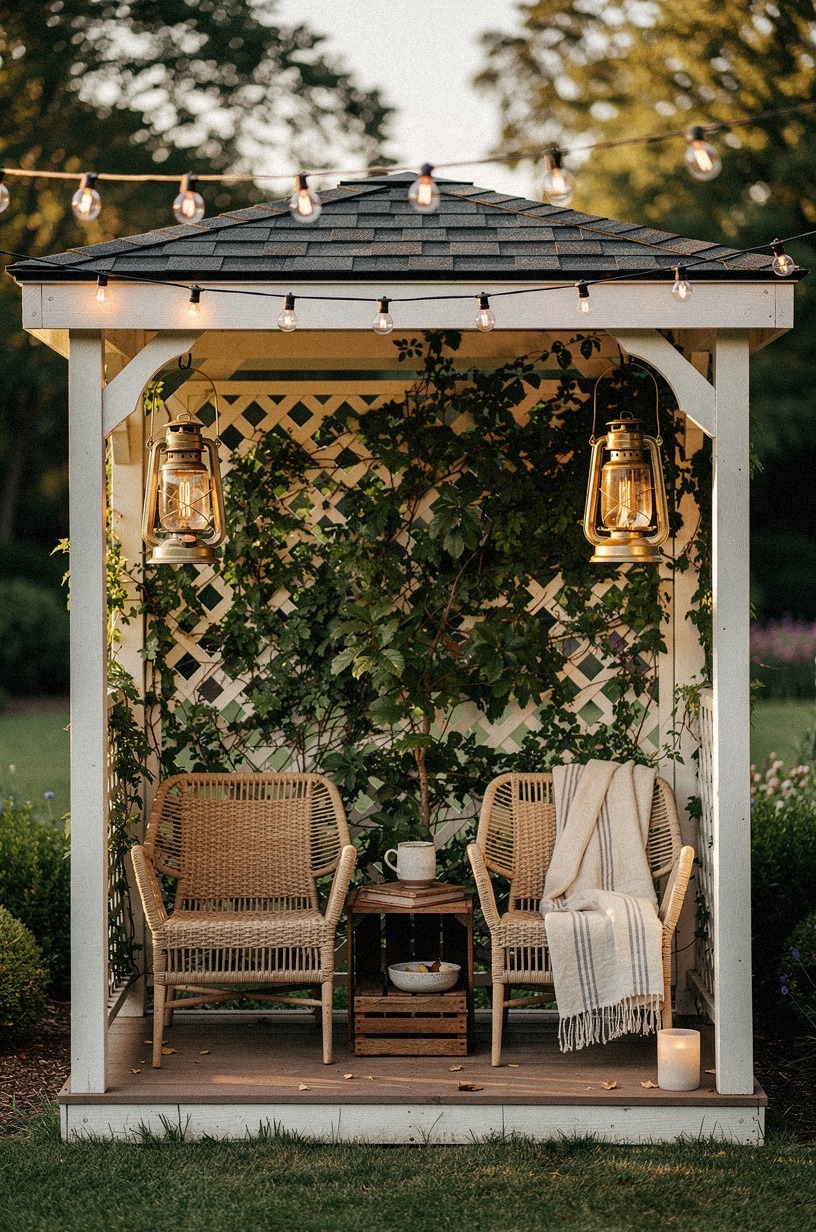
Let a gazebo carry greenery when the structure itself feels a little blunt. That's what makes this image so calming.
The cedar frame stays visible, but the climbing vines blur one wall just enough to make the whole destination feel older and more settled. If your backyard is small, this is one of the best ways to make a gazebo feel integrated instead of dropped in at the last minute.
Here's the move I'd borrow first: train vines on only one or two sides and keep the roofline clean. Too much growth and you lose the crisp silhouette that makes a gazebo satisfying in the first place.
I like Benjamin Moore Aura Exterior on any nearby trim because it holds up well against deep green foliage, and a muted paint color lets the leaves do the talking. And yes, you can keep it simple. A bench. A lantern.
A cushion in midnight blue. Done.
If you're building from zero, this step-by-step backyard guide helps you layer structure before accessories.
6Match the porch roofline beside the door
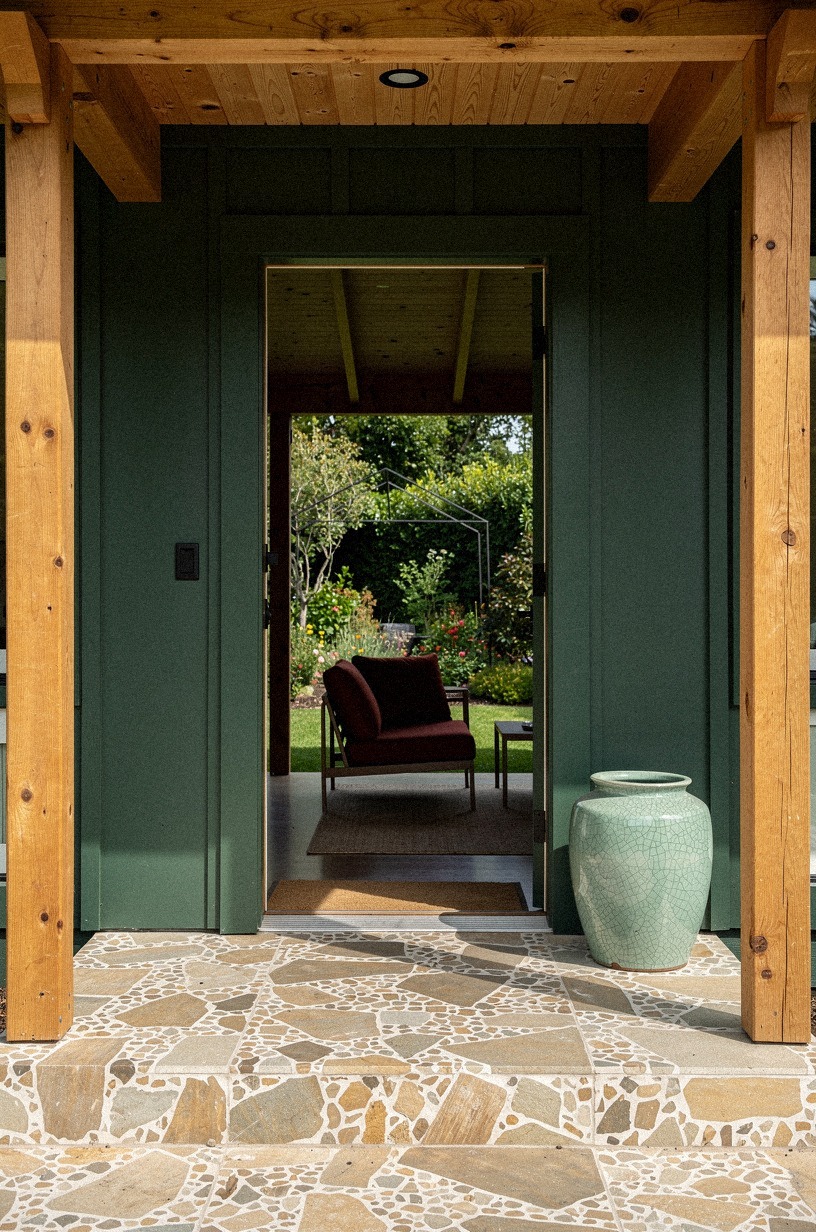
Match the house when the backyard begins right outside your back door and you want the transition to feel easy. In this image, the natural oak beams line up with the eaves, and that self supporting porch roof feeling is what makes the whole setup look expensive without trying too hard.
A gazebo would've felt like a separate object here. A pergola, tied to the roofline language, feels like the house kept going.
This is also the right place to think about budget honestly, because once you start changing paving, lighting, and overhead structure together, costs jump fast. Use the ranges below as typical US markers before you decide whether you're doing a style layer or a true build-out.
I think most people should stay in the middle lane longer than they expect. A clean overhead line, a few good materials, and one strong light source go far.
And honestly, I'd skip the high tier until you've lived with the yard for at least one full season. Otherwise you're guessing on traffic flow, and you'll end up tearing out pavers by year two.
If your door spills into a blank slab, these modern cozy backyard ideas can help you figure out what deserves money first.
7Float a fire table beneath open beams
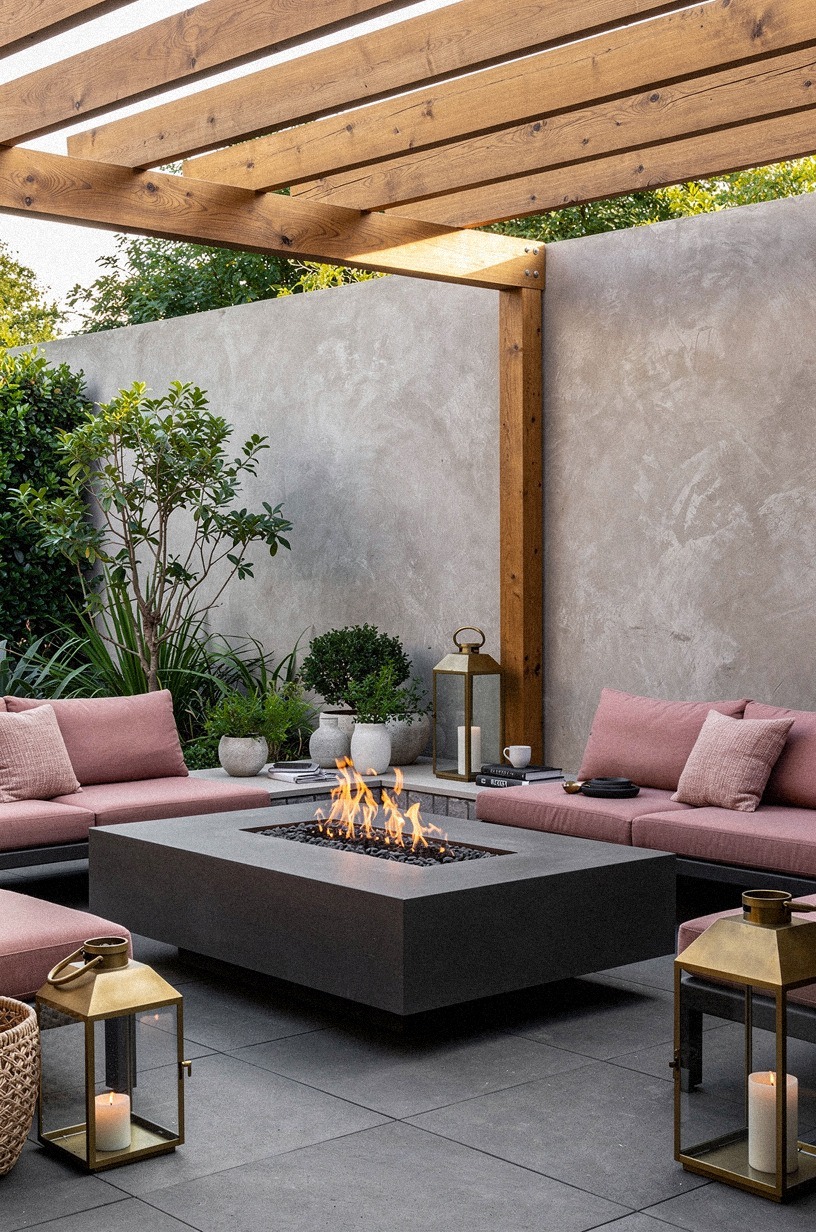
Center your gathering around flame when you want a pergola to feel social instead of purely architectural.
8Wrap string lights around chunky gazebo posts
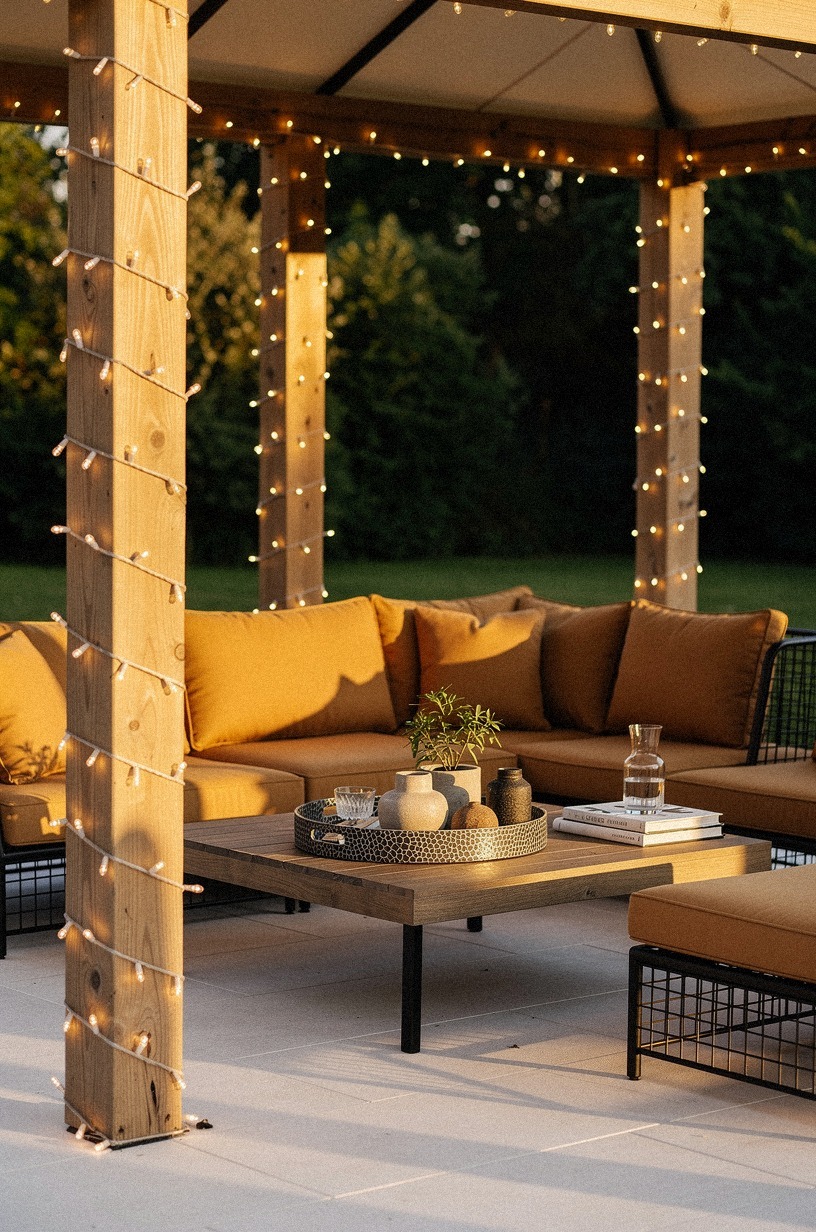
Use the posts as the glow source when your gazebo already has enough roof and shape on its own. That's what I like in this image. The string lights aren't zigzagged across the whole sky.
They're wrapped around chunky posts, which keeps the light low, warm, and close to people. That matters if you want the structure to feel intimate instead of bright.
My Three-Height Light Stack is simple: post glow low, lantern glow at table height, and one overhead sparkle only if the roof still feels dark. LED string lights typically run about $30 to $120, so this is one of the cheaper ways to make a gazebo feel finished fast. And if you're renting, it's far easier to remove than hardwired fixtures.
But skip cool white bulbs. They flatten cedar and make cream cushions look gray.
That one switch can ruin the mood fast! For more ways to layer warmth as the season shifts, this winter backyard setup guide is worth bookmarking.
9Build a garden room with lattice sides
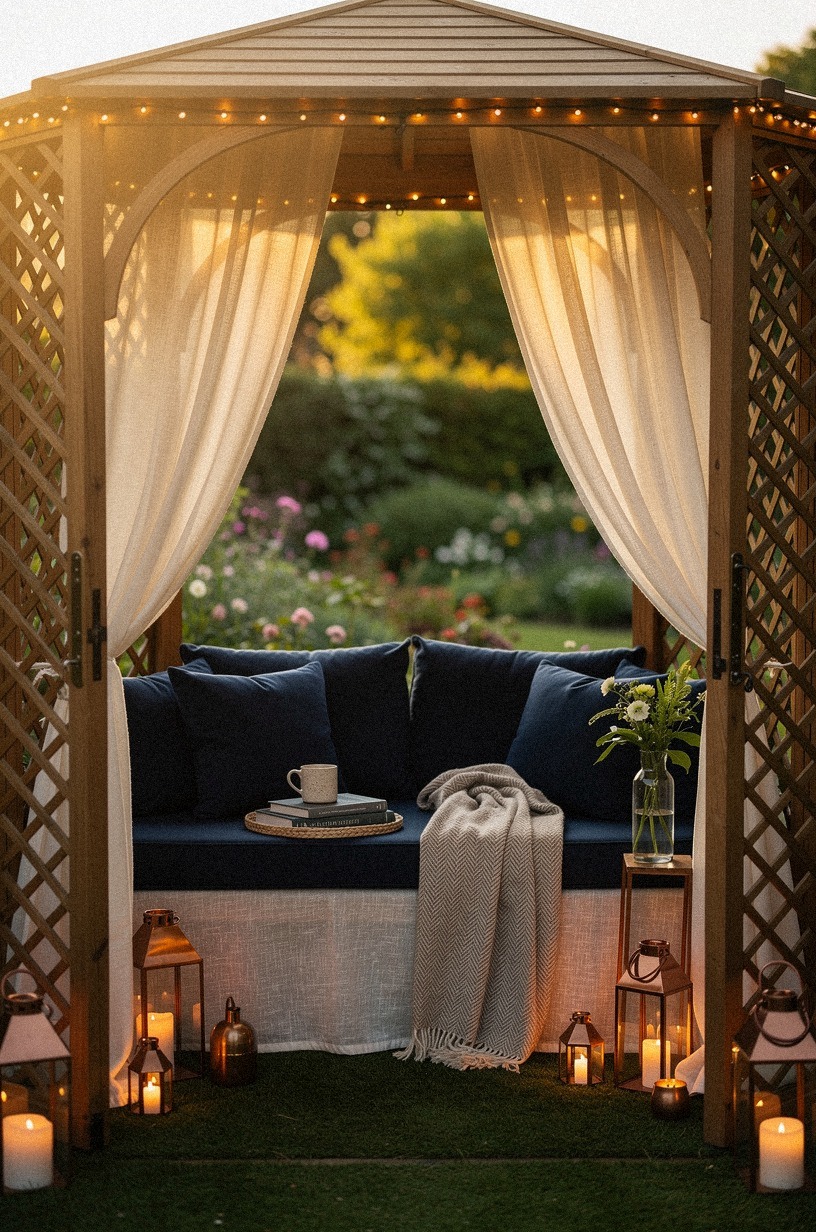
Go with lattice sides when you want the privacy of a gazebo but not the shut-in feeling of solid walls.
10Should you add a ceiling fan under the pergola?
Yes, but only if the pergola is already covered enough to feel like a room. A wet-rated Hinkley Solstice or Modern Forms fan in matte black pulls double duty: it kills the still-air bug problem in July and lets you string the candles without worrying about smoke drifting sideways. I waited two summers before adding one, and I regret waiting.
The catch is wiring. If you've got an exterior ceiling junction already (most homes with a back porch do), the install is a one-hour swap and roughly $250 to $450 all in.
No junction? You're looking at an electrician and another $600 to $1,200 to run conduit cleanly down a post. Worth pricing both before you commit to the fan path.
For renters, a Mr. Brumlie-style misting fan clipped to a beam will cool about 6 ft of seating and unplugs in a minute. Not as pretty, but it works.
11Panel the patio with clear weather screens
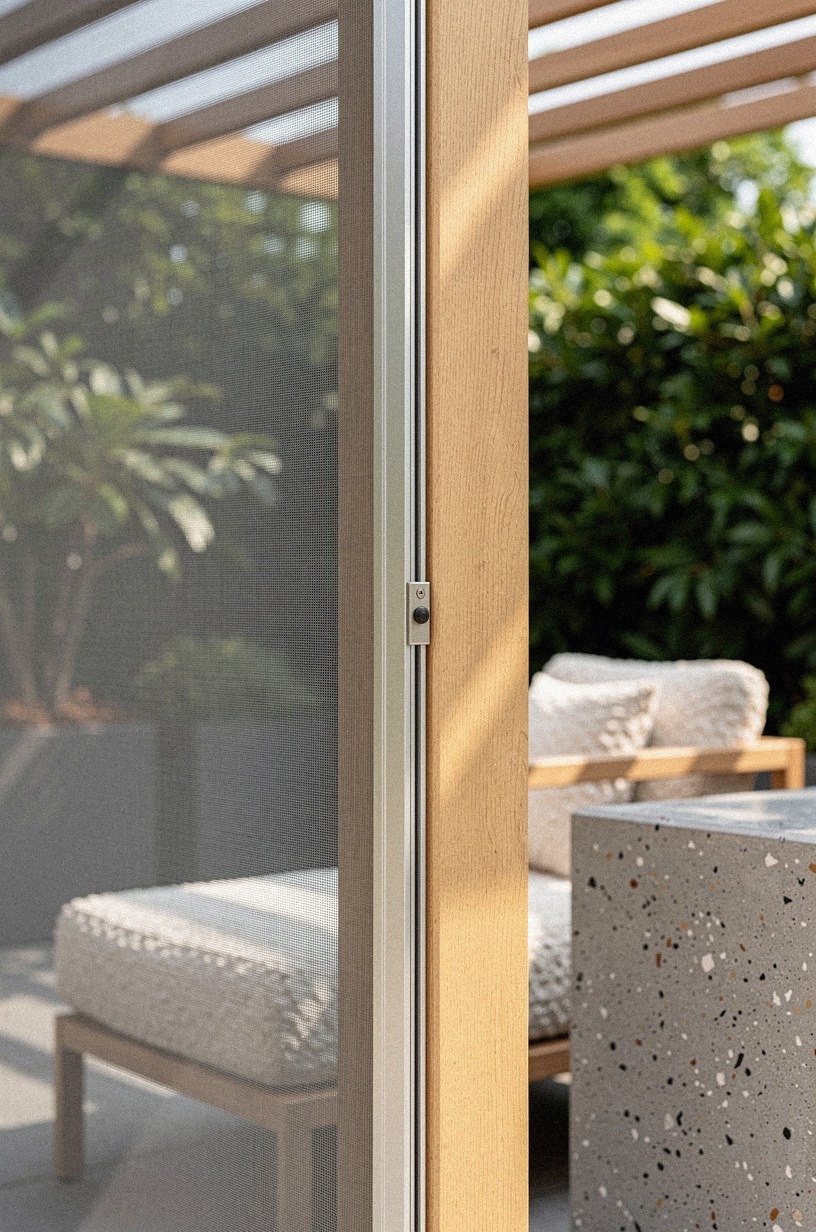
Install clear panels when you love the openness of a pergola but need a closed outdoor patio feeling in wind, bugs, or shoulder-season weather.
12Anchor the lawn with a square pavilion
Pick a pavilion when your lawn needs a destination before it needs decoration. A 14x14 ft square pavilion in the middle of an open yard does what no patio set ever could: it gives the eye a place to land, frames the view back toward the house, and turns the lawn into a usable second room. Most people underestimate how much square footage they actually need.
Anything under 10x10 starts to feel like a bus stop.
If you're going custom, ask for 8x8 cedar posts rather than 6x6, and skip the decorative corbels unless the style of the house calls for them. Roof pitch at 6/12 keeps snow from sticking in a real-winter zone.
And budget honestly: a kit pavilion runs $3,500 to $7,500 delivered, a contractor-built one lands $12,000 to $25,000 depending on footing and roofing. That's a wide range, but it's the real one.
For more on planning a big build-out, this budget-by-priority backyard guide helps you decide where the dollars actually earn their keep.
13Could an IKEA KALLAX build work as outdoor storage?
Surprisingly, yes, if you treat the wood first. The IKEA KALLAX birch-effect unit (4x4 or 2x4) becomes a great outdoor storage wall for cushions, citronella tins, and lanterns if you seal every face with two coats of Waterlox Original marine-grade tung oil.
I've had mine on a covered patio for three winters and the ply hasn't swollen. The whole point is keeping it out of standing rain, so put it against the house wall or under the eaves of your pergola.
Skip the vinyl versions. They warp by August and the off-gassing in summer heat is rough. And if you want a cleaner face, swap the IKEA hardware for matte black square pulls (about $12 for a set of four on Amazon).
It won't win a design award, but for $179 and an hour of sealing, it solves the cushion-storage problem that most backyards quietly fail at.
14Run a stone path to anchor a freestanding pergola
Connect the pergola to the house when it sits more than 12 ft from the back door, or it'll feel like a yard orphan.
15What if your HOA caps structure height?
Read the architectural guidelines before you fall in love with anything over 9 ft. Most HOAs in the US cap freestanding structures at 10 to 12 ft to the highest point, and some ban solid roofs entirely.
If yours is strict, you're better off with a low-profile walnut-stained cedar pergola at 8 ft 6 in than fighting for an exception. The lower height still gives you vine space, string lights, and the "outdoor room" feeling without triggering a review.
My approach on a tricky HOA lot: a gardens-to-gables ratio that matches the home (roughly 1:1.4), no visible satellite hardware, and a pre-approved color from the Sherwin-Williams Accessible Beige family. Took three weeks for approval instead of three months.
16Layer two zones with pergola-then-gazebo
Use both, deliberately, when your yard is wider than 30 ft and you can carve it.
17Light the path between the two
Don't forget the gap. The path between a pergola and a gazebo is where most people under-light the yard and then wonder why nobody walks out there after dark. A pair of low-voltage path lights every 6 ft, set 12 in back from the path edge, gives a soft scallop that leads the eye without flattening the garden.
I'd skip the solar stake lights from the big box. They die by month eight and the color temperature is wrong.
Hinkley Path Bollards or VOLT Brass at 2700K are the right range, and a 200 ft run with transformer and trench lands around $650 to $1,100 professionally installed. Worth it for the years of use.
18Add a water bowl at the gazebo threshold
Place a reclaimed-stone water bowl at the gazebo entry and you'll hear it before you see it.
19Why pergolas are winning some backyards while gazebos still beat them in others
I've gone back and forth on this more than once, because pergolas photograph beautifully and gazebos feel satisfying the second you step under them. But living with a yard is different from pinning one.
Pergolas are better when the backyard already has a decent base and you need flow, continuity, and a reason for people to move from the door toward the seating. Gazebos are better when the yard feels unresolved and you need one move that creates destination, roof, and occasion all at once.
The mistake I made early on was thinking overhead structure was mostly about style. It isn't.
It's about behavior. A pergola says, keep walking, keep lingering, keep the sky in the picture.
A gazebo says, stop here, sit here, this is the room now. If your patio furniture already fits the yard and you're only missing warmth, go lighter.
If the yard feels blank and furniture keeps looking temporary, go more built. That's usually the real fork in the road.
Money changes the answer too. When you're working inside a $200 to $900 styling range, a pergola often gives you more visible payoff because slats, lights, curtains, and planters can do a lot without asking the space to become a whole outdoor room.
Once you're spending into the $1,500 to $6,000 lane, gazebo logic starts getting stronger because tables, lighting, and roofed dining all begin to work together. And if you're pushing toward paving plus structure plus kitchen money, you should be brutally honest about how you'll use it.
A roof nobody sits under is still wasted money.
My blunt take? I'd choose a pergola for lounging, fire, and any backyard where you want your house and patio to feel connected. I'd choose a gazebo for dining, weather cover, and any lawn that still feels like open space with furniture dropped on top.
But I wouldn't choose either until I knew what behavior I wanted from the space. That sounds obvious.
It isn't. Most people buy the structure first and ask the room to explain itself later.
The Questions I Get Asked Most
What is the best pergola vs. gazebo choice for a small backyard?
A pergola is usually the better pick for a small backyard because it keeps the sky visible and makes the footprint feel lighter. A compact Article loveseat under open rafters or a narrow dining setup under a slim cedar gazebo both work, but the pergola gives you more visual breathing room. These pergola ideas for shade and ambiance show that nicely.
Where can I buy pergola or gazebo pieces on a budget?
Start with IKEA, Target Threshold, and Wayfair for the basics, then check Facebook Marketplace for older wood tables or lanterns. The real win is mixing one decent structure with secondhand seating and new cushions, not trying to buy a full matching set in one shot.
How much does a pergola vs. gazebo makeover cost?
Most makeovers land somewhere between about $200 and $6,000, depending on whether you're styling or building. The budget saver is reusing the slab, existing chairs, and planters you already own, then spending on lights, textiles, and one overhead move that changes the room fastest. The bigger builds land at $10,000-$40,000+ once you start changing the roof line, paving, and outdoor kitchen together.
Can I create a pergola vs. gazebo look on a budget?
Yes, and you don't need a full rebuild to get there. Start with cheap wins: repaint planters, add LED string lights, move seating so the front legs sit on the rug, and use curtains or vines to make one edge feel intentional instead of bare. This backyard aesthetic guide can help you keep the spend low while the yard still feels finished.
Is a pergola vs. gazebo upgrade worth it in a small space?
Yes, it's worth it because a small space gets clearer faster once you define where dining or lounging happens. The layout advantage is simple: keep one 36 in path open, push furniture to one side, and let the structure frame the use instead of swallowing the yard. For small-lot inspiration, this cozy patio ideas roundup helps you layer structure without crowding.
Is a pergola or gazebo a good idea for a rental?
Yes, especially if you stay reversible. Use no-damage layers like freestanding curtains on tension rods, removable string lights, outdoor rugs, and planter screens so you get shade and privacy without drilling into everything.
That's the rental sweet spot! These modern backyard ideas can help you keep rentals looking intentional.
Where I'd Start First
If I had to pick one, I'd start with the slatted pergola. It fixes flow before decor, and flow makes a yard feel pricier than more furniture. Pin the pergola idea for later and build from there.