
 by
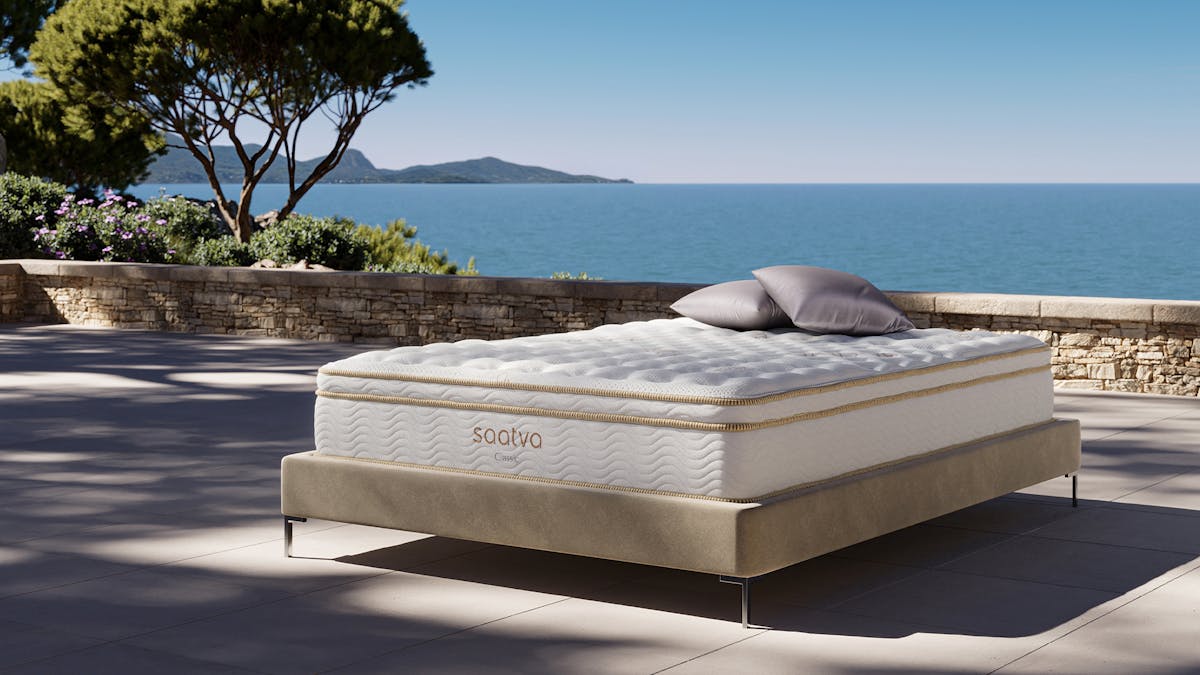
by A queen (60″ × 80″) fits most bedrooms and suits couples who sleep relatively still. A king (76″ × 80″) gives each person 38 inches of space, the same as a twin XL, and is worth the upgrade if your room measures at least 12 × 12 feet and you share the bed with a partner or pets. For either size, our top pick is the Saatva Classic, an innerspring hybrid available in every standard size with a 365-night home trial.
Saatva Classic
9.5/10
- Available in every standard US size: twin, full, queen, king, split king, California king
- Dual-coil construction with zoned lumbar foam reinforcement
- Outstanding cooling, open coil airflow keeps surface temp at 89.5°F max
- Free white-glove delivery, in-room setup, and old mattress removal
- 365-night home trial, lifetime warranty, fiberglass-free construction
- Higher motion transfer than average, not ideal for very light-sleeping co-sleepers
- Ships flat, not compressed in a box, requires scheduled delivery
- $99 return fee applies during the trial
Whether you are sizing up to a king or staying with a queen, the Saatva Classic is the same mattress underneath, just wider. The 365-night trial is long enough to confirm the size works in your room and for your sleep.
King vs queen: the core dimensions
The standard king measures 76 inches wide by 80 inches long. A queen is 60 inches wide by the same 80 inches long. That 16-inch difference in width works out to 8 extra inches per person when two people share the bed, roughly the width of a paperback book per side.
| Size | Width | Length | Per person (couple) |
|---|---|---|---|
| Twin XL | 38" | 80" | 38" (solo only) |
| Full / Double | 54" | 75" | 27" each |
| Queen | 60" | 80" | 30" each |
| King | 76" | 80" | 38" each |
| California King | 72" | 84" | 36" each |
A king gives each co-sleeper the same personal width as a solo twin XL. A queen gives each co-sleeper 30 inches, which is comfortable for relatively still sleepers but noticeably tighter when either partner is restless or larger-framed.
Who should choose a queen mattress
A queen is the most popular mattress size in the US, and for most households it is the right choice. Choose a queen if:
- Your bedroom is smaller than 12 × 12 feet. A queen fits comfortably in a 10 × 10-foot room with nightstands and walking clearance on both sides.
- You sleep alone and want more space than a twin or full without committing to king pricing.
- You share the bed as a couple and both sleep relatively still, 30 inches per person is sufficient for most average-frame sleepers.
- Budget is a factor. Queen mattresses, frames, and bedding all cost meaningfully less than their king equivalents.
- You move frequently. Queen mattresses are lighter and easier to maneuver through doorways and stairwells.
Who should choose a king mattress
A king is the right choice when sleeping space is the priority and your room can support the footprint. Choose a king if:
- You share the bed with a partner and either of you is a restless sleeper, a larger-framed person, or someone who runs hot.
- You regularly share the bed with children or pets. A king accommodates a couple plus a 30-pound dog without anyone being pushed to the edge.
- Your bedroom is at least 12 × 12 feet. Below that, a king leaves insufficient walking clearance and makes the room feel cramped.
- Either sleeper is over 6 feet 2 inches tall. The standard 80-inch length covers most people, but if height is the main concern, the California king at 84 inches adds extra legroom.
- You want maximum personal space and your room and budget support it. The most common regret we see is couples who bought a queen to save money and later wished they had gone to a king once they experienced the space difference.
The cost difference between king and queen
A king mattress typically costs 20 to 40 percent more than the equivalent queen from the same brand. That premium carries through to every accessory: king sheets, king comforters, and king bed frames all cost more than their queen counterparts.
For a concrete reference: upgrading from a Saatva Classic queen to a king adds approximately $400 to $600 on the mattress alone, before bedding. Over a 10-year mattress lifespan the per-night difference is modest, but the upfront gap matters for most buyers. Queen bedding is also easier to find on sale and in a wider range of styles.
Split king: a third option for couples
A split king consists of two twin XL mattresses side by side, each 38 inches wide by 80 inches long. The combined footprint matches a standard king, but each person sleeps on a completely separate surface.
This configuration is ideal for couples with significantly different firmness preferences, different temperature needs, or health conditions that require separate adjustable bases. With a split king, one partner can raise the head of their mattress without affecting the other. The trade-off is a center seam where the two mattresses meet and the need for a split-king-specific fitted sheet.
Minimum room sizes by mattress size
| Mattress size | Minimum room | Comfortable room |
|---|---|---|
| Twin / Twin XL | 7 × 10 ft | 9 × 10 ft |
| Full / Double | 9 × 10 ft | 10 × 10 ft |
| Queen | 10 × 10 ft | 10 × 12 ft |
| King | 12 × 12 ft | 13 × 13 ft |
| California King | 12 × 12 ft | 11 × 13 ft |
Always measure your room before deciding. Subtract two feet on each walkable side of the bed for clear passage. A king that fills the room edge-to-edge will make the room feel smaller and harder to navigate, which erodes the quality-of-life benefit the extra sleep space provides.
Which size is right for you: the verdict
For couples in a room of 12 × 12 feet or larger, a king is a long-term investment in sleep quality that most people who make the jump do not regret. For solo sleepers, couples in smaller rooms, or buyers on a tighter budget, a queen is the practical and fully adequate choice.
Whichever size you choose, the mattress itself matters as much as the dimensions. The Saatva Classic comes in both sizes, and in split king, with the same zoned lumbar support, breathable dual-coil construction, and 365-night home trial regardless of which you order.
Queen for rooms under 12 × 12 ft, solo sleepers, or budget-conscious buyers. King for couples with space, restless sleepers, or anyone who co-sleeps with pets or kids. The Saatva Classic ships in both sizes on a 365-night home trial with free white-glove delivery.
Frequently asked questions
What is the exact size difference between a king and queen mattress?
A standard king measures 76 inches wide by 80 inches long. A queen measures 60 inches wide by 80 inches long. The king is 16 inches wider, 8 extra inches per person when two people share the bed. Both sizes are the same length at 80 inches.
What room size do I need for a king bed?
A minimum of 12 × 12 feet, with 13 × 13 feet preferred to allow nightstands and walking clearance on three sides. A queen fits comfortably in a 10 × 10-foot room. Rooms under 12 × 10 feet will feel cramped with a king, which negates much of the benefit of having more bed space.
Is a king mattress worth the extra cost?
For couples, yes, if your room fits it. The 16 extra inches of width meaningfully reduces sleep disruption from partner movement, and couples who share the bed with a pet gain even more from it. For solo sleepers or guest rooms, a queen is sufficient and cheaper across the board including bedding and frame.
Can two people sleep comfortably on a queen mattress?
Yes, for most couples. Each person gets 30 inches of width on a queen versus 38 inches on a king. For couples who are relatively still sleepers and average-framed, 30 inches per person is comfortable. For restless sleepers, larger-framed individuals, or anyone sharing the bed with a pet, the king's extra space is a noticeable upgrade.
What is a California king and who is it for?
A California king measures 72 inches wide by 84 inches long, 4 inches narrower but 4 inches longer than a standard king. It is the better choice for very tall sleepers (over 6 feet 3 inches) who prioritize legroom over side-to-side space. Couples who want maximum width per person should choose a standard king instead.
Is a split king the same size as a regular king?
Yes. A split king is two twin XL mattresses (38 × 80 inches each) placed side by side, matching the 76 × 80-inch footprint of a standard king. The advantage is that each sleeper has a fully independent surface, useful for couples using separate adjustable bases or different firmness levels.