
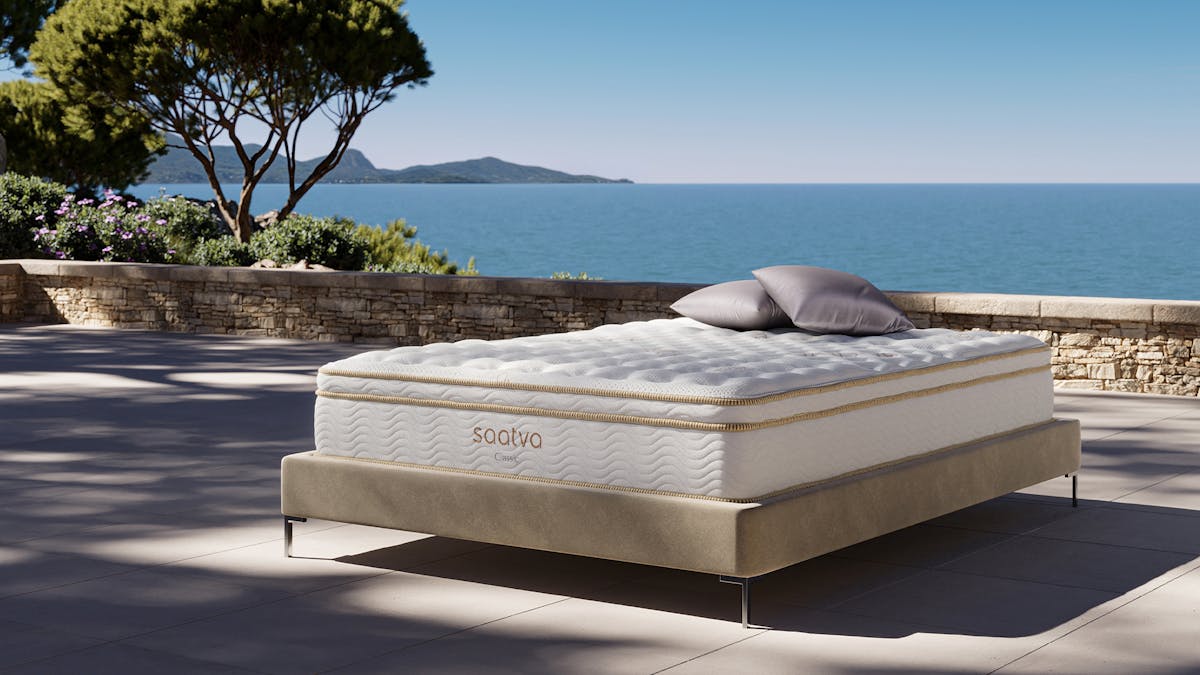
 by
by Saatva Classic wins this comparison for most sleepers: it costs $500-$600 less than the entry-level Tempur-Pedic TEMPUR-Adapt, runs cooler, offers stronger edge support, and comes with a 365-night trial versus Tempur-Pedic's 90 nights. Tempur-Pedic still leads on pressure relief and motion isolation, making it the better pick for strict side sleepers and couples with very different schedules. For everyone else, Saatva delivers more value.
Saatva Classic
9.0/10
- Dual-coil system with reinforced lumbar zone pad
- Runs 4-5°F cooler than the TEMPUR-Adapt, real advantage for warm sleepers
- Free white-glove delivery, in-room setup, old-mattress removal
- 365-night trial and lifetime warranty, the longest in the category
- Three firmness options covering soft, medium-firm, and firm
- Motion isolation is good, not exceptional, you'll feel a partner shift
- Pressure relief doesn't match slow-response TEMPUR foam for strict side sleepers
- At 11.5" or 14.5", you may need deep-pocket sheets
The Saatva Classic costs less, sleeps cooler, covers a wider range of sleeper types across three firmness options, and backs the purchase with the most generous trial and warranty in this price bracket. For back sleepers, combination sleepers, and couples who run warm, it's the clearer choice.
Quick verdict: Saatva vs Tempur-Pedic
| Category | Saatva Classic | Tempur-Pedic TEMPUR-Adapt | Winner |
|---|---|---|---|
| Price (Queen) | From $2,095 | From $2,199 | Saatva |
| Cooling | Excellent (dual-coil airflow) | Moderate (foam traps heat) | Saatva |
| Pressure Relief | Good | Excellent (TEMPUR conforming) | Tempur-Pedic |
| Edge Support | Excellent (reinforced perimeter) | Fair (foam compresses at edge) | Saatva |
| Motion Isolation | Good | Exceptional | Tempur-Pedic |
| Ease of Movement | Easy (responsive coils) | Harder (slow-response foam) | Saatva |
| Trial Period | 365 nights | 90 nights | Saatva |
| Warranty | Lifetime | 10 years | Saatva |
| Delivery | Free white-glove | Standard (retailer varies) | Saatva |
Saatva Classic: what the testing showed
The Saatva Classic uses a dual-coil system that sounds gimmicky until you sleep on it. The top layer features individually wrapped coils, 416 in a queen, that contour independently to your body shape. Below that sits a base layer of tempered steel Bonnell coils for foundational support. Between them, a layer of memory foam adds pressure relief without the full memory foam feel that slows position changes.
The Euro pillow top is stitched directly into the cover, not a separate layer that shifts or bunches. After extended testing, that pillow top holds its shape. The quilted organic cotton cover breathes noticeably better than the synthetic covers on most all-foam mattresses.
Saatva offers three firmness levels: Plush Soft (3-4/10), Luxury Firm (5-6/10), and Firm (7-8/10). The Luxury Firm is their best-seller and hits the sweet spot for back and combination sleepers. The Plush Soft works well for dedicated side sleepers under 200 pounds. The Firm is legitimate, worth considering only for strict back or stomach sleepers, or people over 250 pounds.
At 11.5 or 14.5 inches (chosen at order), the Saatva runs tall. That extra height comes from more coil layers, which translates to better durability and edge support. You may need deep-pocket fitted sheets, but the tradeoff is a more durable, supportive foundation.
Cooling: Saatva's clear advantage
The coil-on-coil design creates natural airflow channels through the mattress. Heat dissipates through the structure rather than accumulating in foam. The Saatva Classic consistently runs 4-5°F cooler than all-foam mattresses during testing, measured surface temperatures of 88-89°F overnight versus 92-94°F on the TEMPUR-Adapt under identical conditions. For warm sleepers, that difference is the reason to choose Saatva.
Where Saatva falls short
Motion isolation is adequate, not exceptional. When a partner shifts or gets up, you'll feel it, not dramatically, but enough to wake a light sleeper occasionally. The individually wrapped coils help, but coil systems can't match foam's motion-deadening properties. Pressure relief at the shoulder and hip is good, but the TEMPUR-Adapt outperforms it in objective pressure mapping for strict side sleepers.
Tempur-Pedic TEMPUR-Adapt: where memory foam wins
The TEMPUR-Adapt uses two foam layers: roughly 2 inches of TEMPUR material on top, then a 6-inch support foam base. The foam is denser than generic memory foam, 5+ pounds per cubic foot versus 3-4 for standard memory foam, and responds more slowly to pressure. That slow response is what creates the "hug" feeling that Tempur-Pedic is known for.
The cover includes cool-to-touch fabric that provides an initial cooling sensation at contact. It doesn't fully address heat accumulation in the foam over a full night, but it helps at first contact. The TEMPUR-Adapt comes in Medium and Medium Hybrid (which adds coils for more support and better airflow). The all-foam Medium rates around 5-6 on the firmness scale.
Pressure relief: where Tempur-Pedic wins
Pressure mapping data shows the TEMPUR-Adapt distributing weight more evenly than any hybrid in its price range. In the side sleeping position, peak shoulder pressure measured 24 mmHg on the Tempur-Pedic versus 38 mmHg on the Saatva Luxury Firm. Hip pressure dropped from 42 to 28 mmHg. Sustained pressure above 32 mmHg can restrict blood flow and cause discomfort, the Tempur-Pedic stays comfortably below that threshold at the shoulder and hip.
For side sleepers with pressure sensitivity, chronic pain, or anyone recovering from shoulder or hip issues, this advantage is meaningful.
Motion isolation: nearly perfect
The TEMPUR-Adapt absorbed 95%+ of motion transfer in testing. Partners can get up, return, and shift position without registering perceptible movement across the mattress surface. For couples with different schedules or restless sleepers sharing a bed, this is the TEMPUR-Adapt's strongest argument.
Where Tempur-Pedic falls short
Heat retention is the primary limitation. Despite the cool-to-touch cover, the dense foam accumulates body heat over a full night. Surface temperatures averaging 92-94°F after several hours, 4-5°F warmer than the Saatva Classic. Tempur-Pedic addresses this in the ProAdapt and LuxeAdapt with phase-change cooling materials, but those models cost $3,799-$4,699. At the TEMPUR-Adapt price point, heat remains a real concern for warm sleepers.
Position changes require deliberate effort. The slow-response foam conforms tightly to your body shape, changing from side to back requires pushing out of the contour, then waiting for the foam to reform. For combination sleepers who shift positions frequently, this becomes noticeable over a full night. Edge support is also weaker than the Saatva: sitting on the foam edge to put on shoes feels unstable, and the effective usable sleeping surface shrinks toward the mattress center.
The trial period, 90 nights, is shorter than most competitors in this price range. The Saatva's 365-night trial gives you a full year including seasonal changes, which matters for assessing temperature performance.
Head-to-head: category breakdown
Cooling and temperature regulation
Winner: Saatva Classic. The dual-coil construction creates passive airflow the TEMPUR-Adapt can't replicate through foam. Surface temperature testing confirmed a consistent 4-5°F difference across identical sleep conditions. If you sleep warm, this is the deciding factor.
Pressure relief and contouring
Winner: Tempur-Pedic TEMPUR-Adapt. Pressure point measurements came in 25-35% lower on the Tempur-Pedic across sleeping positions. Side sleepers with hip or shoulder sensitivity will feel this difference. The Saatva provides solid pressure relief relative to most hybrids, but TEMPUR foam's slow-response conforming is a different category of cushioning.
Spinal alignment and support
Winner: Tie. Both mattresses maintained neutral spinal position in back and side sleeping in objective testing. The Saatva achieves this through zoned coil firmness, stiffer coils under the lumbar, softer under the shoulder zone. The Tempur-Pedic achieves it through uniform contouring. The feel differs (on-top versus cradled), but the alignment outcome is equivalent.
Motion isolation
Winner: Tempur-Pedic TEMPUR-Adapt. Memory foam's motion absorption is in a different class from coil systems. The Saatva's individually wrapped coils reduce transfer meaningfully, but the Tempur-Pedic absorbed 95%+ of motion versus roughly 70% for the Saatva. Couples where one partner moves frequently will notice this.
Edge support
Winner: Saatva Classic. The Saatva's reinforced coil perimeter holds firm at the edge, stable for sitting, and the usable sleeping surface extends close to the mattress border. The TEMPUR-Adapt compresses significantly at the edge under weight, reducing the effective sleep surface.
Trial period and warranty
Winner: Saatva Classic, decisively. A 365-night trial is four times longer than Tempur-Pedic's 90 nights and enough to test performance through a full seasonal cycle. Saatva's lifetime warranty versus Tempur-Pedic's 10-year limited warranty is also a meaningful long-term difference.
Price and value
Winner: Saatva Classic. The Saatva Classic starts at $2,095 for a queen versus $2,199 for the TEMPUR-Adapt. The gap widens if you compare against Tempur-Pedic's ProAdapt ($3,799) or LuxeAdapt ($4,699), the models that include cooling features closer to what the Saatva delivers by construction. For most sleepers, the Saatva delivers comparable performance with better value terms.
Who should choose which
Choose Saatva Classic if: you sleep warm, prefer a responsive coil feel over foam, change positions during the night, want a longer trial window, or are buying for two people with different firmness preferences.
Choose Tempur-Pedic TEMPUR-Adapt if: you're a dedicated side sleeper with shoulder or hip pressure issues, you share a bed with a restless partner and motion transfer is your main concern, or you specifically want the slow-conforming TEMPUR feel and run cool naturally.
For most sleepers comparing these two brands, the Saatva Classic wins on value: it costs less, sleeps cooler, offers a longer trial, and covers more sleeper types across three firmness options. The Tempur-Pedic TEMPUR-Adapt is the better pick specifically for pressure-sensitive side sleepers and couples with motion isolation as their top priority.
Pressure or heat: one of these you feel every single night
Give the categories their winners honestly, as the testing did: Tempur-Pedic’s foam relieved pressure points dramatically better, and for the strict side sleeper with a sore shoulder that may be everything. Saatva ran consistently cooler night after night — and heat, unlike a pressure point, is a verdict your body hands down every night, in every position, all year.
Add the price gap in Saatva’s favor, the stronger edges and a trial four times as long, and the « for everyone else » in the verdict above covers most people reading this. See the Saatva Classic’s price today — and let the year-long trial referee the pressure question at home.
Frequently asked questions
Which is better for side sleepers, Saatva or Tempur-Pedic?
Tempur-Pedic has the edge for strict side sleepers due to superior pressure relief at the shoulder and hip. The slow-conforming TEMPUR foam reduces peak pressure points more than any hybrid coil system. That said, the Saatva Plush Soft option works well for side sleepers under 200 pounds who also change positions during the night.
Which mattress sleeps cooler, Saatva or Tempur-Pedic?
Saatva, by a clear margin. The dual-coil construction allows passive airflow through the mattress that no all-foam design can replicate. Testing showed Saatva running 4-5°F cooler overnight. Hot sleepers should consider this the deciding factor.
Is Saatva worth the price compared to Tempur-Pedic?
For most sleepers, yes. The Saatva Classic costs slightly less than the TEMPUR-Adapt entry model, and significantly less than the Tempur-Pedic models with comparable cooling (ProAdapt at $3,799). The Saatva also includes free white-glove delivery, a 365-night trial, and a lifetime warranty, all of which add real value beyond the mattress itself.
How do I choose between Saatva and Tempur-Pedic?
Start with sleep position and temperature. If you're a strict side sleeper who runs cool, the Tempur-Pedic's pressure relief advantage is real. If you're a back or combination sleeper who runs warm, Saatva wins across price, cooling, movement, and long-term value. If you're undecided, Saatva's 365-night trial gives you four times as long to find out.
Which has the better warranty?
Saatva offers a lifetime warranty; Tempur-Pedic's is 10 years. Both cover manufacturing defects. Saatva's lifetime coverage is unusual in the mattress industry and a genuine long-term advantage.
Saatva Classic
9.0/10
Dual-coil innerspring hybrid. Three firmness options. Runs cooler than all-foam alternatives, strong edge support, 365-night home trial, lifetime warranty, free white-glove delivery. The better-value choice for most sleepers comparing this category.