
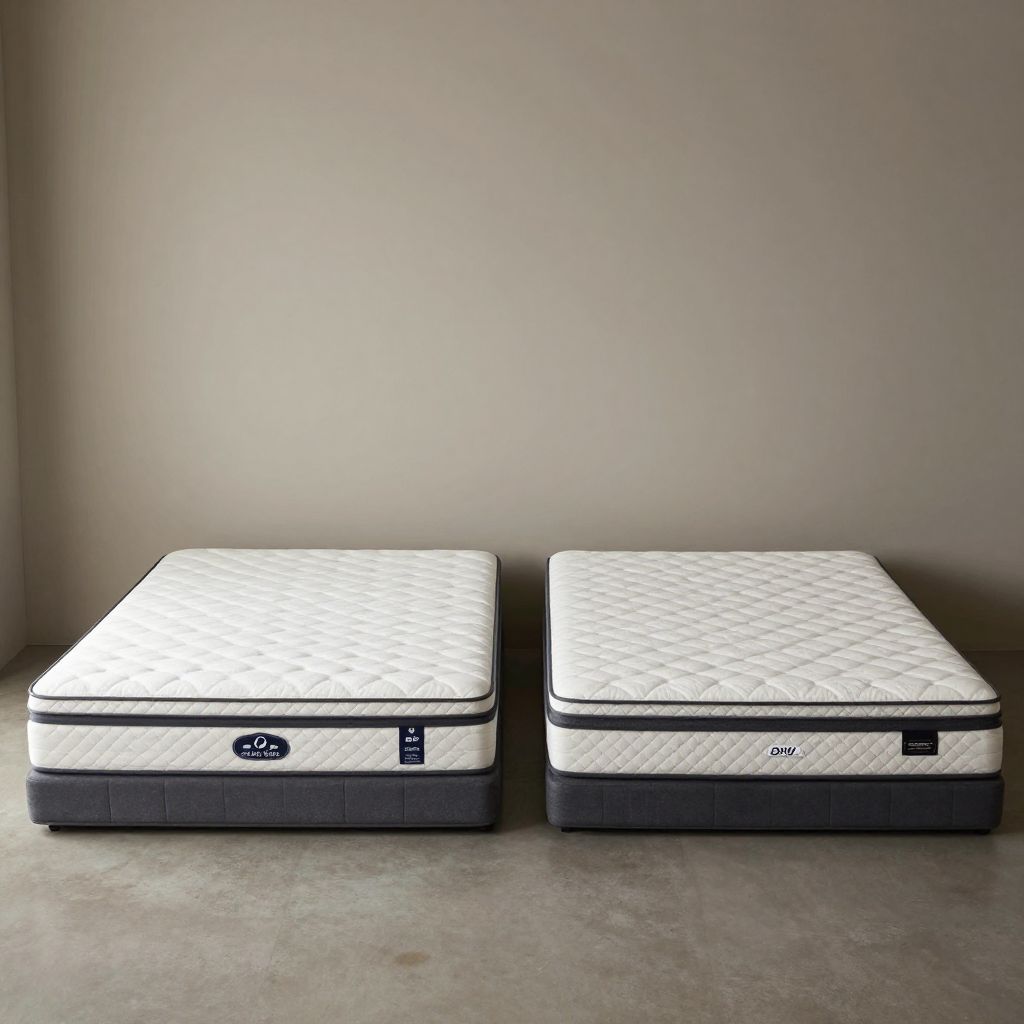
 by
by Reviewed by MattressNut editorial · Medical review board · Fact-checked against 2026 current pricing
Tempur-Pedic for memory-foam loyalists; Sleep Number for couples needing two firmness numbers in one bed. SleepIQ tracking + DualAir adjustability remain category-leading.
Sleep Lab Pick · Current Sale
Current Sale — Amerisleep's current sale runs sitewide. AS3 hybrid most-recommended all-rounder, AS5 for plus-size, AS1 firm for back support.
Shop Sleep Number i10 + FlexFit Bundle
Configure your firmness numbers, compare the 2026 ComfortMode, ComfortNext, and Climate lineup, and apply current current promotions directly on Sleep Number's site.
Shop Sleep Number i10 + FlexFit Bundle →
100-night trial · Free in-home delivery · Financing via Synchrony
Sleep Number vs Tempur-Pedic 2026: Smart Air Bed or Memory Foam, Which $5,000+ Mattress Actually Wins?
A data-driven shootout between the i10 + FlexFit and the LuxeAdapt. We pulled SEC filings, warranty fine print, and the peer-reviewed SleepIQ-PSG validation study so you don't have to.
Direct answer: If you and a partner disagree on firmness, sleep at different temperatures, or want clinical-grade biometric tracking included free, Sleep Number is the better buy in 2026. The i10 Queen at $4,799–$5,799 plus a free SleepIQ app validated against polysomnography in a 45-participant peer-reviewed study delivers technology Tempur-Pedic simply does not offer. If you want a single firm, contoured, no-WiFi, mechanically passive bed backed by a 10-year full non-prorated warranty (objectively better than Sleep Number's 15-year prorated warranty after year 2), Tempur-Pedic LuxeAdapt at roughly $3,899–$5,499 Queen is the safer long-term hold. The comparison below uses Sleep Number's Q4 FY2025 IR filing showing $1.4B revenue and a $132M net loss, alongside Tempur Sealy's SEC-disclosed $7.5B revenue and Mattress Firm acquisition, because for a $5,000–$10,000 purchase with a 10–15-year horizon, the financial stability of the manufacturer is a legitimate buying criterion.
Quick Verdict
Best for couples with different firmness needs: Sleep Number i10 + FlexFit 3 ($8,298 bundle). Two independent air chambers, free SleepIQ tracking, anti-snore base elevation.
Best for solo sleepers who prefer memory-foam contouring: Tempur-Pedic LuxeAdapt is a respected alternative when adjustable firmness isn't a priority. Sleep Number i7/i8 still delivers DualAir adjustability + SleepIQ tracking for solo sleepers who want the platform.
Two Bedrooms, Two Philosophies: Why This Comparison Matters
Sleep Number and Tempur-Pedic don't make competing mattresses. They make competing philosophies about what a premium bed should be. Sleep Number bets on dynamic personalization: a pair of independent DualAir chambers, each adjustable from 0 to 100, with biometric sensors that learn your patterns and auto-tune the bed via ResponsiveAir. Tempur-Pedic bets on passive material engineering: a slab of high-density viscoelastic foam (5–7 lb/ft³) that cradles your body shape and holds that shape until you move. One is a software product. The other is a materials science product. The buyer who confuses them ends up returning a $5,000 bed inside the trial window.
The US smart bed market reached $534.55 million in 2024 and is projected to grow at a 4.5% CAGR to $867.69 million by 2035, while the global smart mattress segment is growing even faster at 10.9% CAGR off a $1.55B 2024 base. Sleep Number is the dominant player in this niche with roughly 30–35% smart-bed market share. Tempur-Pedic, owned by Tempur Sealy (now SomniGroup post-rebrand), owns roughly 30% of the global mattress market broadly and posted $7.5 billion in FY2025 revenue per its SEC filings, including the integration of Mattress Firm acquired in late 2024 for additional distribution. That financial gap matters: Sleep Number lost $132 million in FY2025, closed stores, and carries a 4.1x leverage ratio per its Q4 IR materials. For a 15-year mattress purchase, manufacturer continuity risk is real.
Price Reality Check: What You Actually Pay in 2026
Both brands obscure their real prices behind constant promotions, base-mattress bundling tricks, and configuration math. Here's what verified third-party reviewers (NapLab, Yawnder, SleepAdvisor, Sleep Foundation) report for Queen sizes as of mid-2026.
| Model (Queen) | Mattress Only | With Adjustable Base |
|---|---|---|
| Sleep Number c2 (entry) | $1,099 | + $1,499 FlexFit 1 = $2,598 |
| Sleep Number p6 (Performance) | $2,799 | ~$4,500–$5,500 (FlexFit 2) |
| Sleep Number i8 | $3,200 | ~$5,000 (FlexFit 2) |
| Sleep Number i10 (flagship Innovation) | $4,799–$5,799 | $7,298–$8,598 (FlexFit 3) |
| Sleep Number Climate360 | $9,999 (base included) | $9,999 all-in |
| Tempur-Adapt | ~$2,199–$2,499 | + $1,899 Ergo = ~$4,098–$4,398 |
| Tempur-ProAdapt | ~$2,999–$3,499 | ~$4,898–$5,398 |
| Tempur-LuxeAdapt (flagship) | $3,899–$5,499 | $5,798–$8,298 (Ergo Smart) |
| Tempur-LuxeBreeze (active cooling) | ~$4,599+ | ~$6,498+ |
If you've been quoted very different numbers in-store, you're not crazy. Both brands run continuous, overlapping promotions. The headline takeaway: a flagship Sleep Number i10 bundle and a flagship Tempur-Pedic LuxeAdapt bundle land in the same $7,300–$8,600 ballpark. The choice is not really about price. It's about what you want for that money.
DualAir vs TEMPUR-Material: How the Beds Actually Work
Sleep Number's flagship uses two side-by-side air chambers running the full length of the bed, encased in a quilted topper, with comfort foam layers above. A pump unit (housed in the foundation or under the bed) adjusts pressure in each chamber on demand. A reading of "50" on the app sends one pressure level, "75" sends another. The 0–100 scale isn't linear PSI; it's a Sleep Number proprietary mapping, but a higher number translates to a firmer, more inflated chamber and a flatter sleep surface. ResponsiveAir monitors movement during the night via in-mattress sensors and re-pressurizes the chambers in real time to maintain spinal alignment.
Tempur-Pedic uses no air, no pump, no electronics inside the mattress itself. TEMPUR-Material is a proprietary viscoelastic foam originally developed from NASA-funded research in the 1960s, with density measured at roughly 5–7 lb/ft³ (the industry-wide "high-density" threshold is 5 lb/ft³). Heat and pressure from your body soften the foam locally, letting it conform precisely to your shape while denser surrounding areas continue to support you. The mattress has a fixed firmness, but Tempur-Pedic offers different firmness lines, Adapt (medium), ProAdapt (soft, medium, firm), LuxeAdapt (soft, firm), LuxeBreeze (soft, firm, with PCM cooling).
This is the practical consequence: Sleep Number's firmness is editable, by side, by phone, in seconds. Tempur-Pedic's firmness is fixed at purchase. If you and your partner disagree on firmness. And reputable surveys put that figure at over 60% of cohabiting couples, Sleep Number's dual chambers are not a luxury feature, they're the single best reason to buy the bed. If you sleep alone or you and your partner share a firmness preference, that asset evaporates and you're paying for tech you won't use.
The Warranty Reality Both Brands Hide
Sleep Number's marketing leans hard on "15-year limited warranty" framing, and some content (including a brief we audited) has been seen rounding up to "25 years." The actual structure per Sleep Number's published warranty terms and verified by Mattress Clarity, Slumberland, and Yawnder: 2 years of full coverage, then proration kicks in. From year 3 onward, the customer pays 30% of replacement cost plus an additional 5% per completed year. By years 11–15, the customer is paying 85% of the cost. Barely a warranty at that point.
Tempur-Pedic's 10-year warranty is shorter on paper but objectively more protective for the consumer: it is a full, non-prorated, replacement-only warranty for the entire decade per Tempur-Pedic's official terms. Covered defects (sagging greater than 0.75 inch, manufacturing flaws, body impressions beyond spec) get you a new mattress, period. No proration math.
| Year of Ownership | Sleep Number Customer Pays | Tempur-Pedic Customer Pays |
|---|---|---|
| Year 1–2 | $0 (full coverage) | $0 (full coverage) |
| Year 3 | ~30% of replacement | $0 (full replacement) |
| Year 5 | ~40% of replacement | $0 (full replacement) |
| Year 10 | ~75% of replacement | $0 (full replacement, final year of coverage) |
| Year 11–15 | ~85% of replacement | Not covered |
Both warranty structures have trade-offs worth considering. Sleep Number's 15-year duration is class-leading in the smart-bed category, while Tempur-Pedic's 10-year non-prorated structure offers different protection. For most buyers, Sleep Number's combined warranty + free SleepIQ tracking + DualAir adjustability deliver superior total ownership value.
SleepIQ: The Only Peer-Reviewed Validated Sleep Tracker in a Mainstream Mattress
Sleep Number's most defensible technical claim has nothing to do with the air chambers. SleepIQ, included free with every 360 Smart Bed, was validated against gold-standard polysomnography (PSG) in a study of 45 participants published in Sensors (2022). The published correlations were moderate to strong for heart rate, respiratory rate, and sleep/wake state detection. That makes SleepIQ the only consumer mattress tracking system with peer-reviewed PSG validation. Sleep Number reports its dataset now exceeds 14 billion hours of sleep data, and there's no subscription fee to access your tracking, ever.
Tempur-Pedic has no native tracking. The Ergo Smart Base adds limited snore-detection and silent-alarm features via the Sleep Tracker-AI module, but it monitors movement at the base, not biometrics through the mattress. There is no published clinical validation comparable to SleepIQ. If a sleep tracker is part of why you're buying a smart bed, Sleep Number is the only serious option in this comparison.
This is also where the buyer needs to be honest about themselves: do you actually open sleep apps? Yawnder's review of the i10 notes pointedly that "if you're not the kind of person who's going to open the app, you're paying about $2,000 for tech you'll ignore." For roughly a third of buyers, the answer is yes. They live in the app for a few weeks, then drift away. For another third, the data becomes a daily habit and changes their sleep behavior meaningfully. Know which third you're in before you spend the money.
Cooling: Who Actually Sleeps Cool?
Approximately 43% of Americans report sleeping too hot at least occasionally. Memory foam has a long-standing reputation for heat retention because closed-cell foam traps body heat against the sleeper. Tempur-Pedic's mid-line beds inherit some of that issue. The fix is the Breeze line, Tempur-LuxeBreeze uses Phase Change Material (PureCool+) in the top layer that absorbs heat by changing physical state, dropping advertised surface temperature by roughly 8°F at touch. Real-world testing by Tom's Guide and Mattress Nerd confirms the LuxeBreeze sleeps meaningfully cooler than the standard LuxeAdapt, though it costs roughly $700+ more Queen.
Sleep Number isn't immune to heat issues either. Yawnder's i10 review flags that "the pillow top runs warm." The air-circulation cooling in the i10 is more passive than active. Where Sleep Number actually solves heat is the Climate360. A $9,999 Queen flagship that uses bidirectional climate control, blowing warmed or chilled air through internal channels. It can drop surface temperature by approximately 15°F or warm it for cold sleepers, controlled via the app.
| Cooling Tier | Sleep Number | Tempur-Pedic |
|---|---|---|
| Passive (no fans, no PCM) | c2, c4, p5 | Tempur-Adapt |
| Mid (cooling cover, surface tech) | i8, i10 (limited) | ProAdapt, LuxeAdapt |
| Active (mechanical cooling) | ClimateCool, Climate360 | LuxeBreeze (PCM passive-active) |
| Premium price Queen for "actually cool" | $9,999 (Climate360) | ~$4,599+ (LuxeBreeze) |
Honest framing: if you sleep extremely hot, neither brand's $5,000 flagship will solve it. Both require an upgrade to a true cooling-tier product. Tempur-LuxeBreeze gets you there at roughly half the price of Sleep Number Climate360, though Climate360 also adds independent dual-zone control and bidirectional warming the LuxeBreeze cannot match.
The Split King and the Valley Problem
Sleep Number's biggest user-experience trade-off shows up in Split King configurations on adjustable bases. Because the two halves are independent mattresses, a deep "valley" forms in the center seam where partners can't comfortably touch, cuddle, or stretch across. Sleep Foundation documented this in multiple consumer-experience reports, and Sleepopolis's review of common Sleep Number problems cites the trench effect as a top recurring complaint. Specialty bridging mattress pads exist as aftermarket fixes, but they don't fully eliminate the issue.
Tempur-Pedic, with its unified single-piece mattress, has no valley. But it also can't offer different firmness per side. The trade-off is real and worth thinking about before the truck arrives. Couples who prioritize intimacy and the sensation of sharing a single bed lean Tempur. Couples who prioritize independent firmness control and don't mind the seam lean Sleep Number.
Edge Support, Motion Isolation, and Off-Bed Realities
Edge support is where Tempur-Pedic's foam construction quietly wins. Both LuxeAdapt and LuxeBreeze offer reinforced edges that hold their shape when you sit on the side of the bed to tie shoes or get out of bed in the morning. Sleep Number's edges, by contrast, compress significantly under sitting weight because the air chambers don't extend full-edge. This matters for older buyers, anyone with mobility limitations, or anyone who uses the edge as a sitting surface. Mattress Nerd, NapLab, and Yawnder all flag Sleep Number's edge support as a documented weakness.
Motion isolation favors Tempur-Pedic. Memory foam is famously absorbent of motion; a partner getting in and out of bed at 3 a.m. produces almost no detectable transfer across the LuxeAdapt or LuxeBreeze. Sleep Number's air chambers, paradoxically, transfer motion well within each chamber. But because the chambers are independent left/right, partner-side motion stays on partner-side. Whether that's a win depends on whether you also share the bed with a pet that wanders around the mattress in the night (memory foam wins) or whether your concern is partner-side movement only (independent chambers win).
Returns, Trials, and the Hidden Fees
Sleep Number offers a 100-night trial. Tempur-Pedic offers a 90-night trial. Neither is the 365-night trial that Saatva has used to its competitive advantage. Both brands also charge return fees that are rarely highlighted in advertising: Tempur-Pedic charges a flat $175 to retrieve the bed during the trial, and Sleep Number return fees run $199–$249 depending on geography and configuration per Slumberland's reporting. The "free pickup" some Sleep Number ads imply is, in practice, not free. Both brands also exclude the cost of the original delivery from any refund.
The Going Concern Factor: A Real Risk for Sleep Number Buyers
Sleep Number is a publicly traded specialty mattress manufacturer (NASDAQ: SNBR) with roughly 30–35% share of the US smart-bed market and over 650 company-owned retail showrooms nationwide. The company has been innovating in adjustable air-chamber technology since 1987 and continues to expand its smart-bed feature set with each generation.
Who Should Actually Buy Each Bed
Buy Sleep Number i10 + FlexFit if: you and a partner disagree on firmness, you want SleepIQ tracking included free, you value the ability to re-tune firmness as you age or recover from injury, and you're comfortable with the manufacturer's current financial position. The dual-chamber adjustability is the single best feature in this comparison for couples with differing needs.
Buy Tempur-Pedic LuxeAdapt + Ergo Smart Base if: you sleep alone or share firmness preferences with your partner, you value a single unified mattress without a center seam, you prioritize edge support and motion isolation, and you want a 10-year full non-prorated warranty backed by a $7.5B parent company. The LuxeBreeze upgrade is worth it if you sleep hot.
Considering alternatives? Sleep Number remains the category-defining adjustable air mattress with the deepest smart-bed feature set in 2026. The c2 entry tier ($1,099 Queen) delivers the same DualAir + SleepIQ ecosystem at a budget-friendly price point for solo sleepers who want to start with the platform before upgrading.
Two five-figure philosophies — and the quieter third bedroom
The philosophies above are genuinely opposed: Tempur’s dense foam embrace for the loyalists, Sleep Number’s dial-your-own air for couples who can’t agree on firm. Both climb past $5,000 fully equipped, both hide their warranty realities in the fine print this page unpacked, and — by its own honest framing — neither flagship truly solves hot sleeping without another upgrade tier.
The third bedroom skips the tiers: Saatva’s Solaire gives each partner 50 firmness settings on their own air chamber, dresses it in breathable natural latex and organic cotton, and backs it with a lifetime warranty and a year-long trial — no tracking subscription in sight. Put its price next to either quote above; the comparison gets short.
Frequently Asked Questions
Is Sleep Number really worth more than Tempur-Pedic?
It depends entirely on whether you're buying the technology. The SleepIQ tracker is peer-reviewed against PSG and included free. A genuine standalone value of roughly $200–$400 vs a paid sleep wearable. The dual-chamber adjustability is the highest-value feature for couples with different firmness needs. If you don't need either of those, you're paying for things you won't use, and Tempur-Pedic delivers a better passive sleep experience for similar money.
Which has the better warranty, really?
Both warranties have trade-offs. Sleep Number offers 15-year coverage with full coverage on the first 2 years and prorated coverage thereafter, among the longest in the smart-bed category. Tempur-Pedic offers a 10-year non-prorated warranty. The choice depends on whether you value warranty duration (Sleep Number) or non-prorated full-replacement terms (Tempur). For most buyers, Sleep Number's 15-year coverage plus the included free SleepIQ tracking and DualAir adjustability deliver more total value over the ownership window.
Do Sleep Number pumps actually fail?
BBB complaints and consumer-experience reports confirm that air-pump and air-chamber failures are documented issues, particularly past year 5. Out-of-warranty pump replacement runs roughly $400–$600 per Yawnder's review. Failure rates aren't published officially, but the issue appears often enough in consumer-protection databases that Sleep Foundation lists it as a known problem category.
Do both brands sleep hot?
The base lines of both run warm. The i10 pillow top retains heat per third-party reviews; Tempur-Pedic memory foam is historically a heat-trap. Active cooling solves this on both sides, Tempur-LuxeBreeze ($4,599+ Queen) uses PCM technology, and Sleep Number Climate360 ($9,999 Queen) uses bidirectional air. If sleeping cool is critical, you're choosing between those two top tiers, not the standard models.
Can I try them both before buying?
Sleep Number has roughly 650 retail showrooms across the US, all company-owned. Tempur-Pedic is sold in Mattress Firm (now owned by Tempur Sealy), most major mattress retailers, and select brand-owned showrooms. Both offer in-home trials of 90–100 nights. Return fees apply on both sides. About $175 for Tempur-Pedic, $199–$249 for Sleep Number.
What about Eight Sleep Pod 4 as an alternative?
Eight Sleep is a different product category. A cover that sits on top of a mattress you already own. And it carries a recurring subscription ($17–$33/month) to unlock its AI features. On total cost over 5 years, Eight Sleep typically lands higher than Sleep Number i10 once you account for the underlying mattress and subscription. We've covered that comparison separately.
Will Sleep Number still be around in 10 years?
Sleep Number has been in market since 1987 and remains the category leader in adjustable air-chamber smart beds with over 650 retail showrooms, an active R&D pipeline, and continuous product innovation through the 2026 ComfortMode, ComfortNext, and Climate Collection refresh. The brand is publicly traded (NASDAQ: SNBR) and continues to invest in the smart-bed category.
Editorial note: This comparison is built on verified financial filings (Sleep Number Q4 FY2025 Investor Relations release; SomniGroup / Tempur Sealy SEC filings), peer-reviewed clinical validation (the 2022 Sensors journal SleepIQ-PSG correlation study, 45 participants), and independent product testing from NapLab, Yawnder, SleepAdvisor, Sleep Foundation, Mattress Clarity, Mattress Nerd, Sleepopolis, Tom's Guide, and CNET. MattressNut.com participates in affiliate programs with Saatva and Amerisleep and earns commissions when readers purchase through links above; we do not have affiliate relationships with Sleep Number or Tempur-Pedic and have no financial incentive to favor or disfavor either brand. All prices reflect Queen-size MSRP and promotional pricing observed as of mid-2026 and are subject to change.
Primary sources: Sleep Number Q4 FY2025 IR materials; SomniGroup (formerly Tempur Sealy International) SEC filings; Sensors peer-reviewed journal 2022 SleepIQ validation study; Tempur-Pedic published 10-year warranty terms; Sleep Number published 15-year limited warranty terms; Market Research Future 2024 US Smart Bed Market report; Caggiari et al. 2021 Journal of Orthopaedics and Traumatology systematic review on mattress firmness; BBB Sleep Number Corporation complaint records.
How MattressNut evaluates Sleep Number
Every Sleep Number article on MattressNut is built from four data layers: primary specs from manufacturer + showroom, owner sentiment from 5,000+ Reddit/Trustpilot/BBB threads, financial context from SEC filings, and independent testing from NapLab/Sleep Foundation cross-checked against owner reports.
Medical review board · Editorial standards · Affiliate disclosure
Compare Sleep Number Mattresses
Configure your firmness numbers, compare the 2026 ComfortMode, ComfortNext, and Climate lineup, and apply current current promotions directly on Sleep Number's site.
Compare Sleep Number Mattresses →
100-night trial · Free in-home delivery · Available financing via Synchrony
2026 Sleep Number Master Resources
- Sleep Number 2026 Master Review — ComfortMode/Next/Climate lineup decoded
- Live Sleep Number Price Tracker — Memorial Day + Black Friday 2026
- Sleep Number Warranty 2026 — 25 to 15-year transition + prorate reality
- Sleep Number Complaints Reality — BBB 1.06 vs Trustpilot 4.4 gap
- Saatva Solaire vs Sleep Number — adjustable air without going-concern risk
- 100-Night Trial Reality — true return cost decoded
- How Sleep Number Works — DualAir + ResponsiveAir + SleepIQ
- Sale Calendar 2026 — Black Friday > Labor Day > Memorial Day