
 by
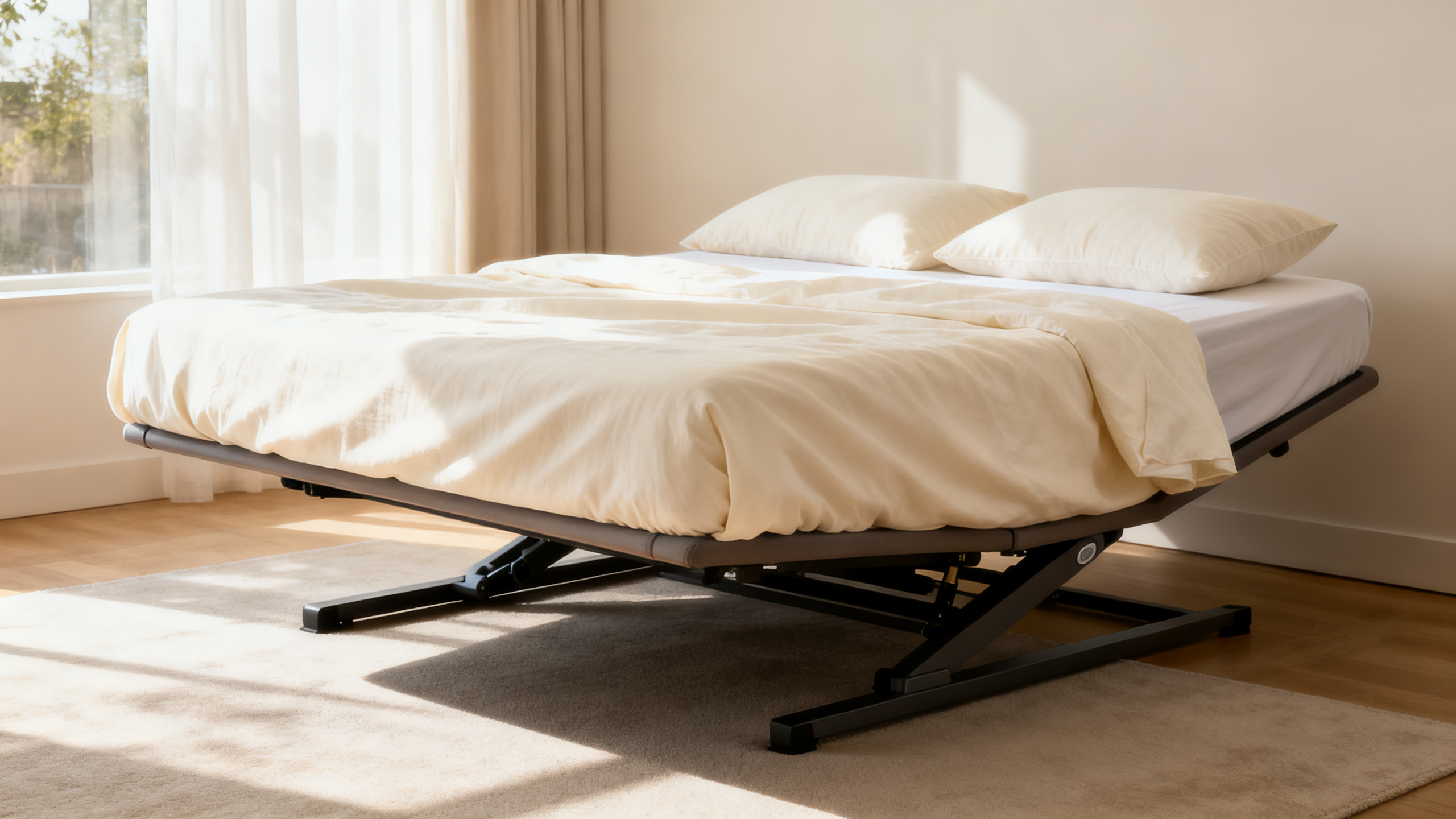
by The best adjustable bed for seniors is the Amerisleep Adjustable Bed Base: wireless backlit remote, zero-gravity preset, anti-snore mode, and a 10-year limited warranty. Pair it with the Amerisleep AS3 mattress for a complete setup that flexes with the base and supports spinal alignment. For seniors who want massage and USB charging, the premium Adjustable Bed+ adds those features at a higher price point.
Amerisleep Adjustable Bed Base
9.4/10
- Wireless backlit remote with zero-gravity and flat one-touch presets
- Anti-snore preset raises head 7° to open the airway passively
- Split King option lets each partner adjust independently
- Max head tilt 60°, max foot tilt 40° — wide therapeutic range
- Pairs perfectly with AS3 Bio-Pur foam, which flexes without cracking
- Free shipping, 100-night trial on AS3 bundle
- No built-in massage on the standard base (available on Adjustable Bed+)
- USB ports and under-bed lighting are Bed+ features only
For seniors, the combination of simple one-touch presets, anti-snore positioning, and a split-king option covers the most common needs without overcomplicating the remote. The 10-year limited warranty covers motor defects through year 2 and the frame beyond that.
Why adjustable beds matter specifically for seniors
Seniors face a set of sleep challenges that a flat mattress simply cannot address. Acid reflux, which affects roughly 20% of adults over 60, worsens in the supine position because gravity no longer keeps stomach acid down. Elevating the head 6 to 8 inches — the zero-gravity and anti-snore presets do exactly this — reduces nighttime reflux episodes measurably.
Arthritis and joint swelling follow circadian patterns. Many seniors wake stiff because blood pools in inflamed joints during hours of uninterrupted stillness. Gentle foot elevation improves venous return and reduces that pooling. The one-touch preset means no fumbling with a remote at 3 a.m.
Getting in and out of bed is a leading cause of senior falls. An adjustable base that raises or lowers the mattress surface to exactly knee height makes standing transfers safer. The Amerisleep base accepts adjustable leg heights of 6, 9, or 12 cm from the frame to the floor, giving meaningful range for different user heights.
Amerisleep Adjustable Bed Base: full senior-focused review
Remote and controls
The backlit wireless remote operates by radio frequency rather than infrared, so it works through bedding without requiring line-of-sight. Buttons are clearly separated: head up/down, foot up/down, zero-gravity, flat, and a programmable memory position you can save once and return to with one press. For seniors with arthritic hands, the physical buttons register with light pressure.
The zero-gravity preset raises both the head (roughly 30°) and the feet simultaneously, distributing body weight evenly across the surface. The anti-snore preset raises the head approximately 7 degrees to reduce airway collapse. Both fire in a single press.
Split King for couples
Two Twin XL bases paired side by side form a split king. Each side is controlled independently. One partner can use zero-gravity for reflux relief while the other stays flat. Sync cables are included if you want to move both sides together. For a senior couple with different positioning needs, this is the most practical configuration available without buying two separate beds.
Pairing with the Amerisleep AS3
The AS3 uses Bio-Pur plant-based foam in an open-cell structure. Foam-only mattresses flex cleanly with an articulating base because there are no springs to buckle. The AS3 at medium firmness (roughly 5.5 to 6.5 out of 10) also works in both the flat and elevated positions without feeling too firm at the flex points. The HIVE 5-zone layer adds lumbar support that remains active regardless of head or foot elevation angle.
Pair: AS3 queen from ~$1,049 + Adjustable Base queen from ~$1,199 = roughly $2,248 before any promotions.
Amerisleep AS3
9.1/10
The AS3 flex-folds cleanly at every angle of the adjustable base and maintains its HIVE lumbar support in all positions. It is the natural pairing for the Amerisleep base, with CertiPUR-US certification and a 20-year warranty.
Alternatives worth considering
Two competing adjustable bases earn genuine consideration for seniors with specific priorities.
Saatva Adjustable Base Plus
8.7/10
- Dual-zone massage with three intensity levels and auto-shutoff timer
- Under-bed LED lighting useful for nighttime transfers
- 25-year frame warranty (5-year motor)
- White-glove delivery available
- Higher price than Amerisleep base
- Best suited to Saatva mattresses; third-party compatibility varies
If massage and under-bed lighting are non-negotiables, the Saatva Adjustable Base Plus delivers them well. The 25-year frame warranty is best-in-class. Choose this over the Amerisleep base only if those therapeutic extras are high on your list.
Tempur-Pedic TEMPUR-Ergo Extend
8.5/10
- Automatic snore response (raises head without waking user)
- Neck tilt and knee break for precise therapeutic positioning
- Lifetime frame warranty
- High price, best value only when bundled with a TEMPUR mattress
- App dependency for advanced features adds complexity for some seniors
The automatic snore detection is a genuine differentiator for couples where one partner snores but does not want to manage a manual preset at 2 a.m. At this price, it makes most sense as a TEMPUR mattress bundle.
Quick comparison: adjustable bases for seniors
| Base | Starting price | Zero-gravity | Massage | Split King | Warranty |
|---|---|---|---|---|---|
| Amerisleep Adjustable Bed Base | ~$1,049 TXL | Yes | No (Bed+ yes) | Yes | 10-yr limited |
| Saatva Adjustable Base Plus | ~$1,249 | Yes | Yes, dual-zone | Yes (split cal king) | 25-yr frame / 5-yr motor |
| Tempur-Pedic TEMPUR-Ergo Extend | ~$2,499 | Yes | Yes | Yes | Lifetime frame / 5-yr motor |
| Purple SmartBase | ~$1,200 | Yes | No | Yes | 10-yr limited |
What to look for in an adjustable base for seniors
- Simple remote: Physical buttons, large enough to press without fine motor precision, backlit for use in the dark. Avoid bases where core presets require an app.
- Zero-gravity and anti-snore presets: One-touch presets avoid manual repositioning. Both are functionally useful for common senior health concerns.
- Leg height flexibility: Look for at least two leg-height settings so the mattress surface can be matched to the user's knee height for safe transfers.
- Split king option: For couples with different positioning needs, two independent Twin XL bases controlled separately prevents sleep disruption.
- Warranty depth: A 10-year limited warranty is the minimum worth considering. Check whether motors and the frame are covered separately and for how long.
- Mattress compatibility: Foam and latex mattresses flex cleanly. Old-school innerspring mattresses may buckle at articulation points and should be replaced when switching to an adjustable base.
Medical benefits of adjustable bases for seniors
Acid reflux and GERD
Elevating the head 6 to 8 inches reduces nighttime acid reflux by keeping stomach contents below the lower esophageal sphincter. Clinical guidelines for GERD management include positional therapy alongside dietary changes. Wedge pillows achieve a similar effect but shift during sleep; a motorized head elevation holds angle consistently through the night.
Sleep apnea and snoring
Head elevation between 7 and 30 degrees reduces airway collapse in mild to moderate obstructive sleep apnea by moving the jaw and tongue slightly forward. Anti-snore presets on most bases target this 7-degree range. This is not a replacement for CPAP therapy in diagnosed OSA, but it reduces snoring intensity and frequency for many users.
Circulation and edema
Elevating the legs above heart level encourages venous return from the lower extremities. Seniors with peripheral edema, varicose veins, or heart failure often find morning ankle swelling reduced after consistent use of a foot-elevated sleeping position. Zero-gravity simultaneously elevates both head and feet to achieve this effect.
Back and hip pain
Zero-gravity distributes body weight across a larger surface area, reducing peak pressure at the lumbar spine and sacrum. For seniors with spinal stenosis, hip osteoarthritis, or degenerative disc disease, this distributed load can measurably reduce morning stiffness. The Amerisleep AS3 HIVE lumbar layer complements this by adding zone-specific support that remains active in all positions.
Does Medicare cover adjustable beds?
Medicare Part B classifies adjustable beds as durable medical equipment (DME) and may cover a portion of the cost when deemed medically necessary. Requirements typically include a physician prescription documenting the medical indication, a qualifying condition (GERD, congestive heart failure, severe COPD, or certain orthopedic conditions), and purchase from a Medicare-approved supplier.
Coverage is limited to the base unit at the DME reimbursement rate, not premium features. Medicaid and VA programs have separate criteria. Confirm with your physician and supplier before purchasing if insurance contribution is part of your budget planning.
Frequently asked questions
What is the safest adjustable bed for seniors with limited mobility?
The Amerisleep Adjustable Bed Base paired with adjustable legs at the correct height for wheelchair-to-bed transfers is the most practical setup. The wireless remote requires no app, no Bluetooth pairing, and no touchscreen. For users who also need side rails, verify that the frame accepts standard third-party rail attachments before purchasing.
Can any mattress go on an adjustable base?
Foam (memory foam, latex, plant-based foam like Bio-Pur) and pocketed coil hybrids flex cleanly on adjustable bases. Bonnell and offset innerspring mattresses with rigid wire construction will buckle at the articulation points and should not be used. The Amerisleep AS3 all-foam construction is designed for base compatibility.
How much should a senior expect to spend on an adjustable base?
The useful range for a durable adjustable base with zero-gravity and anti-snore presets starts around $1,000 to $1,200 for a Twin XL or Queen. Split King configurations run $1,800 to $2,400 because you are purchasing two independent bases. Premium models with massage and automatic features range from $1,800 to $3,500.
Is it safe to sleep in zero-gravity position every night?
Zero-gravity sleeping is safe for most adults and is actively beneficial for those with GERD, edema, or lower back pain. There are no documented adverse effects from consistent use of an elevated sleeping position. If you have a condition that affects circulation significantly, check with your physician before adopting any new sleeping position.
What mattress pairs best with an adjustable base for seniors?
A medium-firmness foam mattress without rigid coil construction is the cleanest pairing. The Amerisleep AS3 is purpose-built for adjustable base compatibility: Bio-Pur foam articulates without cracking or developing pressure points at the flex zones. At medium firmness it also supports the spinal alignment work done by zero-gravity positioning.
The Amerisleep Adjustable Bed Base is the most practical and accessible adjustable base for seniors: simple wireless remote, zero-gravity and anti-snore presets, split-king option, and 10-year limited warranty. Pair it with the Amerisleep AS3 for a complete setup. If therapeutic massage is a priority, the Saatva Adjustable Base Plus adds dual-zone massage at a higher price.
Amerisleep Adjustable Bed Base
9.4/10
Wireless remote, zero-gravity and anti-snore presets, split-king option, 10-year limited warranty. The most complete adjustable base for seniors at its price point, and the cleanest pairing with the Amerisleep AS3 mattress.