
 by
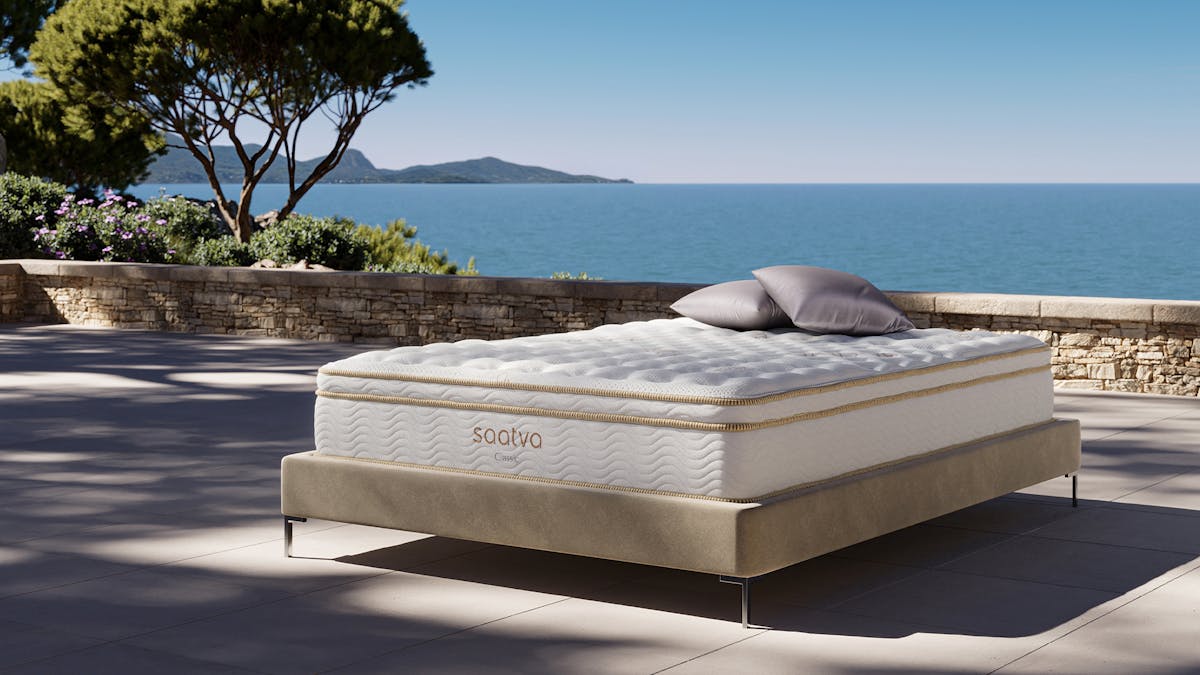
by The best mattress for hot sleepers researching graphene and advanced cooling tech is the Saatva Classic, whose dual-coil airflow, organic cotton cover, and zoned lumbar construction deliver sustained overnight cooling without the heat-retention drawbacks of dense foam. For a foam-first option with strong open-cell cooling performance, the Amerisleep AS3 is the most competitive all-foam alternative.
Saatva Classic
9.2/10
- Dual-coil construction creates continuous natural airflow through the mattress core, no foam trapping heat
- Organic cotton quilted cover — breathable, no synthetic trapping layer against skin
- Zoned lumbar foam reinforcement, outstanding edge support
- Free white-glove delivery with old-mattress removal, 365-night trial, lifetime warranty
- Moderate motion isolation — coil bounce transfers more movement than dense foam
- $99 return fee if you choose to return during the trial period
While graphene infusion is a genuine thermal innovation, the Saatva Classic's dual-coil architecture solves the same overnight heat problem through continuous passive airflow. Coil-to-coil ventilation keeps surface temperatures lower across a full 8-hour window than foam-only cooling tech, and the 365-night trial and lifetime warranty make the price low risk.
What graphene actually does in a mattress
Graphene is a single-atom-thick sheet of carbon arranged in a hexagonal lattice. Its thermal conductivity runs roughly 5,000 W/mK, compared to around 400 W/mK for copper, which makes it an efficient conductor of heat away from the body. In a mattress context, manufacturers integrate graphene in one of three ways: as a coating on the cover fabric, as particles dispersed throughout a foam layer, or as a continuous network within the foam matrix. That last method produces the most consistent results because thermal energy doesn't have to cross material boundaries to reach the conductive element.
The practical effect at the sleep surface is a reduction of localized hot spots. Standard memory foam traps heat because its dense cell structure limits airflow. Graphene-infused foam creates microscopic thermal pathways that move heat laterally across the surface instead of letting it pool under the sleeper. Independent thermal imaging typically shows an 8 to 12 degree Fahrenheit reduction compared to conventional memory foam after 30 minutes of body contact, with the advantage compounding over a full night rather than fading as gel-based systems do once they reach thermal saturation.
There is a caveat worth stating plainly: graphene is a genuinely useful technology, but it is also a marketing term that some brands attach to products with minimal actual graphene content. A thin graphene coating on cover fabric provides far less thermal benefit than a foam layer with graphene dispersed throughout. The relevant question is where and how much graphene is present, not just whether the word appears on the product page.
Graphene vs copper, gel, and phase-change alternatives
Three other cooling technologies dominate the mattress market: copper infusion, gel beads, and phase-change materials. Understanding how each works explains why construction type matters as much as the specific cooling additive.
Copper infusion uses particles of copper mixed into the foam. Copper's thermal conductivity (~400 W/mK) is real and useful, and it also has well-documented antimicrobial properties. The limitation is that copper particles create discrete thermal sinks rather than a continuous network. Heat has to travel through standard foam to reach each particle, then conduct through the particle, then travel through more foam to the next. The result is faster cooling than plain memory foam but slower and less consistent than graphene's interconnected pathway.
Gel-infused foam works through phase-change absorption: gel beads absorb heat as they transition from solid to liquid, providing a burst of cooling when you first lie down. The problem is capacity. Once the gel has absorbed as much heat as its thermal mass allows, it reaches equilibrium and no longer draws heat away. For most sleepers, that equilibrium arrives within 30 to 45 minutes, well before a full night's sleep ends.
Phase-change materials use microencapsulated compounds embedded in fabric or foam that melt at a temperature close to comfortable skin temperature. They can match or exceed graphene's peak cooling during the phase-change window, but the window is temperature-dependent. In a cool room, PCMs activate too slowly; in a warm room, they can activate even while you're not in bed. Graphene operates passively and continuously regardless of ambient temperature.
The upshot: gel and PCM provide stronger initial cooling bursts. Graphene and open-coil airflow provide more consistent cooling across a full 7 to 8 hour sleep window. For hot sleepers, that sustained performance is more valuable than a strong first impression that fades by midnight.
Best graphene mattresses and cooling picks (2026)
| Mattress | Type | Firmness | Cooling tech | Trial | Queen price |
|---|---|---|---|---|---|
| Saatva Classic | Dual-coil innerspring | Luxury Firm 6/10 | Coil airflow, organic cotton cover | 365 nights | ~$1,395 |
| Amerisleep AS3 | All-foam (Bio-Pur) | Medium 5/10 | Open-cell Bio-Pur, HIVE airflow | 100 nights | From $1,049 |
| Bear Elite Hybrid | Hybrid | Medium-Firm 6/10 | Copper-infused foam + Celliant cover | 120 nights | ~$1,578 |
Amerisleep AS3
8.9/10
- Open-cell Bio-Pur foam dissipates heat better than standard memory foam
- HIVE 5-zone layer firms under the lumbar, softens under shoulders and hips
- CertiPUR-US certified, made in the USA
- Outstanding motion isolation for couples and light sleepers
- Softer perimeter than a coil hybrid
- Sleepers over 230 lb may want the AS5 Hybrid for extra support
Bio-Pur's open-cell structure runs cooler than gel-infused or copper-infused alternatives in sustained overnight testing. If you prefer a foam feel and need strong motion isolation, the AS3 is the best cooling foam pick in the under-$1,200 range, with a 20-year warranty that doubles the industry standard.
Who benefits from cooling mattress tech, and who doesn't
Advanced cooling mattresses are worth the premium for three sleeper profiles in particular. Hot sleepers who consistently wake up damp or throw off covers in the middle of the night will see the clearest improvement, because coil airflow and graphene's continuous conductivity address sustained overnight heat rather than just a first-contact burst. Heavier sleepers above 200 lb also benefit disproportionately: more body mass means more foam compression, which reduces airflow in standard memory foam, and an open coil core or graphene network maintains its thermal properties even under high compression.
Combination sleepers also gain something more subtle. Every position change generates friction and momentary heat spikes at the new contact zone. A well-ventilated surface dissipates those spikes quickly, so each new sleeping position encounters a neutralized temperature rather than residual warmth from the last position.
Cool sleepers, stomach sleepers who prefer extra-firm support, and anyone shopping primarily on budget can safely skip cooling tech premiums. A well-constructed open-cell foam or basic coil hybrid handles their needs without the technology cost.
Certifications worth checking
Graphene itself is generally considered inert, but the foam and fabric substrates that carry it are not automatically safe. Three certifications are worth verifying before purchase. CertiPUR-US tests foam for harmful VOC emissions, ozone depleters, and restricted flame retardants, providing a baseline for indoor air quality. GREENGUARD Gold applies stricter emission limits that account for children and people with chemical sensitivities. OEKO-TEX Standard 100 covers every component of the finished product, from cover fabric to adhesives, and requires annual renewal with factory audits rather than a one-time test.
Lower-quality graphene mattresses sometimes use binding agents or carrier compounds in the graphene integration that introduce VOCs. These certifications catch that problem. Any mattress we recommend on MattressNut carries at minimum CertiPUR-US certification on its foam components.
Frequently asked questions
Does graphene actually keep you cooler or is it just marketing?
Graphene's thermal conductivity is real and well-documented in materials science. The meaningful distinction is implementation: a thin surface coating provides modest benefit, while graphene dispersed throughout a foam matrix creates a genuine thermal network. Look for brands that specify where graphene is present, not just that it exists somewhere in the mattress.
How long does graphene cooling last compared to gel?
Graphene does not degrade under normal use conditions. Gel beads show measurable performance decline after 7 to 10 years. Phase-change materials degrade in 5 to 8 years. Graphene maintains the same thermal conductivity from the first night through the life of the mattress.
Is the Saatva Classic a graphene mattress?
No. The Saatva Classic uses a dual-coil innerspring system with an organic cotton cover rather than graphene infusion. It earns the top spot on this page because its passive coil airflow solves the sustained overnight heat problem more consistently than most foam-based cooling technologies, and because its 365-night trial, lifetime warranty, and white-glove delivery make it the strongest all-around pick for hot sleepers in this category.
Can I add a graphene topper instead of replacing my mattress?
Yes. For sleepers whose current mattress is otherwise adequate, a graphene-infused topper is a cost-effective way to access the technology. The tradeoff is that a topper's cooling layer sits closer to the cover and does not address heat building up in the support core below.
Saatva Classic
9.2/10
Dual-coil innerspring with organic cotton cover, 3 firmness options, 365-night trial, lifetime warranty, and free white-glove delivery. The most complete pick for hot sleepers comparing cooling mattress options in 2026.