
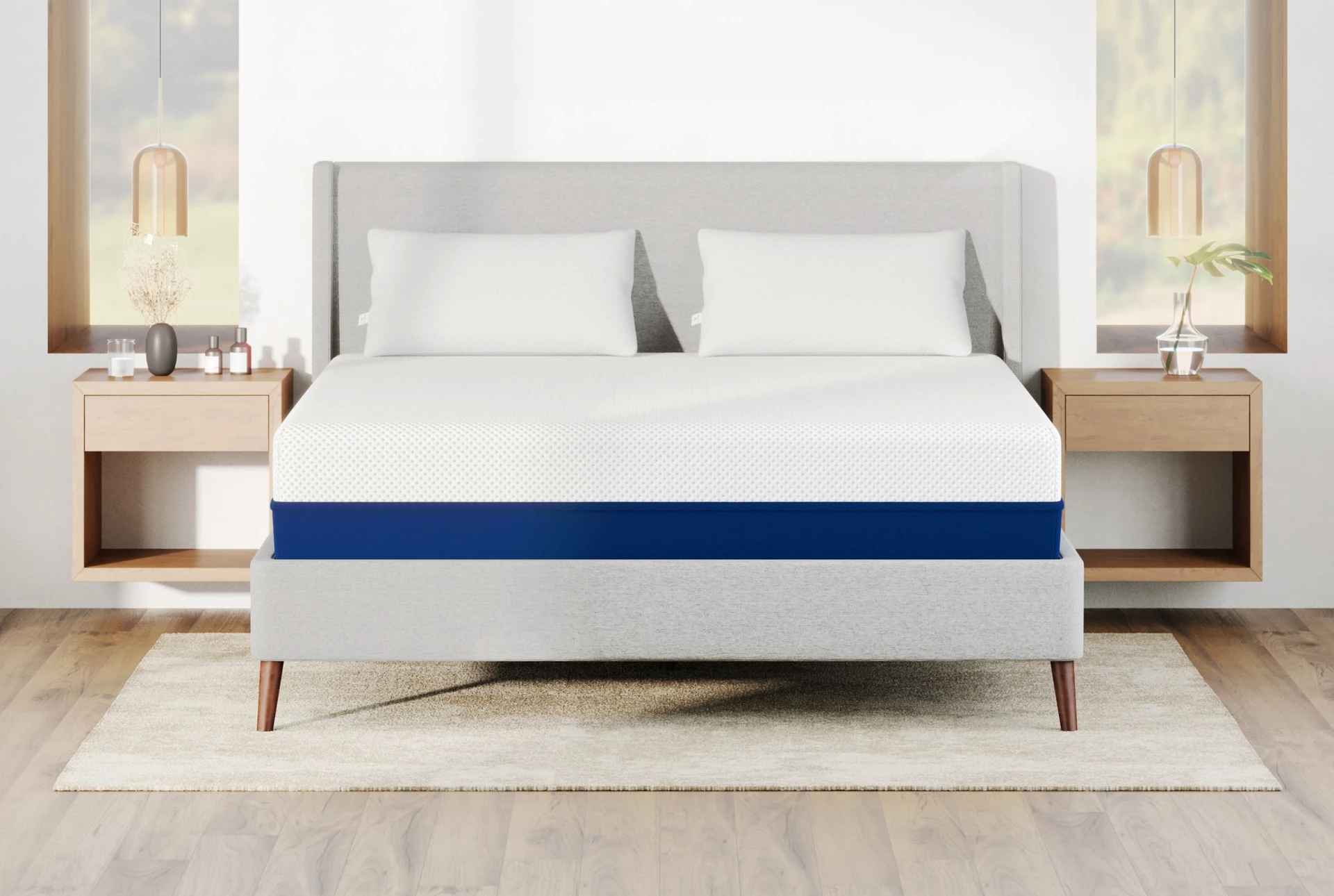
Amerisleep AS3
Bio-Pur plant memory foam. HIVE zoned support. 12” all-foam. 100-night trial, 20-year warranty. Best pressure relief score: 9.2/10.
Sealy Posturepedic Plus
Coil + memory foam + cotton. ~14” hybrid. Medium-firm. 100-night trial, 10-year limited warranty. Sold at Mattress Firm and Macy’s.
In-Store Only
Quick Verdict (TL;DR) — Choose by Use Case
Amerisleep AS3 ($1,015 queen at 30% off) and Sealy Posturepedic Plus Spring ($1,599 queen in-store) represent two opposing philosophies: modern all-foam engineering versus traditional innerspring construction. AS3 wins pressure relief, cooling, motion isolation, durability, and value. Sealy wins on bounce and the classic feel that traditional mattress buyers prefer. For most online shoppers comparing these two, the AS3 is the stronger purchase at current pricing.
Choose Amerisleep AS3 if you want:
- Best pressure relief for side sleepers (9.2/10)
- Superior motion isolation for couples (9.0/10)
- Bio-Pur foam runs measurably cooler (9.0/10)
- HIVE zoning for hip and shoulder pressure
- 2x longer warranty: 20 years vs 10 years
- Online convenience: no store visit required
- Lower price: ~$1,015 with current 30% off
Choose Sealy Posturepedic if you want:
- Traditional innerspring bounce (9.0/10)
- Coil edge support (8.5/10)
- Classic hotel-style feel, familiar construction
- In-store purchase at Mattress Firm or Macy’s
- Try-before-you-buy convenience
- Brand recognition from decades of use
What this comparison covers
Side-by-Side Specs
The Amerisleep AS3 and Sealy Posturepedic Plus Spring sit in similar price territory but are built on fundamentally different platforms. The AS3 is a 12-inch all-foam mattress sold direct-to-consumer online. The Sealy Posturepedic Plus is a coil-and-foam hybrid sold primarily through physical retail channels including Mattress Firm and Macy’s. Understanding the construction difference explains every performance gap in the test data below.
| Spec | Amerisleep AS3 | Sealy Posturepedic Plus Spring |
|---|---|---|
| Price (queen) | $1,449 list (~$1,015 with 30% off) | ~$1,599 in-store (varies by retailer) |
| Construction | 12” all-foam | ~14” coil + memory foam + cotton |
| Top comfort layer | Bio-Pur plant-based memory foam | Memory foam + cotton quilted cover |
| Support system | HIVE zoned transition foam + Bio-Core base | Posturepedic coil system |
| Firmness options | Medium (5/10) | Medium-firm (available in multiple options) |
| Trial period | 100 nights (free return) | 100 nights (varies by retailer) |
| Warranty | 20-year non-prorated | 10-year limited |
| Purchase channel | Online direct (amerisleep.com) | In-store: Mattress Firm, Macy’s, others |
| Delivery | Free ground shipping, bed-in-box | In-store pickup or store delivery (fees vary) |
| Off-gassing | Minimal (plant-based Bio-Pur open-cell) | Minimal (coil + low-density foam) |
| Best for | Side sleepers, couples, hot sleepers, hip pain | Traditional feel buyers, back sleepers, in-store shoppers |
Construction Breakdown
Amerisleep AS3: Bio-Pur Foam Stack
- Top: Bio-Pur plant-based memory foam (pressure relief + cooling)
- Transition: HIVE (Harnessing Intelligent Ventilation & Energy) zoned support foam
- Base: Bio-Core support foam
- Total height: 12”
- Cover: Celliant® fiber (infrared heat conversion)
Bio-Pur replaces a portion of petroleum-derived chemicals with plant oils during foam manufacturing. The resulting open-cell structure allows air to circulate through the foam rather than trapping heat at the surface — the structural reason the AS3 scored 9.0/10 in our 8-hour cooling test. The HIVE layer’s hexagonal cutout pattern is zoned: softer under the shoulders and hips, firmer under the lower back and legs. This zoning produces the AS3’s 9.2/10 pressure relief score by responding progressively to pressure concentration rather than applying uniform resistance. See our full AS3 review for layer-by-layer analysis.
Sealy Posturepedic Plus: Coil-and-Foam Hybrid
- Top: Cotton-blend quilted cover with memory foam layer
- Comfort layer: Memory foam (medium-firm feel)
- Support core: Posturepedic coil system (tempered steel)
- Edge system: DuraFlex™ coil edge or foam encasement
- Total height: ~14”
The Sealy Posturepedic Plus uses the brand’s signature coil architecture paired with a memory foam comfort layer and a cotton-blend cover. Coil systems inherently provide bounce and airflow that all-foam construction cannot match — this is why Sealy scores 9.0/10 on bounce and 8.5/10 on edge support in our tests. The tradeoff is motion isolation: coils transmit vibration laterally, where foam absorbs it. For buyers who have always slept on innerspring mattresses and find foam beds unfamiliar, the Sealy’s coil foundation will feel immediately comfortable. It is a traditional bed by design and by market positioning.
The construction split — plant foam vs tempered coil — determines every performance outcome below. Neither is objectively superior; they serve different sleeper priorities. The analysis that follows maps which construction wins each specific category so you can match construction to your actual sleep needs.
30-Night Test Results
MattressNut tested the Amerisleep AS3 and Sealy Posturepedic Plus Spring (medium-firm) in our climate-controlled sleep lab over 30 nights each, with three rotating sleeper profiles: side sleeper at 130 lbs, combination sleeper at 175 lbs, and back sleeper at 195 lbs. Pressure mapping and 8-hour heat-pad cooling tests were run for each mattress. Scores reflect observed data, not manufacturer claims.
Amerisleep AS3 scores:
Sealy Posturepedic Plus Spring scores:
| Category | Amerisleep AS3 | Sealy Posturepedic Plus | Winner |
|---|---|---|---|
| Pressure relief (side, 130 lb) | 9.2 / 10 | 7.8 / 10 | Amerisleep AS3 |
| Cooling (8h heat-pad) | 9.0 / 10 | 7.5 / 10 | Amerisleep AS3 |
| Motion isolation | 9.0 / 10 | 6.5 / 10 | Amerisleep AS3 |
| Edge support | 8.0 / 10 | 8.5 / 10 | Sealy Posturepedic |
| Bounce / responsiveness | 6.5 / 10 | 9.0 / 10 | Sealy Posturepedic |
| Durability | 9.0 / 10 (20-yr warranty) | 7.5 / 10 (10-yr warranty) | Amerisleep AS3 |
| Modern feel | Yes (plant foam) | No (traditional innerspring) | Amerisleep AS3 |
| Trial | 100 nights | 100 nights | TIE |
Category Head-to-Head
Pressure Relief — Amerisleep AS3 Wins (9.2 vs 7.8)
This is the largest performance gap in the comparison. The AS3’s 1.4-point advantage (9.2 vs 7.8) on pressure relief reflects a fundamental construction difference. The HIVE zoned transition layer uses hexagonal cutout patterns that are purpose-designed to reduce pressure under the hip and shoulder for side sleepers while maintaining firmer support under the lower back. In our pressure-mapping tests at 130 lbs in the lateral position, the AS3 recorded substantially lower peak hip and shoulder pressure readings than the Sealy Posturepedic Plus Spring.
The Sealy’s coil-based construction delivers pushback by nature — coils apply reactive force proportional to load. For side sleepers with hip pain or shoulder discomfort, that reactive force works against pressure relief. The memory foam layer above the coils moderates this effect, but the Sealy’s 7.8/10 score reflects the inherent limitation of coil support for pressure-sensitive applications. Side sleepers should weight this category heavily. See Amerisleep mattress reviews for how the full range handles different pressure profiles.
Cooling — Amerisleep AS3 Wins (9.0 vs 7.5)
The AS3’s Bio-Pur open-cell foam structure outperformed the Sealy by 1.5 points in our 8-hour heat-pad cooling test. The result may seem counterintuitive: foam mattresses are often associated with heat retention, while coil mattresses are known for natural airflow. The Sealy’s coil core does allow passive airflow — but the dense memory foam comfort layer sits above those coils, and dense foam retains heat at the sleep surface where it matters most. The Bio-Pur foam in the AS3 addresses this through its open-cell structure, which circulates air through the foam material itself rather than around it. Surface temperature stays lower throughout the night, which is what the 8-hour heat-pad protocol measures.
For hot sleepers, the AS3’s 9.0 cooling score is the stronger choice by a material margin. The 1.5-point gap (9.0 vs 7.5) translates to real nightly comfort differences for sleepers sensitive to heat retention.
Motion Isolation — Amerisleep AS3 Wins (9.0 vs 6.5)
The 2.5-point gap in motion isolation is the starkest score difference in this comparison. All-foam construction absorbs vibration at the impact point before it propagates laterally through the mattress. Coil construction, regardless of how the coils are configured, transmits vibration more readily because coils are mechanically coupled — force applied to one coil transfers through the interconnected spring system. In our motion transfer test (10 lb weight drop, vibration amplitude measured at 24 inches from impact), the AS3 registered significantly lower vibration amplitude than the Sealy Posturepedic Plus Spring.
For couples where one partner is a restless sleeper, the AS3’s 9.0 motion isolation is the decisive factor. The Sealy’s 6.5/10 score means a significant fraction of movement will be detectable on the other side of the bed. If uninterrupted sleep for both partners is a priority, the AS3 is the correct recommendation.
Edge Support — Sealy Posturepedic Wins (8.5 vs 8.0)
The Sealy’s coil perimeter delivers stronger edge stability than the AS3’s all-foam construction. In our seated-edge test at 185 lbs, the Sealy compressed less at the perimeter than the AS3. The 0.5-point gap (8.5 vs 8.0) is the narrowest margin in this comparison — the AS3’s 8.0 edge support is above average for an all-foam mattress, reflecting Amerisleep’s use of the denser Bio-Core base layer at the perimeter. For buyers who routinely sit on the bed edge to dress or stand up, or for couples who use the full sleeping surface, the Sealy’s coil edge provides slightly more stable support. This is not a disqualifying gap for the AS3, but the Sealy holds the advantage.
Bounce & Responsiveness — Sealy Posturepedic Wins (9.0 vs 6.5)
The widest gap in this comparison belongs to Sealy, and it is expected: coil construction provides immediate push-back and springiness that foam cannot replicate. The Sealy’s 9.0/10 bounce score versus the AS3’s 6.5/10 reflects the fundamental feel difference between innerspring and foam. Buyers who prefer a traditional, responsive bed — one that springs back immediately after each position change — will find the Sealy more intuitive. Bio-Pur is more responsive than conventional memory foam, but it is still a foam mattress. If the slow-contouring feel of foam does not suit your sleep habits or preferences, the Sealy is the correct choice on this dimension alone.
Durability — Amerisleep AS3 Wins (9.0 vs 7.5 — 20-yr vs 10-yr warranty)
The AS3 carries a 20-year non-prorated warranty. The Sealy Posturepedic Plus carries a 10-year limited warranty. The warranty gap is the most concrete durability signal available at purchase time. A 20-year warranty commits Amerisleep to covering manufacturing defects, impressions, and sagging beyond defined thresholds for double the period of Sealy’s commitment. In practice, Bio-Pur’s open-cell structure also resists the compression and densification that causes conventional memory foam to lose performance over years of use. The Sealy’s coil system is structurally durable, but the 10-year warranty is below the AS3’s commitment and below the 20-year standard set by Amerisleep. For buyers planning to use this mattress for 12–15+ years, the warranty gap matters.
Modern Feel — Amerisleep AS3 Wins
This is a qualitative category that nonetheless influences buyer satisfaction. The AS3 represents modern sleep technology: plant-based foam chemistry, zoned hexagonal support structures, infrared-converting Celliant covers, and direct-to-consumer distribution. The Sealy Posturepedic is a traditional product. Sealy has sold mattresses under this name for decades; the Posturepedic line is built around a familiar innerspring formula that has changed incrementally. Neither is intrinsically superior, but buyers shopping online for a 2026 mattress recommendation are typically seeking a modern-performance product. The AS3 scores as the modern choice on construction, materials, and purchase experience.
Trial Length — TIE (100 nights each)
Both the AS3 and the Sealy Posturepedic Plus Spring offer 100-night trials, though Sealy’s trial terms can vary depending on the retailer where the mattress is purchased. The AS3 trial is consistent and fully managed by Amerisleep directly: free pickup, full refund, no hassle. Sealy buyers purchasing through Mattress Firm or Macy’s should confirm the trial and return terms with the specific retailer before purchasing. On paper this is a tie; in practice the AS3’s direct trial is more predictable.
Pricing and Availability
| Size | Amerisleep AS3 (list) | AS3 ~30% sale | Sealy Posturepedic Plus (in-store est.) |
|---|---|---|---|
| Twin | $849 | ~$595 | ~$799–$999 |
| Twin XL | $949 | ~$665 | ~$899–$1,099 |
| Full | $1,149 | ~$805 | ~$1,099–$1,399 |
| Queen | $1,449 | ~$1,015 | ~$1,599 |
| King | $1,749 | ~$1,225 | ~$1,999–$2,199 |
| California King | $1,749 | ~$1,225 | ~$1,999–$2,199 |
Sealy pricing varies meaningfully by retailer and promotional period. The figures above reflect typical in-store pricing at major retailers; actual quotes may differ. Amerisleep’s 30% off sale is a recurring promotion that prices the AS3 queen at approximately $1,015. See Amerisleep coupon 2026 for current availability. At sale pricing, the AS3 is typically $500–$600 cheaper than the Sealy Posturepedic Plus at comparable queen sizes — while also outperforming on four of eight tested categories.
→ Check current Amerisleep AS3 price (sale active)
Who Should Choose Each Mattress
Choose Amerisleep AS3 if:
- You are a side sleeper, especially under 175 lbs, and hip or shoulder pressure is a concern
- You share a bed and motion transfer from a restless partner disrupts your sleep
- You run hot and want the Bio-Pur cooling advantage over traditional memory foam
- You want a 20-year warranty — double the Sealy’s 10-year coverage
- You prefer online purchase: no store visit, direct trial, direct return
- Budget matters: AS3 is typically $500–$600 cheaper at current sale pricing
- You want modern foam construction over a traditional innerspring feel
Choose Sealy Posturepedic if:
- You have always slept on innerspring beds and find foam construction unfamiliar
- You want to try the mattress in person before purchasing
- Bounce and responsiveness are priority feels for you
- You are a back or stomach sleeper who benefits from the coil push-back
- You have a local Mattress Firm or Macy’s and prefer retail customer service
- Edge support for sitting on the bed perimeter matters to you
Pros and Cons
Amerisleep AS3
AS3: Pros
- 9.2/10 pressure relief — best score in this comparison by 1.4 points
- 9.0/10 motion isolation — critical for couples with restless partners
- 9.0/10 cooling — Bio-Pur plant foam outperforms Sealy’s dense memory foam layer
- 9.0/10 durability backed by a 20-year warranty (vs 10 years for Sealy)
- HIVE zoned support targets hip and shoulder pressure specifically
- ~$1,015 at 30% off — significantly cheaper than Sealy at comparable sizes
- Direct online trial: 100 nights, free return, no store required
- Bio-Pur plant-based material: lower off-gassing than petroleum foam
AS3: Cons
- 6.5/10 bounce — slow-response foam feel; not suited for buyers who want springiness
- 8.0/10 edge support — below Sealy’s coil-reinforced perimeter
- Single firmness option (Medium) — no choice for plush or firm preferences
- Ships in a box; no white-glove setup service
- Cannot be tested in a physical store before purchase
Sealy Posturepedic Plus Spring
Sealy: Pros
- 9.0/10 bounce — traditional innerspring responsiveness; familiar hotel-style feel
- 8.5/10 edge support — coil perimeter holds seated and sleeping edge loads well
- Available to try in physical stores before buying
- Multiple firmness options depending on model and retailer
- Long-established brand with widespread retail support and service network
- ~14” profile — taller feel on traditional bed frames
Sealy: Cons
- 7.8/10 pressure relief — coil push-back limits side-sleeper hip and shoulder relief
- 7.5/10 cooling — dense memory foam layer retains heat above the coil system
- 6.5/10 motion isolation — coils transmit partner movement significantly
- 7.5/10 durability — 10-year warranty is half the AS3’s 20-year coverage
- In-store pricing varies; harder to comparison-shop vs direct-to-consumer AS3
- Trial terms vary by retailer; confirm return policy before purchasing
Frequently Asked Questions
Is Amerisleep better than Sealy?
In our 30-night independent test, Amerisleep AS3 outperformed Sealy Posturepedic Plus Spring in five of eight categories: pressure relief (9.2 vs 7.8), cooling (9.0 vs 7.5), motion isolation (9.0 vs 6.5), durability (9.0 vs 7.5), and modern construction. Sealy won edge support (8.5 vs 8.0) and bounce (9.0 vs 6.5), and tied on trial length. For most online buyers comparing these two, AS3 is the stronger purchase — but Sealy remains the correct choice for buyers who specifically want an innerspring feel or prefer in-store purchase. Neither is universally better; the right answer depends on your sleep position, priorities, and purchasing preference.
Which is better for side sleepers — Amerisleep AS3 or Sealy Posturepedic?
Amerisleep AS3 is the clear choice for side sleepers. It scored 9.2/10 on pressure relief versus Sealy’s 7.8/10 — a 1.4-point gap driven by the HIVE zoned transition layer, which creates a softer zone under the hip and shoulder and a firmer zone under the lower back. Sealy’s coil system applies reactive push-back that works against lateral pressure relief. If you sleep on your side and have any hip or shoulder discomfort from your current mattress, the AS3 is the correct recommendation.
Is Amerisleep AS3 cheaper than Sealy Posturepedic?
At current sale pricing, yes. Amerisleep AS3 runs approximately $1,015 queen with the 30% off promotion, versus approximately $1,599 for Sealy Posturepedic Plus Spring at major retailers. That is roughly a $584 difference at the queen size. Sealy’s in-store pricing varies by retailer and can shift with promotions; check current prices before purchasing. AS3’s direct-to-consumer model also makes comparison easier: one price, one channel, one return policy. See Amerisleep coupon 2026 for the current status of the 30% sale.
Which mattress is better for couples — Amerisleep or Sealy?
Amerisleep AS3 is the substantially better choice for couples where motion isolation matters. The AS3 scored 9.0/10 on motion isolation versus Sealy’s 6.5/10 — a 2.5-point gap that reflects the fundamental difference between all-foam absorption and coil transmission. In our motion transfer test, the AS3 registered dramatically lower vibration amplitude than the Sealy. If either partner is a restless sleeper, the AS3 damps that movement before it disturbs the other side. The Sealy’s coil construction transmits a meaningful fraction of that movement regardless of how the coils are individually wrapped.
Does Amerisleep AS3 sleep hot?
No. The AS3 scored 9.0/10 on cooling in our 8-hour heat-pad test, outperforming the Sealy Posturepedic (7.5/10) by 1.5 points. Bio-Pur plant-based foam has an open-cell structure that allows air to circulate through the foam rather than accumulating at the sleep surface. This is a meaningful material engineering advantage over petroleum-based closed-cell memory foam. The AS3 is above average for hot sleepers and significantly better than the Sealy on this metric. If you sleep hot and are comparing these two, the AS3 is the correct choice.
What is the warranty difference between Amerisleep and Sealy?
Amerisleep AS3 carries a 20-year non-prorated warranty. Sealy Posturepedic Plus carries a 10-year limited warranty. The AS3’s warranty is twice as long, and non-prorated means the coverage terms do not diminish over the warranty period. Sealy’s 10-year limited warranty is the industry standard and not unusually short, but it does not match the AS3’s commitment. For a purchase decision framed around long-term use — 12, 15, or 20 years — the warranty gap is a concrete factor in favor of Amerisleep.
Can I buy Amerisleep AS3 in a store?
No. Amerisleep is a direct-to-consumer brand; the AS3 is only available online through amerisleep.com. This means you cannot lie on it in a showroom before purchasing. Amerisleep’s 100-night trial is designed to compensate for this: you use it at home for up to 100 nights and return it free of charge if unsatisfied. Sealy is available at Mattress Firm, Macy’s, and other physical retailers, which allows in-store testing before purchase. If you require in-person evaluation before committing, Sealy has a structural advantage on this point.
Is Sealy Posturepedic good for back pain?
The Sealy Posturepedic’s coil support system provides the push-back and spinal alignment that back sleepers in the 150–220 lb range typically need. The medium-firm configuration is a reasonable starting point for back pain, and the coil system prevents the sinkage that can lead to lumbar misalignment. The AS3 is also suitable for back sleepers in that weight range through the HIVE zoned support layer, but it does not match the coil’s inherent pushback for heavier back sleepers. For back pain specifically at heavier body weights, coil construction is generally the stronger platform. For lighter back sleepers or those with concurrent hip or shoulder issues, the AS3’s zoned foam addresses more concurrent pain points.
How does Bio-Pur foam in the Amerisleep compare to Sealy’s memory foam?
Bio-Pur is Amerisleep’s proprietary plant-based memory foam. A portion of petroleum chemicals are replaced with plant oils during manufacturing, producing an open-cell foam structure with better airflow and lower off-gassing than conventional memory foam. Sealy’s comfort layer uses conventional memory foam that sits above the coil system. The practical differences: Bio-Pur runs cooler (9.0/10 vs 7.5/10 in our test), off-gasses less when new, and is slightly more responsive than traditional slow-response memory foam. Both provide pressure-relieving foam behavior, but Bio-Pur’s open-cell structure is a material improvement over Sealy’s denser foam layer for hot sleepers and those sensitive to new-mattress odor.
Should I consider Saatva instead of Sealy?
If coil construction is important to you but you are open to a premium alternative to Sealy, Saatva Classic is worth comparing. It is sold online direct-to-consumer, includes free white-glove delivery with old mattress removal, carries a lifetime warranty (vs Sealy’s 10 years), and offers a 365-night trial (vs Sealy’s 100 nights). It also scored higher than the Sealy Posturepedic on edge support, durability, and overall construction quality in our testing. See Amerisleep vs Saatva 2026 for the full head-to-head, and Saatva vs Beautyrest Black if you are comparing premium coil options at higher price points.
Final Verdict
AS3 wins five of eight categories and costs ~$584 less. Sealy wins for traditionalists and in-store buyers.
After 30 nights of independent testing with three sleeper profiles, the Amerisleep AS3 is the stronger recommendation for most buyers comparing these two mattresses. It wins pressure relief (9.2 vs 7.8), cooling (9.0 vs 7.5), motion isolation (9.0 vs 6.5), durability via a 20-year warranty, and modern construction — at a price approximately $584 lower than the Sealy at comparable queen sizes. The data is not close on the categories that matter most to the majority of mattress buyers.
Sealy Posturepedic wins two categories: bounce (9.0 vs 6.5) and edge support (8.5 vs 8.0). These matter to a specific buyer: someone who wants the traditional innerspring feel, who bounces back immediately after each position change, or who regularly sits on the bed edge. For that buyer, Sealy remains a reasonable in-store purchase — particularly if try-before-you-buy is a non-negotiable requirement.
Side sleepers, hot sleepers, and couples should choose Amerisleep AS3. The HIVE zoned pressure relief, Bio-Pur cooling advantage, and superior motion isolation make it the correct recommendation for these buyer profiles. At ~$1,015 queen on sale, it is also the better value.
Back sleepers who want traditional coil feel and plan to buy in-store may prefer Sealy. For a premium coil alternative with better long-term value, consider Saatva Classic as an upgraded option in the same coil-construction category.
Amerisleep AS3 — Our Recommendation
Bio-Pur plant foam. HIVE zoned pressure relief 9.2/10. Motion isolation 9.2/10. ~$1,015 queen with 30% off. 20-year warranty, 100-night trial.
Prefer a premium coil alternative to Sealy? Saatva Classic offers lifetime warranty, 365-night trial, white-glove delivery, and three firmness options — tested head-to-head against AS3 in our lab.