
 by
by Our Top Mattress Pick for Better Sleep
The Saatva Mattress combines pressure relief with spinal support — the two factors that matter most for deep, restorative sleep cycles.
Affiliate link — we earn a commission at no extra cost to you.
James Clear's Atomic Habits (2018) became one of the most commercially successful productivity books of the decade by reframing self-improvement around a single idea: small, consistent improvements compound into remarkable results over time. The book's four laws — make it obvious, make it attractive, make it easy, make it satisfying — provide an unusually precise toolkit for building any behavioral change.
Sleep improvement is one of the most powerful applications of the Atomic Habits framework because sleep is fundamentally a behavioral system, not a passive event. What you do in the hours before bed determines what happens during the hours you spend in bed.
Identity-Based Sleep Habits: "I Am a Good Sleeper"
Clear's most distinctive contribution is the concept of identity-based habits. Rather than setting outcome goals ("I want to sleep 8 hours") or process goals ("I will be in bed by 10 PM"), he argues that durable habits come from identity-based statements: "I am the kind of person who prioritizes sleep."
This reframing has a specific neurological basis. Self-perception as a "good sleeper" reduces the pre-sleep performance anxiety that is a significant driver of insomnia. Cognitive behavioral therapy for insomnia (CBT-I) uses a similar technique — changing the narrative from "I have insomnia" to "I am learning to sleep well" — and research confirms it reduces sleep-onset anxiety and hyperarousal.
The practical application: at the start of any sleep improvement effort, write down your new identity ("I am someone who protects my sleep and wakes feeling rested") and find small votes that confirm it.
The Four Laws Applied to Sleep
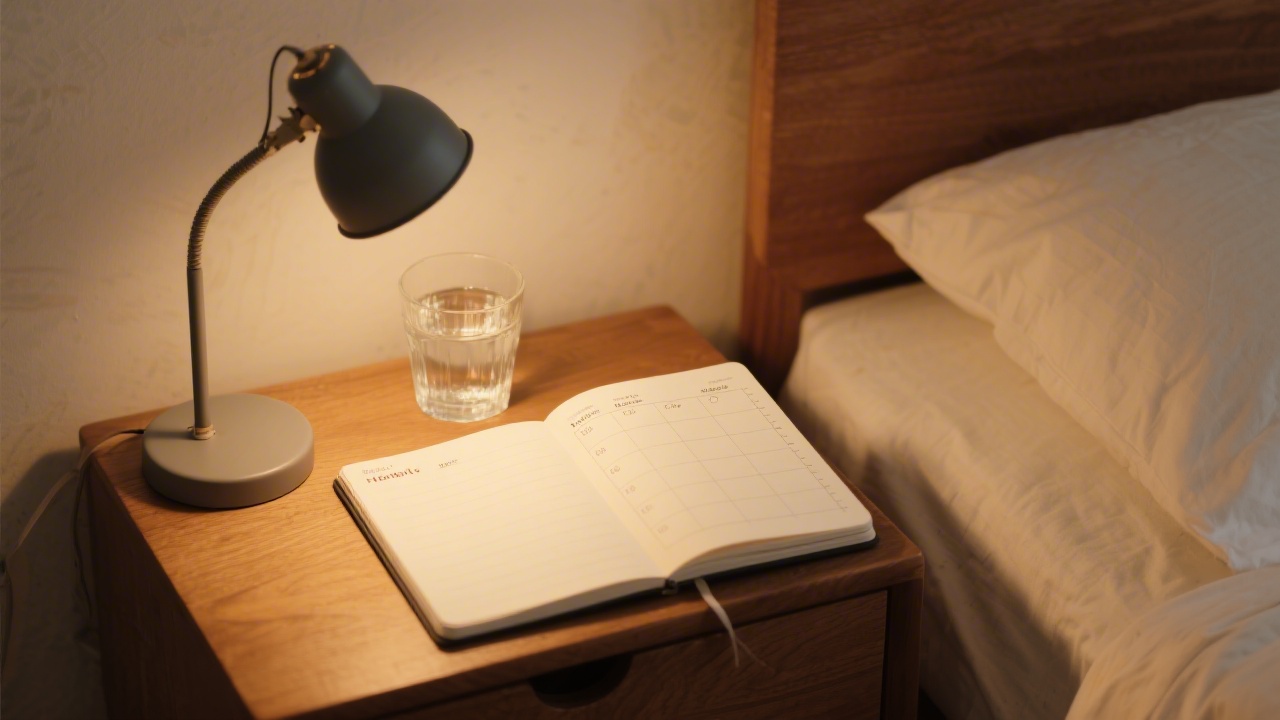
Law 1: Make It Obvious. Your sleep cues should be unmissable. Set a phone alarm labeled "begin wind-down" 60 minutes before your target sleep time. Use environmental design: dim your living room lights at a fixed hour, set your thermostat to drop to 65-68°F automatically, keep your book (not your phone) on your nightstand. Clear calls this "implementation intention" — specifying the when and where of the habit, not just the what.
Law 2: Make It Attractive. The wind-down routine should be genuinely enjoyable, not a chore. Temptation bundle: pair something you want to do (a favorite herbal tea, a specific genre of reading) with your sleep preparation routine. The brain needs to associate bedtime with something pleasant, not restriction. Clear notes that most habits fail because the person made the attractive version unattractive.
Law 3: Make It Easy. The two-minute rule is directly applicable here. If the habit is "read before bed," the two-minute version is "open the book and read one page." The rule's purpose is to eliminate the activation energy barrier — getting started is harder than continuing. For sleep, this means preparing your wind-down environment in advance (clothing laid out, book bookmarked, water poured) so the start cost is near zero.
Law 4: Make It Satisfying. Habit tracking provides the immediate reward that long-term habits like sleep lack. Use a physical habit tracker — a simple calendar where you mark each night you completed your wind-down routine. Clear's "don't break the chain" method creates a satisfying visual streak that motivates consistency more effectively than abstract health outcomes.
Habit Stacking for Sleep Routines
Clear's concept of habit stacking — attaching a new habit to an existing one — is particularly powerful for sleep routines. The formula is "After I [current habit], I will [new sleep habit]."
Example stack:
- After I finish dinner, I dim the living room lights (cue)
- After I dim the lights, I make herbal tea (stack 1)
- After I make tea, I open my journal and write tomorrow's top 3 priorities (stack 2 — GTD capture)
- After I write, I read for 20 minutes (stack 3)
- After I read, I do 5 minutes of box breathing (stack 4)
- Lights out (outcome)
Each step triggers the next through association, reducing the decision fatigue that otherwise leads to "just one more scroll" behavior.
The Plateau of Latent Potential in Sleep
One of Clear's most useful concepts for sleep improvement is the plateau of latent potential — the observation that habit benefits are not linear. Weeks 1-3 of a new sleep routine may produce little visible improvement; the benefits accumulate below the surface, emerging suddenly after a critical mass of consistent behavior.
This matters because most sleep improvement efforts are abandoned precisely at this stage. Understanding that the work is being done even without visible results prevents premature abandonment.
Our Top Mattress Pick for Better Sleep
The Saatva Mattress combines pressure relief with spinal support — the two factors that matter most for deep, restorative sleep cycles.
Affiliate link — we earn a commission at no extra cost to you.
The Mattress as an Environmental Design Decision
Clear devotes significant attention to environment design — shaping your surroundings to make good habits easier and bad habits harder. Your mattress is one of the most important environmental factors in sleep quality. A mattress that creates pressure points causes micro-arousals throughout the night, disrupting sleep architecture without producing full wakefulness. You won't remember these disruptions, but they degrade slow-wave and REM sleep progressively.
Frequently Asked Questions
How do you apply Atomic Habits to sleep?
Apply the four laws: make sleep cues obvious (alarm + environment design), make wind-down attractive (temptation bundling), make it easy (two-minute rule), and make it satisfying (habit tracker). The most powerful technique is habit stacking — a sequential wind-down chain where each step automatically triggers the next.
What is the two-minute rule for sleep?
The two-minute version of your sleep habit is something so small it cannot be refused. Instead of "complete a 30-minute wind-down routine," the two-minute version is "change into sleep clothes and pick up my book." Starting leads naturally to continuing.
What is habit stacking for sleep?
A sequential chain where each evening habit triggers the next: finish dinner, dim lights, make tea, journal, read, breathe, sleep. Each step creates an automatic cue for the following step, reducing decision fatigue and screen time defaults.
How does identity change improve sleep?
Declaring "I am a good sleeper" and taking small confirming actions builds a self-concept that makes sleep-protective behaviors feel natural. It also reduces the performance anxiety and hyperarousal that drive onset insomnia.
How long does it take to build a sleep habit with Atomic Habits?
Research cited by Clear suggests 66 days on average, with a range of 18-254 days. Simple environmental habits automate faster. Complex behavioral chains take longer but produce greater results. Focus on not breaking the chain, not on the outcome.
Related Reading
Key Takeaways
Atomic Habits and Sleep is a topic that depends heavily on individual needs and preferences. The most important thing is to consider your specific situation — your body type, sleep position, and personal comfort preferences — before making any decisions. When in doubt, take advantage of trial periods to test before committing.