
 by
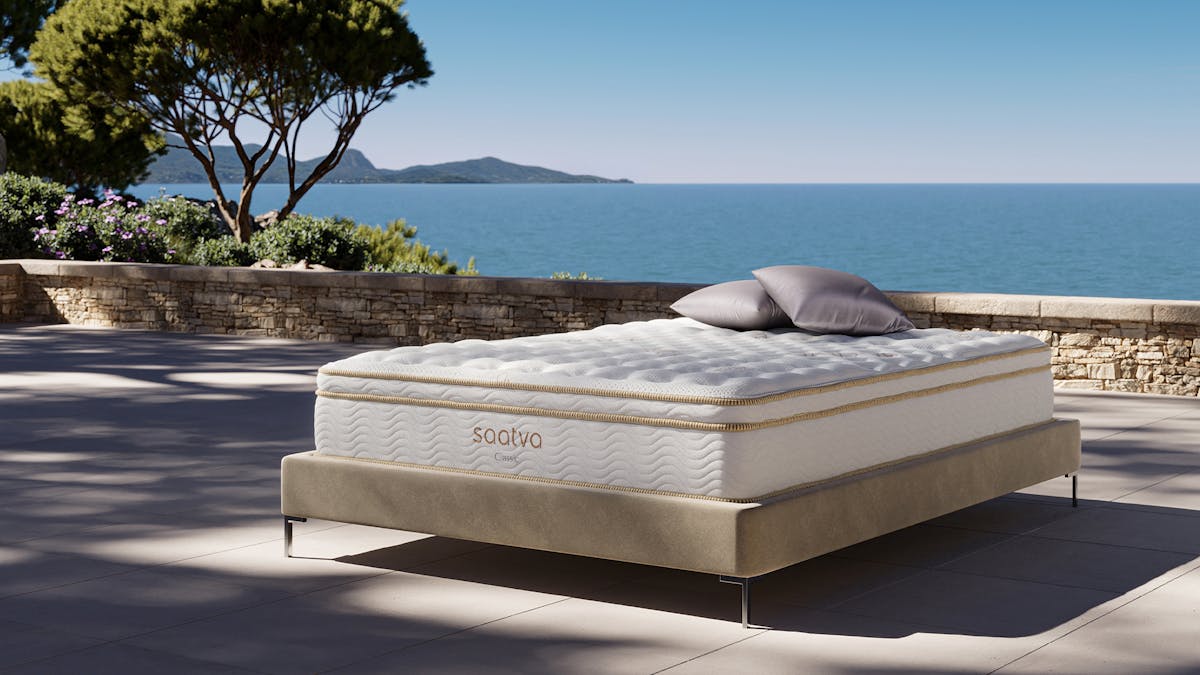
by Most parents use a bassinet for the first 4 months, then move to a crib. The bassinet makes bedside room-sharing practical; the crib is the long-haul sleep surface from 4 months through age 3 or beyond. Whichever route you take, the mattress inside the crib matters far more than the frame. For the crib mattress, the Saatva Crib Mattress is the clearest pick: dual-sided (extra-firm for infants, firm for toddlers), GREENGUARD Gold certified, and built with organic materials throughout.
Saatva Crib Mattress
9.4/10
- Dual-sided design: extra-firm baby surface flips to a firm toddler surface, covering years 0 to 4
- 200 recycled steel coils with double edge reinforcement keep baby centered on the surface
- Organic cotton cover, natural Talalay latex (Cradle-to-Cradle GOLD), organic New Zealand wool, zero fiberglass
- GREENGUARD Gold certified for low VOC emissions, waterproof barrier, washable cover
- $359 puts it above budget foam options (Newton, Naturepedic), though it replaces two mattresses across infant and toddler stages
- At 18 lb, slightly heavier than thin foam pads when fitting into the crib
The Saatva Crib Mattress earns the top spot by covering both the infant and toddler stages in a single, certified, organics-first build. The extra-firm baby side meets AAP firmness guidance precisely; flipping it at toddler age saves you a separate purchase. Free white-glove delivery included.
Bassinet vs Crib: The Verdict
Short answer: Most parents use a bassinet for the first 4 months (room-sharing per AAP guidance), then transition to a crib around the 4-month mark, weight limit, or rolling milestone, whichever comes first. A bassinet is not strictly necessary if you have a dedicated nursery and a single-product budget. The most important purchase is not the frame either way; it is a firm, certified mattress inside it.
This guide covers the CPSC mandatory standards (16 CFR Part 1218 for bassinets, Part 1219 for cribs), the AAP 2022 safe-sleep update, the ASTM voluntary standards, and the actual cost-of-ownership math across four real scenarios.
Quick Verdict by Situation
- Room-sharing in a studio or 1BR? Buy a bedside bassinet first. Halo BassiNest or Mika Micky are the proven picks.
- Have a separate nursery from day one? Skip the bassinet, buy a convertible crib. Saves $150 to $300.
- Budget under $300 total? Go straight to a convertible crib (DaVinci Kalani or IKEA Sundvik) with a quality mattress.
- Want the smart-bassinet experience? Rent the SNOO ($159/month) for 4 to 6 months, then transition. Buying outright at $1,695 rarely pencils out.
- Premature baby or NICU graduate? Follow the discharge pediatrician's specific recommendation. Some preemies stay on a smaller surface longer for thermoregulation.
Safety Standards You Need to Know
CPSC Mandatory Federal Standards
Two federal regulations govern infant sleep furniture:
- 16 CFR Part 1218 — the mandatory federal safety standard for bassinets and cradles. The 2014 revision tightened structural integrity, stability, and mattress fit requirements. All bassinets sold new in the US must comply.
- 16 CFR Part 1219 — the mandatory federal safety standard for full-size cribs. The 2011 update banned drop-side cribs after 32 documented infant deaths between 2000 and 2010 from suffocation or strangulation in the drop-side gap.
If a bassinet or crib is sold new in the US in 2026, it complies with these by law. The risk lives in secondhand units that predate the regulation and recall-affected products still in circulation.
AAP 2022 Safe-Sleep Update
The American Academy of Pediatrics updated its safe-sleep policy in 2022. Core rules:
- Flat surface only. No inclines greater than 10 degrees. This rule ended the Fisher-Price Rock n Play (recalled after 30+ deaths from positional asphyxiation).
- No bumpers, pillows, blankets, plush toys, or weighted swaddles in the sleep area for the first 12 months.
- Room-share without bed-share for at least 6 months, ideally 12 months. Baby in your room, in their own dedicated sleep surface.
- Back-only sleep position until baby can independently roll both ways.
- Firm sleep surface. The mattress should not indent more than one finger-width under the baby's weight.
ASTM Voluntary Standards
- ASTM F2194 covers bassinets and cradles.
- ASTM F1169 covers full-size cribs.
- ASTM F406 covers play yards and portable cribs.
Look for ASTM compliance on the product label. Combined with CPSC mandatory compliance, it is the closest thing to a quality baseline.
SIDS and SUID Context
CDC data places sudden unexpected infant deaths (SUID, which includes SIDS) at roughly 3,400 cases annually in the US. SIDS remains the leading cause of death for infants between 1 month and 12 months. Rates have declined significantly since the 1994 "Back to Sleep" public health campaign. The safe-sleep rules above exist because they reduce these deaths.
Bassinet vs Crib: Functional Differences
| Feature | Bassinet | Crib |
|---|---|---|
| Age range | 0–4 months typical | 0–3+ years (longer if convertible) |
| Weight limit | 15–20 lb typical | 50+ lb |
| Sleep surface | ~16×30 in (~480 sq in) | 28×52 in (1,456 sq in) |
| Height to top of rail | ~30–35 in (bedside height) | 30–40 in |
| Portability | High (wheels on most) | Low |
| Functional lifespan | 4–6 months | 2–4 years (4+ if convertible) |
| Price range | $80–$1,700 | $150–$1,300 |
| Bedside-sleeper option | Yes (Halo, Mika Micky) | Rare |
The functional gap drives the buying decision. A bassinet is a short-term, compact, portable sleep surface built for newborns who need to be near a parent. A crib is a long-term, fixed-location surface built to grow with the child.
The Cradle: A Third Option Most Parents Skip
Cradles are smaller than cribs, often hand-rocking, traditionally wooden. Functional lifespan is short, usually 0 to 3 months, and modern relevance is mostly aesthetic or heirloom. Look for ASTM F2194 compliance and a positive locking mechanism on the rocking motion before accepting one.
When to Transition from Bassinet to Crib
The AAP rule is straightforward: transition at the earliest of three triggers.
- 4 months of age as a default upper bound.
- The bassinet weight limit (typically 15 to 20 lb). Check the product label.
- The rolling milestone. Once baby can roll over independently in either direction, the bassinet sides become a hazard rather than a containment.
Many parents are surprised by the rolling trigger because it can arrive at 3 months in fast-developing babies.
Crib to Toddler Bed
Standard transition is between 2 and 3 years of age, or the moment the child first climbs out of the crib. Climbing out triggers a fall risk that outweighs the containment value of the crib rails. Convertible cribs (DaVinci Kalani 4-in-1, Babyletto Hudson 3-in-1) convert with included hardware to a toddler bed configuration.
Montessori Floor Bed
Some parents transition as early as 6 months to a Montessori-style floor bed. This requires a fully baby-proofed room: outlet covers, furniture anchored to walls, no choking hazards within reach, gated doorway. Floor beds are well-supported in Montessori literature but assume an aggressive baby-proofing regime.
Top Bassinets 2026
| Model | Type | Standout Feature | Price |
|---|---|---|---|
| Halo BassiNest Premiere | Bedside-sleeper | 360-degree swivel, breathable mesh | $300–$380 |
| SNOO Smart Sleeper | Smart bassinet | Auto-rock, white noise, app control | $1,695 (rent $159/mo) |
| Mika Micky Bedside Sleeper | Budget bedside | Simple bed-attach mechanism | $130–$170 |
| Maxi-Cosi Iora | Euro design | Tool-free height adjustment | $300 |
| BabyBjorn Cradle | Rocking cradle | Gentle rocking, minimalist build | $350 |
| Graco Sense2Snooze | Vibration bassinet | Cry detection technology | $230 |
The Halo BassiNest Premiere is the safest default for most families: bedside attachment, breathable mesh sides, simple to use at 3am. The SNOO is the right answer only when budget is open and the auto-rock feature has a meaningful chance of helping; for most families, the $159/month rental is the better way to test the value before committing.
Top Cribs 2026
| Model | Type | Standout Feature | Price |
|---|---|---|---|
| DaVinci Kalani 4-in-1 | Convertible | Toddler bed, daybed, full-size | $200–$260 |
| Babyletto Hudson 3-in-1 | Modern design | GREENGUARD Gold certified | $400 |
| Pottery Barn Kids Sloan | Luxury | Heirloom build quality | $700 |
| Stokke Sleepi | Round Euro | Convertible across stages | $1,300 |
| IKEA Sundvik | Budget Euro | Simple, value-priced | $180 |
| Million Dollar Baby Foothill | Heirloom | Classic styling | $500 |
Why the Crib Mattress Matters More Than the Crib
Spending $1,000 on a crib frame and $80 on an off-brand mattress is optimizing the wrong purchase. The mattress is the safety-critical component. It must be very firm: press your fingers into the surface and release — the indent should not exceed one to two finger-widths. Pillow-top or plush surfaces are unsafe for infants. Used crib mattresses carry additional SIDS risk because previous moisture and bacterial exposure cannot be reliably sanitized.
Crib Mattress Comparison 2026
| Model | Type | Standout Feature | Price |
|---|---|---|---|
| Saatva Crib Mattress | Coil hybrid, dual-sided | GREENGUARD Gold, organic cotton, Talalay latex, flippable infant/toddler | $359 |
| Newton Wovenaire Original | Breathable, washable | 90% air, fully washable cover | $300 |
| Naturepedic Classic Organic | Organic innerspring | GOTS certified, dual firmness | $260 |
| Sealy Posturepedic Crib | Traditional innerspring | Firm, budget-friendly | $120–$180 |
The Saatva Crib Mattress leads because its dual-sided build handles years 0 to 4 in a single purchase, with organic materials, a coil support core, and the GREENGUARD Gold standard for chemical emissions. Newton's Wovenaire is the best pick if breathability is the top priority. Naturepedic suits families who want GOTS organic certification at a lower price point.
Cost-of-Ownership Math Across Four Scenarios
| Scenario | Total Cost | Cost / Year |
|---|---|---|
| Bassinet ($150) + Convertible crib ($300) + Saatva Crib Mattress ($359) | ~$809 over 4 years | ~$202/yr |
| Crib only (skip bassinet) + Saatva Crib Mattress | ~$659 over 4 years | ~$165/yr |
| SNOO rental ($159/mo × 4) + Crib + Saatva Crib Mattress | ~$1,295 over 4 years | ~$324/yr |
| Convertible crib to toddler bed ($500) + budget mattress | ~$680 over 6 years | ~$113/yr |
The lowest-cost path is a convertible crib from day one with no bassinet. The bassinet path costs roughly $37 more per year but buys 4 months of easier bedside room-sharing. The SNOO is a premium feature, not a savings play.
Apartment vs House Setup
- Studio or 1BR: A bedside bassinet is essential for AAP-compliant room-sharing. Halo BassiNest or Mika Micky.
- Multi-room home: A nursery crib from day one is acceptable. Room-sharing for 6 months is still recommended; some parents bring a portable bassinet into their bedroom and reserve the nursery crib for daytime naps.
- Co-sleeper attached to adult bed: Halo BassiNest and Mika Micky both attach directly to the adult bed frame. They create a separate firm surface immediately next to the parent, which is not bed-sharing in the AAP sense.
Safe-Sleep Rules for the First 12 Months
- No blankets, pillows, bumpers, or plush toys in the sleep area.
- No inclined sleepers. The Fisher-Price Rock n Play was recalled after 30+ documented deaths from positional asphyxiation.
- No weighted swaddles. AAP cautions against added weight on infant sleepwear.
- Back-only sleep position until baby can independently roll both ways.
- Pacifier use, once breastfeeding is established, has been associated with reduced SIDS risk in AAP literature.
- Never put a baby to sleep on a couch, recliner, or adult bed. Suffocation and entrapment risk is well documented.
Recall and Secondhand Safety Checks
The CPSC mandatory standards apply to new products at the time of sale. They do not retroactively police hand-me-down units or models predating the 2011 drop-side crib ban or the 2014 bassinet revision.
Before accepting a hand-me-down crib or bassinet, run three checks:
- Look up the make and model on the CPSC recall database. Drop-side cribs pre-2011 are de facto unsafe.
- Inspect hardware for missing screws, splintered wood, or non-original replacement parts. A crib with mismatched hardware loses its certified structural integrity.
- Verify the mattress is original to the unit and unused. If the donor cannot confirm both, replace the mattress regardless of how it looks. Used mattresses are a documented SIDS risk factor.
For bassinets, never accept a unit older than 2014, the year the current CPSC mandatory standard took effect.
The SNOO: Is It Worth $1,695?
The SNOO Smart Sleeper auto-rocks at increasing intensity in response to crying, plays white noise calibrated to the in-utero sound profile, and includes a swaddle that secures the baby on their back. Happiest Baby cites in-house data on sleep extension; independent peer-reviewed evidence is more limited than the marketing implies.
For most families, renting at $159/month converts a capital risk into a known operating expense. If the baby never takes to the SNOO (this happens in roughly 20 to 30 percent of cases based on parenting community reporting), the rental can be ended early. Who benefits most: parents returning to demanding work quickly, parents in apartments where the auto-rock could replace early-morning lifting, or parents recovering from C-section. Who should skip: budget-constrained families and anyone whose newborn sleeps well on a $150 bassinet.
Eventually: The Toddler Bed Transition
Once your child outgrows the crib (typically at 2 to 3 years, or when they first climb out), the next mattress purchase becomes relevant. For the toddler-to-elementary transition, a youth mattress with appropriate firmness and a certified, low-VOC build (GREENGUARD Gold or CertiPUR-US) is the standard. The Saatva Crib Mattress flips to its firm toddler side automatically, meaning no separate purchase until the child moves to a full-size bed.
Frequently Asked Questions
Bassinet vs crib: which should I buy first?
For most parents, the bassinet first, then the crib. The bassinet enables bedside room-sharing per AAP guidance for the first 4 to 6 months. If you have a separate nursery and a tight budget, skipping the bassinet and going straight to a convertible crib is acceptable and saves $150 to $300.
When should baby move from bassinet to crib?
At the earliest of three triggers: 4 months of age, the bassinet's stated weight limit (typically 15 to 20 lb), or the moment baby starts rolling independently. Whichever comes first.
Is a cradle safe for newborns?
Yes if it meets ASTM F2194 and CPSC 16 CFR Part 1218. Look for a locking mechanism on the rocking motion. Cradle lifespan is short (0 to 3 months), so most parents skip them in favor of a bassinet.
Are bedside bassinets safe?
Yes when properly attached and used with baby on back on a firm, flat surface. The Halo BassiNest and Mika Micky are the most commonly recommended bedside-attach models. AAP recommends room-sharing without bed-sharing for at least 6 months.
What is the safest crib mattress?
Very firm (one to two finger-widths of indent maximum), correctly sized to the crib frame (no gaps), and unused. The Saatva Crib Mattress leads for its dual-sided certified-organic build. Newton Wovenaire and Naturepedic are strong alternatives at lower price points.
How long does a baby use a bassinet?
Typically 4 to 6 months. The functional lifespan is bounded by the weight limit (15 to 20 lb) and the rolling milestone. Some smaller babies use a bassinet for 5 to 6 months; fast-developing babies can outgrow it at 3 months.
Can a baby sleep in a Pack n Play instead of a bassinet?
Yes if the Pack n Play meets ASTM F406 and the manufacturer specifies it as approved for sleep. Many play yards include a bassinet attachment for newborns. Always use the manufacturer's bassinet insert and never add aftermarket padding.
Fact-checked against CPSC 16 CFR Part 1218 (bassinet standard) and Part 1219 (full-size crib standard), AAP 2022 safe-sleep policy update, ASTM F2194 and F1169, and CDC SUID/SIDS statistics. Product data from current brand listings. Updated June 2026. This guide is general information; consult your pediatrician for advice specific to your child.