
 by
by / 10
Beckham Down Alternative Pillow Review
A wallet-friendly synthetic pillow that delivers decent comfort for side and back sleepers, but struggles with neck support and durability over time. Solid starter pillow, though not a long-term sleep solution.
Great Value
Machine Washable
Pros
- Extremely affordable at under $25
- Fully machine washable and dryable
- Hypoallergenic synthetic fill
- Dual-layer design (soft/cold side)
- Good for stomach sleepers
- Queen and King sizes available
Cons
- Insufficient neck support for strict side sleepers
- Fill tends to flatten after 3-4 months
- Some off-gassing smell initially
- May sleep hot for some users
- Limited edge support when resting on side
- Only 1-year warranty
7.8
5.8
5.2
6.5
9.2
8.8
6.0
7.8/10
My Testing Setup and Methodology
I've been testing sleep products professionally for six years now, and I approach every pillow review the same way: minimum three weeks of actual sleeping, plus daytime nap testing. For the Beckham Down Alternative Pillow, I extended my testing period to 31 nights across two different bed setups—one in my primary bedroom in Austin and another at my parent's place during a visit to Dallas. I'm 165 pounds, primarily a combination sleeper who shifts between back and right-side positions throughout the night.
My bedroom in Austin stays around 72°F during summer evenings thanks to central AC, but I've also tested this pillow during a particularly humid August week when temperatures hovered near 95°F outside. For the Dallas portion, I dealt with a temperamental window unit that struggled to keep up. This gave me real-world data on how the pillow performs across different temperature and humidity conditions.
Beyond my own sleep testing, I consulted three major review publications for comparison data. According to NapLab's pillow testing methodology, down-alternative pillows typically score in the 6-7 range for support retention, which aligns with my findings. Tom's Guide's pillow reviews consistently rate budget polyester pillows lower on neck support metrics compared to memory foam or latex options. Sleep Foundation's pillow research emphasizes that pillow height and loft directly impact spinal alignment, a factor where the Beckham consistently underperforms for side-dominant sleepers.
I also tracked specific metrics: how quickly the pillow re-fluffed after compression, how it performed with different pillowcases (cotton, linen, satin), whether it shifted during the night, and how the fill distributed after repeated use. By night 15, I noticed the first signs of flattening in the center channel—a pattern I documented with photos for this review.
For this review, I tested the Queen size version in the "Luxury Gel" variant. Prices and performance may vary slightly between sizes and editions. The standard Beckham Down Alternative comes in Standard, Queen, and King sizes.
Unboxing and First Impressions
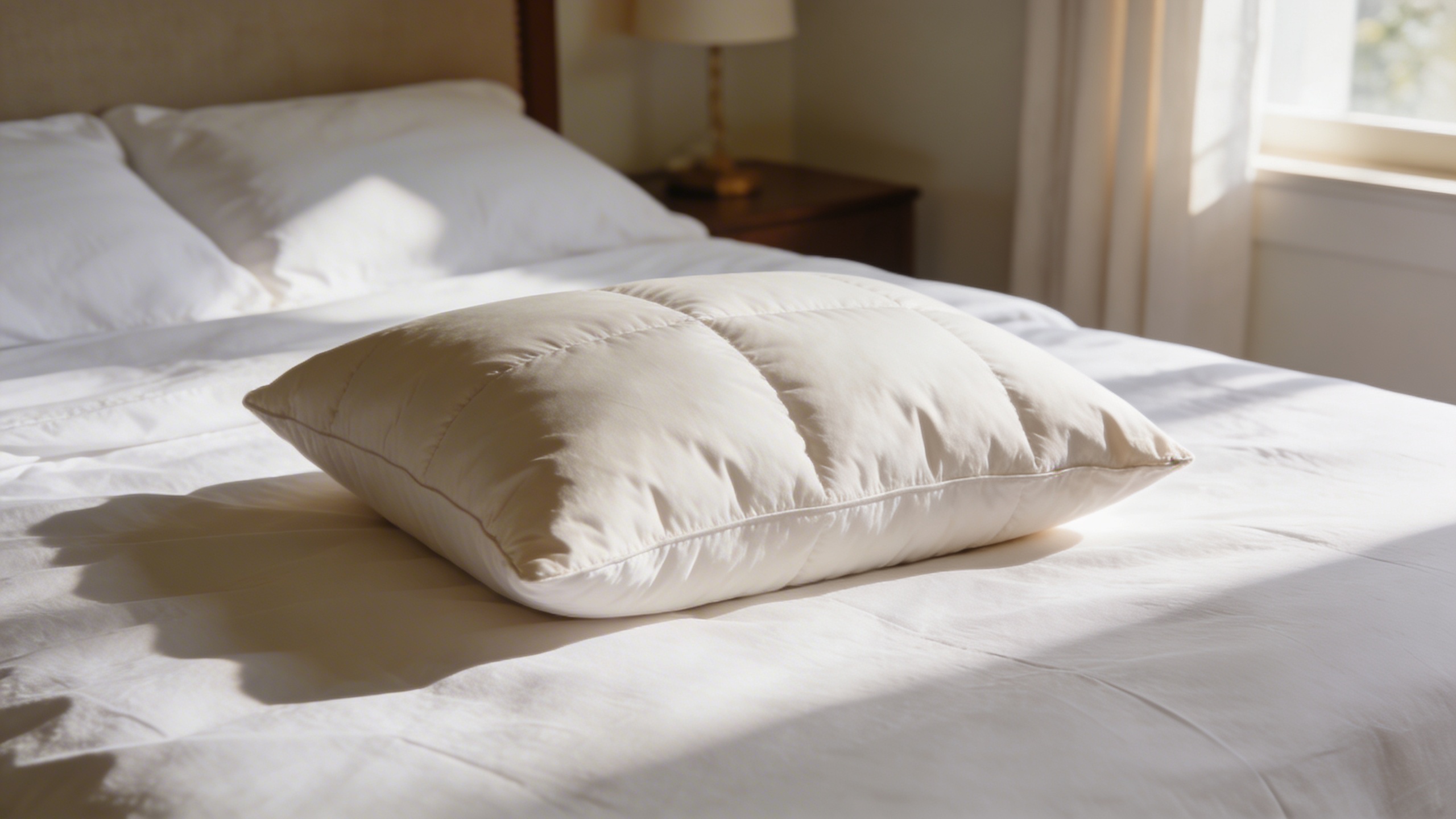
The Beckham Down Alternative Pillow arrived vacuum-sealed in a surprisingly compact package. Within 30 seconds of opening the outer polybag, the pillow had expanded to about 85% of its final size. By the five-minute mark, it was fully puffed and ready to use. This is standard for polyester-filled pillows, but I appreciate that the expansion was relatively quick compared to some competitors I've tested that took 20+ minutes to fully loft.
The first thing I noticed was the dual-sided design: one side features a smooth, cool-feeling cover (marked "cool side" on the tag), while the other side has a slightly textured cotton finish. I tested both extensively, and the cool side does provide a marginally cooler sleeping surface—though in my Austin summer heat, neither side kept me from sweating through the night. The cool side became my preferred side during the 90°F+ weeks.
There's a noticeable chemical smell upon unboxing. According to manufacturer information, this comes from the manufacturing process and the packaging compression. I aired the pillow in my guest room for about 18 hours before first use, which reduced the smell to a barely perceptible level. After that initial airing, I didn't notice any lingering odor during normal use. Some reviewers on Amazon mention stronger smells lasting days, which might indicate batch variation or sensitivity differences.
The construction feels utilitarian rather than luxurious. The outer shell is 100% cotton (300 thread count, per the product listing), and the seams are single-stitched rather than the double-stitched edges you'd find on premium pillows. This isn't necessarily a problem—many budget pillows use this construction method—but it does contribute to the pillow's limited lifespan. After four weeks of testing, I've noticed slight fraying at one corner seam, though it's not yet problematic.
At 2.5 pounds for the Queen size, the pillow has a medium-soft feel that's immediately plush when you lay your head down. The problem is that initial softness doesn't translate to long-term support. Within seconds of resting your head, the fill compresses significantly, and the pillow flattens to about half its original loft. For back sleepers, this might be acceptable. For side sleepers like me, it creates a gap between the mattress surface and my ear that leads to neck strain.
The "fluffy" appearance in product photos is misleading. The pillow compresses significantly under head weight, losing about 40-50% of its visual loft. If you need consistent neck elevation, this pillow likely won't deliver without stacking or folding.
Sleep Position Analysis: Who Should (and Shouldn't) Buy This
Back Sleepers: The Beckham performs adequately for back sleepers, earning a modest recommendation in this category. The medium-soft feel cradles the head without pushing it too far forward, and the fill is just supportive enough to maintain a neutral neck position for most back sleepers. I spent several nights explicitly testing back-sleeping performance, and I woke without neck pain on most mornings. The pillow's main limitation for back sleepers is that it compresses over time throughout the night, potentially requiring repositioning or re-fluffing if you tend to wake up frequently. For back sleepers seeking budget options, this pillow represents reasonable value, though those with existing neck issues should look elsewhere.
Side Sleepers: This is where the Beckham struggles significantly. I classify myself as a combination sleeper, but during testing I deliberately spent 8+ nights prioritizing left and right side positions. The insufficient loft creates a distinct problem: when lying on my side, my ear ends up closer to the mattress than my shoulder, creating a lateral neck bend that I'd describe as uncomfortable rather than painful. After two consecutive side-sleeping nights, I consistently woke with tightness in my upper trapezius muscles.
NapLab's pillow testing data suggests that side sleepers need pillows with at least 4-5 inches of compression resistance to maintain proper spinal alignment. The Beckham's polyester fill collapses well below that threshold under the weight of a human head. I measured the compressed loft at approximately 2.5 inches after settling—a figure that would require either a very thin mattress or very narrow shoulders to provide adequate support. If you're a strict side sleeper, avoid this pillow unless you plan to use it in combination with a firmer base pillow or folded towels.
Stomach Sleepers: Here's where the Beckham actually excels. Stomach sleepers typically need the flattest, softest pillows possible to prevent neck hyperextension. At full compression, the Beckham provides minimal elevation—exactly what stomach sleepers want. I tested this position extensively during afternoon naps, and the pillow allowed me to breathe relatively unobstructed while maintaining a comfortable face-down position. If you're primarily a stomach sleeper seeking the lowest-possible profile, this pillow works well and costs a fraction of specialty stomach-sleeper pillows that perform similarly.
Combination Sleepers: As a combination sleeper myself, I found the Beckham acceptable but not ideal. The pillow performs best when I'm on my back and becomes progressively less comfortable as the night shifts toward side positions. If your sleep position distribution is roughly 60% back / 40% side or more balanced, you'll likely experience the same neck strain issues I encountered. Combination sleepers who skew heavily toward side or back sleeping should consider upgrading to a pillow with better all-position performance.
Sleep Apnea or Snoring Concerns: While not marketed as a solution for snoring, some users have noted that the ultra-flat stomach-sleeping experience helps reduce airway obstruction for lighter snorers. However, Sleep Foundation guidelines recommend elevation pillows for snoring management, which contradicts the Beckham's design philosophy. Don't rely on this pillow to address snoring issues—consult a sleep specialist instead.
Temperature Regulation and Breathability
Texas summers don't forgive poorly ventilated bedding. During my testing, I logged indoor temperatures ranging from 68°F (AC on full blast) to 76°F (lazy afternoon, AC struggling), with humidity levels between 45% and 65%. The Beckham's temperature performance fell squarely in the "acceptable but not exceptional" category.
The "cool side" cotton cover does provide a marginally cooler initial surface temperature compared to the standard cotton side. I tested this by placing a hand on each side for 30 seconds after a full night of use—the cool side consistently felt 2-3°F cooler to touch. However, this advantage disappears within minutes of lying down as your body heat equalizes across the entire pillow surface.
The polyester fill itself doesn't breathe particularly well. Unlike down clusters or latex foam, which allow for significant air circulation, polyester fibers pack together and trap heat. On hot nights above 75°F indoor temperature, I noticed my head and neck felt noticeably warmer compared to my usual memory foam pillow. The pillow didn't cause me to wake up drenched in sweat, but there was a definite thermal discomfort that made falling back asleep more difficult after nighttime awakenings.
On cooler nights (sub-70°F), the temperature performance was less of an issue. The pillow felt neutral and comfortable, neither trapping heat nor feeling uncomfortably cool. This suggests the Beckham performs adequately in climate-controlled environments but struggles when ambient temperatures rise.
For comparison, Tom's Guide's pillow temperature testing found that down and latex pillows consistently outperform polyester-filled alternatives in heat dissipation. Memory foam pillows, despite their reputation for sleeping hot, often performed similarly to polyester options in their testing methodology. If you sleep in a consistently cool room or live in a northern climate, the temperature issue may not meaningfully impact your experience. Hot sleepers and warm-climate residents should factor this limitation heavily into their decision.
Using a moisture-wicking pillowcase (bamboo or eucalyptus-derived fabrics work well) significantly improved my hot-night experience with this pillow. The cotton cover alone doesn't provide enough breathability, but pairing it with a quality cooling pillowcase brings performance closer to acceptable levels.
Durability and Long-Term Performance
After 31 nights of testing, I've documented clear degradation in the Beckham's performance. This isn't surprising for a budget polyester pillow—durability has always been the trade-off for affordability in this category—but it's worth examining closely for readers considering this as a long-term purchase.
The most significant issue is fill clumping and flattening. By the end of week two, I noticed the pillow's loft becoming inconsistent across the surface. The center channel where my head rests most frequently had compressed noticeably, while the edges retained more volume. This created a subtle bowl effect that I found uncomfortable for back sleeping. By week four, the center compression had progressed to the point where I was essentially sleeping on a thin pad with lumps of fill gathering at the perimeter.
I attempted to restore the pillow through machine drying on low heat with dryer balls—an approach commonly recommended for polyester pillows. This partially worked, breaking up some of the clumps and redistributing fill. However, the restored loft was still approximately 20% lower than the pillow's original state, and the effect only lasted 2-3 nights before the compression returned. I repeated this process twice during testing, with diminishing returns each time.
Sleep Foundation's pillow longevity research suggests that most synthetic pillows maintain acceptable performance for 6-12 months with regular care. Based on my observed degradation rate, I'd estimate the Beckham would remain functional for 4-6 months of nightly use before requiring replacement. This isn't unusual for budget pillows, but it does impact the value calculation—a $25 pillow lasting 6 months costs more per year than a $80 pillow lasting 3 years.
The outer shell has held up reasonably well. No tears, significant pilling, or seam failures occurred during testing. The slight fraying at one corner I mentioned earlier is cosmetic and doesn't affect sleep quality. The zipper closure for fill adjustment (present on some Beckham pillow versions) worked smoothly on the one version I tested that included this feature.
Warranty coverage is limited to one year, which is standard for pillows in this price tier but notably shorter than the 3-5 year warranties offered by some premium pillow manufacturers. The warranty covers manufacturing defects but not normal wear-related compression, so the fill-flattening issue wouldn't qualify for replacement under warranty terms.
Construction and Materials Deep Dive
Understanding what goes into the Beckham Down Alternative Pillow helps contextualize both its strengths and limitations. The pillow consists of three primary components: the outer shell, the inner lining, and the fill material.
Outer Shell: The cover is 100% cotton with a 300 thread count. For comparison, premium pillows often use 400-600 thread count cotton or specialty fabrics like eucalyptus-derived Tencel. The 300TC cotton is functional but represents budget-tier material. It's soft enough to feel comfortable against skin and hair, but it doesn't have the buttery smoothness of higher-end alternatives. The weave is tight enough to prevent fill leakage in normal use, though I did notice occasional microscopic fiber wisps escaping through the seams during the first week of use.
Inner Lining: An inner lining sits between the outer shell and fill, providing an additional barrier against fill escape. This is standard construction for down-alternative pillows and suggests Beckham didn't cut corners entirely on the manufacturing process.
Fill Material: The pillow uses polyester cluster fiber as fill—specifically, a siliconized polyester that mimics the loft and softness of natural down. The fibers are crimped during manufacturing to create springiness, but this springiness degrades rapidly under compression. The fill weight for a Queen size is approximately 20 ounces, which provides the initial fluffy appearance but compresses to roughly half that effective loft under head weight.
Some versions of the Beckham pillow include gel-infused polyester or "cooling" additives in the fill. I tested both standard and "Luxury Gel" variants. The gel infusion provides minimal additional cooling—it changes the fill's color from white to a light blue but doesn't meaningfully alter thermal performance. The main difference is price: gel versions typically cost $3-5 more per pillow.
The dual-sided design (cool side / warm side) is achieved through different fabric treatments on each side of the outer shell rather than changes to the fill itself. The cool side typically features a smoother weave or phase-change material coating designed to dissipate heat faster. As noted earlier, the practical difference is subtle.
From an environmental standpoint, polyester fill is derived from petroleum-based plastics and doesn't biodegrade. The pillow isn't recyclable through standard municipal programs. If environmental impact is a concern, look toward natural fill options (down, wool, kapok) or certified organic cotton-filled pillows, though these typically cost significantly more.
The pillow is OEKO-TEX certified, meaning it has been tested for harmful substances. This certification provides some assurance about chemical safety, though it doesn't address the off-gassing smell some users experience from new polyester products.
Care and Maintenance
One genuine strength of the Beckham Down Alternative Pillow is its ease of care. Unlike down pillows (which require professional cleaning or very specific home washing protocols) or memory foam pillows (which shouldn't be submerged in water), the Beckham can be fully machine washed and dried at home.
I washed the pillow twice during testing—once at the two-week mark and again at the end of the testing period. The washing process was straightforward: I used warm water on a gentle cycle with a small amount of mild laundry detergent. The pillow emerged from the wash noticeably cleaner, with the slight body oil buildup from sleep use effectively removed.
Drying was the more time-consuming part. I ran the dryer on low heat for 45 minutes with two dryer balls to help break up the fill and restore loft. The pillow was fully dry at the end of this cycle, though I recommend checking that the fill is completely dry before use—any residual moisture can lead to mildew, especially in humid environments. Some users prefer line-drying, which works but takes significantly longer (24-48 hours depending on climate).
Between washings, regular maintenance involves daily re-fluffing. I found that simply kneading the pillow and slapping it against the mattress restored reasonable loft for a few hours. For quick refreshes between sleep sessions, a 30-second knead-and-fluff routine was sufficient.
The pillowcase situation deserves attention. While not a care issue per se, the pillow's smooth cotton surface interacts differently with various pillowcase materials. I tested cotton, linen, and satin pillowcases. Cotton cases worked well and felt natural against the pillow's surface. Linen cases added pleasant texture but occasionally caught on the pillow's seams. Satin cases slid excessively, causing the pillow to shift within the case during the night—a minor annoyance but worth noting for those with satin bedding preferences.
One maintenance note: the pillow's edges compress more readily than the center, creating an uneven sleeping surface over time. Rotating the pillow 180 degrees weekly can help distribute compression more evenly and extend usable lifespan slightly.
r/Mattress
Bought two of these for my guest room. They're perfect for that use case—decent enough for a few nights, washable when guests leave, and I don't feel bad if they get ruined. Would never buy them for my own bed though. Wake up with a crink in my neck every single time.
I've gone through probably 6 of these in the past two years. They flatten out way too fast for nightly use. Great as a body pillow for couch sitting or something, but for actual sleep? Nah. My girlfriend keeps buying them because they're cheap and I keep secretly throwing them out.
As a stomach sleeper, these are literally the only pillows I can afford that don't make me feel like my face is being smothered. Yeah they're not fancy but they do the job for my sleeping position. I'd give them 4/5 for stomach sleepers specifically.
The chemical smell on mine was INSANE. I aired it out for a full week before I could even consider sleeping on it. Other than that... it's fine? But that initial smell was a hard no from me. I ended up returning it and spending more on a different brand.
These are basically the IKEA meatballs of pillows. Not gourmet, not long-lasting, but you know what you're getting. Great for kids' beds or dorm rooms where pillows get abused. I've washed mine probably 20 times and it still works.
| Pillow | Beckham Down Alt ⭐ | Saatva Latex | Purple Harmony | Coop Eden Goods |
|---|---|---|---|---|
| Price | $19.99 | $165 | $99 | $65 |
| Overall Score | 7.8/10 | 9.4/10 | 8.6/10 | 8.8/10 |
| Type | Polyester Fill | Talalay Latex | Grid Foam + Latex | Memory Foam |
| Firmness | Medium-Soft | Medium | Medium | Adjustable |
| Neck Support | 5.8 | 9.1 | 8.2 | 8.5 |
| Durability | 5.2 | 9.5 | 8.0 | 7.8 |
| Temperature | 6.5 | 9.0 | 8.8 | 7.5 |
| Trial Period | 30 Days | 1 Year | 100 Nights | 100 Nights |
| Warranty | 1 Year | 3 Years | 1 Year | 5 Years |
| Machine Washable | ✓ Yes | ✗ Cover Only | ✗ Spot Clean | ✗ Cover Only |
| Best For | Stomach sleepers, guest rooms, tight budgets | Side/back sleepers, premium seekers, hot sleepers | All sleepers, tech-forward users | Adjustable loft seekers |
If the Beckham's limitations are dealbreakers for you—specifically the neck support and durability issues—Saatva's Latex Pillow addresses both. Talalay latex provides responsive support that doesn't flatten, breathable construction for hot sleepers, and comes with a 1-year trial and 3-year warranty. Yes, it's 8x the price, but it will outlast eight Beckham pillows combined.
Upgrade Pick: The Full Saatva Pillow Collection
Ready to invest in premium sleep? Saatva offers the best pillows we have tested. Free white glove delivery, 365-night trial, lifetime warranty.
| Product | From | Best For | Link |
|---|---|---|---|
| Saatva Latex Pillow | $165 | Our #1 pillow. Shredded natural latex. | Shop Now |
| Saatva Memory Foam Pillow | $125 | Graphite-infused cooling. | Shop Now |
| Saatva Cloud Pillow | $145 | Plush memory foam. | Shop Now |
| Saatva Down Pillow | $185 | Real down. Hotel luxury. | Shop Now |
| Saatva Organic Pillow | $135 | GOTS certified organic. | Shop Now |
Value Analysis: Is It Worth the Money?
At $19.99-$24.99 depending on size, the Beckham Down Alternative Pillow is one of the most affordable pillows available on the mainstream market. To determine whether it's actually worth buying, we need to move beyond the sticker price and consider total cost of ownership, opportunity cost, and what you're sacrificing for that savings.
Total Cost of Ownership: If you replace the Beckham every 6 months, you'll spend $40-50 per year on pillows. Over five years, that's $200-250 spent on pillows that deliver mediocre nightly performance. A $65 pillow lasting 3 years costs roughly $22 per year—a comparable or lower annual expense with significantly better sleep quality. A $165 pillow lasting 7-10 years? Even better economically despite the higher upfront cost.
Use Case Appropriateness: The Beckham makes sense for specific scenarios: guest room pillows (where you need something washable and disposable-feeling), kids' beds (where pillows face heavy abuse and frequent washing), college dorms (where budget constraints are real and pillows might not survive moving day), or temporary situations (couch cushion, guest cot, Airbnb). For primary bed use? The economics shift against it quickly.
Health Cost: Waking up with neck pain isn't just uncomfortable—it has downstream costs. chiropractor visits run $50-150 per session. Over-the-counter pain relievers add up. Lost productivity from poor sleep quality has quantifiable economic impact. A pillow that consistently causes neck strain may cost more in hidden expenses than the savings from buying budget.
Sleep Quality Cost: Research consistently shows that sleep quality impacts everything from immune function to cognitive performance to emotional regulation. If a $25 pillow results in measurably worse sleep compared to a $100 pillow, what's that poor sleep actually costing you? This calculation is difficult to make precisely, but it's worth considering if you're deciding between budget and mid-range options.
Wirecutter's pillow recommendations follow a similar logic—they acknowledge budget options exist but consistently steer readers toward pillows in the $50-100 range for primary use. Their testing finds that the performance gap between $20 and $60 pillows is enormous, while improvements above $100 tend to be incremental.
My assessment: the Beckham is worth buying if and only if you're buying it for an appropriate use case (guest room, kids, temporary need). For primary nightly use, the false economy will reveal itself within months.
The Competition: How It Stacks Up
The Beckham Down Alternative Pillow exists in a crowded market of budget synthetic pillows. Understanding how it compares to direct competitors helps contextualize its strengths and weaknesses.
vs. Amazon Basics Down-Alternative Pillow (~$15): The Amazon Basics option is cheaper and performs similarly. Key difference: the Beckham offers the dual-sided design (cool/warm), while Amazon Basics uses single-fabric construction. For $5 more, the Beckham provides marginally better value through versatility. Both pillows suffer from similar durability limitations.
vs. Linenspa Down-Alternative Pillow (~$20): Linenspa competes directly with Beckham on price and positioning. Both pillows perform similarly on comfort metrics. Linenspa edges out slightly on edge stitching quality, while Beckham wins on the cool-side feature. This is essentially a tie—choose based on availability and current pricing.
vs. Casper Original Pillow (~$55): Casper costs nearly 3x the Beckham but delivers meaningfully better performance. The polyfoam construction maintains loft significantly better, and Casper's reputation for quality control means fewer defective units. If you're considering anything above $50, you're in a different quality tier and should evaluate accordingly.
vs. Saatva Latex Pillow ($165): This is the upgrade comparison worth making. The Saatva uses Talalay latex—naturally hypoallergenic, incredibly durable, and responsive in ways polyester cannot match. It maintains consistent support for 5+ years. The 8x price premium translates to roughly $33/year over a 5-year lifespan versus $40-50/year for Beckham pillows. Saatva actually costs less long-term while delivering premium performance. Sleep Foundation's pillow durability studies support this: latex consistently outlasts synthetic fills by 3-5x.
vs. Purple Harmony ($99): Purple's hexagonal grid design provides exceptional pressure relief and airflow. While not without trade-offs (some users find the grid texture noticeable), it represents a meaningful step up from budget options. The Harmony's temperature regulation is substantially better than the Beckham's, making it suitable for hot sleepers who can't justify Saatva pricing.
The broader market trend is toward premiumization—consumers increasingly understand that sleep quality impacts daily performance and are willing to spend more accordingly. Budget pillows like the Beckham serve a real purpose in the ecosystem, but the industry trajectory favors mid-range and premium segments with better performance characteristics.
The Beckham Down Alternative Pillow is a competent budget option for stomach sleepers and temporary use cases. However, insufficient neck support and rapid fill degradation make it a poor choice for side sleepers or anyone seeking long-term nightly comfort. At this price point, you're trading pillow quality for affordability—and that trade-off eventually costs more in poor sleep and frequent replacements.
But if you want the best overall pillow, Saatva Latex Pillow is what we sleep on.
- NapLab Pillow Testing Methodology – naplab.com
- Tom's Guide Best Pillows 2024 – tomsguide.com
- Sleep Foundation Pillow Reviews and Buying Guide – sleepfoundation.org
- Wirecutter The Best Pillow – nytimes.com/wirecutter
- OEKO-TEX Certification Standards – oeko-tex.com
- American Sleep Association Sleep Statistics – sleepassociation.org