
 by
by Looking for the right mattress to complete your sleep setup? The Saatva Percale Sheets delivers hotel-quality sleep with free white-glove delivery.
A National Sleep Foundation survey found that people who make their beds every morning are 19% more likely to report a good night's sleep. This is not a trivial number. And the investment is 3 minutes — once you know the sequence. Here is the exact method, the science behind it, and the habit-formation framework that makes it automatic.
Why Making Your Bed Improves Sleep
The mechanism works on two levels:
1. Psychological Cueing
Your brain builds associations between environments and states. A made bed is a strong visual signal that the sleep environment is "ready" — it primes the neural state associated with sleep. An unmade bed, by contrast, signals disorder and incompleteness, which activates low-level cognitive arousal. This is the same principle underlying why making the bed is often the first task recommended in CBT-I (Cognitive Behavioral Therapy for Insomnia) protocols.
2. Habit Anchor Effect
Making the bed every morning anchors the start of the day with a completed task — which research shows improves follow-through on subsequent healthy behaviors. Admiral William McRaven's well-known argument is supported by habit-formation research: a small, consistent completed action creates positive behavioral momentum.
The 3-Minute Method: Step by Step
This assumes a standard setup: fitted sheet, flat sheet, duvet or comforter, 2–4 pillows.
Step 1: Straighten the Fitted Sheet (20 seconds)
Pull each corner tight so it lies flat. Sleep movement bunches fitted sheets — 20 seconds of straightening prevents a lumpy base that defeats all subsequent layers. Deep-pocket fitted sheets (15"+) stay in place better on thicker mattresses.
Step 2: Pull Up the Flat Sheet (30 seconds)
If you use a flat sheet, pull it evenly to both sides so it overhangs equally (6–8 inches on each side). Smooth it from the center outward with the flat of your hand — one pass per side. Do not tuck it yet.
Step 3: Spread the Duvet or Comforter (45 seconds)
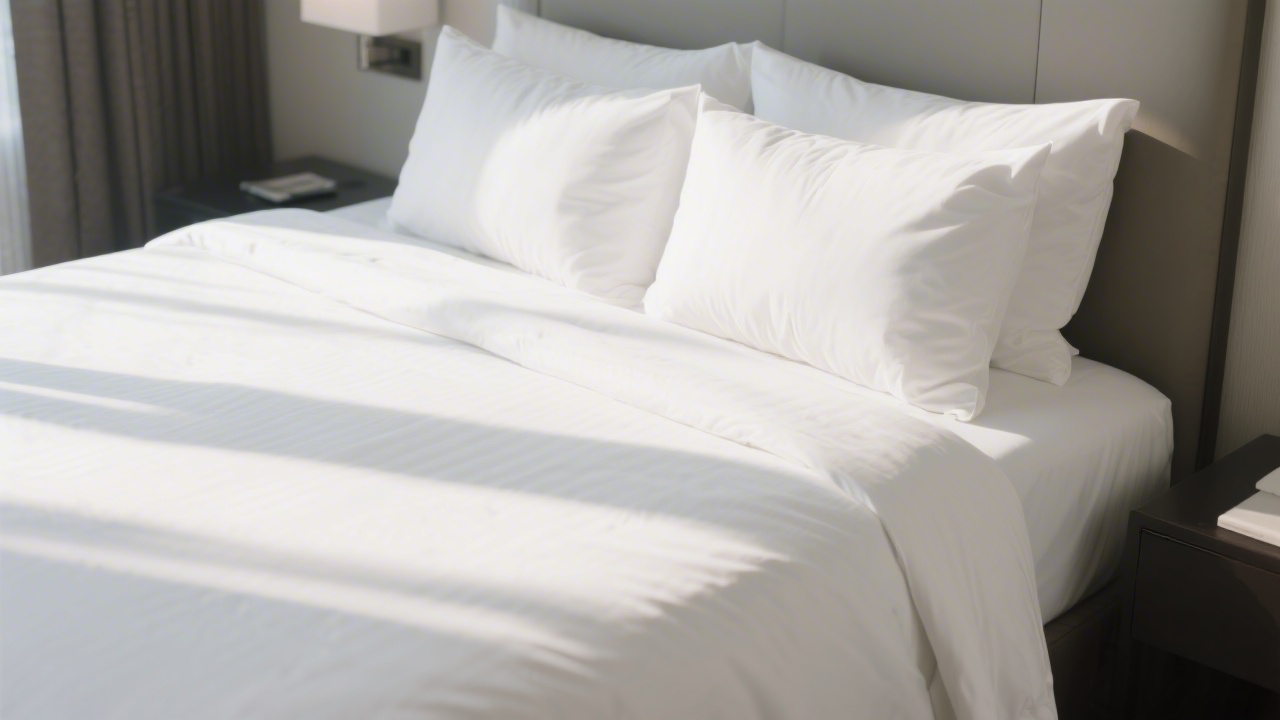
Shake the duvet once to redistribute fill. Spread from the headboard down, centering it. Pull the top edge to the headboard and let the bottom hang evenly. Smooth with both hands from center to edges. Fold the top 6–8 inches of the duvet back over itself to expose the top of the flat sheet — this is the hotel-style finish.
Step 4: Tuck the Flat Sheet (Hospital Corners)
Hospital corners are the difference between a bed that looks made and a bed that looks professionally made. The method: at each bottom corner, (1) pull the flat sheet taut toward the foot of the bed, (2) lift the sheet hanging over the side corner at a 45-degree angle and hold it on top of the mattress, (3) tuck the hanging fabric underneath the mattress, (4) release the held flap and tuck it in. Takes 15 seconds per corner once practiced.
Step 5: Arrange Pillows (30 seconds)
Sleeping pillows go against the headboard. Decorative pillows (if any) go in front. Karate-chop the center of each sleeping pillow to create a dent — the classic hotel pillow finish. Two to four pillows is optimal; more creates a daily chore that reduces compliance.
Step 6: Final Smooth (15 seconds)
One final hand-smoothing pass across the top surface. Stand back and verify the duvet is centered. Total time: under 3 minutes once the sequence is habitual.
Sheets That Make the Method Easier
High-quality percale sheets smooth more easily and hold crisp corners better than microfiber or low-thread-count cotton. The Saatva Percale Sheets are milled from 100% long-staple organic cotton — they lay flat naturally, reducing the effort needed to achieve a clean finish. A well-made bed looks significantly better when the sheet quality matches the technique. See our guide to best cooling sheets for tested sheet options across all materials.
The underlying mattress also matters — a smooth mattress surface (not lumpy or sagging) is the prerequisite for a clean-looking made bed. If your mattress has visible body impressions, hospital corners won't compensate. See our bedroom sleep optimization guide for the full environment framework.
Building the Habit
Habit formation research (Lally et al., 2010) shows that it takes 18–254 days for a behavior to become automatic, with a median of 66 days. The key variable is consistency, not perfection. Missing one day does not reset the habit formation process. The implementation intention format works best: "After I get out of bed in the morning, I will immediately make the bed before leaving the bedroom." Linking the behavior to an existing anchor (getting out of bed) dramatically improves follow-through rate.
Frequently Asked Questions
Is there actual scientific evidence that making your bed improves sleep?
The strongest data is from the National Sleep Foundation survey (19% better sleep quality reported by bed-makers). Controlled experiments are limited, but the mechanism — psychological cueing and habit anchoring — is well-supported in behavioral science.
Does making your bed trap dust mites?
A Kingston University study suggested that an unmade bed reduces dust mite populations due to lower humidity. However, the study was small and the effect modest. For the vast majority of people, the sleep-quality benefit of a made bed outweighs this concern. Using a mattress protector and washing bedding regularly (every 1–2 weeks) is the effective dust mite management strategy.
What is the fastest way to make a bed?
Eliminate the flat sheet — use only a fitted sheet and a duvet. This reduces the sequence to 3 steps and brings total time under 90 seconds. European bed-making style typically omits the flat sheet entirely.
How do I make hospital corners correctly?
At each corner: pull the sheet taut toward the foot of the bed, lift the side overhang at a 45-degree angle and place it flat on the mattress surface, tuck the remaining hanging fabric underneath, then bring the held flap down and tuck it. Practice on one corner 2–3 times — it becomes intuitive quickly.
Does bed-making matter if I'm the only one who sees the bedroom?
Yes — the psychological effect operates independently of social observation. The brain responds to the state of the environment regardless of whether others see it. The sleep-cueing effect and cortisol reduction from an ordered room are self-directed benefits.
Ready to upgrade your sleep foundation? The Saatva Percale Sheets — free white-glove delivery, 365-night trial.