
 by
by Ready to complete your sleep bedroom? The Saatva Classic is our top-rated luxury innerspring hybrid — individually wrapped coils, organic cotton cover, three firmness options, and white-glove delivery. See current pricing and configurations at Saatva.
Most discussions of bedroom design focus on color, furniture, and lighting — but the art on the walls is one of the most consequential sleep-environment decisions you can make. Art affects sleep through three mechanisms: content processing (the brain continues to analyze figurative imagery during pre-sleep drowsiness), color temperature of the dominant hues, and emotional charge of the subject matter. The wrong art can add 20–30 minutes to sleep onset time. The right art functions as a visual anchor that cues safety and rest.
How Art Affects the Pre-Sleep Brain
In the transition state between wakefulness and sleep (hypnagogia), the brain does not fully "switch off" visual processing. It continues to analyze faces, interpret spatial relationships, and process narrative content. Figurative art — particularly art with faces, people, or complex scenes — keeps the visual cortex and associated narrative systems active longer than abstract or landscape work.
Research from the Visual Cognition Laboratory at the University of Illinois found that complex figurative images shown to subjects in a darkened room at low luminance continued to produce measurable visual cortex activation for up to 90 seconds after the image was removed from the visual field. The implication for bedroom art: the last thing your eyes engage with before closing continues to generate neural activity for a minute and a half. This is not trivial for sleep onset.
What to Hang: Evidence-Based Recommendations
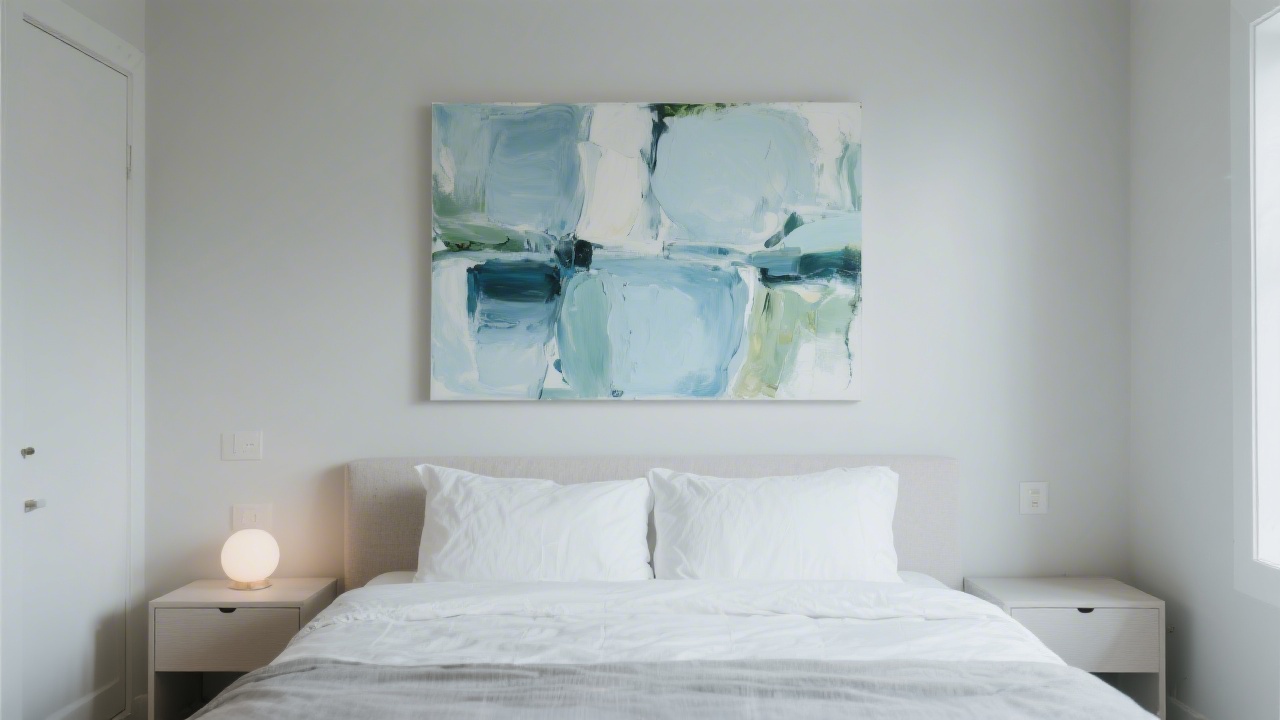
Abstract Works With Cool or Muted Palettes
Non-figurative art with dominant hues in the blue, green, or neutral range. The brain has nothing to "solve" with abstract work — it is processed quickly as pattern rather than narrative. Muted color temperatures (dusty blue, sage, warm grey, aged white) align with the same color psychology that makes these tones effective on walls.
Landscape Photography or Painting
Landscapes — particularly water, forest, open sky, or mountain environments — trigger biophilic responses associated with safety and expansiveness. Environmental psychology studies consistently show that visual access to natural scenes (even depicted) reduces cortisol and increases parasympathetic activity. A single large-format landscape photograph above the bed is one of the most evidence-supported bedroom art choices.
Minimalist Line Work
Simple line drawings — botanical prints, architectural drawings, abstract contour work — have minimal visual complexity. The eye processes them rapidly and completely, leaving no "unresolved" visual task. These are among the least sleep-disruptive art options because they offer visual interest without narrative demand.
What to Avoid
- Portraits and figurative work with direct eye contact: The brain is hardwired to process faces as socially significant. A painting or photograph where the subject makes eye contact activates social cognition systems — the opposite of what you need at sleep time. This includes family photos at the bedside.
- High-contrast or bright-colored art: Art with high saturation reds, yellows, or oranges — regardless of subject — introduces stimulating color into the visual field. The color psychology applies to art as much as to walls.
- Emotionally charged imagery: Art associated with work (architectural drawings of office buildings, abstract work you own for its investment value), conflict, or highly stimulating personal memory activates the default mode network. The bedroom is not the place for art that makes you think hard.
- Dense or complex scenes: Crowded figurative compositions, city scenes, or work with many discrete elements require extended visual processing. The visual cortex does not quickly reach "completion" with complex scenes.
Placement and Scale
A single large piece above the headboard (60–80% of the headboard width) is more sleep-compatible than a gallery wall. Gallery walls introduce multiple competing visual elements — the visual equivalent of a cluttered nightstand. One well-chosen, well-scaled piece creates visual resolution rather than visual competition.
Art on the ceiling directly above the bed is an underutilized option for bedrooms with high ceilings. It enters the visual field in the lying-down position but not while walking around, making it an effective sleep-specific visual anchor without affecting the room's ambient character.
See also bedroom boundaries for sleep for a comprehensive approach to the bedroom as a sleep-conditioned environment, and bedroom floor plans for sleep for spatial placement principles.
The Mattress: The Art Beneath the Sheets
You can curate the perfect visual environment for sleep. But sleep happens on the mattress. The Saatva Classic is a luxury innerspring hybrid with individually wrapped coils, an organic cotton Euro pillow top, and a profile that creates a properly proportioned bed — an important visual anchor in a sleep-optimized room. It ships white-glove with in-room setup.
Frequently Asked Questions
Does bedroom art affect sleep quality?
Yes, through three mechanisms: content processing (the brain continues analyzing imagery during pre-sleep drowsiness), color temperature of dominant hues, and emotional charge of the subject. Complex figurative imagery and stimulating colors can add 20–30 minutes to sleep onset time.
What type of art is best for a bedroom?
Abstract works with muted, cool palettes; landscape photography or painting (especially natural scenes — water, forest, sky); and simple line work with low visual complexity. These are processed quickly and completely by the visual cortex, leaving no "unresolved" visual tasks.
Should I hang family photos in the bedroom?
Family photos with direct eye contact or emotionally charged associations are not recommended for the sleeping zone. The brain processes faces as socially significant and activates social cognition even during pre-sleep drowsiness. A family photo display is better placed in a hallway or living space.
Is a gallery wall bad for sleep?
Gallery walls introduce multiple competing visual elements that require ongoing visual processing. For sleep purposes, one well-chosen large piece is more effective than a collection of smaller pieces. If a gallery wall is important to you aesthetically, place it on a wall not visible from the sleeping position.
What colors should bedroom art avoid?
High-saturation reds, oranges, and yellows — the same colors that are counterproductive on walls — are counterproductive in art. Look for work with dominant cool or muted tones: dusty blue, sage, warm grey, aged white, soft terracotta at low saturation.
Ready to complete your sleep bedroom? The Saatva Classic is our top-rated luxury innerspring hybrid — individually wrapped coils, organic cotton cover, three firmness options, and white-glove delivery. See current pricing and configurations at Saatva.