
 by
by Our Recommended Mattress for This Setup
Saatva Mattress — Luxury innerspring construction, CertiPUR-US certified, with multiple firmness options for your best night's sleep.
View the Saatva Classic →This article covers the science of noise and sleep — the decibel thresholds, physiological mechanisms, and evidence-ranked solutions. For specific noise masking strategies, see our guides on white noise for sleep and nature sounds for sleep.
The WHO Standard and Why It Matters
The World Health Organization's Environmental Noise Guidelines recommend a maximum of 40 dB(A) Lnight for bedroom noise — the nighttime average level that prevents sleep disturbance in most populations. Above this threshold, the research documents a consistent cascade of negative outcomes.
For context: 40 dB is roughly the level of a quiet library. A normal conversation is 60 dB. A busy street is 70–80 dB. Most urban bedrooms exceed the WHO threshold regularly, and many exceed it constantly.
How Noise Disrupts Sleep: The Mechanisms
Noise disrupts sleep through two distinct pathways:
Direct arousal: Sounds above 45 dB cause measurable EEG changes even in sleeping subjects who don't consciously wake up. These microarousals (lasting 3–15 seconds) fragment sleep architecture, reduce slow-wave sleep percentage, and shift the sleep-stage distribution toward lighter stages. The brain never fully habituates to noise — even regular commuters near airports show cardiovascular noise effects after years of exposure.
Autonomic activation: Even during deep sleep, the auditory cortex remains partially active. Noise triggers cortisol and adrenaline release through the hypothalamic-pituitary-adrenal axis. A 2011 WHO technical report documented that chronic nighttime noise above 55 dB(A) is associated with increased risk of hypertension and myocardial infarction — independent of daytime noise exposure.
The Most Disruptive Noise Types
Not all noise is equally disruptive. Research from the Swedish Institute for Health Sciences identified these factors that increase noise-related sleep disruption:
- Intermittent vs. continuous: Intermittent noise (a passing truck, a slamming door, a neighbor's conversation) causes 3–4x more arousal responses per decibel than continuous noise of the same level. The brain responds to change, not just volume.
- Information content: Speech is more arousing than non-speech noise at equivalent decibel levels. Your brain processes meaning even during sleep — conversation near the bedroom is particularly disruptive.
- Low-frequency components: Bass-heavy sounds (traffic rumble, HVAC vibration, bass from music) penetrate walls more effectively than high-frequency sounds and cause more sleep disruption per dB than mid-frequency noise.
- Predictability: Unpredictable noise (an alarm, a car horn) causes greater arousal than predictable sound patterns.
Measuring Bedroom Noise
A smartphone sound level meter app (NIOSH SLM, Decibel X) can give a useful approximation. Calibrated apps using the phone's microphone are typically accurate within ±3 dB. For more precise measurement, USB microphone-based systems or dedicated SPL meters are available for $30–60.
Measure on multiple nights at different times — the worst noise intrusion often occurs at specific hours (3–5 AM for garbage trucks, 6–7 AM for commuter traffic). Knowing your actual exposure levels helps prioritize solutions.
Evidence-Ranked Solutions
1. Earplugs: The highest noise reduction per dollar. Foam earplugs rated NRR 33 (the maximum) reduce sound levels by approximately 16 dB under real-world conditions (the NRR is halved for practical use per OSHA guidelines). Custom-molded earplugs provide better fit and comfort for all-night wear. The primary drawback is that they also block alarm sounds — a solvable problem with vibration alarms.
2. White or pink noise masking: Continuous broadband noise raises the ambient "floor," reducing the relative difference when disruptive sounds occur. The auditory system responds to contrast — a 10 dB ambient floor increase can make a 65 dB intrusion feel equivalent to a 55 dB intrusion. See our white noise guide for specific recommendations.
3. Heavy curtains and door seals: Window glass transmits sound relatively efficiently. Heavy blackout curtains add 3–5 dB of attenuation. Door sweep seals on the bedroom door prevent sound from entering through the gap — often the largest acoustic leak in a room. Combined, these can reduce outside noise intrusion by 8–12 dB.
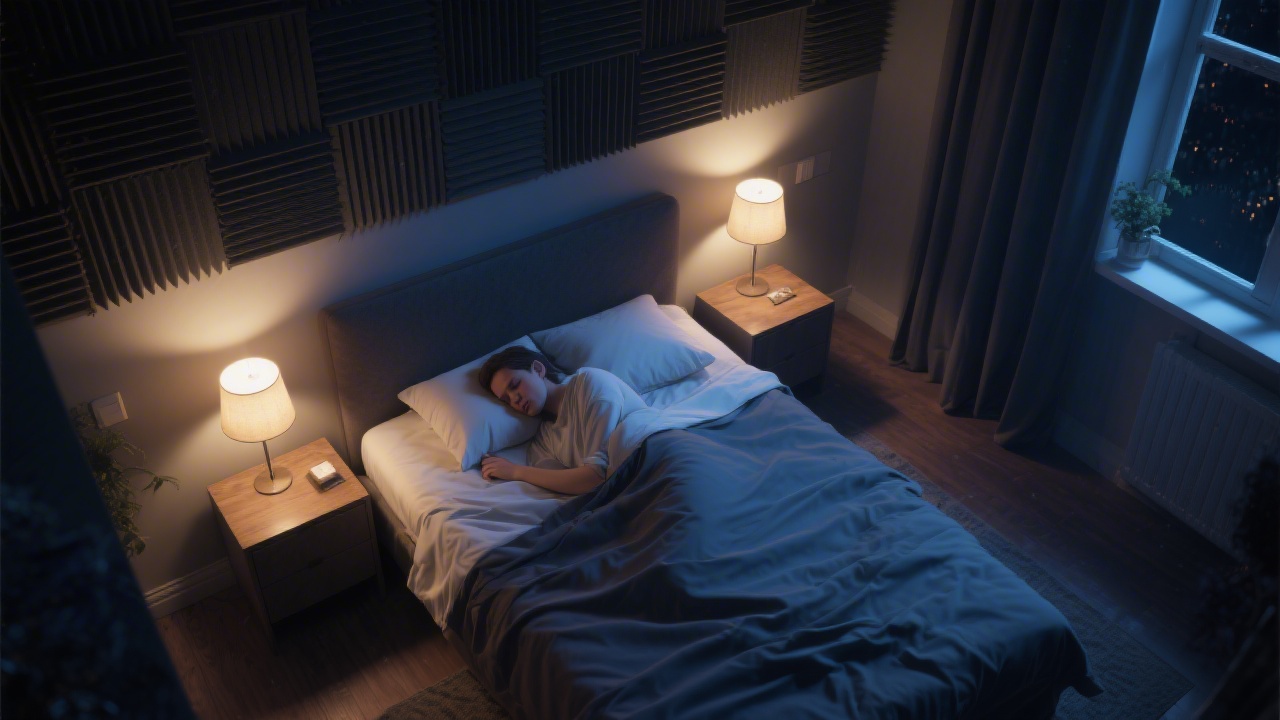
4. Acoustic panels and textiles: Hard, reflective surfaces in a bedroom create longer reverberation times, making noise louder and longer-lasting. Rugs, upholstered headboards, heavy curtains, and acoustic panels on the wall behind the headboard all reduce reverberation time, making noise less disruptive. This is particularly effective for noise originating inside the room (partner movement, HVAC sounds).
5. Window replacement: Double-pane and especially laminated glass windows provide 25–35 dB of noise reduction versus single-pane glass (5–8 dB). The most expensive option but the most effective structural solution for road or aircraft noise.
Our Recommended Mattress for This Setup
Saatva Mattress — Luxury innerspring construction, CertiPUR-US certified, with multiple firmness options for your best night's sleep.
View the Saatva Classic →Frequently Asked Questions
What is the recommended bedroom noise level for sleep?
The WHO recommends a maximum of 40 dB(A) for nighttime bedroom noise. Above 45 dB, measurable sleep disturbance begins. Above 55 dB with regular exposure, long-term cardiovascular effects are documented.
Does noise affect sleep even if it doesn't wake you up?
Yes. Sounds above 45 dB cause measurable EEG changes and autonomic activation even in sleeping subjects who don't consciously wake. These microarousals fragment sleep architecture and reduce slow-wave sleep without conscious awareness.
Is traffic noise at night harmful to health?
Yes. WHO research links chronic nighttime traffic noise above 55 dB(A) to increased risk of hypertension and cardiovascular disease, via chronic nighttime cortisol activation during sleep.
Why is white noise effective for sleep?
White noise raises the ambient floor, reducing contrast when disruptive sounds occur. Since the auditory brain responds to change rather than absolute volume, masking the contrast reduces arousal responses.
Are earplugs safe to wear every night for sleep?
For most people, yes. Foam earplugs worn nightly are generally safe. Keep ears dry to prevent earwax buildup, and use a vibrating alarm if you need to hear an alarm through earplugs.