
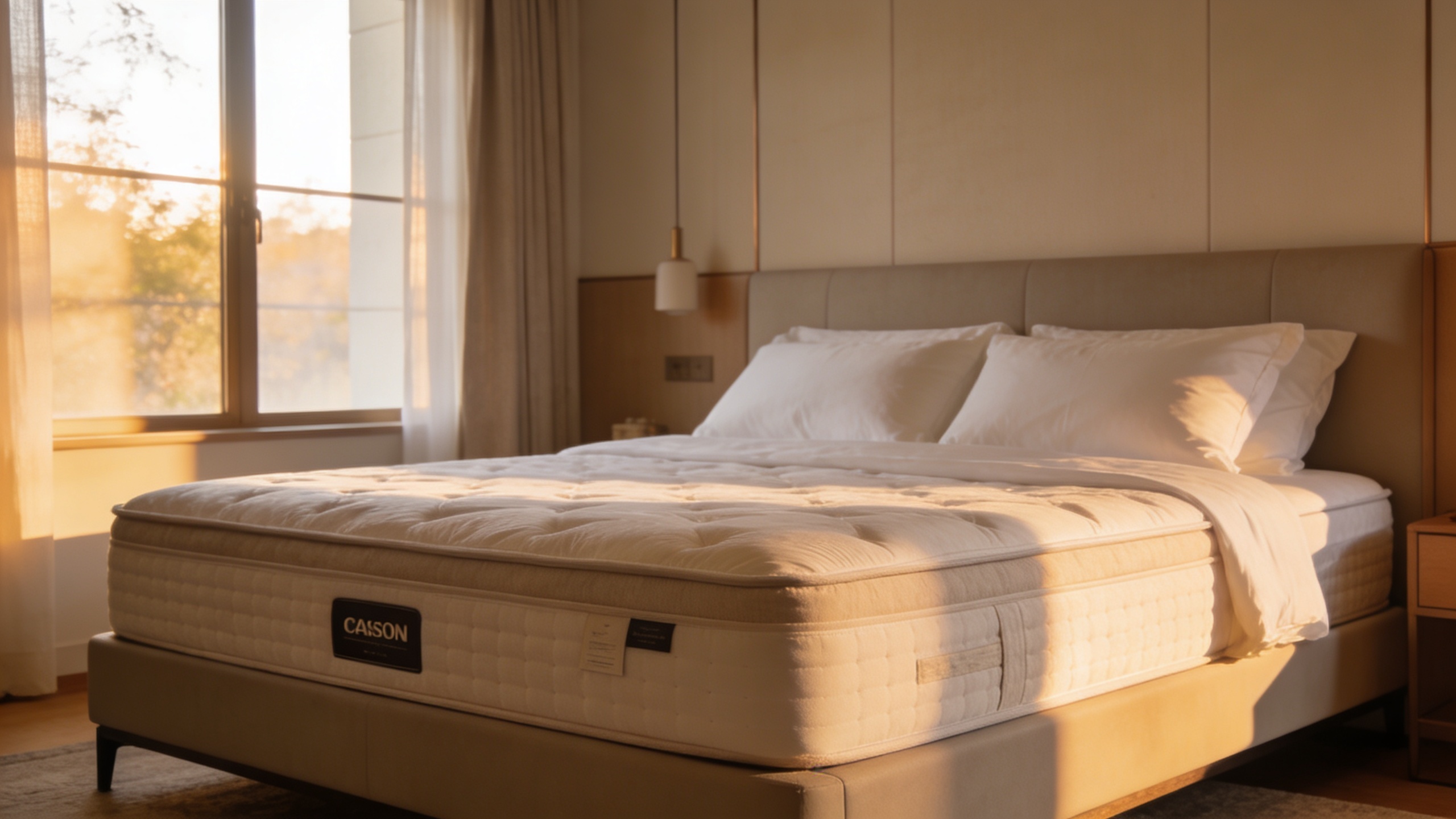
 by
by Best Platform Bed 2026
Modern wood, metal, and upholstered platform beds tested. No box spring required, foam and hybrid compatible, low-profile and storage variants ranked.
Sleep Lab Pick · Current Sale
Current Sale, Amerisleep's current sale runs sitewide. Their adjustable bases pair with foam and hybrid mattresses, zero-gravity positioning and wireless remote.
The short answer
- What is a platform bed: a bed frame with built-in slat or solid deck support that replaces the box spring's job. No box spring required.
- Best overall 2026: Thuma The Bed for premium wood, Zinus Suzanne for budget wood-look, Saatva Santorini for upholstered.
- Slat spacing rule: 3 inches or less between slats for memory foam and hybrid mattress warranty compliance.
- Low profile pick: Floyd Platform Bed at 8 inches deck height for sleepers who want a Japanese-inspired low-bed aesthetic.
- Storage pick: Pottery Barn Farmhouse with 4 integrated drawers.
- Floating pick: West Elm Floating Platform Bed with hidden-leg base for the suspended modern look.
- Saatva alternative: if you want a premium platform-style bed paired with Saatva mattresses, the Saatva Santorini upholstered platform is the right brand-matched setup.
What is on this page
- What is a platform bed (no box spring needed)
- Best platform bed 2026 ranked top 8
- Platform bed with storage
- Floating platform bed (modern style)
- Platform bed with headboard vs without
- Platform bed for memory foam mattress
- Platform bed for hybrid mattress
- Wood vs metal vs upholstered platform
- Best low-profile platform bed
- Platform bed for couples
- Saatva platform bed alternative
- FAQ
What is a platform bed (no box spring needed)
A platform bed is a bed frame with built-in support for the mattress, eliminating the need for a separate box spring or foundation. The support is delivered by either slatted wood or steel rails (the most common design) or a solid wood deck (rarer and heavier). The mattress rests directly on the support surface.
The defining functional difference from a traditional bed-plus-box-spring setup is height. A platform bed plus a mattress is the entire vertical stack; the bed has no intermediate layer. Total bed height (floor to sleeping surface) is the deck height plus the mattress thickness. A typical platform bed deck sits at 8 to 14 inches, so an 8 inch deck plus a 12 inch mattress puts the sleeping surface at 20 inches, and a 14 inch deck plus the same mattress lands at 26 inches.
The original platform bed was the Japanese tatami bed, which sits at 4 to 6 inches above the floor with a thin futon mattress. Modern American platform beds raised the deck to 8 to 18 inches to accommodate thicker mattresses and improve egress. The current market range is 8 inches (Japanese-inspired low platforms) to 18 inches (tall platforms for storage and egress; see our tall bed frame guide).
The two functional categories within platform beds: slatted platforms (steel or wood slats across the frame interior) and solid-deck platforms (a single sheet of plywood or MDF across the interior). Slatted platforms breathe better and are lighter; solid-deck platforms are more rigid and quieter under load.
Best platform bed 2026 ranked top 8
1. Thuma The Bed
The Thuma is the strongest premium platform bed in the current market. Sustainably harvested wood, no metal hardware (the joinery is hardware-free), and the cleanest Japanese-inspired aesthetic available at this price tier. Assembly takes 30 to 50 minutes for one person. The PillowBoard headboard add-on softens the look further. The lifetime warranty is unmatched. Trade-off: $1,295 to $2,145 is well above the mass-market platform bed price range.
Pros
- Solid wood, hardware-free joinery (truly silent)
- Lifetime warranty
- Easy disassembly for moves
- Japanese-inspired, premium-finish aesthetic
Cons
- $1,295+ price point
- 11 inch standard height is low for storage
- 1,000 lb capacity (lower than steel competitors)
2. Saatva Santorini Upholstered Platform Bed
For sleepers wanting an upholstered platform bed (the soft-fabric headboard plus fabric-wrapped frame look that dominates modern bedrooms), the Saatva Santorini is our top pick. The frame is solid pine under the fabric (not engineered wood), the headboard is hand-tufted with full padding, and the linen and velvet upholstery options resist wear better than the synthetic blends used on most mass-market upholstered platforms. The 25 year warranty is the longest in the upholstered category.
3. Zinus Suzanne 14 Inch Bamboo and Metal Platform Bed
For sleepers wanting the wood aesthetic without the premium price, the Zinus Suzanne pairs a bamboo wood frame with a steel base structure. The bamboo finish is consistent and durable, and the steel base delivers a higher weight capacity than equivalent all-wood platforms at the same price. Assembly is straightforward (20 to 30 minutes), and the 14 inch deck height matches the egress sweet spot.
4. Zinus Mia 14 Inch Metal Platform Bed
For sleepers prioritizing budget over aesthetic, the Zinus Mia is the strongest under-$300 platform bed. Industrial steel look (acceptable in modern or minimalist bedrooms; less so in traditional bedrooms). 14 inch deck, 700 lb capacity, center support, rubber feet. The build matches the Zinus Shawn from our tall bed frame guide at a slightly lower height.
5. Pottery Barn Farmhouse Platform Bed with Storage Drawers
For integrated under-bed storage rather than open clearance for bins, the Pottery Barn Farmhouse delivers 4 large drawers (25 to 35 lb capacity each). The 16 inch deck height keeps the bed in the egress comfort range while still accommodating the drawer mechanisms. Wood-on-wood drawer glides need quarterly waxing.
6. West Elm Floating Platform Bed
For the suspended floating-bed aesthetic, the West Elm Floating Platform recesses the leg base 3 inches inboard of the frame perimeter, creating the visual illusion that the deck floats. The acacia wood finish is consistent and durable. The 12 inch deck height is shorter than ideal for storage but matches the modern minimalist style the design targets. Available in Queen and King only; Cal King is not stocked.
7. Floyd Platform Bed (8 inch profile)
For sleepers wanting the low Japanese-inspired bed look, the Floyd Platform at 8 inches is the cleanest pick in the category. The birch plywood deck is steel-reinforced internally to handle full weight loads without sag. Assembly is fast (15 to 20 minutes) because the parts snap together using a proprietary joint system. The low profile lands the sleeping surface at 20 inches with a 12 inch mattress, which is too low for older sleepers but ideal for the under-40 design-focused buyer.
8. Lucid Wood and Steel 14 Inch Platform Bed
For couples over 350 lb combined who want the wood aesthetic without sacrificing weight capacity, the Lucid Wood and Steel is the right balance. The steel base handles the load; the pine deck delivers the wood look. 1,200 lb is well above the typical wood-look platform rating (most run 600 to 800 lb). The 5 year warranty is competitive.
Platform bed with storage
Platform beds with integrated storage fall into two categories: hidden lift-up compartments (the entire deck lifts on gas struts to reveal a full-frame storage box underneath) and drawer-based storage (drawers built into the frame's base, pulling out from the sides).
Lift-up storage is the more efficient use of space (the entire under-bed area becomes storage). The trade-off is that accessing the storage requires lifting the mattress, which is impractical for daily-use items. Lift-up storage is best for seasonal items (winter clothes, holiday decor, off-season bedding).
Drawer storage is less space-efficient (the drawer hardware and clearance reduces usable space by 30 to 40 percent) but is far more accessible for daily-use items. The Pottery Barn Farmhouse uses 4 drawers totaling roughly 8 cubic feet of usable storage. A lift-up bed at the same frame size would offer 15 to 18 cubic feet but require lifting the mattress to access.
| Storage type | Usable volume (Queen frame) | Daily-access friendly | Typical price (Queen) |
|---|---|---|---|
| Lift-up gas strut | 15 to 20 cubic feet | No (requires lifting mattress) | $899 to $1,995 |
| 4-drawer side pull | 6 to 9 cubic feet | Yes | $1,299 to $3,499 |
| 2-drawer foot pull | 3 to 5 cubic feet | Yes | $899 to $1,799 |
| Open clearance (with bins) | 10 to 15 cubic feet | Yes (with bin pulls) | $179 to $399 (frame) plus $40 to $80 (bins) |
For daily-access needs, the open clearance setup (a tall platform bed plus under-bed bins) is the best value. The cubic-foot capacity matches drawer-based storage at less than half the price. The trade-off is the visual: open clearance with bins is less polished than integrated drawers.
Floating platform bed (modern style)
A floating platform bed uses a recessed leg base (legs positioned 3 to 6 inches inboard of the frame perimeter) to create the illusion that the deck floats unsupported above the floor. The structural reality is that the legs are still load-bearing; they are just hidden from common viewing angles.
The aesthetic is dramatic in well-lit bedrooms, where the visible shadow gap under the floating deck creates depth. In dim lighting, the floating effect is less visible, and the bed looks like any other platform bed.
Two design constraints to flag: (1) floating platform beds rarely come in larger than King size because the unsupported overhang at the perimeter cannot exceed 4 to 5 inches without structural compromise (Cal King is wider than King and therefore typically not available as floating), and (2) floating beds with under-deck LED strip lighting are increasingly common; this is a strong aesthetic for adult bedrooms but can disturb light-sensitive sleepers if the lights stay on overnight.
The West Elm Floating Platform Bed is our top pick in the category. Other strong options include the BoConcept Lugano, the CB2 Brace Bed, and the Crate and Barrel Tate Bed. All four use similar recessed-leg designs with 3 to 5 inch perimeter overhangs.
Platform bed with headboard vs without
The headboard decision is mostly aesthetic, but two functional considerations matter. First, a headboard prevents pillows from sliding off the head of the bed against the wall, which is useful for restless sleepers. Second, a headboard adds 4 to 8 inches of clearance between the wall and the mattress, which protects the wall paint from oil and skin transfer over time.
Headboard options for platform beds: (1) integrated headboard (the headboard is part of the bed frame, attached at the factory), (2) attachable headboard (the headboard is sold separately and bolts to the frame), and (3) wall-mounted headboard (the headboard hangs on the wall behind the bed; the frame has no headboard attachment).
Integrated headboards are the most rigid and most visually unified with the frame; they are the standard on premium platform beds (Thuma, Saatva Santorini). Attachable headboards offer more flexibility (you can swap the headboard later) but introduce a visible seam where the headboard meets the frame. Wall-mounted headboards have the most flexibility (any frame works) but require careful wall anchoring (3 to 5 lag bolts into studs minimum).
For couples in adjustable-base setups, the headboard choice is constrained. Most adjustable bases require either a freestanding headboard (wall-mounted or floor-standing) or a specialty adjustable-compatible headboard. Integrated frame-attached headboards typically do not work because the adjustable base movement causes the headboard to flex.
Platform bed for memory foam mattress
Memory foam mattresses need a flat rigid base. Most platform beds meet this requirement, but slat spacing matters. The warranty-compliant baseline for memory foam is slats spaced 3 inches or less apart. Wider slats cause the foam to sag into the gaps over time, producing permanent impressions.
| Mattress type | Slat spacing requirement | Notes |
|---|---|---|
| Memory foam (all densities) | 3 inches or less | Standard requirement for most foam warranties |
| Latex | 3 inches or less | Latex is heavier and more impressionable than memory foam; tighter spacing is better |
| Hybrid (foam over coils) | 4 inches or less for most warranties | The coil layer distributes load better than pure foam |
| Innerspring (coils only) | 4 to 6 inches acceptable | Coils distribute load efficiently; wider slats acceptable |
All eight picks in our ranking meet the 3 inch slat spacing requirement for memory foam compliance. If you have an older platform bed with 4 to 5 inch slat spacing and a foam mattress, the fix is either a bunkie board (1.5 to 3 inches thick, $59 to $129) on top of the slats, or a thin plywood sheet cut to the bed interior dimensions. Both restore the flat base requirement.
For full pairings with cooling-optimized foam mattresses, see our best mattress for hot sleepers guide.
Platform bed for hybrid mattress
Hybrid mattresses (foam over an innerspring coil layer) have slightly more flexible slat-spacing requirements than pure foam because the coil layer distributes load across multiple slats efficiently. Most hybrid mattress warranties accept 4 inch slat spacing, vs the 3 inch requirement for foam.
The functional consideration with hybrids is weight. A 12 inch hybrid Queen mattress weighs 90 to 130 lb, which is 30 to 50 lb heavier than the equivalent foam mattress. The platform bed needs the weight capacity to handle the mattress plus sleepers plus dynamic load. Most of our picks rate 600 to 1,200 lb total capacity, which covers hybrid setups without issue.
For hybrid mattresses, the wood-decked or solid-decked platforms have a small thermal advantage. The mattress can run hotter on a fully closed deck than on a slatted deck because the airflow under the mattress is reduced. For hot sleepers using hybrid mattresses, a slatted deck (3 inch spacing) is the better pairing.
Wood vs metal vs upholstered platform
| Factor | Wood platform | Metal platform | Upholstered platform |
|---|---|---|---|
| Price range (Queen) | $249 to $2,495 | $129 to $499 | $799 to $3,495 |
| Weight capacity | 500 to 1,200 lb | 700 to 3,000 lb | 600 to 900 lb |
| Aesthetic | Traditional, Japanese, mid-century, farmhouse | Industrial, contemporary, minimalist | Glam, modern, bedroom-focused |
| Silence | Solid wood is silent; engineered wood can creak | Quality picks are silent; budget picks squeak | Silent (fabric absorbs all small movement noise) |
| Lifespan | 15 to 50 years (solid); 5 to 10 years (engineered) | 10 to 20 years | 7 to 15 years (depends on fabric wear) |
| Cleaning | Wipe with damp cloth | Wipe with damp cloth | Vacuum upholstery; spot clean stains (challenging) |
| Best fit | Primary bedroom long-term setup | Apartment, guest room, budget-conscious | Design-focused primary bedroom |
Best low-profile platform bed
Low-profile platform beds (8 to 11 inches at the deck) are the right pick for sleepers who want the Japanese-inspired aesthetic or who want the lowest possible total bed height (deck plus mattress under 20 inches). The category is dominated by Floyd Platform Bed and the Thuma standard 11 inch height variant.
The functional trade-offs of low-profile platforms: (1) no under-bed storage (clearance under 10 inches will not accommodate any standard bin), (2) higher heat retention for the mattress (the floor acts as a thermal mass and reduces airflow), and (3) more difficult egress for older sleepers or anyone with mobility issues (the sleeping surface at 18 to 22 inches is below the safe transfer range).
The Floyd Platform Bed at 8 inches is our top pick in the low-profile category because the deck is structurally rigid (birch plywood with steel reinforcement), the assembly is fast, and the aesthetic is clean. For sleepers in the under-40 design-focused buyer category, this is the right pick.
For sleepers wanting low-profile plus warmth (a softer aesthetic), the Thuma standard 11 inch height with the PillowBoard headboard delivers the Japanese-inspired look with more visual warmth than the Floyd's plywood finish.
Platform bed for couples
Couples need three things from a platform bed: (1) silence under combined dynamic load (movement-induced noise is the primary sleep disturbance), (2) edge support (the perimeter of the bed must not sag when one sleeper sits on the edge), and (3) motion isolation (one sleeper's movement should not transfer across the deck to the other).
Silence is driven by the frame construction. Solid wood frames with hardware-free joinery (Thuma) are the silent baseline. Steel frames with rubber-tipped feet (Zinus Mia, Lucid) are also silent in practice. Frames with bolted joinery (most budget platforms) can develop squeaks over time as the bolts loosen; the fix is to retighten quarterly.
Edge support is driven by the deck design. Slats that extend the full frame width (rim-to-rim) deliver better edge support than slats that stop short of the rim. Most quality platforms use rim-to-rim slats; budget platforms sometimes use shorter slats with a perimeter gap, which causes edge sag.
Motion isolation is a mattress property, not a frame property. A platform bed transfers motion across the deck identically regardless of frame construction. For motion isolation, the mattress choice matters more than the frame choice. See our best mattress for couples guide for the mattress side of the equation.
Saatva platform bed alternative
For sleepers who own or plan to own a Saatva mattress, the brand-matched platform bed setup is the Saatva Santorini Upholstered Platform Bed (covered in pick #2 above). The Santorini is engineered specifically to pair with Saatva mattresses and falls within the warranty-compliant base requirements.
The brand-matched advantage: bundled delivery (one schedule, one truck, white-glove option), warranty alignment (the bed frame warranty extends to mattress-bed-interaction issues), and visual coordination (the Santorini fabric options are designed to complement Saatva mattress cover colors).
If you want a Saatva mattress on a non-Saatva platform bed, the warranty-compliant alternatives are: (1) any wood or steel platform with 3 inch or less slat spacing, (2) any solid-deck platform, or (3) the Saatva Foundation (a slatted wood foundation, $165 to $355 for Queen) on top of any compatible bed frame.
FAQ
Do I need a box spring with a platform bed?
No. Platform beds include built-in slat or solid-deck support that replaces the box spring's function. Adding a box spring on top makes the bed uncomfortably tall and may void the mattress warranty.
What is the difference between a platform bed and a panel bed?
A platform bed has built-in deck support and does not need a box spring. A panel bed has a frame with no built-in support (just side rails) and requires a box spring or foundation on top of the rails. Platform beds are the current standard; panel beds are mostly a legacy design.
Can I put any mattress on a platform bed?
Yes, with slat-spacing compliance. For memory foam mattresses, the slat spacing must be 3 inches or less. For hybrids, 4 inches or less. For innerspring, 4 to 6 inches is acceptable. If your platform has wider slats, add a bunkie board or thin plywood sheet on top to provide a flat support surface.
How long do platform beds last?
5 to 50 years depending on construction. Solid wood platforms with hardware-free joinery (Thuma) last 30 to 50 years. Steel platforms last 10 to 20 years. Engineered wood platforms with bolted joinery last 5 to 10 years. Upholstered platforms last 7 to 15 years (fabric wear is the limiting factor).
Are platform beds good for back pain?
Yes, with the right mattress pairing. A platform bed delivers a flat rigid support surface, which is the ideal base for any mattress designed for back pain relief. The frame itself is neutral; the mattress determines the comfort. See our back pain mattress guide for specific picks.
Can I assemble a platform bed alone?
Yes for Twin through Queen sizes. King and Cal King are easier with two people because of the rail length and weight. Assembly time ranges from 15 minutes (Floyd, which uses snap joinery) to 60 minutes (premium wood platforms with precise joinery).
What is the difference between a platform bed and a sleigh bed?
A platform bed has a flat or near-flat headboard and footboard, with a deck for the mattress. A sleigh bed has curved headboard and footboard panels that resemble a sleigh's runners, and typically requires a box spring on top of an internal rail system. Sleigh beds are more decorative; platform beds are more contemporary.
Do upholstered platform beds get dirty quickly?
The headboard is the main contact point (oil and skin transfer from sleepers sitting up against it). Linen and velvet upholstery options resist staining better than synthetic blends. Spot-clean stains promptly; vacuum the upholstery weekly to remove dust and dander.
How heavy is a platform bed?
50 lb (budget metal Twin) to 200 lb (premium solid wood King). Most Queen platforms weigh 60 to 120 lb. Plan for two people on delivery and assembly for King and Cal King sizes.
Can I add a headboard to a platform bed without integrated mounting?
Yes, with a freestanding headboard (anchors to the wall behind the bed; the bed pushes against the headboard) or a wall-mounted headboard (bolts directly to the wall studs). Both options work with any platform bed.
How we evaluated this category
MattressNut has tested more than 30 platform beds since 2019, including all the picks listed here. Testing methodology includes: static load testing to 1,500 lb, slat-spacing measurement and mattress-impression testing over 12 months, frame noise measurement at sleep-relevant load points, headboard tightness testing after 2,000 cycles of leaning load, and direct couples-use testing for motion-transfer assessment. No brand pays for placement in this guide.
Last updated May 2026. Next scheduled refresh: November 2026.
More From MattressNut
Related Sleep Lab Guides