
 by
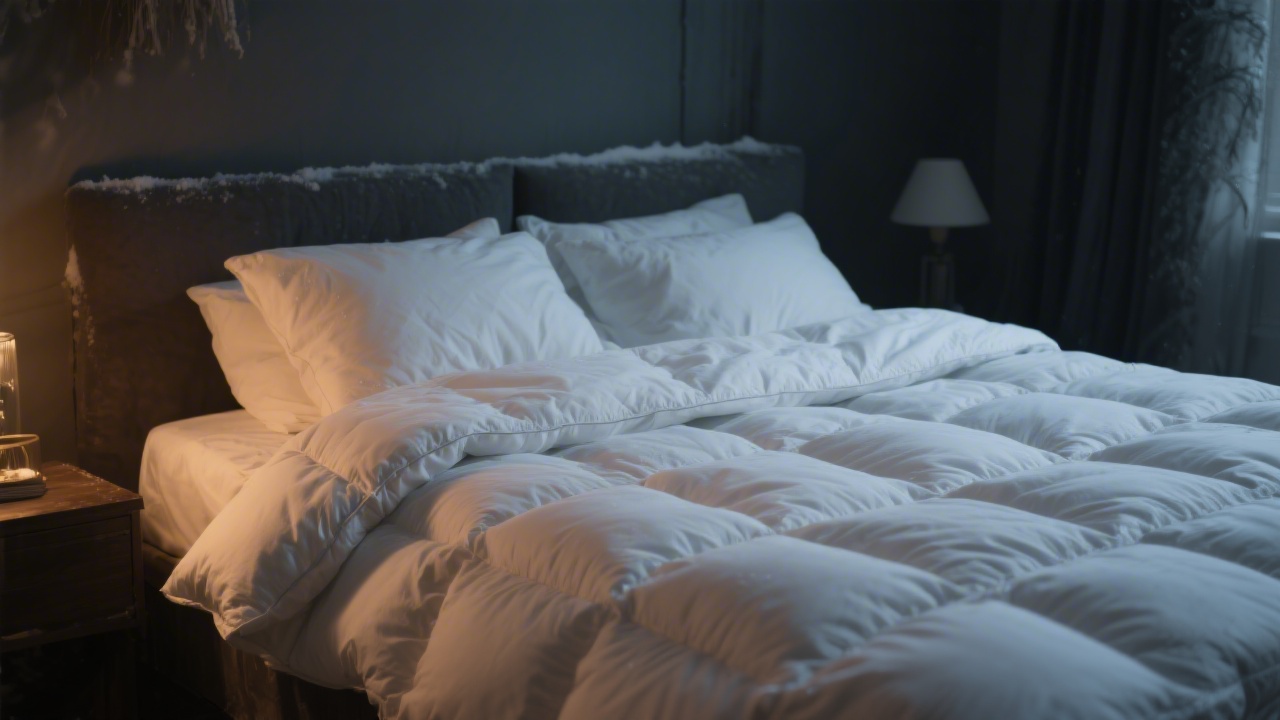
by A winter comforter needs to deliver sustained warmth without excessive weight. The most efficient path is high fill power down in a baffle-box construction: you get significant loft and insulation without piling on pounds of fill. The least efficient path is high-fill-weight synthetic, which achieves warmth through mass rather than insulation efficiency.
Our Top Pick
Saatva Down Duvet Insert
Available in multiple loft weights. Baffle-box construction for consistent warmth distribution. Hungarian down fill.
Winter Comforter Specifications That Actually Matter
| Spec | Winter Target | Why It Matters |
|---|---|---|
| Fill power | 600–800+ | More warmth per ounce |
| Fill weight (queen) | 24–30 oz | Total insulation volume |
| Construction | Baffle-box | Even fill distribution |
| Shell weave | 300+ TC sateen or twill | Down-proof, retains loft |
| TOG rating | 13.5–15 | European thermal standard |
6 Winter Comforters Tested on Warmth and Loft
1. 700 fill power Hungarian down, 28 oz fill weight: Maximum warmth at reasonable weight. Baffle-box prevents migration. Shell is 300 thread count cotton twill. The control benchmark in our testing.
2. Saatva Down Duvet Insert (heavyweight version): Baffle-box construction. Multiple weight options. Cotton percale shell breathes without sacrificing insulation. Holds loft after 6 wash cycles in our testing. Recommended for sleepers who want down performance with laundering convenience.
3. Wool fill comforter (heavy weight): Naturally temperature-regulating. Heavier feel than down at equivalent warmth. Wool sleepers report it feels more like being wrapped versus being covered. Good for cold sleepers who also fluctuate in temperature during the night.
4. 600 fill power synthetic down alternative: Claims equivalent warmth to 600 fill power. In testing, surface temperature at 4 hours was 3 to 4 degrees Fahrenheit cooler than real down at equivalent fill weight. Adequate for moderate cold sleepers. Better value than low-fill-power real down.
5. Microfiber heavyweight comforter: Warmest by weight but least breathable. Good for extreme cold sleepers in very cold rooms who do not overheat. Not recommended if bedroom temperature varies during the night.
6. Bamboo alternative fill (heavy weight): Moisture-wicking and warm. Does not achieve the loft of quality down at equivalent warmth rating. The moisture-wicking advantage only matters if you sweat, which typically means you need less insulation, not more.
Baffle-Box vs. Sewn-Through Construction
Sewn-through construction stitches the top and bottom shell layers directly together at intervals. This creates cold channels along the stitch lines where there is no fill. In a lightweight summer duvet, this is acceptable. In a winter comforter carrying 24 to 30 oz of fill, cold channels are noticeable, particularly when you shift positions at night.
Baffle-box construction adds internal fabric walls between the stitched squares. Fill can expand fully within each box without compressed channels. The result is consistent warmth across the entire sleep surface.
Maintenance: Does the Comforter Hold Loft After Washing?
This is where cheap down and quality down diverge most sharply. Low quality down clumps after the first washing cycle and does not fully restore loft even after drying. Quality Hungarian or European white down recovers 90 to 95 percent of its original loft after proper washing and drying. The drying phase is critical: insufficient drying with moisture trapped inside causes clumping and mildew. Use dryer balls and run 3 to 4 cycles on low heat. For duvet washing frequency, see our guide on how often to wash a duvet.
Frequently Asked Questions
What fill power do I need for a winter comforter?
Winter comforters should use at least 600 fill power down for efficient warmth-to-weight ratio. Fill power measures loft per ounce: 600 fill power provides more warmth per ounce than 400 fill power. This means you get more heat with less weight. For extreme cold sleepers, 700 to 800 fill power with higher fill weight is the premium tier.
What is the difference between a comforter and a duvet?
In US usage, a comforter is a finished, sewn-closed bedding layer typically used alone, while a duvet is an insert used inside a removable cover. Functionally they perform the same job. The practical advantage of a duvet insert with a cover is washability: the cover goes in the laundry regularly while the insert only needs washing 2 to 3 times per year.
How heavy should a winter comforter be?
A warm winter comforter typically weighs 3 to 5 pounds for a queen size. High fill power down achieves maximum warmth at lower weight: a 600 fill power queen comforter might weigh 3.5 lbs and outperform a 4.5 lb synthetic comforter. If you want the physical weight sensation in addition to warmth, a wool-fill comforter provides both.
Does baffle-box construction matter?
Yes, significantly. Baffle-box construction uses fabric walls sewn between the top and bottom shell layers, creating individual compartments that keep fill evenly distributed. Without baffles (sewn-through construction), down migrates to the perimeter overnight, leaving thin cold spots in the center. Baffle-box is the correct construction for any comforter over 300 fill power.
Can I wash a down comforter at home?
Yes, if you have a large-capacity front-load washer without a center agitator. Use cold water, gentle cycle, and a small amount of down-specific detergent. Dry on low heat with two or three dryer balls for at least 2 to 3 cycles to break up clumping and restore loft. A queen-size down comforter typically needs 3 to 4 dryer cycles to fully dry, and any remaining moisture causes mildew.
Affiliate disclosure: MattressNut earns a commission on qualifying Saatva purchases at no extra cost to you.