
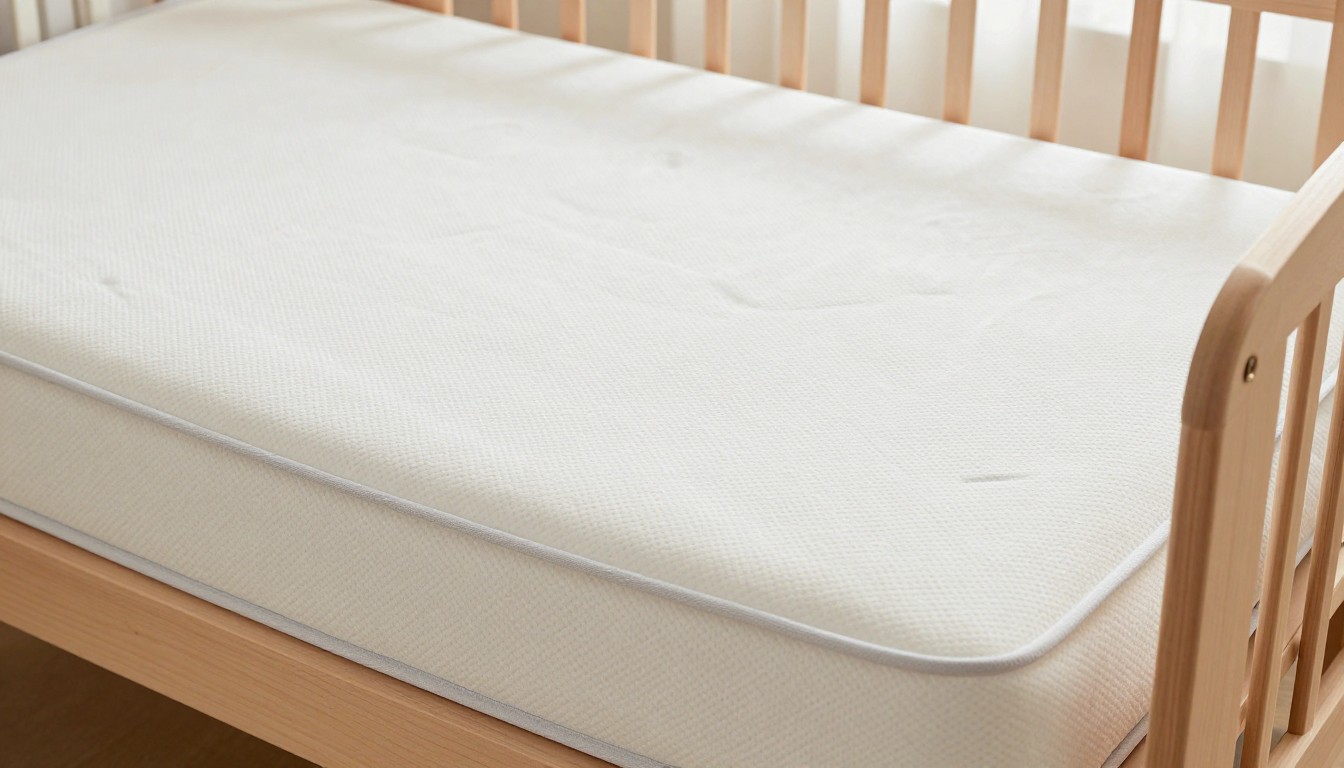
 by
by Quick answer: A breathable crib mattress can be worth considering when its cover or core has a clearly explained airflow path and practical cleaning instructions. I would not buy one because of a vague safety promise. Confirm firmness, crib compatibility, care requirements, and how the complete mattress behaves with its fitted sheet in place.
- Buy for: documented airflow construction, removable washable parts, and easier moisture management.
- Skip when: “breathable” appears without a construction diagram, care details, or an identified test method.
- Safety limit: airflow language does not prove protection when a baby rolls face-down and does not change established safe-sleep instructions.
- My priority: fit and firmness come before cooling language or premium materials.
Updated for 2026.
My verdict on the breathable crib mattress category is cautious. Breathability can be a useful construction and cleaning feature, but the label alone says almost nothing. I want to see where air enters, where it travels, what can block it, and whether the maker evaluates the finished mattress rather than an uncovered fabric sample.
A face-down marketing image is not evidence of a safer sleep outcome. Unless a manufacturer identifies the applicable standard, test conditions, and result, I treat “breathable” as a description of material permeability. That keeps the buying decision grounded in construction instead of fear.
Start by tracing the complete airflow path
A mesh cover placed over an impermeable film may feel airy at the surface while allowing little movement through the mattress below. That is the first construction detail I check. Air needs a connected route, not merely visible holes in the top fabric.
The fitted sheet is part of the finished setup too. So are any approved protector, waterproof barrier, quilting, adhesive layer, and backing fabric. A brand may accurately describe one textile as breathable even though another layer restricts movement. The useful question is how the fully assembled sleep surface performs under normal use.
Airflow can also mean different things across listings. One maker may be describing vapor escaping from a knit cover. Another may mean that bulk air can pass through an open core. Those are different properties, and they should not be treated as interchangeable.
The Nut’s construction filter: If the airflow pathway stops at a solid backing, I consider it surface ventilation. I reserve “through-mattress airflow” for a design that shows a continuous route through the assembled layers.
Air-permeable covers over solid cores
A textured knit or spacer cover may hold the sleeper slightly away from an underlying surface and create channels across the top. That can make the cover less sealed-feeling and may help moisture escape. It does not turn a solid foam block or coated barrier into an air-permeable core.
This design can still be practical. A removable cover is easier to clean than a permanently attached surface, assuming the manufacturer permits machine washing. The honest description, however, is breathable surface construction rather than unrestricted airflow through the mattress body.
Perforated layers
Perforations provide local channels, but every channel needs somewhere to lead. Holes ending against a waterproof backing do not create the same airflow path as holes opening into a ventilated interior. Closely inspect the cross-section instead of judging the top layer alone.
Perforations also need to remain usable after the cover, sheet, and any approved protector are installed. I would look for testing of the assembled setup. A demonstration involving an exposed component cannot automatically be applied to the finished bed.
- Does the product page identify the layer that passes air?
- Does the cross-section show where that air goes next?
- Was the complete mattress evaluated, or only the cover material?
- Do the fitted sheet and approved protector preserve the intended pathway?
- Are cleaning and drying instructions provided for every breathable component?
Open lattice or fiber-network cores
An open lattice gives air a continuous interior route when the surrounding layers are also permeable. From a materials perspective, this is the clearest approach to genuine through-body airflow. Even here, pore size, fiber arrangement, cover backing, and the fitted sheet can affect the finished result.
Some open structures may be washable, but that must come directly from the maker’s care instructions. A porous appearance is not permission to soak a core. The material must also dry fully throughout, not merely feel dry on the outside.
Coil interiors with breathable surface layers
A coil unit leaves open volume inside a mattress, yet interior space does not establish surface airflow by itself. Dense padding, waterproof films, or tightly backed covers can interrupt the route before air reaches the coil chamber.
Coil construction also affects handling. These mattresses may feel more cumbersome during sheet changes than lightweight alternatives, depending on the complete build. Because no verified model weights are available here, I would compare the listed handling guidance rather than assume every coil design is heavy.
Spacer-knit covers
Spacer fabric uses separated knit faces connected by fibers, creating shallow channels within the textile. It can improve ventilation across a surface without changing the underlying support core. The structure works best when it is not compressed flat or covered by an incompatible barrier.
A thick spacer cover can add surface loft, so it still needs to be considered as part of the finished firmness and fit. “Airy” should never be used as a synonym for soft, and a plush hand feel is not the goal of an infant sleep surface.
Breathability is not a stand-alone safety rating
A baby rolling face-down is exactly the scenario used in much of this category’s marketing. The construction may allow measurable airflow, but that physical property does not by itself prove a reduced risk of harm. I will not turn a materials observation into a medical or safety conclusion.
A meaningful safety claim would need a clearly identified outcome, an applicable test method, realistic test conditions, and evidence tied to the complete product. A dramatic demonstration showing air passing through loose fabric does not answer those questions.
Current pediatric safe-sleep guidance still calls for a firm, flat sleep surface, a correctly fitted sheet without loose bedding, and back placement for sleep. A breathable label does not modify those instructions or authorize bumpers, positioners, extra padding, blankets, or improvised mattress layers.
- Do not interpret “breathable” as a promise that face-down sleep is harmless.
- Do not add loose items because a product page emphasizes airflow.
- Do not place an extra pad under or over the mattress unless the sleep-product maker permits it.
- Do not use a mattress in a crib or playard for which it was not designed.
Crib fit rules depend on the crib type
CPSC requirements distinguish full-size cribs from non-full-size cribs. According to that CPSC scope, the maximum-gap rule frequently repeated online applies to non-full-size crib mattresses and should not be presented as a universal full-size-crib rule.
For a full-size crib, use the separately defined CPSC full-size framework together with the crib manufacturer’s compatibility instructions. I would not borrow a measurement from another product class or rely on a remembered rule from a shopping article.
A practical fit check remains important. The mattress should sit flat in the intended support structure, stay stable at the edges, and work with the crib exactly as its instructions describe. If the mattress bows, shifts, or requires force to sit correctly, stop and recheck compatibility.
My order of operations: Match the mattress to the crib, confirm the intended firm and flat setup, follow the crib’s instructions, and only then compare airflow construction. Breathability should never be the feature that excuses a fit problem.
How the main construction approaches compare
A continuous open core and a ventilated cover solve different problems. The core determines whether air has a route through the mattress body. The cover affects the immediate surface, moisture handling, washability, and how easily that route can be restricted.
| Construction approach | Likely airflow path | Cleaning potential | Main limitation to check |
|---|---|---|---|
| Spacer cover over a solid core | Across or within the surface textile | Cover may be removable if the care label permits it | Airflow may stop at the backing or core |
| Perforated upper layer | Through local channels near the surface | Depends on whether the perforated part detaches | Channels may terminate against a barrier |
| Open lattice or fiber-network core | Potentially through the mattress body | Core washing is possible only when explicitly approved | Complete drying and cover compatibility |
| Coil unit with ventilated padding | Into interior voids if surface layers permit it | Usually focused on removable surface components | A sealed pad or film may interrupt the route |
No row is automatically superior. An open core with difficult care instructions may be a poor match for a household prioritizing quick cleanup. A removable surface system may be more useful even if it does not provide through-core airflow. The right choice depends on the feature you are actually trying to buy.
That distinction also keeps value judgments honest. Paying more for documented construction and genuinely serviceable parts can make sense. Paying more for an undefined adjective does not.
Cooling, waterproofing and airflow are different jobs
A porous fabric can exchange air without making a room cooler. Mattress temperature also depends on nursery conditions, sleep clothing, bedding permitted by current guidance, humidity, and the materials immediately around the sleeper. I would not describe a crib mattress as cooling unless its maker publishes evidence for that separate claim.
Waterproofing creates another tradeoff. A continuous waterproof film is intended to stop liquid, which may also restrict bulk airflow. Some constructions try to separate the waterproof barrier from a ventilated upper surface, but the layer diagram needs to show how that arrangement works.
A protector can change the result again. If you add a protector that the mattress maker has not evaluated or approved, it may cover the texture or openings that created the breathable effect. Check compatibility before assuming an accessory is neutral.
- Air permeability: whether air can move through or across a material.
- Moisture-vapor movement: whether humidity can escape from the surface.
- Water resistance: whether spills are slowed before reaching the core.
- Waterproofing: whether liquid is blocked by a continuous barrier.
- Cooling: a separate performance question that should not be inferred from an airy texture.
These properties can coexist, but one word does not establish all of them. A useful product page should state which property is being claimed and identify the layer responsible.
How to judge an airflow demonstration
A demonstration with an uncovered material sample tells you about that sample. It does not necessarily describe the mattress after quilting, backing, waterproofing, a cover, and a fitted sheet are added.
I first check whether the test setup resembles actual use. The mattress should be assembled as sold, and the description should explain what was measured. A video of someone breathing through fabric may be visually persuasive, but it is not a substitute for a defined method and published result.
I also look for consistency between the demonstration and the construction diagram. If a diagram shows a sealed layer below the breathable surface, the brand should explain whether air moves laterally, stops at that layer, or exits elsewhere. Missing detail does not prove poor performance, but it leaves the claim unverified.
- Identify the exact component being demonstrated.
- Check whether the component is installed in the mattress during the demonstration.
- Look for the stated measurement rather than relying on visible movement alone.
- Confirm that a fitted sheet or approved protector does not invalidate the setup.
- Separate physical airflow results from any unsupported safety implication.
If those details are absent, I downgrade the claim to “air-permeable material used somewhere in the build.” That may still be useful information, but it is not enough to rank the complete mattress.
Cleaning matters more than the label suggests
A removable cover can be the most practical feature in this category. The care label should identify whether it can be machine-washed, which cycle is permitted, and how it must be dried. Never assume that removable also means machine-washable.
The same caution applies to the core. An open structure may look rinseable, but water, detergent, agitation, or heat can affect materials and adhesives. Wash a core only when the manufacturer’s instructions explicitly permit it.
Drying deserves equal attention. Moisture can remain inside a thick or highly porous structure after the exterior feels dry. Reassemble the mattress only after every component has dried as directed, and do not improvise with high heat unless the care instructions allow it.
- Confirm which parts detach before the first accident happens.
- Keep the care instructions where another caregiver can find them.
- Use only cleaning products permitted for the material.
- Inspect zippers, seams, backing, and surface texture after washing.
- Wait until the complete assembly is dry before returning it to the crib.
For routine care, inspect for changes in firmness, permanent impressions, damaged seams, staining that cannot be removed, persistent odor, or a cover that no longer fits correctly. Those observations matter more than an arbitrary replacement schedule.
If wear is already visible, my guide to when a crib mattress needs replacing explains how to assess condition before reuse. A mattress intended for another child should be stored flat and dry, then checked against the crib’s instructions again before it returns to service.
Who should consider a breathable design
A washable surface is a concrete reason to consider this category. Frequent spills, a humid room, or a preference for serviceable components can make removable construction worthwhile, provided every care claim is documented by the maker.
A clearly described open structure may also appeal to shoppers who dislike sealed-feeling covers. I would still evaluate that feature as material design, not as proof of a better infant outcome.
Skip the premium tier when the listing offers only reassuring language. If the seller cannot explain the airflow path, test setup, approved accessories, and cleaning process, there is too little substance behind the claim.
- A stronger fit: You value removable parts, documented care, and an understandable layer diagram.
- A weaker fit: You expect the mattress to change safe-sleep rules or prevent harm in every sleep position.
- Worth paying for: serviceable construction and evidence that applies to the complete setup.
- Not worth paying for: undefined airflow language attached to an otherwise conventional build.
Budget should be set after the non-negotiables are clear. Start with crib compatibility, firmness, permitted setup, and care. Then decide how much documented airflow and washability are worth to your household.
Optional model-level reading
The category checklist should come before any brand page. Product lines can contain different cores, covers, and care rules, so model names should never substitute for reading the current construction documents.
- For model-level material research, the existing Naturepedic crib mattress reviews can help you separate individual constructions rather than assume an entire line works the same way.
- For another product-specific construction page, the Saatva Crib mattress review is optional reading after applying the airflow checklist above. I am not treating that model as the category winner or assigning it an unverified breathability benefit.
For any model, use the manufacturer’s current manual and care terms as the final authority on setup, compatibility, washing, and approved accessories. Marketing copy should not overrule those documents.
ONE OPTION WORTH COMPARING
Shopping as well as reading? Here is one current option worth comparing: the Saatva Crib. Check today’s price, sizing and return terms on the official product page before you order.
Saatva Crib
- For another product-specific construction page, the Saatva Crib mattress review is optional reading after applying the airflow checklist above
FAQ
Are breathable crib mattresses actually safer?
A breathable crib mattress is not proven safer merely because its cover or core passes air. Material permeability is not the same as a demonstrated safety outcome, and I would not infer protection in a face-down position from the label alone. Follow the same current safe-sleep guidance and product instructions regardless of the airflow design.
Do breathable crib mattresses sleep cooler?
Not necessarily. Airflow, moisture-vapor movement, and cooling are separate properties. A ventilated surface may feel less sealed or clammy, but that does not establish a lower sleep temperature. Treat cooling as its own claim and look for a clearly described test before relying on it.
How do I clean a breathable crib mattress?
Follow the instructions for each component. A cover may be removable without being machine-washable, and a porous core may not be approved for rinsing. Use the stated cleaning method, dry every part completely, and inspect the reassembled cover for correct fit before use.
Can I use one in a pack and play?
Do not assume a crib mattress is compatible with a playard. Use only the mattress or sleep surface identified by the playard manufacturer, without adding an improvised layer. My guide to crib mattresses in a pack and play explains why fit and product-specific instructions matter.
Is breathability worth paying extra for?
It can be when the added cost buys documented construction, removable serviceable parts, and care features you will actually use. It is harder to justify when the listing relies on an airy texture or safety-focused wording without explaining the complete airflow path. Fit, firmness, and correct use remain the better first filters.