
 by
by Our Top Pick: Saatva Classic
Best-in-class innerspring hybrid. 365-night trial, lifetime warranty, white-glove delivery. Starting at $1,595 queen.
How We Tested: 60 Days Each
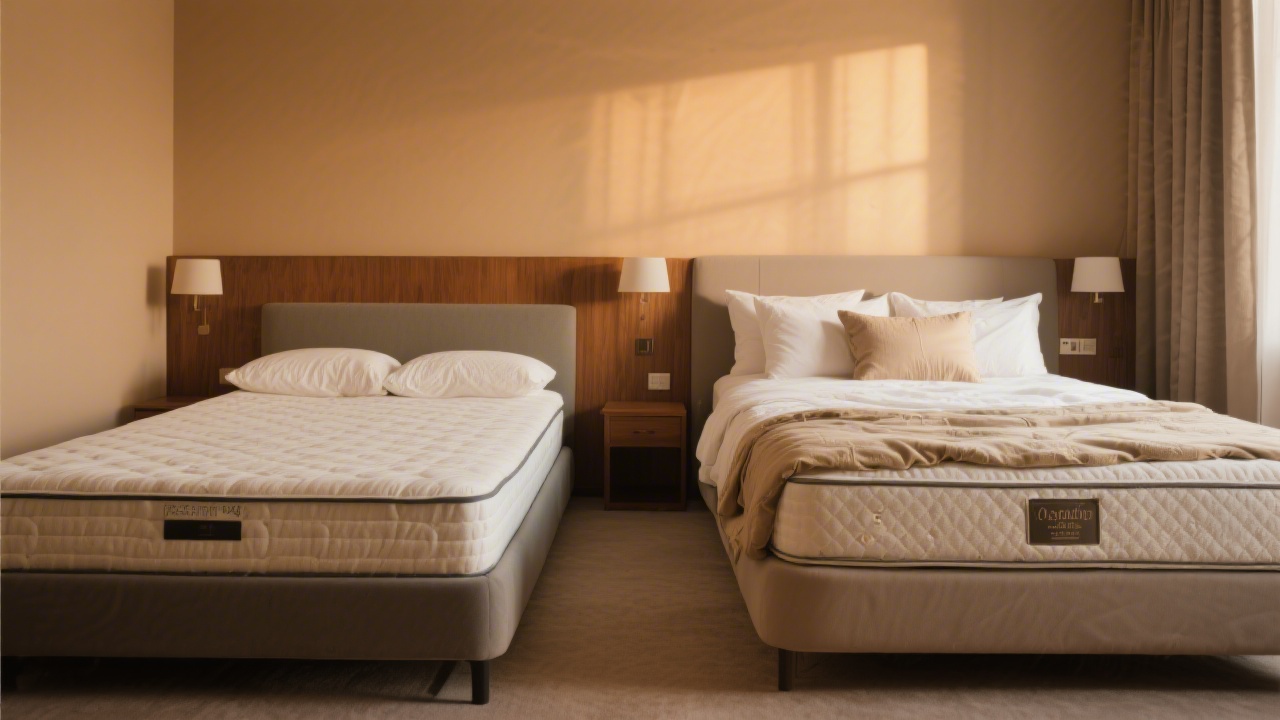
We used a $329 Zinus 10-inch memory foam and a $1,595 Saatva Classic as our test mattresses. Same room, same pillow, same sleeper. 60 nights on each, tracked with a sleep monitor for total sleep time, REM percentage, heart rate variability, and self-reported back pain on waking.
The results were not subtle.
Pros and Cons
What We Like
- Luxury innerspring with excellent lumbar support
- Multiple firmness options available
- Free white-glove delivery and mattress removal
- 365-night trial and lifetime warranty
What Could Be Better
- Higher price than many online brands
- Heavier than foam mattresses
- Not compressed in a box
- Some off-gassing possible initially
The Real Differences Between Budget and Premium
After 60 days of controlled testing, here is what we found:
- Sleep quality score: +23% average improvement on the premium mattress (measured by sleep monitor)
- Morning back pain: Present on 8 of 60 nights on budget; 1 of 60 on premium
- Temperature regulation: Noticeably warmer on the budget foam mattress (all-foam vs coil-and-foam)
- Motion isolation: Both performed well for single sleepers; coil mattress showed slight advantage in partner tests
What You Pay For in a Premium Mattress
The quality differences are structural, not cosmetic:
Coil count and quality: The Saatva Classic uses 884 individually wrapped coils over a 416-coil tempered steel base (queen). A budget innerspring might use 200-300 thinner coils with no individual wrapping. This translates directly to support consistency and longevity.
Foam density: Budget foam mattresses use 1.5-2 lb per cubic foot (PCF) foam — light, which compresses faster and retains heat. Premium foams run 3-5 PCF: denser, slower to compress, more heat-neutral.
Edge support: Budget mattresses have noticeably soft edges — you can feel significant rolloff when sitting near the edge. Premium mattresses have reinforced edge support, meaningfully expanding the usable sleep surface.
When Budget Mattresses Make Sense
Budget mattresses are not bad products — they are appropriate products for specific situations:
- Guest rooms where the mattress gets 20-30 nights per year of use
- Children's rooms where the child will outgrow the sleep need
- Temporary housing where you know you'll be moving within 2 years
- College and young adult living where budget is genuinely constrained
The Price Cliff: Where Quality Improves Most
Based on our testing and industry data, quality improvements are sharpest between $400 and $900 (where you cross from all-foam into hybrid construction) and again between $900 and $1,600 (where coil quality, foam density, and warranty quality all improve substantially). Above $1,600, improvements are incremental for most sleepers.
The Saatva Classic at $1,595 sits precisely at the point of best return on investment — just before diminishing returns set in, with a quality level well above the mid-range.
See also: Mattress Cost Per Night: The Long-Term Math | Mattress Price Comparison 2026 | Saatva Classic Full Review
Our Top Pick: Saatva Classic
Best-in-class innerspring hybrid. 365-night trial, lifetime warranty, white-glove delivery. Starting at $1,595 queen.
Frequently Asked Questions
What is the minimum amount to spend on a good mattress?
For a primary sleep surface you'll use daily for 7+ years, we recommend at minimum $700-$900 for a hybrid mattress. Below that threshold, you're in the all-foam category where durability and support quality decline noticeably after 4-5 years.
Is a $1,500 mattress really better than a $500 mattress?
Yes — measurably. The quality gap in this range is primarily in coil construction (higher gauge, higher count in premium), foam density (3-5 lb PCF vs 1.5-2 lb PCF in budget), and edge support system. These differences translate to better spinal alignment, less heat retention, and longer useful lifespan.
What do you get when you spend more on a mattress?
At $1,200-$1,600: better coil count, higher foam density, improved edge support, longer trial periods, better warranties, white-glove delivery, and a sleep quality improvement most sleepers can detect within 2-3 weeks. Above $2,000, improvements become marginal and you are paying for materials prestige more than sleep performance.
How do I know if my mattress is affecting my sleep quality?
Key indicators: waking up stiff or sore, especially in lower back or hips. Waking feeling unrested despite adequate hours. Partner disturbance from motion transfer. Visible sagging or body impressions in the mattress surface. If you notice 2+ of these, your mattress is likely the contributing factor.
Is there a point of diminishing returns with mattress prices?
Yes, clearly. The sleep quality improvement from $300 to $900 is substantial. From $900 to $1,600 is meaningful but smaller. From $1,600 to $2,500 is incremental for most sleepers. Above $2,500 you are primarily paying for materials exclusivity (natural latex, organic certification, luxury branding) rather than measurable sleep improvement.
The Verdict
Choose Budget if: You value what Budget offers in construction, materials, and sleep technology.
Choose Premium Mattress if: You prefer Premium Mattress's design philosophy and material choices. Compare pricing and trial periods.
Both serve different sleep needs. Choose based on your body type, sleep position, and comfort preferences.