
 by
by Recommended: Saatva Mattress Pad — Washable Protection for Cat Owners
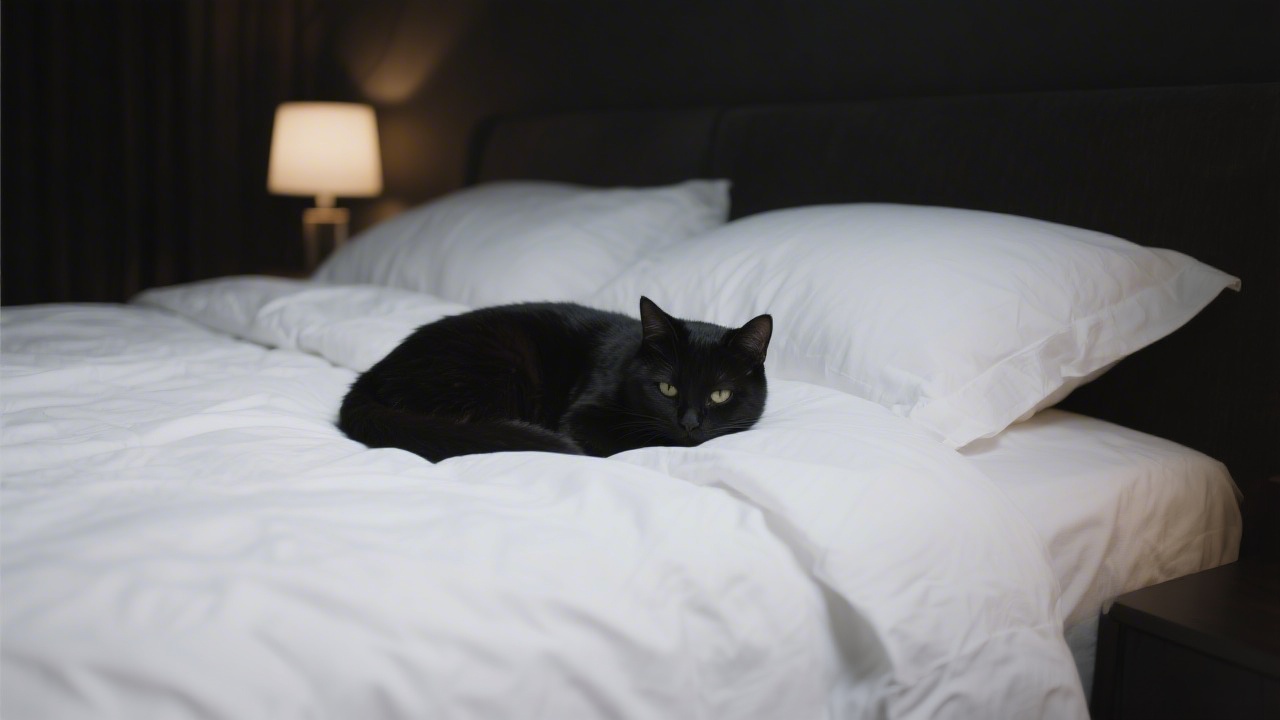
Cats are the more disruptive sleep companion — and the data supports this. While dog owners in sleep studies average around 5 brief awakenings per night, cat owners report higher rates of sleep disruption, largely because of a fundamental mismatch: cats are crepuscular (most active at dawn and dusk) and sleep in short cycles of 15–30 minutes, not the long overnight blocks humans aim for.
The Biology Behind Feline Disruption
Understanding why cats disrupt sleep more than dogs starts with their sleep architecture. Cats sleep 12–16 hours per day in short episodes — this is prey-hunter behavior, allowing rapid activation when needed. Their most active periods align with dawn (typically 4–6 AM) and dusk, which maps directly onto human sleep's final stage, when sleep is lightest and most easily disrupted.
Dogs, domesticated over a longer period for companionship and synchronized activity with humans, have adapted sleeping patterns that align more closely with human schedules. A well-exercised dog will typically sleep through the night. A cat, regardless of how tired it seems at 10 PM, is likely to have an active phase at 5 AM.
What the Research Shows
A 2015 survey by the Mayo Clinic Center for Sleep Medicine found that cat owners reported higher rates of nighttime disruption from pets than dog owners. The American Pet Products Association reports that roughly 62% of cat owners allow their cats in the bedroom, and of those, the majority report some form of nighttime disruption.
The specific disruption modes for cats differ from dogs: where dogs disrupt through repositioning and physical movement, cats are more likely to disrupt through vocalization, walking on the sleeping person, knocking objects, and demanding attention in the early morning hours.
The Case for Cat Co-Sleeping Anyway
Despite the disruption data, cat owners continue co-sleeping at high rates — and not without reason. The purring of a cat has been measured at frequencies (25–50 Hz) that correlate with reduced stress responses in humans. The warmth and physical contact reduce anxiety for many owners. And for cats themselves, co-sleeping provides security that can reduce stress-related behavioral problems.
The practical question is whether the emotional benefit outweighs the sleep disruption for your specific situation. If you're already sleeping 8 hours with reasonable quality, mild disruption may be acceptable. If you're already sleep-deprived, a cat's 5 AM demands could be the difference between functional and non-functional.
Strategies That Actually Reduce Cat Disruption
The most effective strategies address the biological mismatch rather than trying to change cat nature entirely:
- Feeding schedule management: Cats associate early waking with feeding. If you feed at 7 AM, your cat learns to demand food from 5 AM. Moving the feeding time later, or using an automatic feeder with a set schedule, removes the association.
- Pre-sleep play session: A 15–20 minute active play session before your bedtime (not the cat's preferred play time, which is dawn/dusk) depletes enough energy to shift the active phase. Timing matters: play, then feeding, then sleep is the natural cat sequence.
- Exclusion with transition: Keeping the cat out of the bedroom is effective but requires a transition period. Cats that are used to bedroom access will vocalize outside the door for days to weeks. A consistent no-access rule, combined with a comfortable cat bed outside, eventually works.
- Comfortable alternative: A cat tree or heated cat bed positioned near your bedroom gives the cat proximity without access to your sleeping surface.
- Blackout enrichment: Puzzle feeders that release food overnight give the cat something to do during active phases that doesn't involve waking you.
Mattress and Allergen Considerations for Cat Owners
Cat allergens (specifically Fel d 1, the primary feline allergen) are smaller and more airborne than dog dander, and they're more persistent — remaining active in fabric for months. This makes mattress protection more important for cat owners than for dog owners, even those without obvious allergy symptoms.
Cat claws also create fabric damage over time. Even with regular trimming, a cat kneading on a mattress cover will eventually abrade the surface. A washable mattress pad acts as a sacrificial layer that can be replaced, protecting the mattress underneath. See our general guide to sleeping with pets for more on allergen management, and our pet dander and sleep guide for specific Fel d 1 strategies.
Frequently Asked Questions
Why do cats wake you up at 4 or 5 AM?
This is biological. Cats are crepuscular, meaning their natural peak activity periods are dawn and dusk. Early morning activity is not misbehavior — it's the cat's normal rhythm. The most effective solution is managing feeding schedules and pre-sleep play to shift the energy peak.
Do cats actually disrupt sleep more than dogs?
On average, yes. Sleep medicine research finds cat owners report higher rates of nighttime disruption. The disruption mode differs — cats are more likely to walk on you, vocalize, or demand attention than to simply reposition like dogs do.
Is cat dander worse than dog dander for sleep?
In terms of allergen persistence, yes. Fel d 1 (cat allergen) is smaller, more airborne, and remains active in fabric significantly longer than dog dander. This makes mattress protection more important for cat owners, even those without diagnosed allergies.
How do I stop my cat from waking me up without kicking it out of the room?
The most effective approach is managing the feeding schedule (automatic feeder set to go off when you want to wake up, not when the cat starts demanding), a vigorous play session before your bedtime, and ignoring the early-morning attention-seeking completely. Responding — even to push the cat away — reinforces the behavior.
Should I let my cat sleep on my pillow?
This is where allergen exposure is highest. If you have any respiratory sensitivity, the pillow is the highest-exposure point. A consistent "not on the pillow" boundary (enforced every time) is trainable but requires months of consistent reinforcement.
Recommended: Saatva Mattress Pad — Washable Protection for Cat Owners