
 by
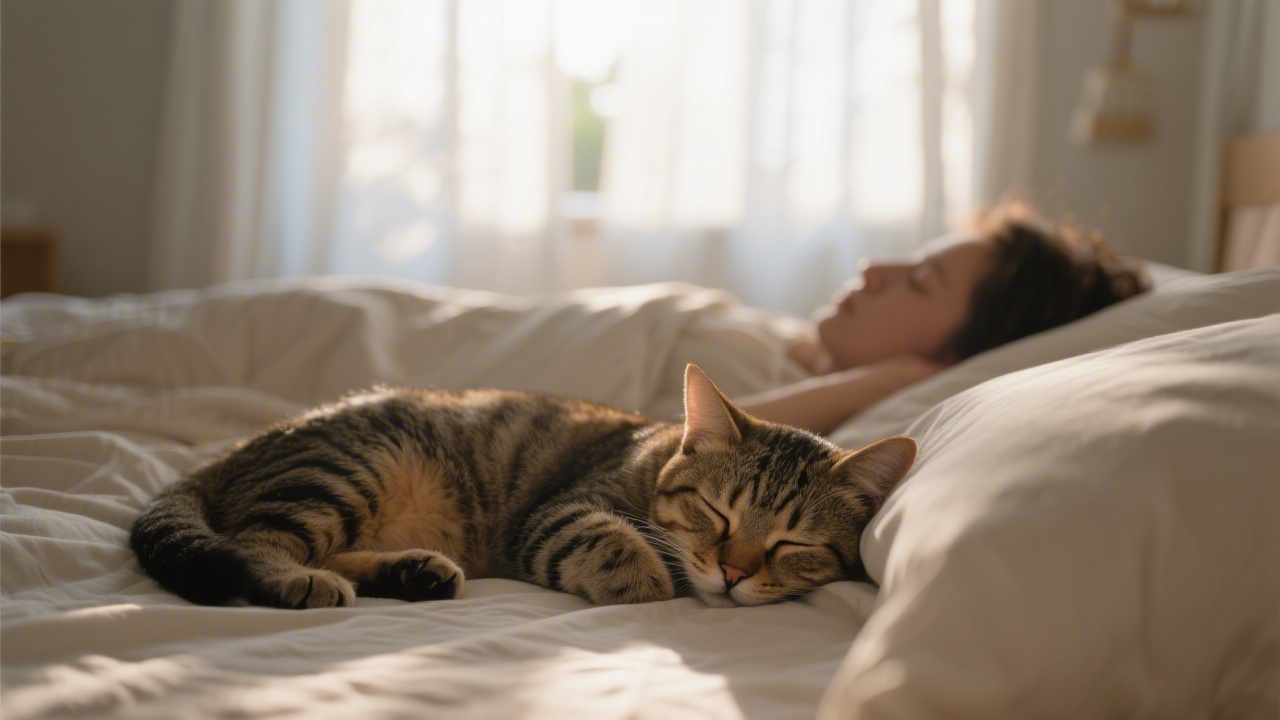
by Cats sleep 12 to 16 hours per day. This is not sloth. It is an adaptation to a hunting lifestyle that demands explosive muscle performance and then extended recovery. Understanding why cats sleep so much, when they are biologically wired to be active, and how their behavior disrupts human sleep is the first step toward managing a cat-inclusive bedroom.
Our Recommendation
Saatva Mattress Pad — waterproof protection for cat owners
Affiliate disclosure: We may earn a commission if you purchase through our links at no extra cost to you.
Feline Sleep Biology
Cats are crepuscular by evolutionary design: their peak activity windows align with dawn and dusk, when their ancestral prey species (rodents, small birds) are most active and most vulnerable. Between these activity windows, cats sleep in polyphasic patterns: many short cycles of approximately 15 to 30 minutes rather than one consolidated rest period.
Cat sleep has two main stages: slow-wave sleep (light sleep, from which cats arouse easily) and paradoxical sleep (the feline equivalent of REM, during which muscle twitching and eye movement occur). Cats spend approximately 6 hours per day in slow-wave sleep and a smaller proportion in deep paradoxical sleep. The high ratio of light sleep explains why cats appear to sleep constantly but remain responsive to their environment.
Domestic cats raised in human households often shift their crepuscular windows to align with household activity patterns. A cat that receives attention and food when the owner wakes at 7 am will often develop a pre-7 am activity burst. This social entrainment is useful: it means cat behavior is modifiable through feeding schedule management.
How Cat Sleep Affects Human Sleep
Research from the Mayo Clinic Sleep Disorders Center found that 20% of pet-owning patients cited pets as sleep disruptors. For cat owners specifically, the disruption mechanisms include:
Repositioning: Cats move frequently between sleep cycles, approximately every 15 to 30 minutes. On a shared bed, this motion is transmitted to the sleeping human. Light sleepers with a reactive startle response to motion experience micro-arousals that fragment sleep architecture without full conscious waking.
Dawn activity bursts: A cat whose circadian phase places its active window at 4 to 6 am will vocalize, knock objects off surfaces, or directly engage the sleeping owner. The behavioral goal is typically food or attention. Each reinforced response (getting up to feed the cat) strengthens the behavior.
Allergen exposure: Fel d 1, the primary cat allergen, concentrates in fur and saliva. Co-sleeping cats deposit allergen continuously on bedding. For sensitized individuals, this produces sustained low-level inflammatory response that fragments sleep quality without obvious sneezing or wheezing.
Predatory play at night: Young cats with unused prey drive may engage in predatory play behavior (stalking, pouncing on feet or hands under bedding) during human sleep. This is a behavioral issue managed through pre-bedtime interactive play that depletes the drive before lights out.
Managing Cat Behavior for Better Human Sleep
Timed automatic feeder: Install a timed feeder programmed to dispense at 6:00 or 6:30 am. This decouples the cat's hunger-driven morning activity from your presence. The cat learns that waking you is not the mechanism for food; the machine is. This single intervention resolves most early-morning cat disruption within 1 to 2 weeks.
Pre-bedtime active play: 10 to 15 minutes of prey-mimicking interactive play (feather wand, laser pointer) before your bedtime depletes the cat's immediate prey drive and reduces the probability of midnight predatory play behavior directed at you.
Large meal at bedtime: Cats that eat a larger meal immediately before their human's bedtime sleep longer before hunger-driven waking. A measured portion of calorie-dense wet food at 9 to 10 pm is more effective than multiple small portions throughout the day for extending the overnight quiet window.
Cat-free bedroom: For owners who need uninterrupted sleep, excluding the cat from the bedroom with a closed door is the simplest solution. Expect 3 to 5 days of door-scratching and vocalization before the cat adjusts to the new boundary.
Mattress protection: Regardless of sleeping arrangement, a waterproof mattress pad protects against hairball cleanup, tracked litter, and the gradual allergen accumulation from cat fur that penetrates standard mattress covers.
Frequently Asked Questions
Why do cats sleep so much?
Cats are obligate carnivores whose ancestral hunting strategy requires explosive bursts of energy followed by long recovery periods. A wild cat expends enormous energy in a hunt and requires extended sleep for muscular recovery, metabolic processing, and neural integration of learned hunting patterns. Domestic cats retain this sleep architecture despite not hunting actively. Calorie-dense commercial diets also reduce the need for frequent foraging activity.
Why is my cat active at 3am?
Cats are crepuscular by evolutionary design: most active at dawn and dusk, when their prey species (small rodents and birds) are also active. Domestic cats often have their crepuscular activity windows shift based on when owners are awake, but many retain dawn activity. A 3 am activity burst is typically the pre-dawn window for cats whose circadian phase has not fully synchronized with the household schedule.
How can I stop my cat from waking me up at night?
Strategies with evidence: feed a larger meal immediately before your bedtime (reduces early morning hunger-driven waking), provide enrichment activity before bed to use up activity energy, use an automatic feeder timed to 6 am to decouple your waking from the feeding routine, install a cat door to give access to another room where the cat can play at night, and avoid reinforcing 3 am meowing by responding with food or attention.
Is it bad to let cats sleep in your bed?
For healthy adults, cat co-sleeping has low health risk. A Mayo Clinic study found that 20% of pet owners find their pets disturbing to sleep; 41% find them unobtrusive or helpful. Cats' polyphasic sleep (many short cycles) means they reposition frequently. Light sleepers register this as disruption. Cats also carry allergens on fur that can worsen respiratory symptoms. Immunocompromised individuals should consult a physician about pet co-sleeping.
Do cats need a dark room to sleep?
Cats are less light-sensitive than humans for sleep initiation because they sleep in many short bursts throughout the day regardless of ambient conditions. However, their natural crepuscular activity windows are influenced by light. Very bright rooms can shift cats toward nocturnal patterns. Moderate darkness during typical human sleep hours aligns cat rest periods slightly better with human sleep, but cats will sleep in daylight without difficulty.
Key Takeaways
Cat Sleep Patterns is a topic that depends heavily on individual needs and preferences. The most important thing is to consider your specific situation — your body type, sleep position, and personal comfort preferences — before making any decisions. When in doubt, take advantage of trial periods to test before committing.