
 by
by Our Recommended Mattress for This Setup
Saatva Mattress — Luxury innerspring construction, CertiPUR-US certified, with multiple firmness options for your best night's sleep.
View the Saatva Classic →The CO2 Problem Most Bedrooms Have
Outdoor air sits around 420 ppm (parts per million) of CO2. A closed bedroom with two adults sleeping can reach 2,000–3,000 ppm by morning. That's not an emergency — it won't cause CO2 poisoning — but it's well above the threshold where cognitive function and sleep quality degrade.
Research from the Technical University of Denmark and studies published in Indoor Air have established that CO2 concentrations above 1,000 ppm measurably impair cognitive performance. For sleep specifically, concentrations above 1,500 ppm are associated with more fragmented sleep and reduced slow-wave (deep) sleep duration.
How CO2 Disrupts Sleep Architecture
Elevated CO2 affects sleep through two overlapping mechanisms:
Respiratory drive: The brain monitors blood CO2 levels and responds to elevations by increasing breathing rate. In a high-CO2 environment, this constant low-level respiratory signal keeps the nervous system in a lighter sleep state, reducing slow-wave sleep and REM duration.
Perceived air quality: Humans can detect elevated CO2 at roughly 1,000 ppm through a vague sense of stuffiness or heaviness. This perception — even below the conscious threshold — activates mild arousal responses that reduce sleep depth.
A landmark study by Strøm-Tejsen et al. (2016) put subjects in bedrooms at different CO2 levels. At 2,400 ppm versus 900 ppm, subjects had significantly worse next-morning performance and reported lower sleep quality — despite sleeping the same number of hours.
CO2 Thresholds to Know
400–600 ppm: Excellent. Equivalent to outdoor air. Maximum sleep quality conditions.
600–1,000 ppm: Good. ASHRAE ventilation standards aim for this range in occupied spaces.
1,000–1,500 ppm: Marginal. Noticeable decline in air quality perception; slight increase in arousal frequency.
1,500–2,500 ppm: Poor for sleep. Measurable reduction in slow-wave sleep; next-day cognitive impacts.
Above 2,500 ppm: Very poor. Common in small, tightly sealed bedrooms with multiple occupants.
How to Measure Bedroom CO2
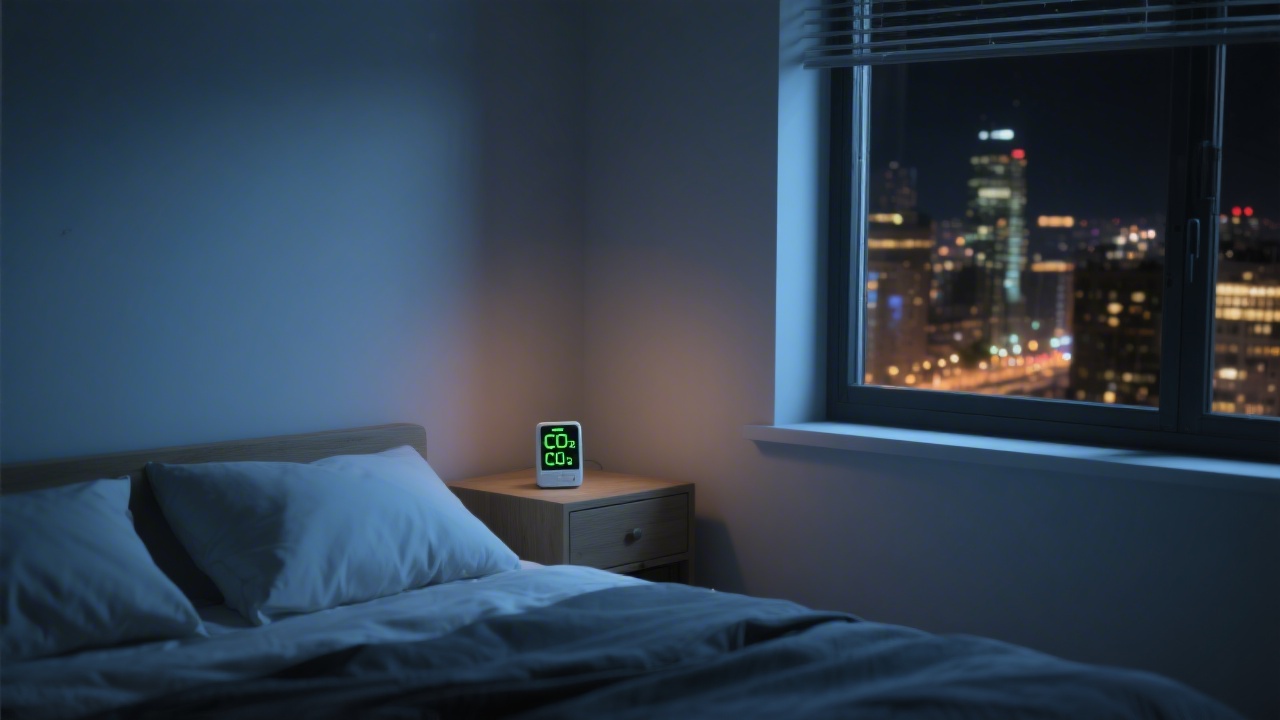
CO2 monitors have dropped dramatically in price. Accurate NDIR (non-dispersive infrared) sensors — the gold standard — are now available in consumer devices for $50–100. Recommended units include the Aranet4, CO2Meter devices, and Govee's CO2 monitor.
Avoid electrochemical CO2 sensors found in very cheap devices — they drift quickly and are unreliable for bedroom monitoring. Look for NDIR technology in the product specifications.
Measure over several nights with the door closed at your typical sleeping conditions. Most people are surprised to find morning readings 3–5x outdoor levels.
Solutions by Severity
Cracking a window (1–2 inches): The single most effective, free intervention. Even a small gap dramatically increases air exchange rate. A 2021 study found that cracking a bedroom window reduced CO2 from 2,400 ppm to under 1,000 ppm by 3 AM in a typical bedroom. This works in all but the coldest or noisiest environments.
Leaving the bedroom door open: Allows CO2 to diffuse into the larger home volume. Less effective than a window but significantly better than a fully sealed room. Useful in winter when opening windows isn't comfortable.
Mechanical ventilation: A small, quiet bathroom exhaust fan run at low speed provides continuous fresh-air exchange. More effective than passive methods and can be controlled with a timer or humidistat. ERVs (energy recovery ventilators) provide fresh air while preserving heat — the premium option for cold climates.
Note on bedroom size: Room volume matters significantly. A 100 sq ft bedroom with 8-foot ceilings (800 cubic feet) will accumulate CO2 roughly twice as fast as a 200 sq ft room with two people breathing. Small guest rooms and hotel rooms are particularly problematic.
CO2 and Your Mattress Off-Gassing
New foam mattresses off-gas VOCs and some CO2-adjacent compounds during the first weeks. While not the primary source of bedroom CO2 (human respiration dominates), this is one reason ventilating a new mattress and sleeping in a well-ventilated room matters. Our full indoor air quality guide covers VOC off-gassing in detail.
For bedroom temperature context — often linked to ventilation decisions — see our guide to bedroom temperature and sleep. Our bedroom humidity guide covers the companion ambient condition.
Our Recommended Mattress for This Setup
Saatva Mattress — Luxury innerspring construction, CertiPUR-US certified, with multiple firmness options for your best night's sleep.
View the Saatva Classic →Frequently Asked Questions
What CO2 level is safe for sleeping?
Below 1,000 ppm is optimal. Between 1,000–1,500 ppm, sleep quality begins to decline. Above 2,000 ppm, research shows measurable reductions in slow-wave sleep and next-day cognitive performance.
How do I lower CO2 in my bedroom at night?
Cracking a window 1–2 inches is the most effective free intervention. Leaving the door open is the next best option in winter. For sealed environments, a mechanical ventilation fan provides continuous air exchange.
Do air purifiers reduce CO2?
No. Standard HEPA and activated carbon purifiers filter particles and VOCs but do not remove CO2. CO2 reduction requires air exchange — bringing in fresh outdoor air — not filtration.
Can houseplants lower bedroom CO2?
To a negligible degree. Plants respire CO2 at night, meaning the net effect in a bedroom is near zero. The volume needed to meaningfully reduce CO2 is impractical.
How quickly does CO2 build up in a closed bedroom?
Two adults in a 150 sq ft closed bedroom can raise CO2 from 600 ppm to 2,000+ ppm within 2–3 hours. By morning in a fully sealed room, levels above 2,500 ppm are common.