
 by
by Our Recommended Pick
The Saatva Classic's pocketed coil base provides continuous airflow that outperforms gel foam for hot sleepers.
Walk into any mattress showroom and you will find the words "cooling gel" on nearly every foam mattress. Gel has become the default answer to heat retention — but does a cooling gel mattress actually keep you cooler? The honest answer is: yes, modestly, and only for part of the night.
What Is Gel Infusion and How Does It Work?
Gel is introduced into mattress foam in two primary ways:
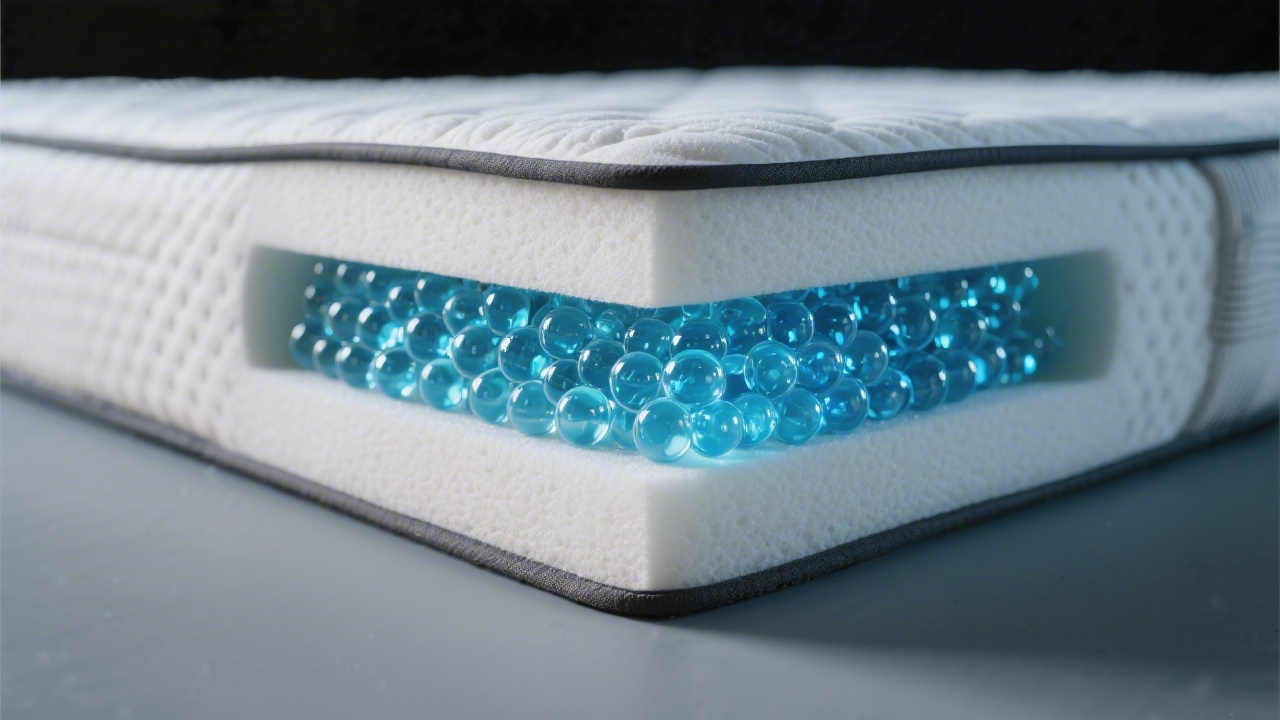
- Gel beads: Small polymer capsules mixed into the foam before it sets. Each bead absorbs heat as it transitions from solid to liquid state — this is called phase change behavior (see our full guide to phase change materials).
- Gel layer / swirl: A liquid gel compound is swirled or poured directly into the foam mixture, creating visible blue or green streaks. This version primarily improves thermal conductivity — it conducts heat away faster — but does not change phase and therefore has a more limited effect.
The key physics: dense viscoelastic foam (memory foam) is an insulator. It traps body heat. Gel is a better thermal conductor than foam alone. Adding gel reduces the foam's insulating effect. But gel is still far less conductive than copper, graphite, or open-cell structures.
How Much Cooling Does Gel Actually Provide?
Published thermal studies on gel-infused foam (including work cited by the Sleep Research Society) show surface temperature reductions of roughly 1–3°F compared to non-gel foam. That is a real difference but a modest one. It is most noticeable in the first 20–30 minutes after lying down — the "initial cool touch" effect that reviewers frequently comment on.
After 30–60 minutes, body heat overwhelms the gel's heat-sink capacity unless the gel contains true phase-change material with sufficient latent heat capacity. Most budget gel mattresses use swirl gel, not PCM-grade beads, so the cooling effect fades.
Gel Beads vs Gel Layer vs Open-Cell Foam
| Technology | Mechanism | Duration of Effect | Cost Tier |
|---|---|---|---|
| Gel swirl / layer | Conductivity increase | Initial only | Budget–mid |
| Gel beads (PCM) | Phase change latent heat | 30–90 min | Mid–premium |
| Open-cell foam | Airflow through cell structure | Continuous | All tiers |
| Graphite infusion | High conductivity channel | Continuous | Mid–premium |
| Pocketed coils (hybrid) | Active airflow between coils | Continuous | Mid–premium |
What Actually Works Better Than Gel for Cooling?
If heat retention is your primary concern, coil-based airflow is the most effective passive solution. A hybrid mattress with pocketed coils allows continuous air circulation through the coil layer — something foam alone cannot replicate regardless of gel content. For hot sleepers, a hybrid is almost always a better choice than an all-foam gel mattress.
Copper and graphite infusions also outperform gel swirl for thermal conductivity. We cover graphite mattresses and toppers and copper-infused mattresses separately.
Who Benefits From a Cooling Gel Mattress?
- Sleepers who run slightly warm but do not have severe night sweats
- Those who prefer the pressure-relief of memory foam and cannot tolerate a hybrid
- Budget-conscious buyers for whom a gel foam is the practical step up from basic polyfoam
If you are a severe hot sleeper, gel alone will not solve your problem. Consider a hybrid with coil airflow, a PCM-enhanced cover, or a graphite topper added to your existing mattress.
What to Look for When Buying a Cooling Gel Mattress
- Cell structure: Open-cell foam compounds gel's conductivity benefit with airflow. Closed-cell + gel is a wash against non-gel open-cell.
- Gel type: Ask whether it is phase-change beads or swirl gel. Marketing rarely distinguishes them.
- Cover material: A Tencel or phase-change fabric cover adds a meaningful temperature layer on top of any gel benefit.
- Coil support base: A hybrid construction under the foam layers provides the airflow no amount of gel in the comfort layer can match.
Our Recommended Pick
The Saatva Classic's pocketed coil base provides continuous airflow that outperforms gel foam for hot sleepers.
Frequently Asked Questions
Does gel memory foam sleep cooler than regular memory foam?
Yes, modestly. Expect a 1–3°F surface temperature improvement. Gel-infused foam consistently outperforms non-gel viscoelastic foam in initial cool touch. The gap narrows after the first hour as body heat builds.
How long does the cooling effect of gel mattresses last?
Gel swirl provides an initial cool touch for roughly 20–30 minutes. PCM-grade gel beads can extend effective cooling to 60–90 minutes. Neither replaces continuous airflow from a coil layer.
Is gel foam good for back pain?
Gel does not directly affect spinal support — that is determined by the foam's density and ILD (indentation load deflection), plus the support core below. A gel foam can have excellent or poor support depending on those factors, independent of its gel content.
Do cooling gel mattresses lose their cooling effect over time?
The thermal conductivity of gel swirl does not degrade significantly. However, as foam breaks down over 5–8 years, compressed cells reduce airflow and the overall thermal performance decreases.
Is a cooling gel mattress worth the price premium?
For mild-to-moderate heat retention: yes, a gel foam is worth a modest premium over basic polyfoam. For severe hot sleepers: invest the premium in a hybrid with coil airflow instead — the airflow benefit is larger and continuous.