
 by
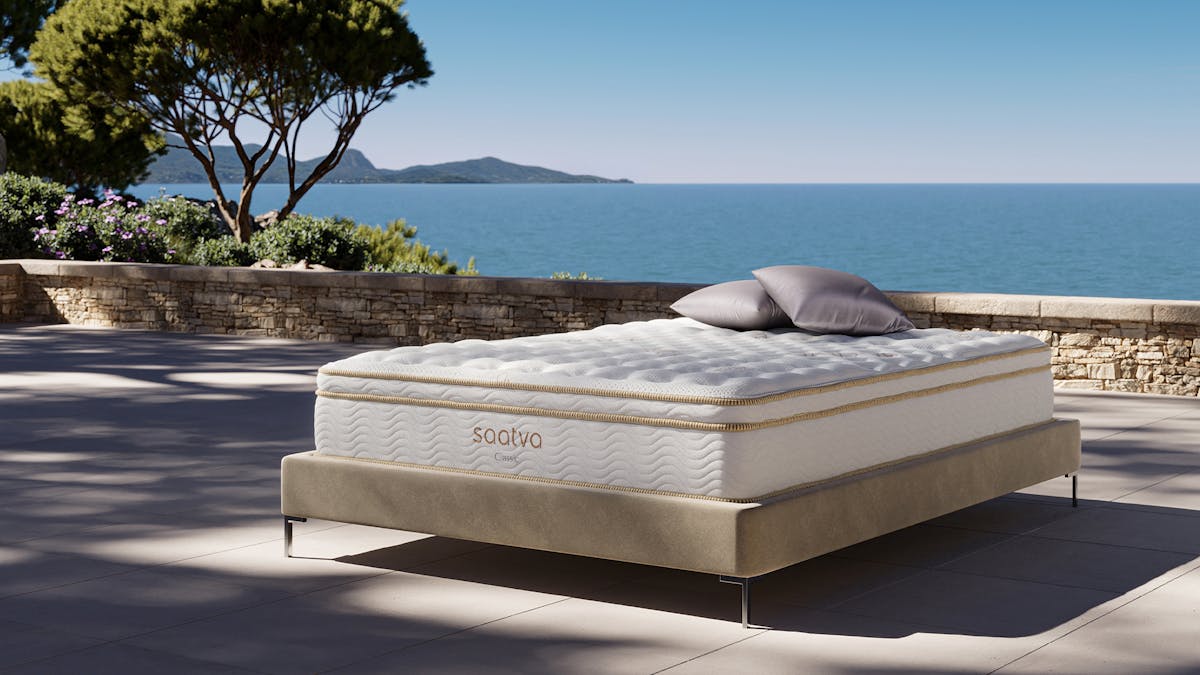
by Copper-infused foam and gel foam both sleep cooler than plain memory foam, but neither is dramatically cooler than the other. Copper's real advantage is antimicrobial properties, not superior heat dissipation. For genuinely cooler sleep, the bigger lever is airflow from a coil-based hybrid, not the foam infusion. The Saatva Classic delivers that structural airflow via dual coil layers, an organic-cotton cover, and a Euro pillow top, making it the most practical recommendation for hot sleepers who want real results beyond the marketing on the label.
Saatva Classic
9.2/10
- Dual-coil construction with genuine airflow channels, not reliant on foam infusions
- Breathable organic-cotton cover and Euro pillow top for surface comfort without heat retention
- Zoned lumbar support pad reinforces the center third of the mattress
- 365-night trial, lifetime warranty, free white-glove delivery with old-mattress removal
- Ships flat rather than compressed in a box
- $99 return fee during the trial window
- Less deep foam hug than an all-foam design
If cooling is your actual goal, structural airflow from two coil layers does more work than any foam infusion. The Saatva Classic is built around that airflow, and its 365-night trial gives you a full year to confirm it before committing.
How copper and gel infusions actually work
Standard memory foam traps heat because its dense, closed-cell structure limits airflow. Both copper and gel were introduced as targeted fixes, though they work through different mechanisms.
Copper-infused foam uses copper's high thermal conductivity to pull heat away from the sleeper's body rapidly. Copper also carries a secondary benefit: it is antimicrobial, resisting bacteria and odor accumulation over time. Some manufacturers add copper oxide particles; others use copper-coated foam fibers. The conductivity effect is real, but it helps most during initial contact. Once the copper reaches body temperature, its advantage over gel narrows.
Gel foam takes a different approach. Gel beads or swirled gel are mixed into or layered on the foam. These act as phase-change materials: they absorb heat as they shift from solid to semi-liquid, delaying the warm-up curve. The benefit scales with how much gel is used and how close it sits to the sleep surface. A thin gel layer deep in a stack contributes very little. A thick gel topper at the top of the comfort layer makes a meaningful difference to initial feel.
Copper vs gel foam: side by side
| Factor | Copper-Infused Foam | Gel Foam |
|---|---|---|
| Cooling mechanism | Thermal conductivity draws heat away | Phase-change gel absorbs heat over time |
| Cooling vs plain foam | Modest improvement, most noticeable on contact | Modest improvement, especially at surface |
| Cooling vs each other | Roughly comparable overall | Roughly comparable overall |
| Unique advantage | Antimicrobial, resists bacteria and odor | Longer initial cool sensation when gel is thick |
| Shared limitation | Still foam-based, restricts airflow vs coils | Still foam-based, restricts airflow vs coils |
| Premium justified? | Only if antimicrobial matters to you | Only if the gel layer is thick and near the surface |
| Common use case | Mid-range to premium all-foam mattresses | Budget to mid-range all-foam mattresses |
The honest ceiling on foam cooling
Both infusions help relative to plain memory foam, and neither is a scam. The problem is the baseline they are improving: all-foam construction restricts air movement because foam cells, even open-cell varieties, create a more sealed environment than a coil system. Copper and gel push the ceiling up, but they cannot push through it.
Independent thermal testing across multiple foam mattress categories consistently shows that coil-based hybrids sleep significantly cooler than all-foam alternatives at the same price point. The coils leave open air channels throughout the support layer, and many hybrids add an airflow-friendly cover on top. That structural airflow does the work that copper and gel are attempting to replicate chemically.
This does not mean copper or gel foam mattresses are bad for hot sleepers, especially at lower price points where a quality hybrid is out of budget. It means that if you are already spending $1,000 or more, a hybrid will likely outperform an infused-foam mattress on thermal regulation at the same price.
When to choose each
Choose copper-infused foam if: you want the antimicrobial benefit alongside modest cooling, you prefer the deep conforming feel of all-foam, or your budget limits you to this category and you are sensitive to odor or allergens.
Choose gel foam if: you want a cooler initial surface feel in an all-foam design, your budget is tighter, or you already own a gel-foam topper and want to assess it separately from the mattress itself.
Look past both toward a coil hybrid if: cooling is your primary concern and your budget is $1,000 or above. The Saatva Classic (dual-coil, organic cotton cover) and the Amerisleep AS3 Hybrid (Bio-Pur foam over pocketed coils) both do more for temperature regulation than any foam infusion alone.
Amerisleep AS3
8.7/10
- Bio-Pur foam is partially plant-based with an open-cell structure for better airflow than standard memory foam
- HIVE 5-zone support layer adds targeted pressure relief without requiring gel or copper
- CertiPUR-US certified, made in the USA, 100-night trial
- Cooler than most all-foam alternatives without a foam infusion marketing add-on
- Still an all-foam design, so airflow is lower than a coil hybrid
- Sleepers over 230 lb may prefer the AS5 Hybrid for better support and airflow
The AS3's open-cell Bio-Pur foam runs cooler than gel or copper-infused competitors without relying on infusion marketing. If you want a foam-feel mattress that still manages heat reasonably, this is the one to test during its 100-night trial.
What to look for beyond the label
Foam infusion marketing is everywhere, and most of it is technically accurate while being practically overstated. A few things to actually check before buying:
- Gel layer placement and thickness: gel at the very top of the comfort layer matters. Gel buried three inches below the sleep surface barely registers.
- Cover material: a breathable organic-cotton or Tencel cover adds more cooling than a synthetic quilted cover, regardless of what is in the foam below.
- Support core: coils outperform foam cores on airflow every time. A hybrid with copper or gel foam is the best of both systems; a pure all-foam copper bed is the weakest position on cooling.
- Foam density: lower-density foams (3 to 4 lb per cubic foot) sleep cooler than high-density foams (5+ lb) because there is more open space in the cell structure, even before any infusion.
Copper and gel foam both beat plain memory foam on temperature, but the gap between them is small. The bigger gap is between all-foam and coil-based hybrids. For serious cooling, choose a hybrid like the Saatva Classic with real structural airflow. For a foam-feel option, the Amerisleep AS3 runs cooler than most infused-foam alternatives without leaning on infusion marketing.
Frequently asked questions
Does copper foam actually sleep cooler than gel foam?
Not meaningfully. Both infusions outperform plain memory foam by a modest margin, but independent testing consistently finds them within a few degrees of each other. Copper's more defensible advantage is antimicrobial protection, not superior cooling versus gel.
Is gel or copper foam worth the extra cost?
Gel foam is worth it only if the gel layer is thick and near the surface. Thin gel layers buried in the middle of a comfort stack add almost nothing. Copper foam is worth it if antimicrobial properties matter to you, but not if you are paying a premium purely for a cooling claim.
What mattress type sleeps coolest overall?
Innerspring hybrids with coil support layers sleep coolest, followed by latex hybrids, then open-cell all-foam designs, then standard memory foam. Copper and gel infusions can lift an all-foam mattress one tier, but they cannot close the gap against a well-designed hybrid.
Can I add cooling to a foam mattress I already own?
Yes. A cooling mattress topper (latex, gel, or phase-change material) placed directly on the sleep surface makes a meaningful difference because it is where contact happens. A thin cooling cover alone does less. The Saatva mattress pad uses organic wool, which regulates temperature naturally and is worth considering as a separate layer.
Do all Saatva mattresses use coils?
Most do. The Saatva Classic, Saatva Latex Hybrid, and Saatva HD all use coil support systems with open airflow channels. The Loom and Leaf (also by Saatva) is an all-foam design and does use gel-infused foam, so it sits in a different thermal category than the coil models.