
 by
by Your sleep starts at home — not just at the office
The Saatva Classic delivers consistent, pressure-relieving support that helps you fall asleep faster and wake up recovered — on work nights and weekends alike.
Affiliate disclosure: We may earn a commission at no extra cost to you.
Why Corporations Are Investing in Employee Sleep
Sleep deprivation is not a personal problem. It is a corporate balance sheet problem. The RAND Corporation estimates that the United States loses 411,000 working days per year to sleep deprivation — a drag worth $411 billion annually in reduced economic output. Against that backdrop, Goldman Sachs, Nike, Google, and Ben & Jerry's have all made structured investments in employee sleep. This is not wellness theater. It is performance infrastructure.
The trigger was a converging set of evidence: productivity research showing that a sleep-deprived employee performs at 70% of their cognitive capacity; healthcare cost data linking chronic sleep loss to cardiovascular disease, type 2 diabetes, and depression; and liability exposure from fatigue-related workplace accidents. When McKinsey published research in 2023 showing that poor sleep was the single largest driver of executive performance variance — ahead of diet, exercise, and stress management combined — the C-suite started paying attention.
What Corporate Sleep Programs Look Like in Practice
There is no single template. The most common components, in order of adoption:
1. Education and Awareness Campaigns
The entry-level intervention. A certified sleep coach or behavioral health professional runs a 90-minute workshop on sleep hygiene: consistent wake times, light exposure management, caffeine cutoffs, pre-sleep wind-down routines. Cost is low; impact is modest but measurable — typically a 10–15% reduction in self-reported sleep problems in 60-day follow-up surveys.
2. Nap Rooms and Rest Infrastructure
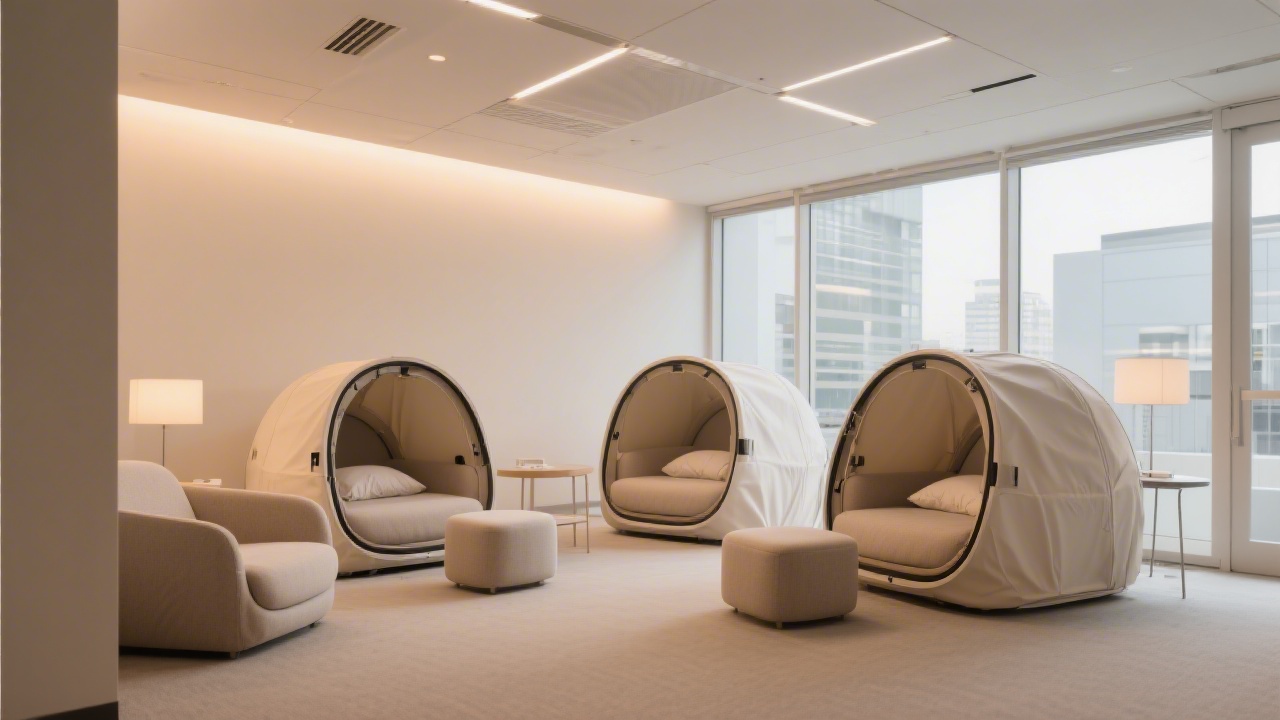
Nike's headquarters in Beaverton, Oregon has dedicated rest rooms. Ben & Jerry's installed a nap room in the early 2000s — ahead of its time. Google provides EnergyPod recliners (designed by MetroNaps) in several offices. The science behind this is unambiguous: a 10–20 minute nap between 1 pm and 3 pm restores alertness by 30–40% and does not impair nighttime sleep when kept under 30 minutes. See our deep-dive on nap rooms in the office for the full evidence base and setup guide.
3. Flexible Scheduling and Chronotype Alignment
This is the highest-leverage structural intervention. Chronotype — your biological predisposition to morning or evening wakefulness — is largely genetic. Forcing night owls into 7 am start times creates chronic social jet lag that compounds across the work week. Companies like Basecamp (asynchronous work by default) and Buffer (flexible global hours) report that chronotype-friendly scheduling reduces stated sleep problems by 25–40%. For a detailed playbook, see our guide on flexible work schedules and sleep.
4. Clinical EAP Sleep Support (CBT-I)
Cognitive Behavioral Therapy for Insomnia is the gold-standard clinical treatment for chronic insomnia — more effective than sleep medication in long-term studies and without dependency risks. Johnson & Johnson's Human Performance Institute incorporates CBT-I elements. Advanced EAP providers like Lyra Health and Spring Health now include dedicated sleep therapy pathways. Aetna has offered employees up to $300/year for verified sleep improvement via wearable devices since 2016.
5. Wearable Sleep Tracking Programs
Fitbit, WHOOP, and Oura Ring have all developed corporate wellness partnerships. The tracking data allows HR to identify departments with systemic sleep problems — often correlating with excessive overtime, unrealistic deadlines, or management styles that send emails at 11 pm. This is where corporate sleep programs intersect with meeting overload and its effect on sleep.
The ROI Case: What the Research Shows
Aetna reported that after implementing a sleep improvement program, healthcare costs for employees who improved their sleep dropped by $2,000 per person annually. The program cost approximately $300 per enrolled employee — a 6.5:1 ROI. A 2021 RAND study projected that if 10% of the U.S. workforce added one hour of sleep per night, GDP would increase by $226.4 billion. The math is not subtle.
For individual contributors, the productivity case is equally clear: a well-rested employee completes cognitively demanding tasks 20–25% faster and with 30–40% fewer errors than a sleep-deprived counterpart. For executives and senior managers — who make decisions with outsized organizational consequences — the cost of even moderate sleep deprivation can be catastrophic. Research by McKinsey found that sleep-deprived leaders score 20–30 points lower on 360-degree leadership assessments, particularly on empathy and strategic clarity.
The Goldman Sachs Case: From 100-Hour Weeks to Sleep Policy
Goldman Sachs became the unlikely face of corporate sleep reform in 2021 when a leaked survey of first-year analysts described a work culture of 100-hour weeks and chronic sleep deprivation. The internal document described deteriorating mental health, inability to maintain personal hygiene, and self-reported impaired judgment. Goldman's response — reducing analyst hours and implementing mandatory daily maximums — was not purely altruistic. The bank had calculated that burned-out analysts made more errors, required longer training periods, and churned at higher rates, all of which had concrete financial costs. The policy change was a business decision.
Implementation Checklist for HR Leaders
If you are building a corporate sleep program from scratch, the sequence that produces the fastest measurable ROI:
- Baseline survey: assess current sleep duration, quality, and daytime impairment across departments
- Quick wins: set a no-email-after-9pm norm; implement meeting-free morning blocks for deep work
- Physical infrastructure: install at least one quiet rest space if your office has 50+ employees
- EAP enhancement: add CBT-I to your existing EAP or choose a provider that includes it
- Manager training: managers who model healthy sleep behaviors have direct downstream effects on team sleep patterns
- 90-day reassessment: re-survey and measure absenteeism, error rates, and self-reported performance
The home environment is the foundation all of this rests on. Employees cannot benefit from workplace nap rooms if they are not getting quality nighttime sleep at home. A premium mattress that eliminates pressure-point waking and maintains spinal alignment throughout the night is the baseline investment that makes every corporate sleep program more effective.
The foundation is your home sleep quality
The Saatva Classic delivers consistent, pressure-relieving support that helps you fall asleep faster and wake up recovered — on work nights and weekends alike.
Affiliate disclosure: We may earn a commission at no extra cost to you.
Frequently Asked Questions
Do corporate sleep programs actually improve productivity?
Yes. A Harvard Medical School study found that insomnia costs U.S. employers $63.2 billion in lost productivity annually. Companies like Aetna that implemented sleep programs reported a measurable reduction in absenteeism and improved employee engagement scores within 12 months.
What does a corporate sleep program typically include?
Most programs combine education (sleep hygiene workshops), structural support (nap rooms or flexible scheduling), and clinical support (cognitive behavioral therapy for insomnia, or CBT-I, via an EAP). Advanced programs add wearable sleep tracking and one-on-one coaching.
How much does it cost to implement a corporate sleep program?
Basic lunch-and-learn workshops cost under $5,000. A full program with nap pods, EAP sleep coaching, and tracking infrastructure typically runs $50,000–$200,000 per year for a mid-size company — yielding an estimated ROI of 3:1 to 6:1 based on reduced absenteeism and healthcare costs.
Which companies are the most advanced in workplace sleep support?
Google (EnergyPods, sleep stipends), Nike (nap rooms, flexible scheduling), Johnson & Johnson (sleep coaching in their Human Performance Institute programs), Ben and Jerry's (nap rooms), and Aetna (cash incentives of up to $300/year for employees who log sufficient sleep via a tracker).
Can a better mattress at home complement a corporate sleep program?
Absolutely. Corporate programs address scheduling and habits, but sleep quality at home is the baseline. A supportive mattress that reduces pressure points and maintains spinal alignment dramatically reduces the time needed to reach deep, restorative sleep stages — compounding the benefits of any workplace sleep initiative.