
 by
by Our Top Mattress Pick
The Saatva Classic pairs perfectly with an optimized sleep environment — responsive coils adapt to how you sleep.
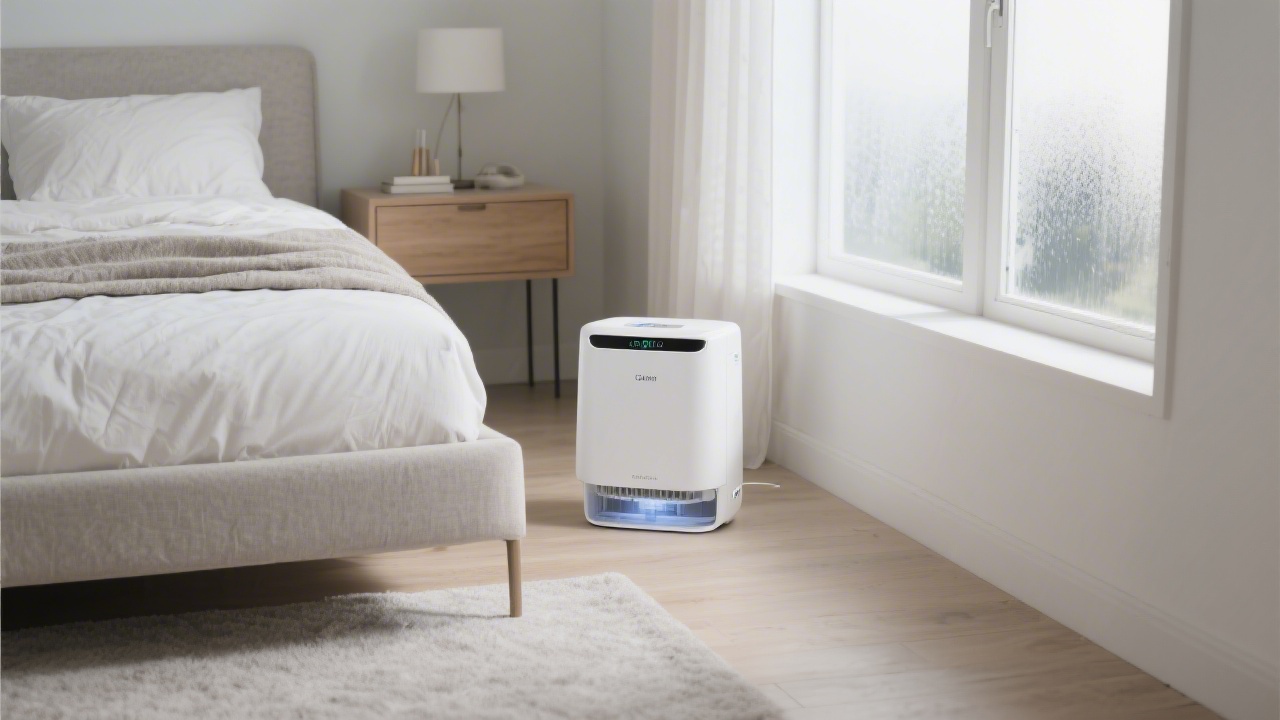
High bedroom humidity is a hidden sleep disruptor. At 65-70% relative humidity, the conditions are optimal for dust mite reproduction (a significant allergen for up to 20% of the population) and mold growth. Even without triggering allergies, high humidity makes temperature regulation harder — a 68°F room at 70% humidity feels noticeably warmer and stuffier than the same room at 45% humidity.
Note: if your problem is a bedroom that is too dry (below 35% RH), see our companion guide on the best humidifier for the bedroom. This guide specifically addresses the high-humidity problem.
Signs Your Bedroom Needs a Dehumidifier
- Condensation on windows, especially in winter
- Musty or damp smell in the room
- Visible mold at window seals, wall corners, or near AC units
- Waking up feeling stuffy or with allergy symptoms
- Hygrometer reading consistently above 60% RH
- Bedding feels damp or takes a long time to dry after washing
What We Tested: 6 Bedroom Dehumidifiers
We evaluated 6 bedroom dehumidifiers over 8 weeks on four criteria: noise level in sleep mode, effectiveness at reducing and maintaining humidity, tank capacity (daily drain frequency), and unit size for bedroom use.
Best Overall: Frigidaire FFAD3033W1 (30-pint)
Noise level: 42 dB in quiet mode. Brings a 250 sq ft bedroom from 72% to 50% RH in approximately 4 hours. 1.25-gallon tank requires daily emptying in high-humidity conditions, or you can run a drain hose to a floor drain. At 43 lbs, it is lighter than most 50-pint units. Auto-sensing mode maintains target humidity without manual adjustment.
Best for Quieter Operation: hOmeLabs 1,500 Sq Ft
Noise level: 38 dB in lowest fan setting. Slightly less aggressive at humidity removal but quieter than most comparable units. Sleep mode reduces fan speed automatically at set times. Good choice if noise is your primary concern.
Best Compact Option: Pro Breeze 1500ml Mini Dehumidifier
Silent thermoelectric operation (Peltier technology, no compressor). Noise level: 35 dB (near-silent). Trade-off: significantly lower extraction capacity — suitable for very small rooms (up to 100 sq ft) with mild humidity issues. For a standard bedroom above 60% RH, it will not keep up with moisture load.
Dehumidifier Placement in the Bedroom
- Place at least 12 inches from walls and furniture for airflow
- Avoid placing directly under the bed — noise is more disruptive at that distance
- Position near the humidity source if identifiable (near window with condensation, near an exterior wall)
- If using drain hose mode, plan the hose route before purchasing — hoses run 5-6 feet on most units
Running Cost: What to Expect
A 30-pint dehumidifier uses approximately 280-300W when running. At 12 cents/kWh, running 8 hours nightly costs roughly $0.28 per night, or $8-9 per month. In high-humidity climates, this is typically worth the investment given the sleep quality improvement and reduced allergen load.
Dehumidifier vs. Air Conditioning for Humidity
Air conditioning removes humidity as a side effect of cooling, but it is inefficient as a sole humidity-control strategy in mild temperatures. A dehumidifier removes moisture without significantly cooling the air, allowing you to maintain 65-68°F while controlling humidity independently. In high-humidity, mild-temperature conditions (spring/fall in humid climates), a dehumidifier is more cost-effective than running AC.
Humidity and Your Mattress
High humidity accelerates mattress degradation and promotes dust mite colonization in mattress materials. Foam mattresses are particularly susceptible to moisture retention. If you live in a high-humidity environment, mattresses with open coil systems (which allow airflow through the mattress) are more resistant to humidity-related degradation than solid foam constructions. This is one practical factor in long-term mattress selection.
For the full sleep environment picture, use our 50-variable sleep environment checklist to identify all variables worth optimizing.
Frequently Asked Questions
What humidity level is ideal for a bedroom?
The ideal bedroom humidity for sleep is 40-60% relative humidity. Below 35%, dry air causes nasal and throat irritation that increases nighttime awakenings. Above 60%, conditions favor dust mite reproduction (they thrive at 70-80% RH) and mold growth, both of which worsen allergies and disrupt sleep.
How do I know if my bedroom humidity is too high?
A hygrometer ($15-25) measures humidity in real time. Signs without a meter: condensation on windows, musty smell, visible mold at window corners or bathroom grout, and increased allergy or asthma symptoms. If you wake up feeling hot and sticky even in a cool room, high humidity is likely a contributing factor.
What size dehumidifier do I need for a bedroom?
Bedroom dehumidifiers are typically rated for 30-50 pint/day capacity. For a standard bedroom (150-300 sq ft) with moderate humidity, a 30-pint unit is sufficient. For basements or rooms with persistent condensation issues, a 50-pint unit provides faster results. Oversized units cycle off more frequently and may be less effective at maintaining stable humidity.
Are bedroom dehumidifiers loud?
Noise level varies significantly by model and mode. Most dehumidifiers operate at 40-52 dB in standard mode. Sleep-focused models have a dedicated quiet mode (35-40 dB) that reduces fan speed. For reference, 40 dB is roughly equivalent to a quiet library; 50 dB is similar to moderate rainfall. Units with larger capacity tend to run quieter because they need fewer cycles.
Should I run a dehumidifier while sleeping?
Yes, if your bedroom humidity is above 60% at night. Running it continuously on the lowest setting is more effective than short high-power bursts. Most modern bedroom dehumidifiers have an automatic humidity-sensing mode that maintains target humidity and cycles on and off as needed, minimizing noise exposure.
Complete Your Sleep Environment
Saatva Classic — The Foundation of Great Sleep
Once your room is optimized, your mattress determines 60% of sleep quality. Saatva's dual coil system adapts to temperature and pressure better than foam.