
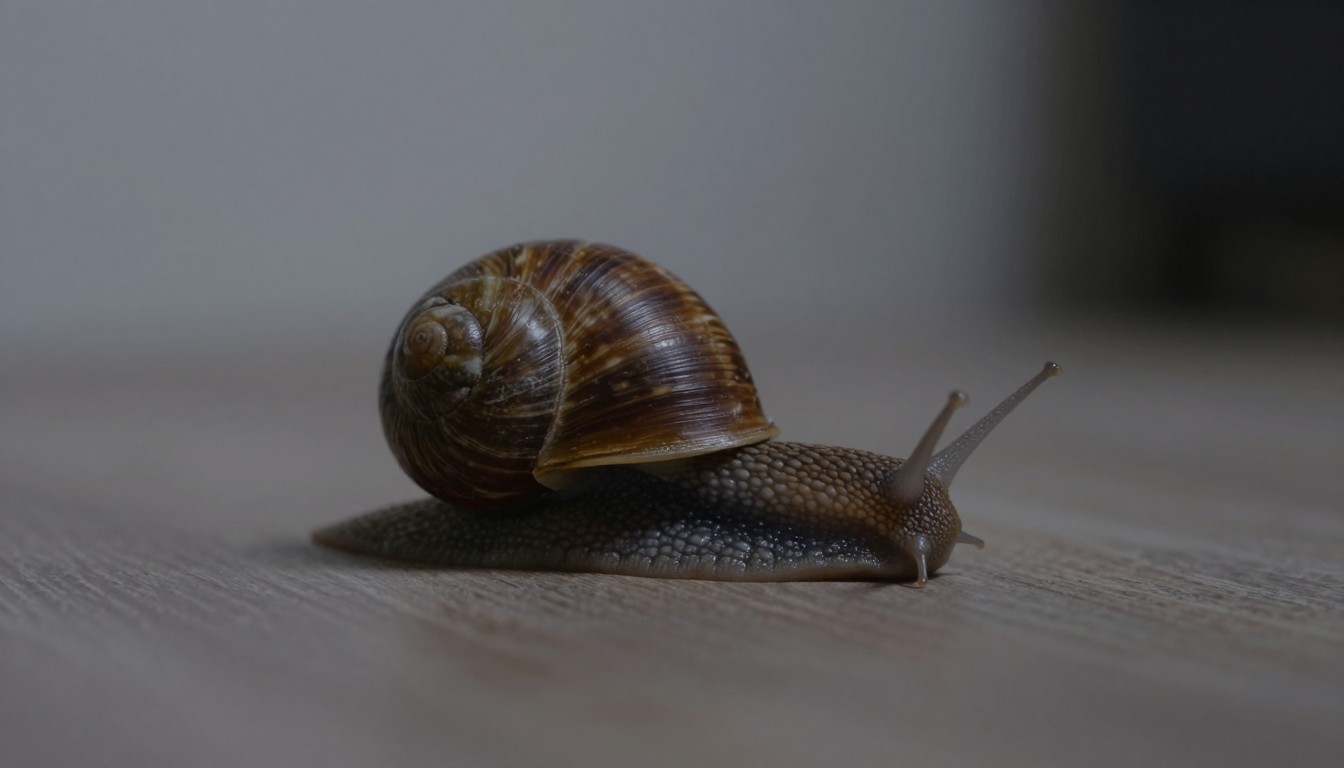
 by
by Quick answer: Yes. Snails sleep, but their pattern isn’t a human-style night of rest. Birds & Blooms reports a typical cycle lasting 2 to 4 days, followed by wakefulness beyond a full day.
- Birds & Blooms says plainly that snails do sleep.
- A typical snail sleep cycle usually spans 2 to 4 days, according to Birds & Blooms.
- After that cycle, a snail can remain awake longer than a full day, per the same source.
Updated July 2026 · Reviewed for accuracy
Yes, a snail sleeps. The catch is that its pattern doesn’t fit the familiar rhythm of sleeping at night and waking the next morning. That difference matters because a brief glance at a motionless snail won’t tell you where it is within its longer cycle.
Does a snail really sleep?
Birds & Blooms gives an unambiguous answer: snails do sleep, although they do it differently from humans. That direct statement is the strongest basis for answering the question with a clear yes.
ScienceDaily defines sleep broadly as a state of natural rest observed throughout the animal kingdom. Its overview notes that sleep occurs across numerous animal groups, which helps explain why the word isn’t reserved for the familiar human pattern of going to bed at night.
Still, the term can create the wrong mental picture. Saying that a snail sleeps doesn’t mean it follows a bedtime, rests for one uninterrupted block, or wakes on a predictable daily schedule. Those details aren’t established by the cited descriptions.
My take: Treat “sleep” as a confirmed form of natural rest, not as shorthand for a human-style night. The basic answer is firm. The exact behavior of an individual snail requires more cautious interpretation.
This distinction separates the supported fact from the assumptions people tend to add. Birds & Blooms supports the claim that snails sleep and describes a general cycle. It doesn’t provide a bedtime chart, a visual diagnostic test, or a schedule that can be applied to every individual.
I’d therefore avoid saying that a snail is asleep simply because it hasn’t moved while you were watching. At that moment, the only direct observation is inactivity. Sleep may be one interpretation, but the source doesn’t say that stillness alone proves it.
| Question | What the cited facts support | What they don’t establish |
|---|---|---|
| Do snails sleep? | Yes, according to Birds & Blooms. | That every motionless snail is asleep. |
| Is their sleep human-like? | The source says it differs considerably from human sleep. | A regular nightly bedtime or morning wake-up. |
| Can one glance confirm sleep? | A glance can confirm only whether movement was visible then. | A definite sleep state or exact point in the cycle. |
How the snail sleep cycle works
The useful range is 2 to 4 days. Birds & Blooms says a typical snail sleep cycle lasts a few days, usually within that span. It then says a snail can stay awake longer than a full day after the cycle.
The word cycle deserves attention. A cycle lasting 2 to 4 days isn’t necessarily the same thing as one unbroken sleep session lasting that long. The source describes the length of the cycle, but it doesn’t say that the snail remains continuously asleep from beginning to end.
That keeps the answer accurate without stretching it. You can say the sleep cycle usually spans several days. You shouldn’t quietly change that into a claim that every snail sleeps without interruption for the entire period.
Read the wording carefully:
- “Typical” describes a general pattern, not a promise for every snail.
- “Usually 2 to 4 days” describes the reported cycle range, not necessarily one continuous sleep bout.
- “Can stay awake” indicates possibility, not an identical waking period for every individual.
The waking part is just as unusual from a human perspective. According to Birds & Blooms, a snail may stay awake longer than a full day after its sleep cycle. The source doesn’t identify an exact upper limit, so “longer than a full day” is the careful phrasing.
I’d use this pattern as a reason to be patient, not as a countdown timer. If a snail hasn’t moved during one observation, its broader cycle can’t be reconstructed from that moment alone. Likewise, seeing movement later tells you that it moved between observations, not precisely when it slept or woke.
The clearest model is a broad repeating pattern: a sleep cycle that may extend across several days, followed by an extended waking period. Anything more precise would require details that Birds & Blooms doesn’t give in its general account.
What the reported timing does and doesn’t prove
The words “typical” and “can” set the boundaries of the evidence. Birds & Blooms reports a common 2-to-4-day cycle and says wakefulness can extend beyond a full day. Neither word creates a universal timetable.
| Statement | Fair reading | Overstatement to avoid |
|---|---|---|
| The cycle usually lasts 2 to 4 days. | That is the typical range reported by Birds & Blooms. | Every snail always follows that exact range. |
| A snail can stay awake longer than a full day. | Wakefulness may continue beyond one complete day. | All snails remain awake for one fixed period. |
| Snails sleep differently from humans. | Their reported cycle doesn’t match a simple nightly pattern. | Every detail of snail sleep is known from this general comparison. |
The cited account doesn’t provide a species-by-species breakdown. It also doesn’t connect the reported timing to a particular time of day or state that every snail begins resting under identical circumstances. Those gaps mean the general pattern shouldn’t be turned into a rigid schedule for an individual animal.
There’s also no stated basis for calling snail sleep exclusively nocturnal. A person may notice a snail resting at night, but that observation alone can’t establish a rule for all snails. The cycle described by Birds & Blooms is measured across days rather than framed as a nightly routine.
ScienceDaily’s broad definition adds useful context but not snail-specific timing. It supports the idea that natural rest occurs widely across animals. It doesn’t replace the more specific Birds & Blooms account or supply missing details about how to identify each stage of a snail’s cycle.
The safe claim: A typical snail sleep cycle reportedly spans 2 to 4 days, after which the animal can stay awake longer than a full day. That is a general pattern, not an exact schedule for every snail.
This is a good example of why wording matters. “Usually” leaves room for variation. “Can” leaves room for different outcomes. Keeping those qualifiers isn’t evasive. It prevents a useful general fact from becoming a false certainty.
How to observe a resting snail carefully
One motionless moment proves only that you didn’t see movement during that moment. Birds & Blooms confirms that snails sleep, but its account doesn’t provide a physical checklist that can positively identify sleep from appearance alone.
Start with observation rather than a forced response. Note where the snail is, what you can actually see, and the time of the observation. Return later and record whether its position or visible activity has changed.
The aim is to separate what happened from what you think it means. “I didn’t see movement” is an observation. “The snail was definitely asleep” is an interpretation, and the cited material doesn’t give enough criteria to make that interpretation certain from a single check.
A clean observation record should include:
- The time at which you looked.
- The snail’s visible location and position.
- Whether you actually saw movement.
- Any change visible at a later observation.
- A clear separation between recorded facts and your interpretation.
A time-stamped photograph can make that comparison easier without pretending to measure sleep itself. If the snail appears elsewhere later, you know movement occurred between the images. You still don’t know the exact moment it became active or how much of the interval was spent asleep.
A longer sequence of undisturbed observations is more informative than repeatedly trying to provoke movement. Once you interfere, you’re no longer recording the animal’s undisturbed pattern. You’re recording what happened after an intervention.
| What you observe | What you can safely say |
|---|---|
| No visible movement during one check | No movement was seen during that observation. |
| A changed position later | The snail moved sometime between observations. |
| No visible change across repeated checks | You observed a longer period of inactivity, not a confirmed diagnosis of sleep. |
If you’re concerned about the condition of a captive snail, a general sleep fact isn’t a substitute for species-specific care guidance. Consult a qualified animal-care professional familiar with that snail rather than trying to decide its condition from the reported sleep-cycle range.
My rule is simple: record first, interpret cautiously, and don’t turn the 2-to-4-day figure into a deadline. The figure describes a typical cycle reported by Birds & Blooms. It isn’t a test for whether one particular snail is healthy, sleeping, or due to move.
Snail sleep isn’t a model for human sleep
A sleep cycle spanning 2 to 4 days, followed by wakefulness beyond a full day, is plainly different from the human-style nightly schedule people often have in mind. Birds & Blooms makes that contrast explicit by saying snails sleep quite differently from humans.
ScienceDaily’s definition shows that natural rest is widespread across the animal kingdom. That shared word doesn’t make every animal’s schedule interchangeable. “Sleep” describes a broad state, while the timing and pattern described for a snail remain its own unusual case.
That means snail behavior can’t answer a question about your mattress, supplement use, or personal sleep routine. For human-focused reading, see whether a mattress can affect sleep quality or read the separate discussion of whether magnesium helps you sleep. Those are distinct questions that need human-specific evidence.
Keep the categories separate: Snail sleep is an animal-behavior question. It doesn’t validate a human sleep schedule, a bedding choice, or a treatment claim.
The bottom line stays refreshingly simple. Snails sleep. Birds & Blooms reports that their typical cycle usually spans 2 to 4 days and may be followed by more than a full day awake. Use that as a broad pattern, watch patiently, and resist turning it into a stopwatch for every snail.
FAQ
Do snails actually sleep?
Yes. Birds & Blooms states directly that snails sleep, although their sleep pattern differs considerably from the familiar human routine. ScienceDaily also defines sleep broadly as a natural state of rest found across the animal kingdom.
How long does a snail sleep?
Birds & Blooms reports that a typical snail sleep cycle lasts a few days, usually 2 to 4. That wording describes the overall cycle and shouldn’t automatically be read as one uninterrupted sleep session lasting the entire time.
Do snails sleep only at night?
The cited account confirms that snails sleep but doesn’t say they sleep exclusively at night. Its timing is expressed as a multi-day cycle, so there’s no support here for assigning every snail a fixed nightly bedtime.
Can a snail stay awake for more than a day?
Yes. According to Birds & Blooms, a snail can stay awake longer than a full day after its typical sleep cycle. The source doesn’t give an exact maximum or say every snail remains awake for the same length of time.
How can I tell if my snail is sleeping?
A motionless moment isn’t enough to confirm sleep because the cited material doesn’t provide a visual diagnostic checklist. Record undisturbed observations over time, separate visible facts from interpretation, and seek species-specific care guidance if you’re concerned about a captive snail.