
 by
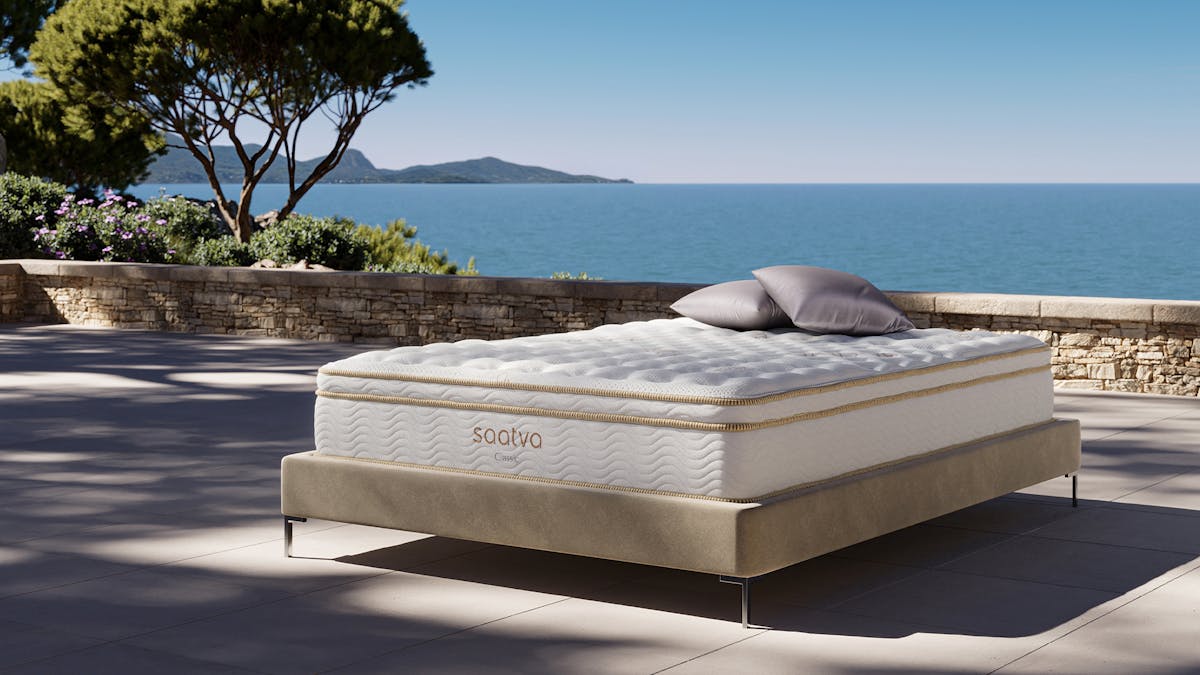
by A double bed and a full bed are identical. Both names refer to the same mattress size: 54 inches wide by 75 inches long. There is no size difference, no regional variant, no hidden spec. If you are shopping for a full or double mattress, the Saatva Classic is our top pick at this size, available in full with white-glove delivery and a 365-night trial.
Saatva Classic
9.2/10
- Dual-coil innerspring construction with a reinforced lumbar zone pad
- Three firmness choices: Plush Soft, Luxury Firm, and Firm
- Free white-glove delivery, in-home setup, and old-mattress removal
- 365-night home trial and lifetime warranty
- Not compressed or boxed, requires scheduled delivery
- $99 return fee if you decide to send it back during the trial
The Saatva Classic is the best-built mattress available in full/double: hotel-quality coil construction, three firmness options, and a 365-night trial that gives you a full year to decide. It is the pick we would choose for a guest room, a solo sleeper, or anyone upgrading from a budget full-size mattress.
Why two names for one size?
Before queen and king mattresses existed, American households had two choices: a single (roughly 39 inches wide) or something wider that could fit two people. The wider option was called a double because it was roughly double the width of a single. That naming made practical sense, and for decades "double" was the industry standard term.
In the 1950s, the mattress industry introduced queen (60"×80") and king (76"×80") sizes. Suddenly the old double, at 54 inches wide, felt modest by comparison. Manufacturers and retailers began marketing the same 54"×75" mattress as a full, a cleaner, more neutral name that did not imply it was specifically a two-person bed. The rebranding was about perception: "full" sounds complete on its own, while "double" invites the question of whether it is really big enough for two adults.
Both names stuck. Older consumers, furniture retailers with decades of catalog history, and many apartment listings still say "double." Newer brands and bedding manufacturers overwhelmingly use "full." Neither group is wrong, and every mattress size guide lists them as the same entry regardless of which label appears first.
Full / double dimensions at a glance
A full size mattress measures 54 inches wide by 75 inches long (approximately 137 cm × 191 cm). That gives each sleeper on a shared bed about 27 inches of personal width, roughly the same as a crib. For reference, a standard twin is 38 inches wide, a queen is 60 inches wide, and a king stretches to 76 inches.
| Size | Dimensions (in) | Dimensions (cm) | Best for | Min. room size |
|---|---|---|---|---|
| Twin | 38" × 75" | 97 × 191 cm | Children, solo sleepers, bunk beds | 7' × 10' |
| Full / Double | 54" × 75" | 137 × 191 cm | Solo adults, occasional couples | 9' × 10' |
| Queen | 60" × 80" | 152 × 203 cm | Couples, solo sleepers wanting space | 10' × 10' |
| King | 76" × 80" | 193 × 203 cm | Couples wanting maximum space | 12' × 12' |
Note that both twin and full share the same 75-inch length. If you are taller than about 6 feet, that length can feel tight. The queen adds 5 inches of length (to 80 inches) alongside 6 inches of width, which is why many taller sleepers step up to queen regardless of whether they sleep alone or with a partner.
Who actually fits on a full/double?
A full mattress is genuinely comfortable for one adult sleeping alone. At 54 inches wide, you have room to shift positions, keep a pillow beside you, or sleep with a pet without feeling cramped. This is the most underrated use case for the full size: solo adults who want more room than a twin but are furnishing a guest room, a smaller primary bedroom, or a studio apartment where a queen would crowd the walls.
For two adults sleeping regularly, a full is functional but snug. Each person gets about 27 inches of lateral space. That works for couples who sleep close together by preference, but most sleep experts recommend a queen as the minimum for two adults who both want room to move. If you or your partner tend to sprawl, the extra 6 inches a queen provides makes a real difference night over night.
For a child or teenager, a full is an excellent upgrade from a twin. Kids move around a lot, and the extra width gives them room to grow into the bed without outgrowing it quickly.
Room size planning for a full/double
The general recommendation is a minimum room size of 9 feet by 10 feet for a full mattress. That allows for the bed frame plus at least 24 inches of clearance on the sides for walking and opening drawers. If you want nightstands on both sides, aim for a 10' × 10' room.
One practical advantage of a full over a queen is that it fits into older homes and apartments built before queen beds became the default. Pre-war buildings, converted guest rooms, and urban studio apartments often have bedroom dimensions that make a queen uncomfortably tight while a full fits cleanly. If you are comparing the two sizes for a specific room, measure your space and factor in the full bed frame, which typically adds 2 to 4 inches on each side.
When to size up to a queen
A queen is worth the upgrade in four situations:
- You share the bed regularly. Two adults sleeping on 54 inches of width will feel the difference versus 60 inches.
- You are over 6 feet tall. The queen's 80-inch length versus a full's 75 inches is 5 inches that matter when your feet approach the footboard.
- Your room can accommodate it. If you have a 10' × 12' or larger room, there is little reason to take a full when a queen fits with room to spare.
- You sleep with a pet. Dogs and cats that claim bed territory consume real estate. What feels fine solo can feel crowded once a 40-pound dog settles into the corner.
If budget is the concern, a full mattress from a quality brand will outperform a cheap queen every time. A well-built mattress for couples at the full size will sleep better than a bargain queen at 60 inches.
Bedding and sheets for a full / double
Full and double mattresses use the same sheets. When shopping for bedding, look for labels that read "Full" or "Full/Double" — these are interchangeable and will fit. Do not buy twin sheets for a full; twin fitted sheets will not stretch to cover the extra width.
Standard full/double bedding dimensions:
- Fitted sheet: typically 54" × 75" with a 14 to 16-inch pocket depth for thicker mattresses
- Flat sheet: approximately 81" × 96"
- Comforter / duvet: usually 80" × 86" to allow adequate overhang
One common mistake: buying a comforter sized for a queen (usually 90"×90") for a full mattress. It will work and give you extra drape, but it will bunch and shift more than a properly sized full comforter. If you like a tucked-in look, stick with full-sized bedding.
What about UK doubles?
UK sizing adds a small wrinkle. In the United Kingdom, a double bed is 54 inches wide by 75 inches long, coincidentally the same footprint as the US full/double. However, UK bedding and mattress standards sometimes differ in depth and edge specification, so mattresses sold in the UK as doubles may not come in the same models or firmness options as US full mattresses. If you are buying a mattress or bedding internationally, confirm the exact dimensions on the product listing rather than relying solely on the size name.
The single vs twin comparison covers a similar naming divergence: "single" in the UK maps to "twin" in the US, both at roughly 38"×75".
Frequently asked questions
Is a double bed the same as a full?
Yes, completely. In the United States, double and full are two names for one mattress size: 54 inches wide by 75 inches long. The terms are used interchangeably and there is no dimensional difference between them.
Why do some stores say "double" and others say "full"?
Historical naming. "Double" was the original industry term before queen and king sizes were introduced in the 1950s. Once larger options arrived, manufacturers rebranded the 54"×75" as a "full" to position it as a complete solo mattress rather than a modest couples bed. Both names persisted, so you see them side by side in retail today.
Will full-size sheets fit a double bed?
Yes. Full sheets and double sheets are the same product. Any bedding labeled "Full" or "Full/Double" will fit a double mattress without alteration. Check the pocket depth on fitted sheets if your mattress is thicker than 12 inches.
How does a full compare to a queen?
A queen is 60"×80", 6 inches wider and 5 inches longer than a full. For two regular adult sleepers, the queen is the more comfortable choice. For a solo sleeper or a smaller room, a full offers solid value without giving up meaningful sleep quality.
Is a full/double big enough for two people?
It depends on the sleepers. Two adults can share a full, but each gets only about 27 inches of width. Couples who sleep close together and do not move much often find it acceptable. Couples who prefer personal space, or where one or both partners are broad-shouldered, will find a queen meaningfully more comfortable. Check the best mattresses for couples if you are shopping for two.
What room size do I need for a full/double bed?
A minimum of 9 feet by 10 feet is the standard recommendation, which gives you clearance on the sides and foot of the bed for moving around comfortably. If you want nightstands on both sides, a 10'×10' room or larger is more practical.
Does California king vs king sizing have a similar naming issue?
Not quite. The California king vs king comparison covers two distinct sizes (Cal king is 72"×84", standard king is 76"×80"), unlike full and double which are truly the same size.
Double and full are the same mattress: 54" × 75". If you are shopping at this size, the Saatva Classic is the best-built option available in full, with a 365-night trial, three firmness choices, and free white-glove delivery.