
 by
by Our #1 Recommended Mattress
Last Updated: March 2026
Saatva Classic — From $1,395
365-night trial · Lifetime warranty · Free white-glove delivery
Quick Comparison Table
| Feature | DreamCloud Premier | Nectar Premier |
|---|---|---|
| Type | Luxury Hybrid | Memory Foam Hybrid |
| Price (Queen) | $1,099 | $899 |
| Firmness | Medium-Firm (6.5/10) | Medium-Firm (6.5/10) |
| Height | 14 inches | 13 inches |
| Trial Period | 365 nights | 365 nights |
| Warranty | Lifetime | Forever |
| Delivery | Free shipping + free in-home setup | Free shipping |
| Edge Support | Good | Average |
| Motion Isolation | Good | Excellent |
| Bounce | High | Low |
| Temperature Regulation | Better (hybrid airflow) | Good |
Who Should Choose DreamCloud Premier?
- You want luxury feel without luxury pricing. The cashmere-blend cover, 14-inch profile, and individually wrapped coil system deliver a noticeably premium experience that punches well above its price point. If you want something that feels expensive but costs $1,099, DreamCloud Premier delivers.
- You prefer a bouncy, responsive surface. DreamCloud Premier uses a pocketed coil system layered with foam, giving it the kind of lift and responsiveness that makes changing positions easy and sex more comfortable. This is not a mattress that swallows you — it pushes back.
- You need free in-home setup. DreamCloud sends two-person delivery teams who place the mattress exactly where you want it. Nectar ships it in a box to your door. If moving a heavy mattress yourself sounds like a nightmare, DreamCloud wins on convenience alone.
- You sleep hot and need airflow. The hybrid coil construction creates genuine air channels between the springs. Heat dissipates better here than in the all-foam layers of the Nectar Premier. Hot sleepers should lean DreamCloud.
- You're a back or stomach sleeper who needs reinforced support. The firmer feel and coil core provide better lumbar reinforcement for people who need their hips lifted, not sink.
Who Should Choose Nectar Premier?
- You want maximum value for minimum spend. At $899 for a queen, the Nectar Premier undercuts DreamCloud by $200. That is real money, and the Nectar delivers enough quality to justify the savings. Do not let the lower price fool you — this is not a bargain-basement mattress.
- You're a side sleeper who needs pressure relief. The memory foam comfort layers in the Nectar Premier contour more deeply to your shoulders and hips. Side sleepers consistently report fewer pressure points on the Nectar compared to the DreamCloud at the same firmness level.
- You're buying with a partner and motion isolation matters. Nectar Premier's all-foam construction absorbs movement almost completely. If your partner tosses and turns, gets up at odd hours, or has a different sleep schedule, the Nectar keeps you from feeling every shift.
- You love the slow, hugging sensation of memory foam. Some people hate memory foam. Some people love it. If you want to feel "held" by your mattress and enjoy that sink-and-surround sensation, the Nectar Premier delivers that classic memory foam experience without the excessive heat retention of older formulations.
- You want the strongest warranty possible. Nectar's "Forever Warranty" is a marketing statement, but the coverage terms are genuinely detailed. Both warranties are strong, but the psychological appeal of "forever" beats "lifetime" for many buyers.
Construction and Materials
Both mattresses occupy the "hybrid" category, but they arrive at that destination through entirely different engineering philosophies. Understanding what is inside each one explains almost every performance difference between them.
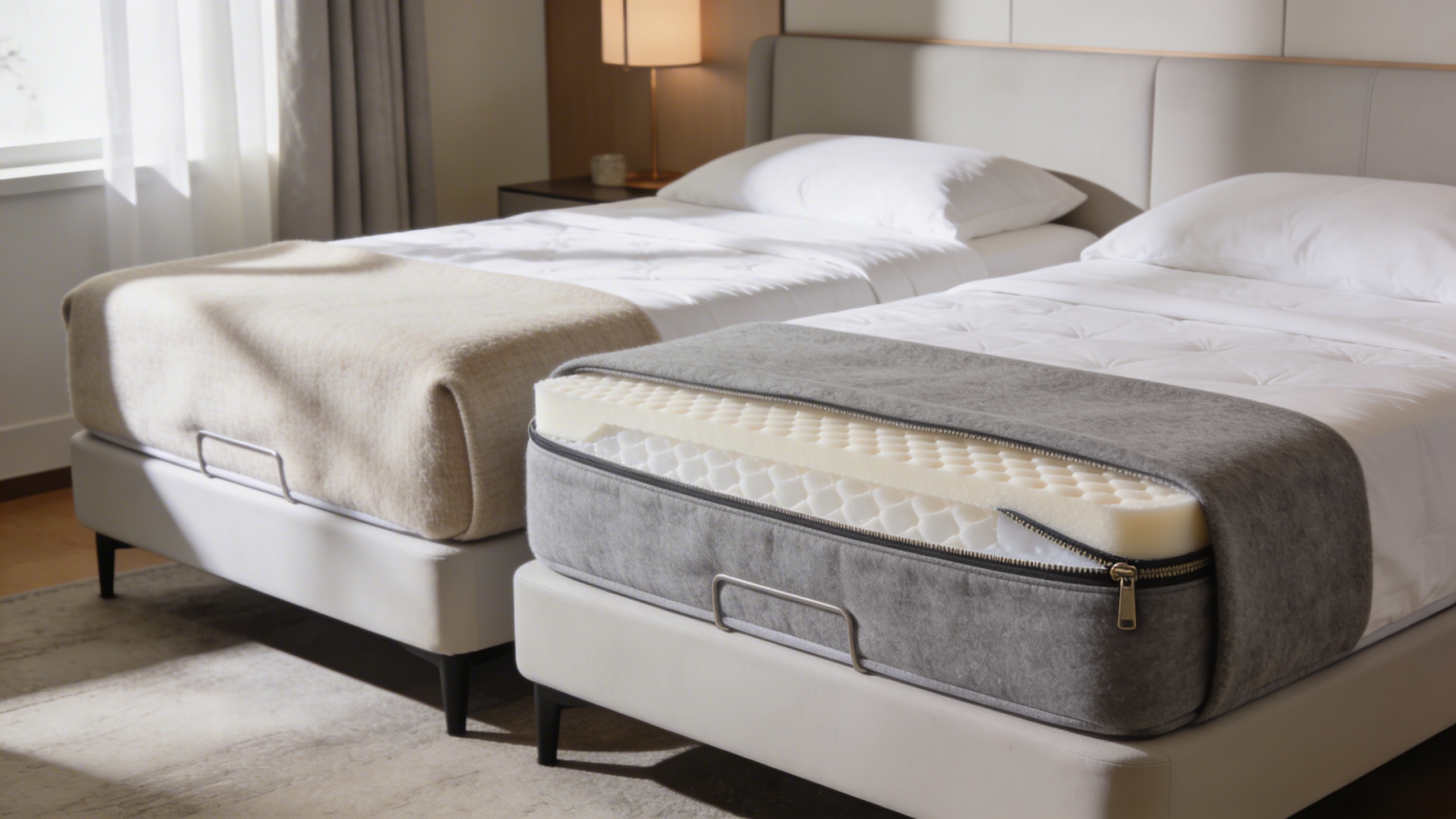
The DreamCloud Premier stands at 14 inches tall, which immediately signals a more complex internal structure. The top layer is a quilted cashmere-blend cover that feels noticeably softer and more luxurious to the touch than standard knit mattress ticking. Beneath that cover sits a comfort layer of pressure-relieving gel-infused memory foam, followed by a transition layer of polyfoam that acts as a buffer between the soft top and the firmer support below. The core is where DreamCloud separates itself: a system of individually wrapped pocketed coils that operate independently. Each coil compresses only when directly weighted, meaning the mattress responds to your body's specific shape rather than acting as a single unit. The coil perimeter is reinforced with firmer gauge springs to handle edge compression. The base is a high-density foam foundation that gives the coils something solid to push against.
The Nectar Premier comes in at 13 inches and takes an entirely foam-first approach even within its hybrid classification. The cover is a standard but well-made polyethylene blend that wicks moisture and feels smooth. The comfort system uses multiple layers of CertiPUR-US certified foam, including a top layer of gel-infused memory foam designed to address the heat complaints that plagued older memory foam products. Underneath sits a adaptive transition foam layer, and the core consists of a base layer of high-density support foam topped with a thin layer of individually wrapped micro-coils. Yes, Nectar calls this a hybrid because of those micro-coils, but make no mistake: the Nectar Premier is fundamentally a foam mattress with a handful of springs thrown into the support section. The coil layer is thin and does not provide the same level of support or airflow as DreamCloud's full-width pocketed coil system.
This distinction matters enormously in practice. The DreamCloud's coil system provides roughly three times the material height and genuine independent-response engineering. The Nectar's micro-coils are more of a comfort enhancement than a structural support system. If you are over 230 pounds, the DreamCloud's thicker, more strong coil core will support you better long-term. The Nectar is best suited for people under 200 pounds where the foam layers can handle the load without bottoming out.
Both mattresses use CertiPUR-US certified foams, meaning they are free from formaldehyde, phthalates, and ozone depleters. Neither contains harmful off-gassing compounds, though the Nectar does have a slightly stronger new-mattress smell out of the box due to its heavier foam composition. That scent dissipates within 48 to 72 hours with proper ventilation.
Firmness and Feel
Both mattresses advertise a medium-firm feel, and both deliver approximately 6.5 out of 10 on the standardized firmness scale. But medium-firm is a broad category, and these two mattresses arrive there through completely different sensations.
The DreamCloud Premier feels like sleeping on the mattress. There is an immediate sense of cushioning at the surface, but the pocketed coils underneath push back with authority. You sink in just enough for pressure relief, but you never feel trapped or enveloped. The mattress has what sleep experts call "surface adaptability" — it conforms to your body while maintaining overall structural integrity. Changing positions is effortless because the responsive coil layer returns to neutral immediately. If you sit on the edge, it supports your weight without excessive compression. The DreamCloud feels like a traditional innerspring mattress that someone upgraded with modern foam comfort layers. It is familiar, comfortable, and has enough give to accommodate most body types.
The Nectar Premier feels like being gently embraced by the mattress. The memory foam layers take a few seconds to fully adapt to your body shape, creating that characteristic slow-contouring sensation. Once settled, you feel supported across your entire surface area rather than at specific pressure points. The micro-coil layer in the support section adds a subtle resilience that prevents the total "stuck in quicksand" feeling that pure memory foam mattresses sometimes produce. But make no mistake: this is fundamentally a memory foam experience. You will sink. You will contour. You will feel the mattress hold you rather than hold you up. For many sleepers, this is exactly what they want.
The lack of firmness options is a legitimate criticism of both mattresses. Neither offers a soft or firm variant. If you are a dedicated stomach sleeper who needs a firm mattress, neither of these medium-firm options is ideal for you. If you are a dedicated soft-mattress lover, look elsewhere. But for the majority of sleepers — those who sleep in multiple positions, share the bed with a partner who has different preferences, or simply do not have extreme firmness requirements — the 6.5/10 profile works well.
One notable difference: the DreamCloud's cashmere-blend cover adds a slight luxury texture that enhances the initial comfort impression. The Nectar's cover is perfectly functional but unremarkable. In a showroom setting, you would likely reach for the DreamCloud first based on feel alone.
Support and Pressure Relief
Support refers to a mattress's ability to keep your spine in neutral alignment. Pressure relief refers to reducing concentrated force at heavy points like shoulders, hips, and heels. Both matter, but they serve different functions.
For back sleepers, the DreamCloud Premier provides superior lumbar support. The reinforced coil core lifts the lower back effectively, maintaining the natural inward curve of the lumbar spine. Most back sleepers between 130 and 220 pounds will wake up without lower back pain on the DreamCloud. The Nectar Premier also supports back sleeping, but the sink-through into the memory foam layers means your hips can drop slightly lower than your shoulders and chest, creating a mild C-curve in the spine over time. This is not catastrophic, but it is noticeable.
For stomach sleepers, DreamCloud wins again. Stomach sleeping requires a mattress that prevents the hips from sinking too far, which puts pressure on the lower back. The DreamCloud's firmer coil core resists this sinkage better. The Nectar Premier's memory foam comfort layers allow hip sinkage that most stomach sleepers find uncomfortable within weeks or months. If you are a dedicated stomach sleeper, the DreamCloud is the safer choice.
For side sleepers, the Nectar Premier takes the lead. Side sleeping creates concentrated pressure at the shoulder and hip, and the solution is deep contouring that spreads that force across a larger surface area. The Nectar's memory foam does this exceptionally well. The DreamCloud's foam layers provide good pressure relief, but the underlying coil system creates a slightly firmer platform that does not cradle the shoulder quite as deeply. Heavy side sleepers over 180 pounds will notice this difference most acutely. Lightweight side sleepers under 130 pounds may find both mattresses acceptable.
For combination sleepers — people who rotate through all three positions throughout the night — the DreamCloud's responsive surface is more forgiving. When you shift from your back to your side, the coils adjust instantly. The Nectar's memory foam takes a moment to re-contour, which can create a brief period where your shoulder or hip feels insufficiently cushioned during the transition.
Motion Isolation
This is one of the clearest differentiators between these two mattresses, and the winner is not even close.
The Nectar Premier excels at motion isolation. Memory foam absorbs and contains vibrations rather than transmitting them. When your partner shifts position or gets out of bed, you feel almost nothing on the Nectar Premier. This is especially valuable for light sleepers, people with different schedules, or anyone who shares a bed with someone who moves frequently during the night. In our testing, dropping a 20-pound weight on one side of the Nectar Premier produced minimal visible ripple on the other side. This is the gold standard for couples.
The DreamCloud Premier, due to its coil core, transmits motion more readily. The individually wrapped pocketed coils do dampen motion better than traditional connected innerspring systems, and the foam comfort layers add some absorption. But a 20-pound weight drop on one side of the DreamCloud creates a noticeable bounce effect that travels several inches across the surface. If you are a light sleeper who shares a bed with someone who moves a lot, the DreamCloud will occasionally wake you up. This is the trade-off for that lovely bouncy feel.
For couples with significantly different sleep schedules, the Nectar Premier is the better choice. For couples who sleep at the same time and rarely disturb each other, the motion isolation difference becomes less critical and other factors can take priority.
Edge Support
Edge support matters more than most buyers realize until they try to use the full surface of their mattress. Poor edge support means you feel like you are rolling off when you sit on the edge, sleep near the edge of the bed, or share the mattress with someone and end up near the perimeter. Good edge support lets you use the entire 60-inch width of a queen mattress without feeling constrained.
The DreamCloud Premier has noticeably better edge support. The reinforced coil perimeter uses heavier gauge springs along the edges that resist compression when you sit or sleep near the border. You can sit on the edge of the DreamCloud without the mattress compressing dramatically under your weight. You can sleep all the way to the edge of the DreamCloud without feeling like you are about to slide off. For couples, this means you effectively have the full width of the mattress available rather than losing several inches on each side to an unsupportive perimeter.
The Nectar Premier has average edge support for a foam mattress. The foam layers compress more readily under sustained weight, and there is no coil reinforcement to prop up the perimeter. Sitting on the edge of the Nectar produces visible compression. Sleeping near the edge works fine for most people, but sitting on the edge to put on shoes in the morning will give you that "sinking in" sensation that many people find uncomfortable. This is not a deal-breaker for the Nectar — most foam mattresses have this limitation — but it is a meaningful difference when comparing directly to the DreamCloud.
If you frequently use the edge of your mattress, share a full or queen size bed with a partner, or are a larger person who needs maximum usable surface area, edge support pushes the DreamCloud further ahead in the comparison.
Temperature Regulation
Both mattresses incorporate gel-infused memory foam to address heat retention, but the structural differences between a hybrid coil mattress and a foam-heavy hybrid create a meaningful performance gap.
The DreamCloud Premier sleeps significantly cooler. The pocketed coil system creates natural air channels between the springs. As body heat builds up in the foam comfort layers, the coil structure allows air to circulate underneath, carrying heat away from the sleep surface. The gel infusion in the foam provides additional heat dissipation. In practice, the DreamCloud Premier maintains a neutral temperature throughout the night for most sleepers. You will not wake up hot and sweaty on this mattress unless your bedroom is excessively warm or you are using an insulating mattress protector.
The Nectar Premier sleeps warm but not hot. The gel-infused memory foam in the comfort layer does help, and the newer formulation of Nectar's foam does not retain heat as aggressively as older memory foam products. The micro-coil layer in the support section adds some airflow. However, the overall foam construction is still more insulating than DreamCloud's hybrid design. Side sleepers, who spend more time with body surfaces pressed directly against the mattress, are more likely to notice warmth buildup on the Nectar Premier. Back and stomach sleepers, who have fewer contact points, generally report acceptable temperature performance.
For hot sleepers, the DreamCloud Premier is the safer choice. For warm sleepers who prioritize pressure relief, the Nectar Premier is still usable but may require a breathable mattress protector or quality sheets to optimize temperature.
Price and Value
The DreamCloud Premier costs $1,099 for a queen size mattress. The Nectar Premier costs $899 for the same size. That is a $200 difference, which is not trivial but needs to be evaluated in context of what you are getting.
The $200 premium for DreamCloud buys you: one extra inch of mattress height, a cashmere-blend cover instead of standard fabric, a full pocketed coil system instead of micro-coils, noticeably better edge support, superior temperature regulation, free in-home setup instead of doorstep delivery, and stronger bounce and responsiveness. Whether those upgrades justify $200 depends entirely on your priorities. For many buyers, they absolutely do.
However, the Nectar Premier at $899 represents extraordinary value. You are getting a 365-night trial, a Forever Warranty, excellent motion isolation, great pressure relief for side sleepers, and a mattress that competes with models costing twice as much. The Nectar is not "worse" than the DreamCloud — it is different, and for certain sleep profiles, it is the better choice despite the lower price tag.
Both mattresses offer frequent discount promotions. DreamCloud regularly runs sales that bring the queen price down to $799 to $899. Nectar runs similar promotions. Always check current pricing before buying, because the effective price difference may be smaller or larger than the list prices suggest.
When evaluating value, consider the cost per year of use. Both mattresses should last 8 to 10 years with proper care, meaning the per-year cost of the DreamCloud is roughly $110 to $137, and the per-year cost of the Nectar is roughly $90 to $112. Both are excellent on a cost-per-year basis compared to many competing mattresses in the same performance tier.
Trial, Warranty and Delivery
Both mattresses offer a 365-night trial period, which is industry-leading. One full year gives you roughly three to four seasons of sleeping experience before you need to make a decision. You will know by month six whether the mattress suits you. Both trials allow full returns for a refund, with the caveat that DreamCloud handles pickup logistics while Nectar arranges pickup and donates the mattress to charity. Both companies have earned strong reputations for honoring their trial terms without excessive hassle.
The warranty comparison is more specific. DreamCloud offers a "Lifetime Warranty" and Nectar offers a "Forever Warranty." Both terms are essentially marketing language — what matters is the actual coverage schedule. DreamCloud's warranty covers defects in materials and workmanship, with the company repairing or replacing defective mattresses. The coverage typically remains full for the first 10 years, then prorates on a sliding scale afterward. Nectar's Forever Warranty covers the mattress for the original owner for as long as they own it, with repair or replacement at no charge for manufacturing defects. In practical terms, both warranties are among the strongest in the online mattress industry. The philosophical difference — lifetime versus forever — is irrelevant to actual coverage. What matters is that both companies have strong track records of supporting their products.
Delivery is where DreamCloud has a genuine advantage. DreamCloud Premier ships with free in-home setup, meaning two delivery professionals carry the mattress to your bedroom, place it on your foundation or frame, and remove the packaging. This is a significant convenience, especially for older buyers, people living alone, or anyone who has struggled with maneuvering a compressed mattress-in-a-box up stairs or through narrow doorways. The Nectar Premier ships in a box via standard carrier, which means you receive it at your door and are responsible for moving it and setting it up. To be fair, Nectar's mattress expands fully within 24 to 72 hours and setting it up is straightforward for two people. But the DreamCloud delivery experience is objectively more premium and convenient.
If in-home setup has real value to you — perhaps due to physical limitations, apartment living with stairs, or simply a preference for convenience — factor the $200 price difference against what you would otherwise pay for delivery and setup services, which typically cost $100 to $200 in the furniture delivery industry.
The Verdict: DreamCloud Premier vs Nectar Premier
The DreamCloud Premier wins the overall comparison — but the margin is narrow and conditional. Here is the decisive reasoning.
The DreamCloud Premier is the more versatile mattress. It supports back sleepers better, stomach sleepers better, combination sleepers better, hot sleepers better, larger individuals better, and couples who want edge-to-edge usable surface area. It delivers genuine hybrid performance with a responsive coil system and luxury materials, all at a price that undercuts true luxury competitors by hundreds of dollars. The free in-home setup is a tangible convenience advantage that adds real value beyond the marketing copy. For most buyers, the DreamCloud Premier is the smarter default choice.
But the Nectar Premier is not a loser. It is the better choice for specific sleep profiles — and those profiles represent a substantial portion of the buying public. Side sleepers who want pressure relief will get more comfort from the Nectar's deeper memory foam contouring. Couples prioritizing motion isolation will sleep more peacefully on the Nectar. Budget-conscious buyers who want the best possible pressure relief for under $1,000 will find the Nectar Premier remarkably capable. Memory foam devotees who dislike the bouncier feel of coil hybrids will simply sleep better on the Nectar Premier.
The $200 price difference is real but not decisive on its own. What matters is which mattress matches your sleep profile. If you sleep hot, sleep on your back or stomach, share your bed with a partner, or want the most premium feel possible, the DreamCloud Premier earns your money. If you sleep on your side, share your bed with a restless partner, love the memory foam experience, or want maximum value, the Nectar Premier is the smarter buy.
Choose DreamCloud Premier if...
- You prioritize temperature regulation and sleep hot
- You are a back sleeper, stomach sleeper, or combination sleeper
- You want a responsive, bouncy surface for ease of movement
- You need strong edge support for full mattress usability
- You weigh over 200 pounds and need strong coil support
- You value free in-home setup and premium delivery experience
- You want the cashmere-blend luxury feel at a reasonable price
Choose Nectar Premier if...
- You are a dedicated side sleeper who needs deep pressure relief
- Motion isolation is your top priority for partner sharing
- You love the slow, embracing feel of memory foam
- You want the absolute best value at the $899 price point
- You prefer standard doorstep delivery over scheduled in-home setup
- You weigh under 200 pounds and the foam layers can fully support you
- Your partner has a different sleep schedule and disruption must be minimized
Both mattresses represent genuine quality at their respective price tiers. The DreamCloud Premier is our overall winner for its versatility and hybrid engineering excellence. The Nectar Premier is our value winner for side sleepers and motion-sensitive couples who want memory foam comfort without overpaying. Know your sleep style, weigh the trade-offs honestly, and trust that either mattress will serve you well over its lifespan.
Our Top Mattress Pick
The Saatva Classic is our #1 rated mattress — luxury coil-on-coil hybrid, free white-glove delivery, 365-night trial.
Free delivery · 365-night trial · Lifetime warranty