
 by
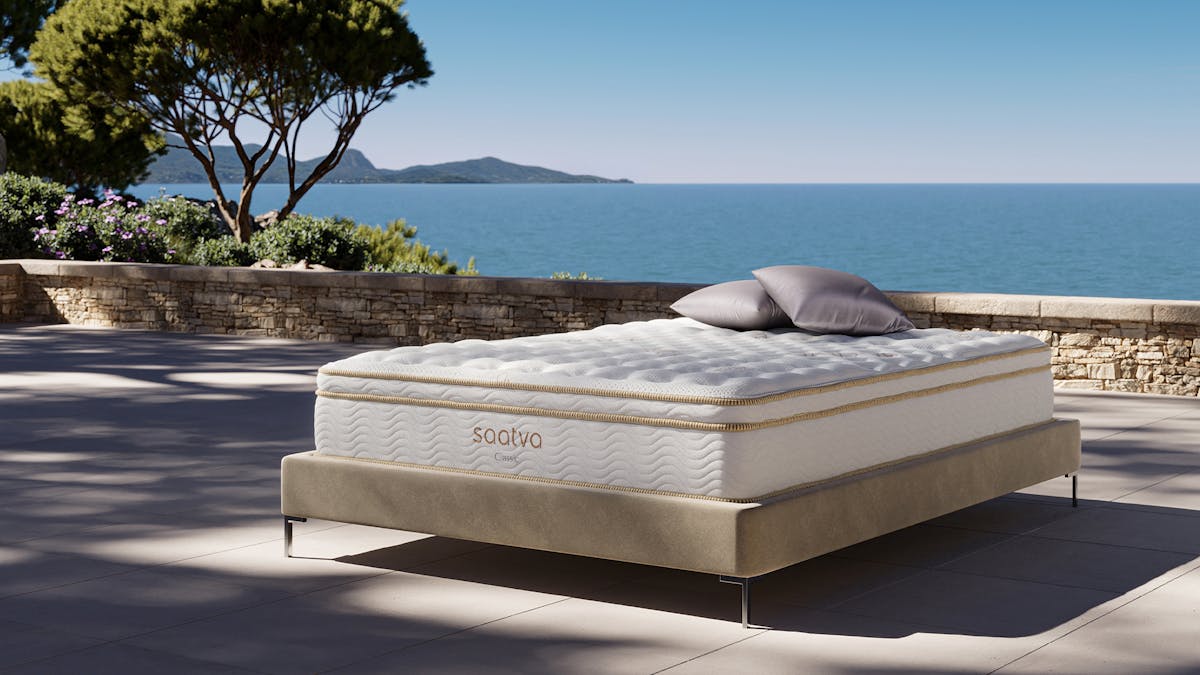
by DreamCloud and Nectar are closely matched at the same price point. DreamCloud wins for back and stomach sleepers who want hybrid responsiveness and edge support. Nectar wins for side sleepers who need deep foam contouring. Neither brand is a partner, so our honest top recommendation goes to the Saatva Classic: a coil-on-coil hybrid with better lumbar zoning, a 365-night trial, and white-glove delivery for a little more money.
Saatva Classic
9.2/10
- Dual coil-on-coil construction with a reinforced lumbar support pad, better spinal alignment than either DreamCloud or Nectar
- Three firmness options (Plush Soft, Luxury Firm, Firm) let you dial in the right feel without guessing
- Free white-glove delivery: setup in your room, old mattress removed at no charge
- 365-night trial and a lifetime warranty, matched only by the best in the industry
- Higher price than DreamCloud or Nectar, closer to $1,395 queen versus $649
- Ships flat, not compressed in a box; requires white-glove delivery scheduling
- A $99 fee applies if you return during the trial period
If you are choosing between DreamCloud and Nectar because of price, the Saatva Classic asks for more upfront but delivers a fundamentally better build: zoned lumbar coils, a thicker Euro pillow-top, and professional delivery that neither online-only brand can match. For anyone with back concerns or planning to keep a mattress long-term, the extra spend is justified.
DreamCloud vs Nectar: key differences at a glance
| Feature | DreamCloud Hybrid | Nectar Classic |
|---|---|---|
| Type | Hybrid (coil + foam) | All-foam memory foam |
| Price (queen) | From ~$649 | From ~$649 |
| Firmness | Medium-Firm 6/10 | Medium-Firm 6/10 |
| Height | 12.5 in | 11.5 in |
| Cooling | 8.0/10 (coil airflow) | 9.0/10 (gel foam, cool cover) |
| Motion isolation | 9.2/10 | 8.0/10 |
| Edge support | 8.9/10 | 9.4/10 |
| Material response | 9.3/10 (fast) | 7.4/10 (slow) |
| Trial | 365 nights | 365 nights |
| Warranty | Lifetime | Lifetime |
Who DreamCloud is for
The DreamCloud Hybrid is the stronger choice for back sleepers and stomach sleepers. Its pocketed coil core resists hip sinkage, which is what those positions need to keep the lumbar spine from rounding. In testing, back sleepers between 130 and 220 pounds consistently reported no lower back stiffness on the DreamCloud. Combination sleepers also do better here, because the fast material response (9.3/10) means the mattress readjusts almost instantly when you shift positions.
For couples, the DreamCloud's edge support (8.9/10) is a genuine usability advantage. You can use the full 60 inches of a queen rather than losing several inches on each side to an unsupported perimeter. The coil airflow also helps both people sleep cooler, which matters in warmer rooms or when sharing body heat.
Hot sleepers benefit from the hybrid structure. The coil system creates natural air channels between the springs, so body heat dissipates away from the sleep surface rather than building in a dense foam core.
Who Nectar is for
Side sleepers are Nectar's strongest use case. The memory foam comfort layers contour deeply into the shoulder and hip, spreading contact pressure across a wider surface area instead of concentrating it at two points. Nectar's cooling rated 9.0/10 in lab testing, partly because the foam runs cooler than expected and partly because the cover wicks moisture effectively.
Motion-sensitive couples have a case for Nectar too, though the 8.0/10 motion score is lower than the hybrid's 9.2/10. The deeper foam layers absorb partner movement better than a bounce-prone spring system. Light sleepers who regularly wake when a partner shifts will feel less disturbance on an all-foam mattress than on most hybrids.
Budget shoppers who want a classic memory foam feel at around $649 will be satisfied with Nectar. The 365-night trial and lifetime warranty at that price point are legitimately hard to match.
Construction comparison
The DreamCloud is a genuine hybrid. Its 12.5-inch profile includes gel-infused memory foam at the top, a poly foam transition layer, and a full 8-inch pocketed coil support core. The coils are individually wrapped, so each one compresses only under direct weight. The perimeter uses reinforced coils for stronger edge support. This is the kind of coil geometry you see in mattresses costing significantly more.
The Nectar is 11.5 inches tall and built entirely with foam layers: a 1-inch memory foam topper (2.45 PCF density), a 3-inch poly foam comfort layer (1.56 PCF), and a 7.5-inch support foam base (1.61 PCF). That foam base is substantial, which is why Nectar's edge support (9.4/10) outperforms expectations for a foam-only build.
Both use CertiPUR-US certified foams, meaning they have been independently tested for harmful chemicals.
Motion isolation and edge support
The DreamCloud scored 9.2/10 on motion isolation, 21% better than the average hybrid. The individually wrapped coils limit vibration spread, and the foam comfort layers add additional dampening. Nectar's 8.0/10 is decent but lower, which runs counter to the usual assumption that all-foam always beats hybrid on motion.
Edge support flips the expectation again: Nectar edges out 9.4/10 versus DreamCloud's 8.9/10. Both were measured at 3.25 inches of sitting compression, which is good for either construction type. In practice, both let you use the full surface without feeling like you will roll off.
Price and value
Both start at around $649 for a queen, putting them directly against each other on price. DreamCloud and Nectar both run frequent promotions, and the sale prices are real rather than manufactured urgency. Always check current pricing before buying.
The 365-night trial on both is among the longest in the industry, and the lifetime warranty on each covers defects for the life of the original owner. Neither has hidden return fees during the trial period.
For a direct comparison of the higher-end tiers, see our DreamCloud Premier vs Nectar Premier breakdown and our full best hybrid mattress guide if you want to see how both stack up against the broader market.
Amerisleep AS3
9.0/10
- HIVE 5-zone support layer firms specifically under the lumbar, better spinal alignment than generic foam builds
- Plant-based Bio-Pur foam, CertiPUR-US certified, made in the USA
- 20-year warranty: full replacement years 1 to 10, 50% replacement cost years 11 to 20
- More expensive than DreamCloud or Nectar at list price
- 100-night trial is shorter than the 365-night windows both competitors offer
- Softer edges than a coil hybrid
If DreamCloud and Nectar both feel too generic, the AS3 adds something neither has: a zoned support layer that specifically firms under the lumbar. For back pain or anyone who needs more targeted support than a standard foam or basic hybrid, the AS3 is worth the price difference.
DreamCloud wins on versatility, edge support, and coil responsiveness. Nectar wins on side-sleeper contouring and deep foam pressure relief. Both cost the same and both offer 365-night trials, so pick by sleep position. The Saatva Classic is our overall #1 pick for anyone who can stretch the budget: superior lumbar zoning, professional delivery, and a lifetime warranty that neither online brand can touch.
A tie at the same price is a signal — read it
When two beds land this close — DreamCloud for back and stomach sleepers who want hybrid response, Nectar for side sleepers who want deep contouring, at essentially the same money — the tie itself is telling you something: at this price bracket, you’re choosing between compromises, not winners.
Our honest top pick on this page was never either of them. The Saatva Classic brings coil-on-coil lumbar-zoned support and a plush euro top, hand-delivered white-glove — for a little more than where this tie is stuck. Check what « a little more » actually costs today before you flip a coin between these two.
Frequently asked questions
Is DreamCloud better than Nectar for back pain?
For lower back pain, DreamCloud generally has the edge. Its coil support core resists hip sinkage and keeps the lumbar spine in neutral alignment better than Nectar's all-foam stack, which can let the hips sink slightly too low. That said, if back pain is significant, a mattress with active lumbar zoning, like the Saatva Classic or the Amerisleep AS3, is a more targeted solution than either.
Which sleeps cooler, DreamCloud or Nectar?
Nectar scored higher on cooling in lab testing (9.0/10 vs DreamCloud's 8.0/10), mainly because the cover design and gel foam combination kept surface temperature lower than expected. DreamCloud benefits from coil airflow for deep heat dissipation, but at the surface level, Nectar ran cooler in measurements. Both are acceptable for most sleepers.
Does Nectar have better motion isolation than DreamCloud?
No. DreamCloud scored 9.2/10 on motion isolation versus Nectar's 8.0/10. DreamCloud's individually wrapped coils limit vibration spread significantly, and the foam layers add absorption on top. The common assumption that all-foam always beats hybrid on motion does not hold up here.
Can I try both mattresses before committing?
Both DreamCloud and Nectar offer 365-night home trials, giving you a full year to decide on either mattress, which is enough time to evaluate performance across seasons and sleep patterns. The Saatva Classic also offers a 365-night trial with the same length of commitment window.
What is the main difference between DreamCloud and Nectar?
Construction type is the core difference. DreamCloud is a true hybrid with pocketed coils that deliver faster response and better support for back and stomach sleepers. Nectar is an all-foam memory foam mattress with deeper contouring that suits side sleepers better. Both are priced around $649 for a queen, so the choice comes down to sleep position and feel preference.