
 by
by Talalay latex is softer, more uniform, and better for side sleepers and hot sleepers. Dunlop latex is denser, firmer, and more durable, making it the smarter call for back sleepers, stomach sleepers, and heavier bodies (230 lb+). If you want a mattress built around Talalay, the Saatva Zenhaven is the best all-Talalay option on the market. For customizable latex layers, the PlushBeds Botanical Bliss (Dunlop core + Talalay topper) covers both processes in one bed.
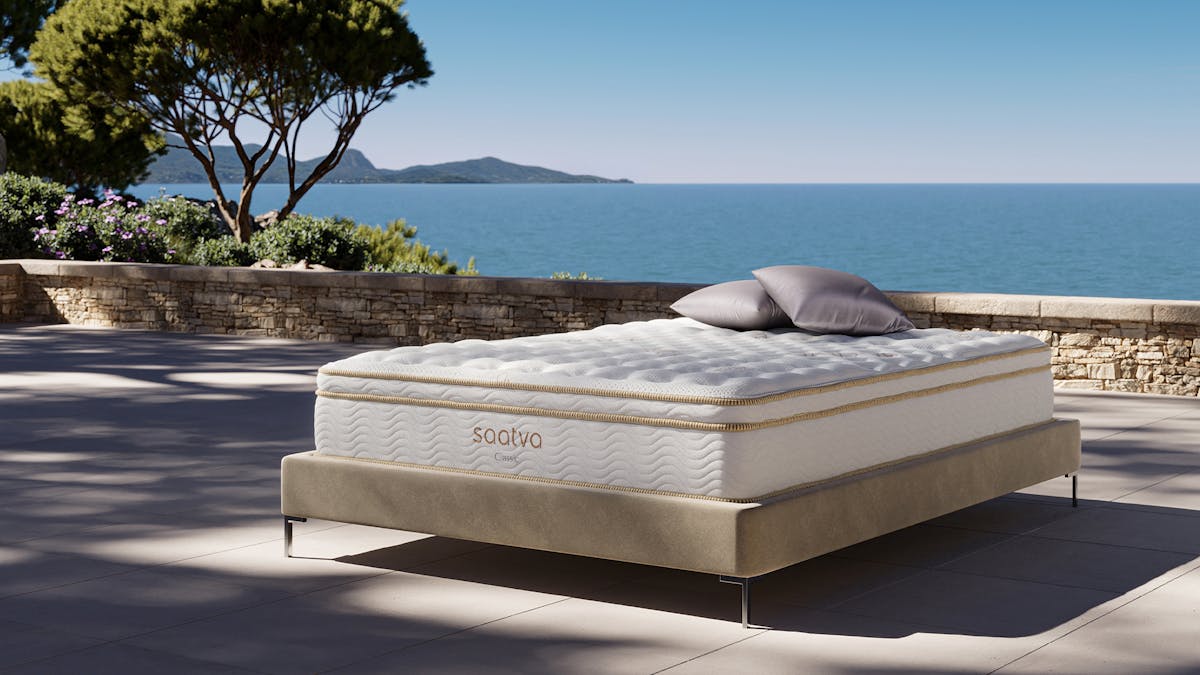
Saatva Zenhaven
9.2/10
- 100% natural Talalay latex throughout, no polyfoam filler
- Flippable: Luxury Plush (19 ILD) on one side, Gentle Firm (24 ILD) on the other
- GOLS and GOTS certified, organic cotton cover
- Free white-glove delivery and old-mattress removal
- 365-night trial, lifetime warranty
- Premium price point
- Heavier than foam beds, harder to flip solo
The Zenhaven is the definitive answer if you want pure Talalay latex. Two firmness options in one flippable bed means you can test both feels during the 365-night trial without returning anything. Saatva backs it with a lifetime warranty, which is rare even in the latex category.
How Dunlop and Talalay are made
Both processes start with the same raw material: liquid latex harvested from Hevea brasiliensis rubber trees. What happens next is where they diverge.
Dunlop process (1929)
Liquid latex is whipped into a foam, poured into a mold in a single continuous pour, then vulcanized with heat. As the latex sets, heavier sediment particles drift toward the bottom. The result is a core that is noticeably denser and firmer at the bottom than at the top, a natural gradient that works well for support layers. Dunlop uses fewer steps, fewer inputs, and produces a denser, heavier product at a lower cost per pound.
Talalay process (1950s)
Talalay adds two steps to the Dunlop method. After the mold is partially filled, a vacuum expands the foam evenly throughout the mold, then the mold is flash-frozen before vulcanization. The freeze locks the foam structure in place before heat sets it, preventing the sediment settling that defines Dunlop. The result: a completely uniform open-cell structure, softer and more elastic throughout. The extra steps add cost, but they also produce a noticeably more consistent feel from one layer to the next.
Dunlop vs Talalay: head-to-head
| Property | Dunlop | Talalay |
|---|---|---|
| Typical density | 5.5–7 lb/ft³ | 3.5–4.5 lb/ft³ |
| Feel | Firm, dense, stable | Softer, bouncier, more uniform |
| Breathability | Good | Excellent (open-cell structure) |
| Durability | 15–25 years | 8–12 years |
| Price (relative) | Lower | Higher |
| Best sleeper type | Back/stomach, 230 lb+ | Side sleepers, hot sleepers |
| Used in mattresses as | Support cores, firm all-latex builds | Comfort layers, all-Talalay builds (Zenhaven) |
| Eco footprint | Less energy to produce | More processing steps |
Who should choose Talalay
Side sleepers
Talalay's lower density allows the shoulder and hip to sink enough to relieve pressure without fighting resistance. Side sleepers on firm Dunlop beds often develop aches at the shoulder within a few weeks.
Hot sleepers
The open-cell structure of Talalay allows significantly more airflow than Dunlop or memory foam. In head-to-head temperature tests, Talalay consistently runs cooler than gel memory foam. If heat retention has driven you off memory foam, Talalay is the material to try next.
Combination sleepers under 230 lb
Talalay's elasticity makes it more responsive when you shift positions, which translates to less effort when rolling from side to back and back to side. Heavier sleepers may find it compresses too much underfoot.
Who should choose Dunlop
Back and stomach sleepers
Dunlop's denser structure provides a stable platform that resists hips sinking past the lumbar line. Back sleepers in particular benefit from the firmer push-back that keeps the spine neutral without needing a separate coil base.
Heavier sleepers (230 lb+)
Dunlop's higher ILD ratings and denser foam maintain their support profile far longer under heavier loads. Talalay at soft or medium firmness can bottom out sooner for larger bodies, leading to that same lumbar sag that causes back pain.
Eco-priority buyers
Dunlop is a less energy-intensive process with fewer chemical steps. Both can achieve GOLS (Global Organic Latex Standard) certification, but Dunlop's simpler process makes it easier to certify at every production stage.
Durability-first buyers
Dunlop's denser structure resists permanent compression longer. A quality Dunlop latex core routinely lasts 15–25 years; Talalay typically lasts 8–12. For the lifecycle cost calculation, Dunlop wins at every price point.
PlushBeds Botanical Bliss
8.9/10
- Uses both: Dunlop core for support, Talalay topper for pressure relief
- GOLS, GOTS, GREENGUARD Gold, and Eco-INSTITUT certified
- Three thickness options (9", 10", 12"); layers are replaceable
- Handcrafted in California, lifetime warranty
- Higher MSRP ($2,949 list); sale pricing brings it to ~$1,449
- Heavy, tricky to move without help
The Botanical Bliss is built around the Dunlop-core, Talalay-topper principle that many latex experts consider optimal: the dense Dunlop base provides stable long-term support, while the Talalay comfort layer handles pressure relief. Four independent certifications make it one of the most verifiable organic beds in the category.
Where each brand lands in 2026
| Brand | Latex type | Position in mattress | Construction |
|---|---|---|---|
| Saatva Zenhaven | 100% Talalay | Whole mattress | All-Talalay, flippable |
| Saatva Latex Hybrid | Talalay | Comfort layer | Latex + pocketed coil |
| PlushBeds Botanical Bliss | Dunlop core + Talalay topper | Layered, customizable | All-latex, replaceable layers |
| Avocado Green | Dunlop | Comfort layer | Hybrid latex + coil |
| Awara Premier | Dunlop | Comfort layer | Hybrid latex + coil |
| Latex for Less | Both (flippable) | Dunlop side / Talalay side | All-latex, flippable |
| Sleep On Latex | Dunlop | Whole mattress | All-Dunlop |
The cost reality
Natural latex mattresses typically run $1,500–$3,500 for a queen at list price, though sales regularly bring that down. The lifecycle math argues in favor of the upfront spend: a quality Dunlop core at $2,200 that lasts 20 years costs $110 per year. A $950 memory foam mattress lasting 6 years costs $158 per year, with progressively worse performance as the foam compresses. Talalay builds sit in the middle: more expensive to produce than Dunlop, but still outlasting foam alternatives by a significant margin.
The practical floor for a verified GOLS-certified latex mattress is around $1,400–$1,600 on sale. Below that price point, check whether the "latex" label refers to natural, blended, or synthetic latex, as the durability and certification story changes materially for each.
Frequently asked questions
What is the main difference between Dunlop and Talalay latex?
The process. Dunlop pours liquid latex into a mold and vulcanizes it directly, which lets sediment settle and creates a denser, firmer core. Talalay adds vacuum and flash-freeze steps before vulcanization, producing uniform density and a softer, more consistent feel throughout. Dunlop is cheaper to make and more durable; Talalay is more breathable and better for pressure relief.
Is Dunlop or Talalay better for back pain?
For most back pain presentations, Dunlop is the safer call. Its denser structure keeps the hips from sinking past the lumbar line, which is where mattress-related back pain typically originates. Talalay at a firm ILD (24+) can work for back sleepers under 200 lb, and is particularly good for side sleepers with localized hip or shoulder pain.
How long do Dunlop and Talalay latex mattresses last?
Dunlop: 15–25 years with normal care. Talalay: 8–12 years. Both outlast memory foam (5–8 years average) and most hybrid builds (7–10 years). The density difference is the main reason Dunlop lasts longer; its tightly packed foam structure resists permanent body impressions for a longer period.
Can you use Dunlop and Talalay in the same mattress?
Yes, and many high-end latex mattresses do exactly this. A Dunlop core gives you long-term support and durability at the bottom of the stack; a Talalay comfort layer on top handles pressure relief. The PlushBeds Botanical Bliss uses this construction, and its layers can be rearranged or individually replaced if one wears out before the other.
Is Talalay latex cooler than memory foam?
Yes. Talalay's open-cell structure allows substantially more airflow than standard or gel memory foam. Memory foam traps body heat because it relies on that heat to soften and conform; latex achieves its conforming feel without requiring heat, so it does not absorb warmth the same way. Talalay runs cooler than Dunlop as well, due to its more open cell network.
What does ILD mean in latex mattresses?
ILD (Indentation Load Deflection) measures how much force it takes to indent a latex sample 25% of its thickness. Low ILD (14–20) = very soft. Medium ILD (20–28) = medium feel. High ILD (28–40) = firm. Most Talalay comfort layers run 19–24 ILD. Most Dunlop support cores run 28–40 ILD. When comparing latex mattresses, ILD is more useful than a manufacturer's generic "soft/medium/firm" label.