
 by
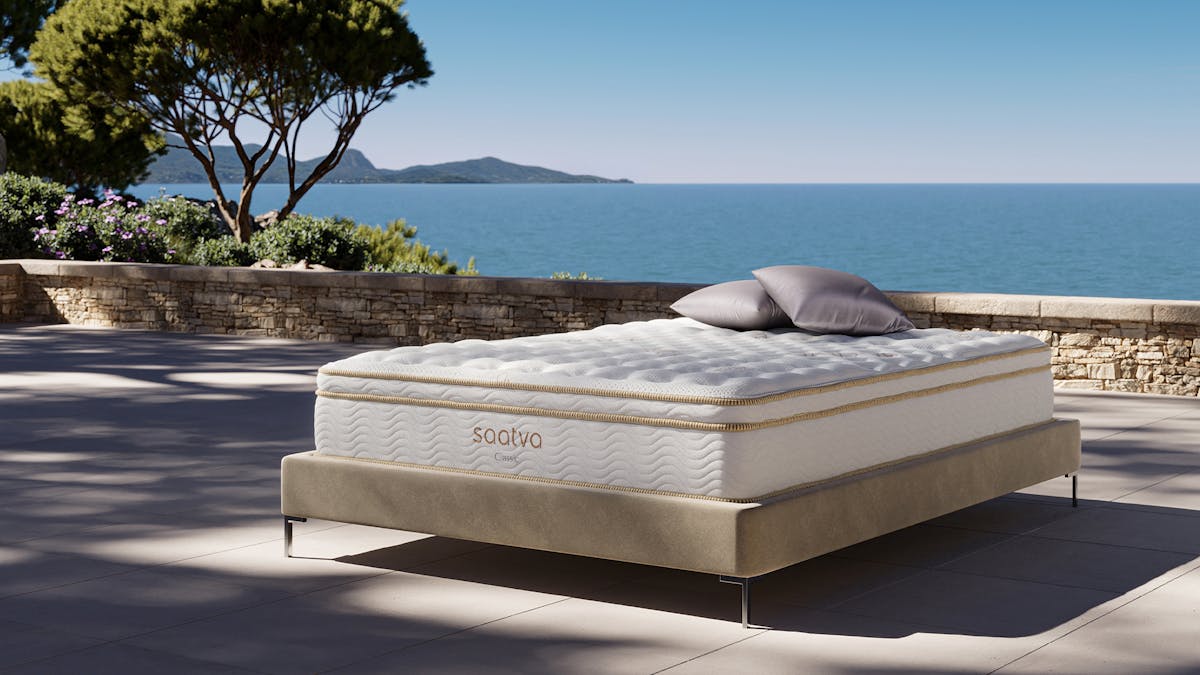
by Foam and latex mattresses share the same contouring goal but achieve it very differently. Memory foam wins on motion isolation and deep pressure relief at a lower price. Natural latex wins on durability, cooling, and eco credentials, though it costs more and feels bouncier. For most sleepers, the right answer comes down to budget and whether you run warm. Our overall recommendation is the Saatva Latex Hybrid, which bridges both worlds: a natural Talalay latex comfort layer over pocketed coils gives you latex responsiveness with innerspring support, at a price that undercuts most all-latex beds.
Saatva Latex Hybrid
9.0/10
- Natural Talalay latex comfort layer for responsive pressure relief and better airflow than foam
- Pocketed coil support core adds durability and edge support foam-only beds lack
- 365-night trial and lifetime warranty are the best in the industry
- Free white-glove delivery, setup, and old-mattress removal
- Heavier than all-foam beds, not roll-packed in a box
- Not for latex allergy sufferers (rare)
If you want the best of both materials, the Saatva Latex Hybrid is the clearest answer: natural latex responsiveness and cooling on top, coil support underneath, at a price that makes sense next to all-latex alternatives. The 365-night trial removes all risk.
Foam vs latex: the core difference
Both materials contour to your body, but the mechanism is different. Memory foam absorbs pressure slowly, sinking around your shape and holding it, which is great for pressure relief and motion isolation but can trap heat and make it harder to change positions. Natural latex pushes back, compressing where you press but springing back as you move, which feels more responsive, runs cooler, and lasts significantly longer.
Polyurethane foam (poly foam), used in many lower-cost or support-layer applications, is stiffer and less conforming than memory foam but cheaper and more durable at the lower end. Most quality mattresses use poly foam as a transition or base layer, not a comfort layer.
Foam vs latex: full comparison
| Feature | Memory Foam | Natural Latex |
|---|---|---|
| Feel | Slow-responding, deep contouring | Responsive, buoyant, springy |
| Pressure relief | Excellent | Very good |
| Motion isolation | Excellent (near-silent) | Good (not as quiet as foam) |
| Cooling | Moderate (standard) to good (plant-based or gel) | Good (open-cell structure, natural airflow) |
| Durability | 7-10 years typical | 12-20+ years typical |
| Eco / organic | Mostly synthetic (some plant-based partial) | Natural, GOLS/GOTS organic options |
| Off-gassing | Mild new smell, usually 24-72 h | None (natural rubber) |
| Price range | $300-$1,500 | $1,200-$3,000+ |
| Edge support | Weak to moderate (foam compresses) | Better (denser material) |
| Weight | Moderate | Heavy (all-latex beds are hard to move) |
Memory foam: who it suits best
Memory foam is the right choice if you:
- Share a bed with a light sleeper. No material isolates motion better. Each person's movements stay on their side of the bed.
- Sleep on your side. Memory foam's slow-response contouring cushions the shoulder and hip particularly well for side sleeping.
- Have a budget under $1,200. Quality memory foam mattresses start around $700-800. Comparable natural latex starts at $1,200 or more.
- Don't run especially warm. Standard memory foam can sleep hot; plant-based or gel-infused memory foam closes this gap, but latex is still naturally better on temperature.
The main weakness to plan around is heat retention and the slow sink that can make changing positions feel like work, particularly for combination sleepers who switch between back and side frequently through the night.
Natural latex: who it suits best
Natural latex makes sense if you:
- Sleep warm. Latex's open-cell structure and natural airflow properties run meaningfully cooler than standard memory foam.
- Want a long-term investment. A quality all-latex mattress lasts 15-20 years; most memory foam beds need replacing at 7-10 years. Over a 20-year window, the higher upfront price often pencils out.
- Prefer a responsive feel. If you disliked the "quicksand" feel of memory foam, latex's buoyancy is usually the fix. It contours without the slow-sinking sensation.
- Want organic or eco-friendly materials. GOLS-certified latex and GOTS-certified cotton/wool covers are genuine certifications, not marketing language.
The main considerations: latex is heavier (all-latex queen beds can weigh 120-150 lb), significantly more expensive upfront, and not suitable for the small percentage of people with a latex allergy.
Talalay vs Dunlop latex
Within natural latex, the two manufacturing methods produce meaningfully different materials:
- Talalay latex is whipped into a mold and flash-frozen before vulcanization, producing a lighter, softer, more consistent open-cell structure. It's used primarily in comfort layers where plush feel and airflow matter most. Costs more to produce.
- Dunlop latex is poured into a mold and cured in one step, settling heavier particles at the bottom. It produces a denser, firmer, more durable slab. Used primarily in support cores and by sleepers who want a firmer feel. Less expensive and more eco-efficient to produce.
Many premium latex mattresses use Talalay in the comfort layer and Dunlop in the support core to optimize for both feel and durability. The Saatva Latex Hybrid uses Talalay latex in the comfort layer.
Plant-based foam: the middle ground
Brands including Amerisleep use partially plant-based memory foam (Bio-Pur in Amerisleep's case) to address the main criticism of traditional petroleum-based memory foam. Plant-based foams use partial bio-sourced oils in place of some petroleum inputs, which produces a more open-cell structure that runs cooler and off-gasses less.
This is not the same as natural latex. "Plant-based foam" still means synthetic memory foam with a partial bio-sourced component, not a natural rubber product. It's a meaningful improvement over standard petroleum foam on cooling and off-gassing, but it doesn't reach the durability or true-natural credentials of GOLS-certified latex.
PlushBeds Botanical Bliss
8.7/10
- GOLS-certified organic Dunlop latex, GOTS-certified cotton and wool cover
- Firmness customizable via interchangeable layers (you can reorder to adjust feel)
- Made in California, 25-year warranty
- No off-gassing, hypoallergenic, naturally temperature-neutral
- Heavy to move (all-latex construction)
- Buoyant feel doesn't suit sleepers who prefer deep memory-foam contouring
- Higher price than foam alternatives
For anyone buying on eco and organic grounds, the Botanical Bliss is the most credentialed option in this category. GOLS and GOTS certified, made in California, 25-year warranty. The firmness customization is a genuine advantage over every foam or hybrid alternative.
Frequently asked questions
Is latex or memory foam better for back pain?
Both work, through different mechanisms. Memory foam's deep contouring cushions pressure points and takes load off the lumbar for side and back sleepers. Latex provides more pushback, which some back sleepers prefer because it keeps the spine more neutral without the sinking sensation. If your back pain is primarily pressure-related, foam tends to edge out; if you find foam too soft or slow, a firmer latex is usually the fix. A zoned design in either material helps more than the material choice alone.
Does latex sleep cooler than memory foam?
Yes, in most cases. Natural latex's open-cell structure lets air circulate more freely than standard memory foam. Petroleum-based memory foam is the warmest of the common mattress materials. Plant-based memory foam and gel-infused foam close this gap substantially, but natural latex without any modifications still runs cooler than foam alternatives at comparable price points. Latex + coil hybrids (like the Saatva Latex Hybrid) are particularly good on temperature because coils add airflow underneath the latex comfort layer.
How long does memory foam last compared to latex?
Memory foam mattresses typically last 7-10 years before the foam begins to sag or lose its pressure-relief properties. Natural latex mattresses commonly last 12-20 years, sometimes longer if the construction is high-quality Dunlop or Talalay. The durability gap is real and factors into the value calculation: a latex bed that costs $2,000 and lasts 18 years may cost less per year than a foam bed at $900 that needs replacing at 8-10 years.
Can I flip a latex mattress?
Most modern latex mattresses are not designed to be flipped (they have a defined top comfort layer and a support core). Some older or specialty designs are flippable. Rotating your mattress 180 degrees head-to-foot every 6 months is always recommended to even out wear patterns, regardless of material.
What about latex allergies?
True latex allergies are rare, affecting roughly 1-6% of the general population (higher among healthcare workers with repeated glove exposure). If you have a confirmed latex allergy, avoid natural latex mattresses. Synthetic latex (styrene-butadiene rubber) is not the same protein as natural rubber and does not trigger the same allergy, but most quality mattresses use natural latex, not synthetic. Memory foam is the safe alternative for confirmed latex allergy sufferers.
For most sleepers, memory foam wins on price and motion isolation while natural latex wins on durability, cooling, and eco credentials. The Saatva Latex Hybrid is our top overall pick: it gives you natural latex feel and responsiveness paired with coil support, on a 365-night trial with a lifetime warranty. For a pure all-latex organic bed, the PlushBeds Botanical Bliss is the gold standard.