
 by
by Our Recommended Mattress for This Setup
Saatva Mattress — Luxury innerspring construction, CertiPUR-US certified, with multiple firmness options for your best night's sleep.
View the Saatva Classic →What Are EMFs and Why Do People Worry About Them?
Electromagnetic fields (EMFs) are areas of energy that surround electrical devices and wireless communication systems. The spectrum ranges from extremely low frequency (ELF-EMF) — like the 50/60 Hz fields from power lines and household wiring — to radiofrequency (RF-EMF) from Wi-Fi, mobile phones, and Bluetooth, to visible light, UV, and X-rays at higher frequencies.
Concern about EMFs and sleep has grown in parallel with the proliferation of wireless devices in the bedroom. The specific worry is that EMF exposure during sleep disrupts melatonin production, affects brain wave patterns, or causes biological changes that degrade sleep quality.
What the Science Actually Shows
The honest answer: the evidence is genuinely mixed, and different EMF frequencies have different research profiles.
ELF-EMF (power lines, electrical wiring, 50/60 Hz): This is the most-studied frequency range for sleep effects. Several studies in the 1990s and 2000s suggested that ELF-EMF exposure suppressed melatonin production, which would plausibly affect sleep. However, systematic reviews — including a 2020 meta-analysis in Environmental Health Perspectives — found no consistent effect of ELF-EMF on melatonin levels across multiple well-controlled studies. The earlier positive findings were largely not replicated.
RF-EMF (Wi-Fi, mobile phones, 2.4–5 GHz): Some laboratory studies have found that RF-EMF exposure at levels approximating phone use affects EEG patterns during sleep — specifically, a transient increase in spindle activity in NREM sleep. Whether this represents a meaningful sleep disruption or a neutral neurological response is debated. The World Health Organization's International Agency for Research on Cancer (IARC) classifies RF-EMF as "possibly carcinogenic to humans" (Group 2B) — the same classification as pickled vegetables — reflecting uncertainty rather than established harm.
Population studies: Epidemiological research on people living near high-voltage power lines and mobile phone towers has not consistently found sleep disruption beyond what can be explained by noise, anxiety about living near such structures, or other confounders.
Idiopathic EMF sensitivity (IEF): Some individuals report sleep disruption, headaches, and other symptoms that they attribute to EMF exposure. Blinded provocation studies — where subjects don't know whether EMF is active — consistently fail to show that IEF-sensitive individuals perform better than chance at detecting EMF presence. This suggests a nocebo effect (anxiety about exposure rather than exposure itself) for at least the majority of reported cases.
The Indirect EMF Problem: Light and Notification Disruption
Here's what the research does clearly support: the electronics that produce EMFs — phones, tablets, laptops — are significant sleep disruptors through mechanisms completely separate from their electromagnetic fields.
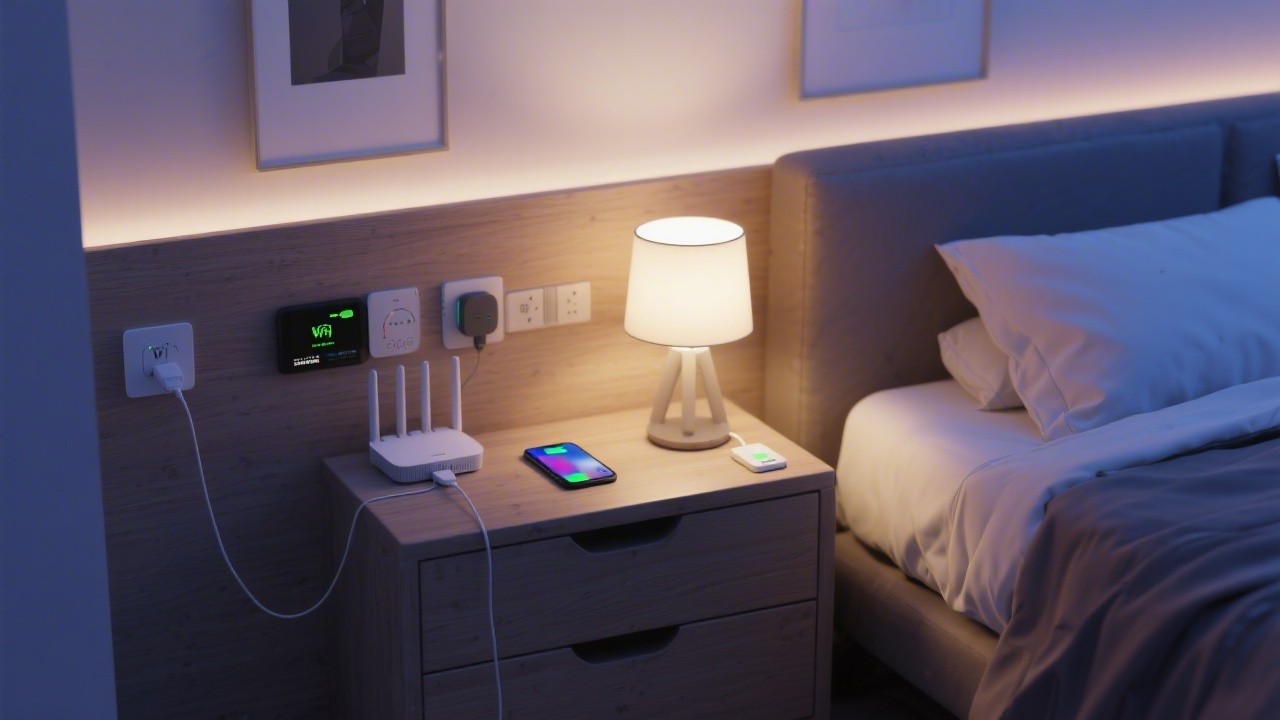
A phone on a nightstand is a source of: intermittent light (each notification lights the screen), notification sounds, the temptation to check messages at 3 AM, and blue light from pre-sleep use that suppresses melatonin. These effects are well-documented and large in magnitude compared to any plausible direct EMF effect.
If moving electronics out of the bedroom improves your sleep, the mechanism is almost certainly the removal of these behavioral and light-based disruptions — not EMF reduction per se. See our guide to light and sleep for detail on the light mechanism.
Practical Exposure Reduction (If You're Concerned)
Even without definitive evidence of harm, reducing unnecessary RF-EMF exposure in the bedroom is low-cost and potentially beneficial through the indirect behavioral mechanisms described above:
- Move your phone to another room at night, or at minimum put it in airplane mode
- Move your Wi-Fi router out of the bedroom — signal strength decreases with the square of distance
- Use wired ethernet connections for bedroom devices rather than Wi-Fi where practical
- Switch smart plugs and connected devices to timer modes rather than continuous polling
- Use a traditional battery alarm clock instead of a phone alarm
These recommendations improve sleep through established behavioral mechanisms (eliminating light and sound disruption) regardless of any direct EMF effects. The bedroom environment benefits from reducing electronic clutter as much as from any specific EMF consideration. For other ambient bedroom factors, see our indoor air quality guide and humidity guide.
Our Recommended Mattress for This Setup
Saatva Mattress — Luxury innerspring construction, CertiPUR-US certified, with multiple firmness options for your best night's sleep.
View the Saatva Classic →Frequently Asked Questions
Do EMFs from Wi-Fi affect sleep quality?
The evidence is mixed and not conclusive. Some laboratory studies show small EEG changes with RF-EMF exposure, but blinded provocation tests have not consistently demonstrated meaningful sleep disruption from Wi-Fi frequencies at typical household levels.
Should I turn off my Wi-Fi router at night?
Moving the router out of the bedroom is more practical. The sleep benefit of removing bedroom electronics likely comes from eliminating light and notification disruptions rather than direct EMF effects.
Does sleeping with my phone in the room disrupt sleep?
Yes, but primarily through behavioral and light mechanisms. Notification sounds cause microarousals, screen light suppresses melatonin, and phone presence increases nighttime checking behavior. Keeping it in another room is evidence-supported.
What does the WHO say about EMFs and health?
The WHO classifies RF-EMF as "possibly carcinogenic" (Group 2B), reflecting limited and inconsistent evidence rather than established harm. The WHO does not recommend avoiding normal use of household electronics based on current evidence.
Are EMF shielding products effective for improving sleep?
There is no peer-reviewed evidence that EMF shielding products (Faraday canopies, shielding paint, grounding mats) improve sleep quality. Their mechanism of action is not supported by current scientific understanding of EMF interactions at typical exposure levels.