
 by
by Struggling with sleep? Your mattress matters too.
A supportive, pressure-relieving mattress reduces the time it takes to fall — and stay — asleep. The Saatva Classic is our top-rated pick for deep, restorative sleep.
Why Work Email Is Different From Other Screens
Social media before bed is bad for sleep because of arousal and variable reward. Gaming is bad because of cognitive engagement and competition. Work email has a different mechanism: it activates a specific cognitive mode — problem-solving — that is particularly incompatible with sleep onset.
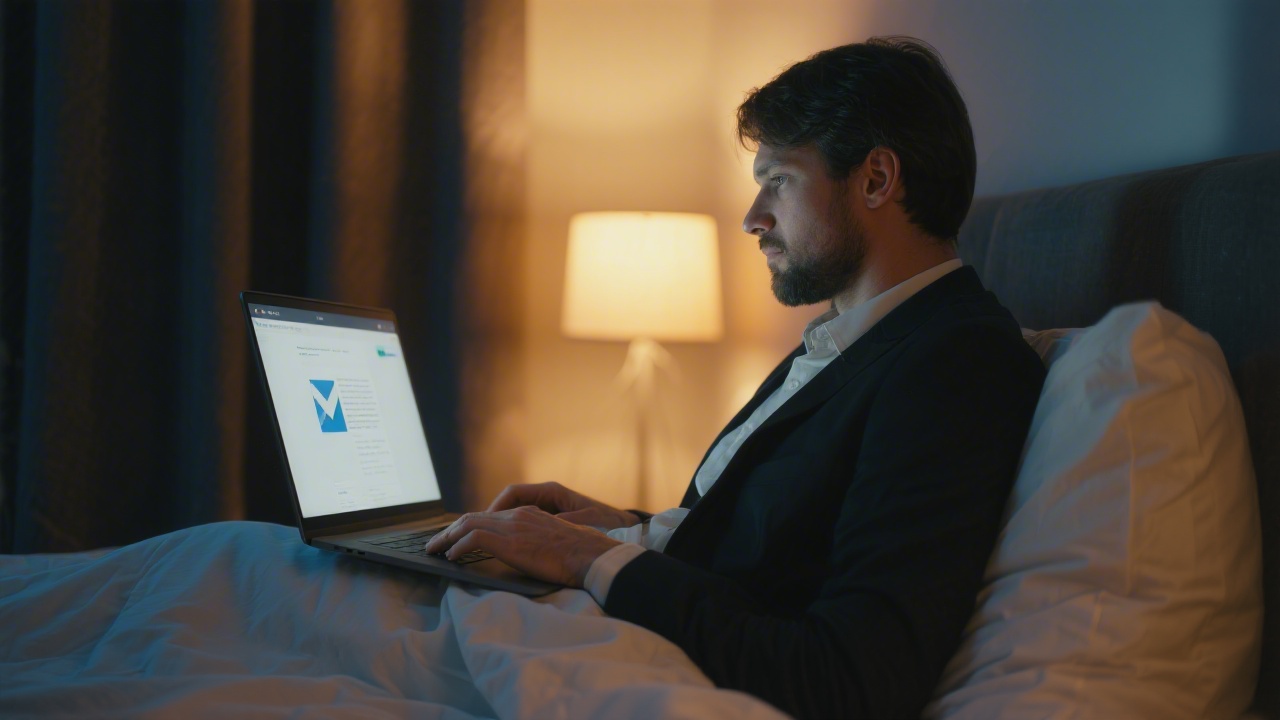
When you check work email before bed, you're not passively consuming content. You're evaluating whether action is required, mentally triaging priorities, and often beginning to solve problems — even if you don't respond. This executive function activation triggers the planning-oriented rumination that is one of the most powerful sleep onset inhibitors in otherwise healthy people.
The Emotional Valence Problem
Work email carries emotional weight that entertainment content usually doesn't. Every email has valence: a request creates obligation, a problem creates stress, a positive message creates anticipation or excitement. None of these are neutral — all of them activate affective processing systems that oppose sleep.
Researchers at the University of Florida (2018) found that work email after 9 PM was associated with worse next-morning wellbeing and lower sleep quality, even when participants reported the email content as non-urgent. The mere awareness of pending work communication was sufficient to elevate evening cortisol and delay sleep.
This is distinct from how to fall asleep faster — work email creates problem-specific cognitive arousal rather than the diffuse threat-processing of news content.
The Anticipatory Anxiety Effect
For many professionals, the most sleep-disruptive aspect of evening email isn't what they find — it's what they might find. Not checking creates a form of anticipatory anxiety ("what if something urgent arrived?") while checking creates activation from actual content. Both disrupt sleep, but in different ways.
Research on email checking frequency found a U-shaped relationship with stress: both very frequent checking (every 30 minutes) and complete abstinence (with high anticipatory anxiety) produced elevated stress. A scheduled final check at a set time (e.g., 8 PM, with explicit communication to colleagues) produced the lowest stress and best sleep outcomes.
What Actually Happens in the Brain
Sleep onset requires default mode network deactivation and prefrontal cortex quieting. Work email reading activates exactly the opposite: the task-positive network (TPN), which handles planning, problem-solving, and executive function. TPN and sleep are mutually inhibitory — you can't be in problem-solving mode and falling asleep simultaneously.
The activation doesn't end when you close the email app. Working memory holds the task-relevant information in a primed state — you're mentally "working on" the email content for 20–40 minutes after you stop reading. This is why reading one email that raises a concern can produce 30+ minutes of pre-sleep rumination about a problem you technically decided to handle tomorrow.
Strategies That Work for Professionals
- The scheduled final check: Set a fixed email cutoff time (between 8–9 PM for most schedules) and communicate it to key colleagues. "I review email until 8:30 PM and respond to anything urgent within 10 minutes of receipt before then; after that I'll respond by 8 AM" is a professional norm that most organizations accept.
- Email on laptop only: Remove email from your phone. The laptop-only rule creates natural session endings (closing the laptop) and adds enough friction that impulsive checking becomes uncommon. This single change has the largest adherence rate of any work email intervention.
- The task-capture buffer: Before your final email check, open a notepad. Write down every action item that emerges from the email session. This externalization of working memory items into a trusted system allows the brain to release the "holding" function — you don't need to keep thinking about it because it's captured. GTD (Getting Things Done) research shows this reduces pre-sleep rumination significantly.
- Work-to-home transition ritual: A defined end-of-work activity (brief walk, specific playlist, consistent dinner preparation) signals role transition. Without a clear signal, professional cognitive mode persists into the evening. See our guide on screen time before bed and sleep for how to build an effective pre-sleep wind-down.
The "Always On" Culture and Sleep Debt
Organizations with always-on email cultures have measurably worse employee sleep than those with clear after-hours boundaries — a finding from a large-scale study of German knowledge workers (2021). The effect is dose-dependent: each additional after-hours email sent by managers was associated with worse subordinate sleep quality, even if the subordinate didn't check until morning. The expectation of availability disrupts sleep independently of actual email use.
This is a structural problem that individual habit change can only partially address. If your organization has an implicit expectation of evening responsiveness, negotiating clearer boundaries — or choosing an organization with healthier norms — is the most effective long-term sleep intervention.
Frequently Asked Questions
How late is too late to check work email?
Research supports a cutoff between 8 and 9 PM for people targeting 10–11 PM sleep. The minimum buffer between final email check and sleep target is 90 minutes. For email that frequently contains stressful content, 2 hours is better.
What if I miss something urgent?
True urgency is rarer than we perceive. Establish a protocol with your team: for genuine emergencies, phone calls are the escalation path. Email is not an emergency communication channel. This reframing reduces the anticipatory anxiety that drives after-hours checking.
Is email worse than social media for sleep?
For sleep architecture, they're comparably disruptive but through different mechanisms. Social media creates arousal through variable reward and social comparison; email creates arousal through problem-solving activation and anticipatory anxiety. Both delay sleep onset and reduce sleep quality.
Does reading email without responding still disrupt sleep?
Yes. The disruption comes from cognitive processing of the content (evaluating urgency, mentally triaging) and working memory activation, not from the act of responding. Reading a stressful email and deciding to respond tomorrow still produces the problem-solving activation that delays sleep.
Can I check email but avoid reading stressful messages?
Partially. Scanning subject lines without opening messages creates lower activation than reading full content. But the subject line scanning still triggers evaluation — 'Do I need to open this?' — which is itself a form of task-mode activation. The cleanest solution remains a full cutoff.
Struggling with sleep? Your mattress matters too.
A supportive, pressure-relieving mattress reduces the time it takes to fall — and stay — asleep. The Saatva Classic is our top-rated pick for deep, restorative sleep.
Our Top Mattress Pick
The Saatva Classic consistently ranks #1 for comfort, support, and long-term durability.
Key Takeaways
Checking Email Before Bed is a topic that depends heavily on individual needs and preferences. The most important thing is to consider your specific situation — your body type, sleep position, and personal comfort preferences — before making any decisions. When in doubt, take advantage of trial periods to test before committing.