
 by
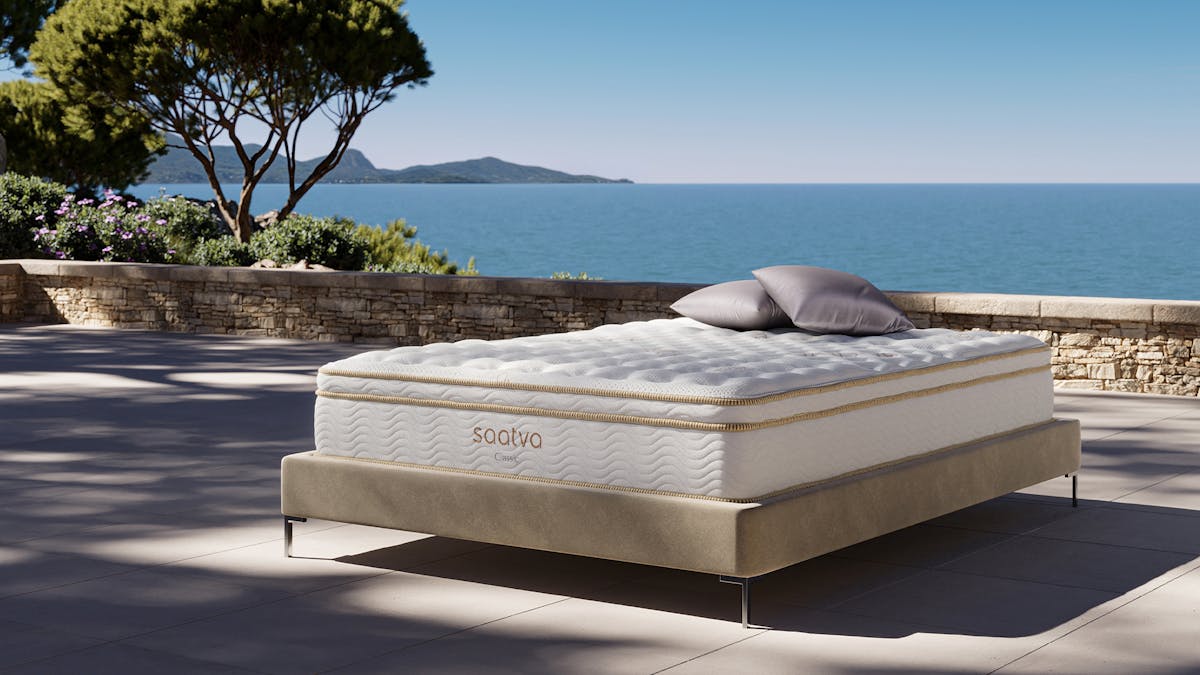
by Euro tops and pillow tops both add a sewn-in comfort layer to innerspring or hybrid mattresses, but the construction is different. A Euro top is flush with the mattress sides and uses denser fill, which holds its shape better over 8 to 12 years. A traditional pillow top overhangs the edge and uses lighter fill, giving a softer initial feel that compresses faster. For most sleepers buying a mattress to keep long-term, Euro top construction is the better choice. The Saatva Classic, which uses a 3-inch Euro pillow top with a zoned lumbar insert, is our top recommendation in this category.
Saatva Classic
9.2/10
- 3-inch Euro pillow top sewn flush with the sides, denser fill than a traditional pillow top
- Zoned memory-foam lumbar insert targets the center third of the sleep surface
- Dual-coil construction (14.5-gauge pocketed coils over 13-gauge base coils)
- Free white-glove delivery, in-room setup, and old-mattress removal
- 365-night home trial, lifetime warranty
- Heavy, does not compress into a box for shipping
- $99 return fee applies during the trial period
The Saatva Classic is the clearest example of quality Euro top construction on the market. The 3-inch flush-mounted comfort layer uses zone-specific foam densities (denser under the lumbar, softer at the shoulders), which is exactly what separates a well-engineered Euro top from a basic pillow top. Three firmness options make it work for back, side, and combination sleepers.
What Euro top and pillow top have in common
Both Euro tops and pillow tops add a sewn-in comfort layer to the top of an innerspring or hybrid mattress. This layer is filled with foam, fiber, latex, wool, cashmere, or a combination, and its purpose is to provide additional cushioning and pressure relief above the coil system. Unlike a mattress topper (a separate product you add to any mattress), both Euro tops and pillow tops are integral to the mattress construction. When the comfort layer compresses over time, there is no replacing it without replacing the mattress.
The key structural difference
The defining physical difference is how the comfort layer aligns with the mattress sides:
- Pillow top: The added comfort layer is sewn onto the top of the mattress at an offset, extending slightly beyond the mattress border and creating a visible overhang around the perimeter. Traditional pillow tops use lighter fill to allow this overhang to drape without bunching.
- Euro top: The comfort layer is sewn flush with the sides of the mattress, creating a clean, squared-off profile. The flush construction allows for a denser, more uniform fill because there is no overhang constraint. This is the primary reason Euro tops maintain their shape better over time.
This is not just aesthetic. The denser fill in a quality Euro top is what produces better long-term durability. A pillow top with lighter fill compresses faster, particularly under heavier loads.
Fill materials and density
Pillow top fill is typically fiberfill (polyester fiber), soft foam, or memory foam at relatively low density. The soft, light fill creates the classic "cloud-like" initial feel, but it also accounts for faster break-in and compression over the first few years of use.
Euro top fill uses denser materials: higher-density foam, latex, wool, or cashmere. Because the fill is constrained on all sides by the flush mount, manufacturers can use denser, firmer materials without creating a bulky or awkward construction. The Saatva Classic, for example, uses foam measured at approximately 2.5 pcf in the lumbar zone and 1.5 to 1.8 pcf toward the head and foot, with a separate memory-foam lumbar insert beneath the Euro top layer.
Euro top vs pillow top: how they compare
| Factor | Euro Top | Traditional Pillow Top |
|---|---|---|
| Edge profile | Flush with mattress sides | Overhangs the mattress edge |
| Initial feel | Firm-soft, structured | Very soft, "plushy" |
| Fill density | Higher density (foam or latex) | Lower density (fiberfill or soft foam) |
| Compression over 5 years | Moderate (dense fill holds shape) | Significant (light fill compresses) |
| Sagging risk | Lower | Higher |
| Edge integrity | Better (flush construction) | Variable (overhang can bunch or warp) |
| Rotation needs | Head-to-foot rotation every 3 to 6 months | More critical to prevent uneven compression |
| Best for | Long-term ownership (8 to 12 years) | Sleepers who replace every 5 to 7 years |
Euro pillow top: the hybrid construction
Some manufacturers use a construction called a "Euro pillow top" that combines the flush-edge profile of a Euro top with a slightly more cushioned fill than a standard Euro top. This gives the visual profile and durability advantage of Euro construction while delivering a softer initial feel closer to a traditional pillow top.
Saatva's Classic line is the most widely reviewed example of this approach. The 3-inch Euro pillow top uses a quilted organic cotton cover over zoned polyfoams, with tighter quilting and higher-density foam in the lumbar band and slightly softer specs at the head and foot. The result sits between a firm Euro top and a soft pillow top in feel, while retaining the structural longevity of the flush-mount design.
When evaluating any mattress described as a "Euro pillow top," check whether the fill layer is genuinely flush-mounted and uses measurably denser materials. Some brands use the term loosely for marketing a standard pillow top with a cleaner aesthetic.
Which is better for different sleepers
For most buyers planning to keep a mattress for 8 to 12 years, Euro top construction is the stronger long-term choice. The more uniform compression means the mattress maintains its rated firmness and support longer than a light-fill pillow top under similar conditions.
Traditional pillow tops offer a softer initial experience that some sleepers strongly prefer, particularly those who like the feeling of sleeping in a "nest." If you replace mattresses every 5 to 7 years, a well-made pillow top is a reasonable option, but factor in the compression timeline.
- Back sleepers: Luxury Firm Euro top (like the Saatva Classic in Luxury Firm) provides enough give for natural lumbar curve without letting the hips sink into misalignment.
- Side sleepers: A Euro top in Plush Soft, or a high-density pillow top, gives adequate shoulder pressure relief while maintaining edge structure for sitting and getting up.
- Heavier sleepers (230 lb or more): Euro tops are strongly preferred. Heavier compression forces accelerate fill breakdown in low-density pillow tops, sometimes within 2 to 3 years.
- Combination sleepers: Euro tops in a medium-firm option (Luxury Firm on the Saatva scale) balance the competing demands of back and side positions without excessive sink.
Durability and maintenance
Both Euro tops and pillow tops are one-sided, meaning they cannot be flipped. Head-to-foot rotation every 3 to 6 months distributes compression wear more evenly across the comfort layer. For pillow tops, this rotation is more critical because light fill compresses unevenly with regular use patterns concentrated in the shoulder and hip zones.
A properly cared-for Euro top on a quality hybrid should hold its original feel for 8 to 10 years. A pillow top with light fill under similar conditions often shows noticeable softening within 3 to 5 years. If your current pillow-top mattress has body impressions deeper than 1.5 inches, it has likely compressed beyond its design spec and will not recover with rotation alone.
Euro top construction holds up better over time because the flush-mounted, denser fill resists compression more effectively than the lightweight overhang fill of a traditional pillow top. For a mattress you intend to keep for a decade, choose Euro top. The Saatva Classic with its 3-inch zoned Euro pillow top is the most widely reviewed example of this construction done well, available in three firmness levels on a 365-night trial.
Frequently asked questions
What is the difference between a Euro top and a pillow top?
A Euro top is sewn flush with the mattress sides and uses denser fill, which holds its shape longer. A traditional pillow top overhangs the edge, uses lighter fill, and compresses faster over years of use.
Do pillow top mattresses sag faster than Euro tops?
Generally yes. Traditional pillow tops use lighter fill that compresses more under regular body weight. Regular head-to-foot rotation every 3 to 6 months extends useful life for both types, but is more critical for pillow tops.
Can you flip a Euro top mattress?
No. Both Euro tops and pillow tops are one-sided constructions. Head-to-foot rotation, not flipping, is the correct maintenance approach every 3 to 6 months.
What is a Euro pillow top?
A Euro pillow top combines the flush-edge profile of a Euro top with slightly plusher fill, aiming to deliver Euro durability alongside a softer initial feel. Quality varies significantly by brand. The Saatva Classic is a well-documented example using zoned foam densities and a memory-foam lumbar insert within a 3-inch Euro pillow top.
Are Euro tops better for heavy sleepers?
Yes. Heavier sleepers (230 lb or more) generate higher compression forces that accelerate fill breakdown in low-density pillow tops. Euro tops with high-density foam or latex fill hold their support structure better under sustained higher loads.
Is the Saatva Classic a Euro top or pillow top?
Saatva calls it a Euro pillow top. The 3-inch comfort layer is sewn flush with the mattress sides (Euro construction) but uses a slightly plusher fill specification than a standard Euro top, with zoned foam densities that are firmer under the lumbar and softer at the shoulders.
Saatva Classic
9.2/10
Three-inch Euro pillow top with zoned foam densities, dual-coil support, memory-foam lumbar insert, organic cotton cover, 365-night trial, and lifetime warranty. The most thoroughly reviewed Euro top construction at this price point.