
 by
by 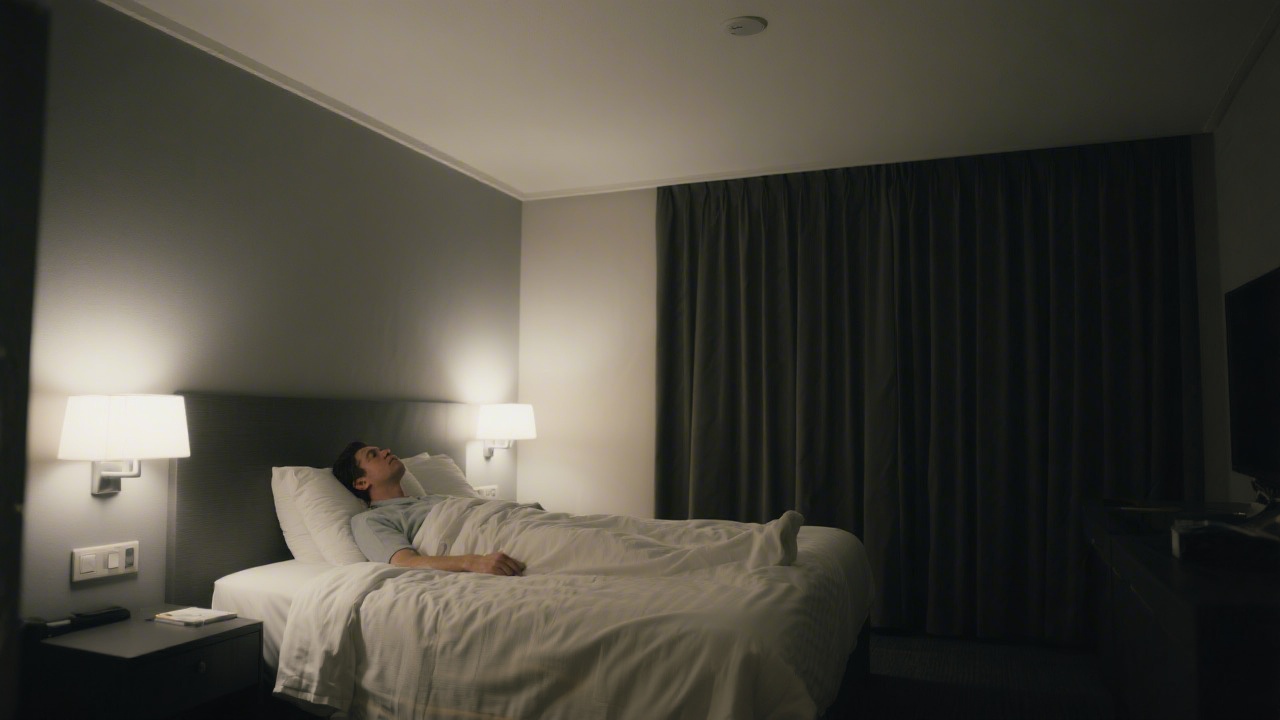
Our Top Mattress Pick for Better Sleep
The Saatva Classic offers three comfort levels, dual coil support, and a breathable organic cotton cover — designed for all sleep positions and built to last.
You check into a hotel, you're genuinely tired, the bed is comfortable — and you sleep terribly. The next night, in the same room, you sleep fine. This isn't random. It's a documented neurological phenomenon called the first night effect, and it has an evolutionary purpose.
What Is the First Night Effect?
The first night effect (FNE) is the observation that sleep quality is significantly reduced on the first night in an unfamiliar environment compared to subsequent nights in the same location. It was first formally documented in polysomnography research in the 1960s, when sleep lab technicians noticed their subjects always slept worse on the first night of recording.
The effect is measurable: delayed sleep onset, reduced slow-wave sleep, increased micro-arousals, and lower overall sleep efficiency on night one, returning to baseline on night two.
The Neuroscience: Unihemispheric Sleep
A 2016 study by Yuki Sasaki's lab at Brown University identified the mechanism. Using high-density EEG, they found that on the first night in an unfamiliar environment, the brain's default mode network in the left hemisphere remained significantly more alert than normal, while the right hemisphere showed typical sleep patterns.
This is a form of unihemispheric slow-wave sleep — the same mechanism observed in dolphins, who must keep swimming while sleeping and therefore sleep one hemisphere at a time. In humans, it's an attenuated version: the left hemisphere acts as a night watchman, remaining more responsive to external sounds and novel stimuli.
The watchman hemisphere showed heightened responses to irregular sounds specifically — suggesting active threat monitoring rather than general arousal. The brain is not just sleeping lightly; it is actively patrolling.
Why Some People Are More Affected
Not everyone experiences the first night effect equally. Research identifies several moderating factors:
- High neuroticism and anxiety sensitivity — individuals with higher trait anxiety have more reactive threat-monitoring systems
- Frequent travelers vs. home-bound sleepers — frequent travelers show habituation over time, with the FNE diminishing after years of regular travel
- Noise sensitivity — individuals who are more sensitive to environmental sound show stronger FNE
- Sleep disorders — those with existing sleep disorders, including those sleeping with anxiety disorders, show more pronounced first night effects
The FNE vs. Simple Environmental Discomfort
It's important to separate the first night effect from ordinary discomfort effects. A noisy hotel room, an uncomfortable mattress, or an overly warm environment will impair sleep through direct physical mechanisms — these are not the first night effect. The true FNE occurs even in objectively optimal sleep environments and specifically normalizes on night two without any environmental change.
Our guide to sleeping away from home covers practical environmental optimization. This article focuses on the neurological phenomenon itself.
How Long Does the First Night Effect Last?
For most people, the FNE resolves after a single night. By night two, left hemisphere asymmetry disappears and sleep quality returns to baseline. In people with very high anxiety or sleep disorders, a attenuated second-night effect can persist.
Extended unfamiliar environments — a new apartment, a hospital stay — show a progressive adaptation curve: most of the FNE resolves in 1-3 nights, with full adaptation typically by 5-7 nights.
Techniques to Minimize the First Night Effect
Olfactory Anchoring
The Sasaki lab's research suggests sensory familiarity counters the novelty signal that triggers FNE. Bringing a pillowcase or small item with a familiar scent from home can provide olfactory cues associated with safe sleep — a technique sleep researchers have begun formally studying.
Sound Masking
The FNE mechanism specifically involves heightened response to irregular sounds. Continuous, predictable noise — white noise, brown noise, or a fan — masks the irregular environmental sounds that the watchman hemisphere is monitoring for threats. Portable white noise machines or apps are highly effective specifically for first-night-effect mitigation.
Sleep Restriction Before Travel
Higher sleep pressure (accumulated adenosine) makes sleep more robust against environmental disruption. Slightly restricting sleep the night before a travel day increases homeostatic sleep drive, which can partially overcome the FNE alertness on arrival.
Familiar Pre-Sleep Ritual
Consistent bedtime rituals create strong conditioned associations with sleep. Because the ritual itself is familiar even in an unfamiliar location, it provides a counterweight to the novelty signal. The ritual signals safety: this is what we do before sleep.
Temperature and Darkness Control
Reducing other arousal signals makes the FNE less disruptive. Blackout curtains (or a sleep mask), optimal room temperature (65-68°F / 18-20°C), and earplugs reduce the additional sensory load on the watchman hemisphere.
Our Top Mattress Pick for Better Sleep
The Saatva Classic offers three comfort levels, dual coil support, and a breathable organic cotton cover — designed for all sleep positions and built to last.
Frequently Asked Questions
Does the first night effect happen at friends' houses?
Yes, but typically less severely than in completely unfamiliar environments. Partial familiarity — knowing the people, the general environment — may partially attenuate the novelty signal. Complete strangers' spaces or commercial lodging triggers the strongest FNE.
Can you train yourself out of the first night effect?
Frequent travelers show significantly reduced FNE over years of regular travel. This is habituation — the brain learns that unfamiliar environments are generally safe, weakening the automatic watchman response. You cannot eliminate it quickly, but the effect diminishes with travel frequency.
Is the first night effect related to insomnia?
They share a mechanism — hypervigilance during sleep — but are distinct. Insomnia involves persistent conditioned arousal in the home environment. FNE is a context-specific response to novelty. However, chronic insomnia sufferers typically show stronger FNE, suggesting their threat-monitoring systems are chronically upregulated.
Does taking melatonin help with the first night effect?
Melatonin's primary action is circadian phase shifting, not sleep depth. It may help with the sleep onset delay component of FNE but doesn't directly address the hemispheric asymmetry. White noise and olfactory anchoring are more targeted interventions for the watchman-hemisphere mechanism.
What about the second-night effect in sleep labs?
Sleep researchers accommodate FNE by either discarding first-night data (adaptation night) or statistically controlling for it. The protocol of using a habituation night before data collection is standard in polysomnography research precisely because the first night effect is so reliable and consistent.
Voted best luxury innerspring mattress with exceptional lumbar support and white-glove delivery.
Check Price & Availability FAQPage", "mainEntity": [ {"@type": "Question", "name": "Does the first night effect happen at friends' houses?", "acceptedAnswer": {"@type": "Answer", "text": "Yes, but typically less severely than completely unfamiliar environments. Partial familiarity may attenuate the novelty signal that triggers the watchman-hemisphere response."}}, {"@type": "Question", "name": "Can you train yourself out of the first night effect?", "acceptedAnswer": {"@type": "Answer", "text": "Frequent travelers show significantly reduced FNE over years through habituation. The brain learns that unfamiliar environments are generally safe, weakening the automatic watchman response."}}, {"@type": "Question", "name": "Is the first night effect related to insomnia?", "acceptedAnswer": {"@type": "Answer", "text": "They share a hypervigilance mechanism but are distinct. FNE is context-specific to novelty; insomnia involves persistent conditioned arousal at home. Chronic insomniacs typically show stronger FNE."}}, {"@type": "Question", "name": "Does taking melatonin help with the first night effect?", "acceptedAnswer": {"@type": "Answer", "text": "Melatonin may help with sleep onset delay but doesn't address hemispheric asymmetry. White noise and olfactory anchoring are more targeted for the FNE mechanism."}}, {"@type": "Question", "name": "What about the second-night effect in sleep labs?", "acceptedAnswer": {"@type": "Answer", "text": "Sleep researchers use an adaptation night before data collection, or discard first-night data, because the first night effect is so reliable and would otherwise confound results."}} ] }