
 by
by First responders — police officers, firefighters, and emergency medical technicians — face a convergence of sleep stressors found in almost no other occupation: irregular shifts, night work, acute psychological stress, physical exertion, and the constant hyperarousal maintained by a professional culture that equates rest with vulnerability. The result is a population with documented sleep disorder rates 60–80% higher than the general public and a suicide rate that, in several studies, exceeds line-of-duty deaths.
Our Mattress Recommendation
After testing dozens of mattresses for sleep quality and support, the Saatva Classic consistently ranks at the top for recovery sleep — particularly important for shift workers and high-demand professionals.
Sleep Challenges by Profession
Law Enforcement
Police officers average 6.2 hours of sleep per night according to a 2012 Journal of Sleep Research study of 4,957 officers — significantly below the recommended floor. The root causes are structural: shift work (most departments rotate officers through day, evening, and night shifts), court appearances scheduled during off-duty hours, secondary employment (moonlighting is prevalent among officers at all levels), and the hyperarousal state of tactical threat monitoring that does not cleanly switch off at end of shift.
Sleep disorders are disproportionately common: the same study found that 40% of officers screened positive for at least one sleep disorder, with obstructive sleep apnea (33%), insomnia (7%), and shift work sleep disorder among the most prevalent. Officers with sleep disorders had significantly higher rates of administrative errors, use-of-force events, and injuries on duty.
Firefighters
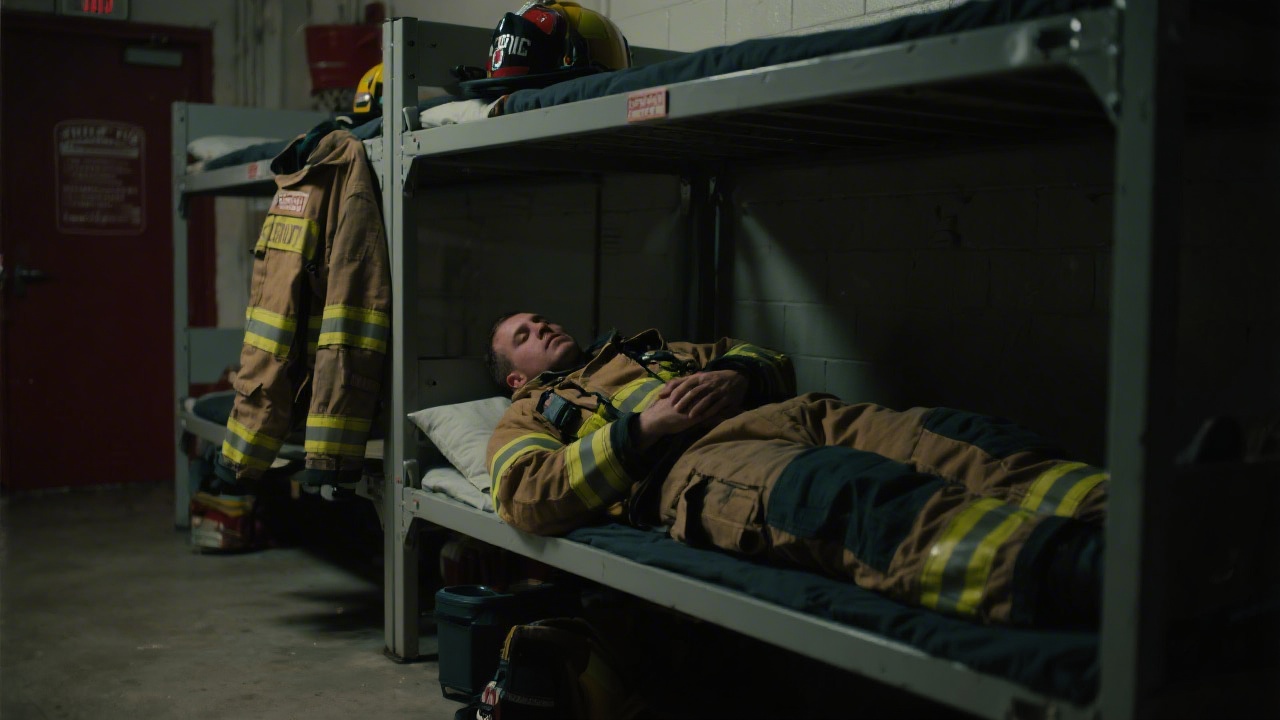
Fire station duty schedules are uniquely disruptive. Most departments run 24-hour on/48-hour off cycles or 12-hour alternating shifts — both of which create sleep fragmentation within the duty period. Nighttime calls interrupt sleep at irregular intervals, a pattern that resembles the worst characteristics of both shift work and on-call medicine in terms of sleep architecture disruption.
A 2014 study in the Journal of Occupational and Environmental Medicine found that firefighters called out during the night took an average of 47 minutes to return to full alertness — significantly longer than the standard 5–10 minute vehicle response window. The sleep inertia gap between waking and full cognitive function creates an often-unacknowledged performance deficit at the most critical moments of emergency response.
Emergency Medical Services
EMS providers may be the most sleep-deprived group within the first responder category. Many EMS systems operate on 24-hour shifts with call-in periods that preclude normal sleep — providers may handle 12–18 calls during a shift, each requiring full cognitive and physical engagement. Burnout and turnover rates in EMS correlate directly with sleep deprivation severity in multiple analyses. The profession also has among the highest rates of PTSD outside active military combat deployment.
Evidence-Based Strategies for First Responder Sleep
Light management between shift type transitions: Transitioning from day to night shifts requires circadian adjustment. Bright light therapy (10,000 lux light box) used in the morning during night-shift adaptation periods can accelerate the biological shift by 1–2 days. Conversely, wearing amber/blue-blocking glasses during the drive home after a night shift prevents morning light from resetting the clock prematurely.
Structured napping within 24-hour shifts: The research supports permissive napping during low-call windows in 24-hour duty cycles. Departments in Canada, Australia, and several U.S. progressive jurisdictions have implemented formal "sleep windows" during low-probability call periods (typically 2–5am) with documented improvements in alertness performance and reduced preventable incidents.
Sleep hygiene in shared sleep spaces: Fire station dormitories and EMS crew quarters are shared sleep environments with significant social pressure against noise complaints and sleep scheduling. Individual sleep tools — ear plugs, sleep masks, white noise devices — help create personal sleep microenvironments within shared spaces.
Post-critical incident sleep protocols: Following high-intensity incidents (line-of-duty deaths, pediatric codes, mass casualty events), the psychological activation prevents normal sleep onset for hours or days. Progressive departments now deploy peer support check-ins within 24–72 hours of critical incidents, recognizing that untreated acute stress disrupts sleep and accelerates PTSD onset. See our guide on sleep and anxiety for relevant strategies.
Our Mattress Recommendation
After testing dozens of mattresses for sleep quality and support, the Saatva Classic consistently ranks at the top for recovery sleep — particularly important for shift workers and high-demand professionals.
Frequently Asked Questions
Why do firefighters have higher heart attack rates on duty?
Multiple factors converge: physical exertion under heat stress, chronic sleep deprivation's cardiovascular effects (elevated resting heart rate, impaired glucose regulation), and the acute physiological stress of nocturnal alarm activation (catecholamine surge from deep sleep disruption). Studies show heart attack rates spike in the first hour after nighttime alarm response — the intersection of all three factors simultaneously.
What shift schedule is best for police officer health?
Permanent shifts (working the same time of day consistently) produce better sleep outcomes than rotating shifts in nearly all research. When rotation is unavoidable, forward rotation (day → evening → night) is better tolerated than backward rotation. Compressed schedules (4 days on/4 days off in 10-hour shifts) show mixed results — they reduce rotation frequency but extend individual shift duration, creating different sleep compromise patterns.
How does PTSD affect first responder sleep differently than combat PTSD?
The mechanisms are similar (hyperarousal, nightmare disruption, insomnia) but the triggers and recovery context differ. First responders often continue working in environments that include repeated trauma exposure — a police officer or paramedic cannot fully avoid re-exposure in the way a veteran separating from service can. This creates a dual challenge: treating the existing PTSD sleep disruption while continued occupational exposure maintains the threat-sensitization state. Specialized occupational trauma programs address this dual challenge.
Is sleep deprivation a union bargaining issue in first responder contracts?
Increasingly, yes. Police and fire unions in several major U.S. cities have negotiated minimum rest periods between shifts, limits on mandatory overtime, and access to employee assistance programs that include sleep disorder screening. The International Association of Fire Fighters (IAFF) and the Fraternal Order of Police (FOP) both have wellness programs that address occupational sleep health as a collective issue, not just an individual responsibility.
What mattress features matter most for first responders?
First responders often experience musculoskeletal injuries from the physical demands of their work. A mattress with strong pressure relief (particularly at shoulders and hips) and adequate lumbar support for back injuries addresses the most common physical sleep disruptors. Temperature regulation matters because shift workers sleeping at non-standard hours are often trying to sleep during warmer daytime periods. See our back pain mattress guide for options suited to physically demanding professions.