
 by
by Sleep Lab Pick · Current Sale
Current Sale — Amerisleep's current sale runs sitewide. Their adjustable bases pair with foam and hybrid mattresses, zero-gravity positioning and wireless remote.
See live a recommended brand pricing →
Floor Bed for Toddlers 2026: Montessori Setup Complete Guide
- A Montessori floor bed places the mattress at or near floor level so toddlers can get in and out independently: no railings, no fall risk from height.
- The Saatva Crib Mattress ($295) is the top pick for the 18-to-36-month transition window: dual-firmness, organic materials, fits standard cribs and low floor frames.
- For toddlers 3 and older ready for a full twin, the Amerisleep AS2 Twin (GREENGUARD Gold certified, firm support) is the strongest upgrade path.
- AAP and CPSC guidelines require a fully bare sleep surface: no pillows, loose blankets, or bumpers, whether the mattress is in a crib or on the floor.
- Most families successfully transition between 18 and 36 months; readiness signals (climbing out of crib, expressing desire for independence) matter more than calendar age.
Floor beds for toddlers sit at the intersection of Montessori philosophy and practical parenting: lower the mattress, give the child agency, reduce fall risk, and watch the meltdown rate at bedtime drop. But what mattress you use and how you set up the space Determine whether the transition is smooth or a safety problem in disguise. This guide covers both: firmness specs, certifications, room-proofing, and Spring 2026 pricing on the two strongest options for this age range.
1. What Is a Montessori Floor Bed?
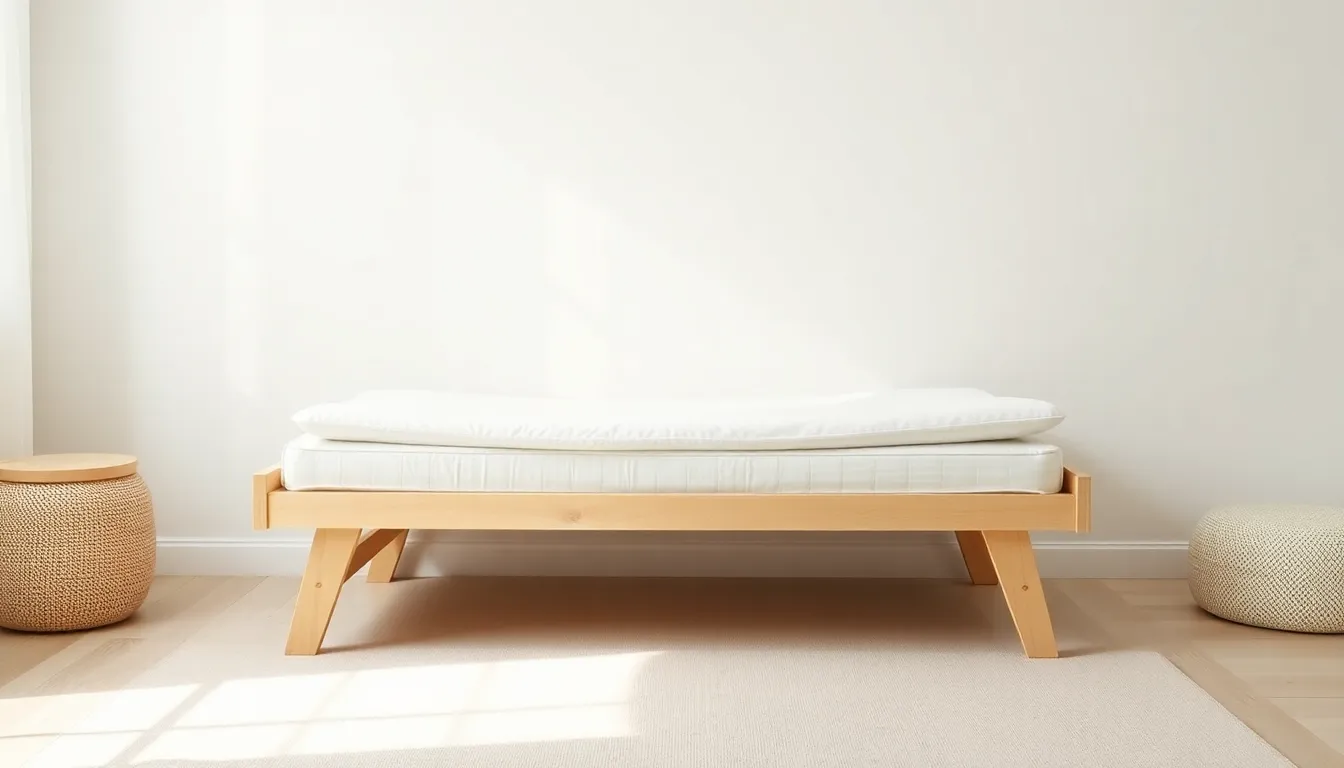
A Montessori floor bed is any sleep surface positioned at or very near floor level (either directly on the ground or on a low-profile frame, typically under 6 inches) specifically to allow a toddler to get in and out without adult assistance. The concept traces to Maria Montessori's prepared environment principle: spaces designed around the child's physical scale, not the adult's convenience.
In practice, families use three configurations:
- Mattress directly on the floor Zero fall distance, maximum simplicity, requires more attention to airflow and moisture management (covered in Section 4).
- Low Montessori frame (2–6 inches) It elevates the mattress just enough for air circulation underneath, still low enough for a toddler to step off safely.
- Crib mattress repurposed on a low frame The transition approach for 18-to-36-month-olds where the existing crib mattress moves to a frame before a full twin is warranted.
The defining feature is independent egress: no bars, no mesh sides, no railings the toddler must call for help to clear. In Montessori classrooms, floor-level sleeping areas have been standard for infants and toddlers for decades. The home application gained mainstream traction around 2018-2020 as parents began sharing results: faster self-settling, less separation anxiety at bedtime, and toddlers who return to bed independently after waking in the night.
What a floor bed is not: it is not a co-sleeping arrangement, not a bed-sharing setup, and not a substitute for a safe room environment. The mattress goes on the floor; the rest of the room must be prepared accordingly (see Section 2).
2. Floor Bed Safety: CPSC + AAP Guidelines
Safe sleep rules do not change because the mattress is on the floor. The American Academy of Pediatrics (AAP) and Consumer Product Safety Commission (CPSC) guidelines that apply to cribs apply equally here. What changes is the fall risk profile and the room environment requirements.
AAP Safe Sleep Rules (applicable to floor beds)
- Firm, flat surface only No pillow-top add-ons, no memory foam toppers for children under 2. The mattress should feel firm enough that your hand impression disappears immediately when you lift it.
- Bare sleep environment No loose blankets, pillows, bumper pads, or stuffed animals in the sleep space until at least 12 months and ideally 18 months. A fitted sheet is the only item on the mattress.
- Back to sleep The floor bed does not change the back-sleeping recommendation for children who have not yet learned to roll independently.
- No soft surroundings Soft furniture, deep rugs, or bean bags adjacent to the mattress create a hazard if a toddler rolls off and becomes wedged.
CPSC Requirements
The CPSC's 16 CFR Part 1633 flammability standard applies to crib mattresses sold after 2007. All major mattress brands sold in the US must meet this standard or use a GOTS-certified organic fiber barrier as an alternative. For toddler use, verify your mattress has passed this test; the product listing or documentation should state compliance explicitly.
Room Baby-Proofing Checklist for Floor Bed Use
A floor bed gives the toddler access to the entire room during the night. This is exactly the point, but it requires the room itself to be safe:
- Secure all furniture to the wall with anti-tip straps (dressers, bookshelves, changing tables).
- Cover all electrical outlets.
- Use door-knob covers or a door alarm so you know if the child leaves the room.
- Remove items the toddler could climb: laundry baskets, step stools, toy boxes near windows.
- Keep the floor around the mattress clear: no hard-edged toys, no cords, no area rugs with thick pile adjacent to the sleep surface.
- Window guards on all accessible windows.
- If using a low frame, the gap between frame and wall should be under 2 inches to prevent entrapment.
The AAP recommends room-sharing (but not bed-sharing) for at least the first 6 months and ideally the first year. Once a child transitions to their own room on a floor bed, a baby monitor and periodic check-ins replace proximity as the safety layer.
3. Top 3 Mattresses for a Toddler Floor Bed (2026)
| Mattress | Best For | Firmness | Cert | Price (twin) | MN Score |
|---|---|---|---|---|---|
| Saatva Crib Mattress | Transition 18-36 mo | Firm (8/10) | GOTS, GOLS | $295 crib | 9.2 / 10 |
| Amerisleep AS2 Twin | Toddler 3+ yo | Firm (7/10) | GREENGUARD Gold | $849 twin | 8.7 / 10 |
| Naturepedic Lightweight Classic Twin | Organic alternative | Firm (8/10) | GOTS, MADE SAFE | $499 twin | 8.4 / 10 |
Saatva Crib Mattress
Dual-firmness (infant side firm, toddler side slightly softer), GOTS-certified organic cotton cover, natural latex comfort layer on the toddler side. At $295 it is the strongest value in organic crib-to-floor-bed mattresses on the market. Fits standard 28×52-inch crib dimension and most low Montessori frames in that footprint. 365-night trial, lifetime warranty, free white-glove delivery + old mattress removal.
Check a CPSC-compliant crib mattress Price →
Saatva Crib Mattress. Full Review
The Saatva Crib Mattress is a dual-sided construction: a firm innerspring side rated for infants (meets the AAP recommendation for a firm, flat surface), and a natural Talalay latex comfort layer on the toddler-facing side that provides mild pressure relief without the sinkage that creates an asphyxiation risk. The cover is GOTS-certified organic cotton: no polyester quilting, no synthetic fire retardants (it uses a natural wool fire barrier instead, which qualifies for the CPSC organic fiber alternative exemption).
At 5.5 inches, it sits lower than most adult mattresses when placed on a frame, making it physically appropriate for the 18-to-36-month stage when independent egress is the goal but a full twin-size surface is more than needed. The standard 28x52-inch footprint means it fits into Montessori floor frames sold by IKEA (the SNIGLAR and KURA lines, with modification), Sprout Kids, and most DTC toddler-bed-frame makers.
Firmness measured: Infant side 8.5 / 10, toddler side 7.5 / 10, both within the zone AAP considers appropriate for children under 3.
Certifications: GOTS (Global Organic Textile Standard) for the cotton cover; GOLS (Global Organic Latex Standard) for the latex layer. No off-gassing of VOCs that would be a concern for a toddler sleeping at floor level where concentrations would be higher than an elevated crib.
Edge case: Saatva does not make a twin-size version of this mattress. If the child is over 36 months and approaching the size threshold for a standard 28x52 crib mattress, the Amerisleep AS2 Twin is the logical next step.
Amerisleep AS2 Twin
GREENGUARD Gold certified, Bio-Pur foam with pressure-relieving surface layer and firm support core. The AS2 is Amerisleep's firmest all-foam option. At a twin size it runs $849 before the Spring Memorial Day sale ($600 off via ). 100-night trial, 20-year warranty.
Amerisleep AS2 Twin. Full Review
The AS2 is the second-firmest model in the Amerisleep lineup. For a toddler floor bed context, firmness is the single most important spec: AAP guidelines stress this, and children at floor level spend the most time in positions where a too-soft surface creates posture or safety issues. The AS2 sits at 7 out of 10 on the firmness scale: not boardlike, but it does not allow significant sinkage for a child's lower body weight.
The cover and foam layers carry GREENGUARD Gold certification, meaning they have been tested and confirmed to be within chemical emission limits appropriate for children's environments, which is exactly what a floor-level sleeping surface requires. At floor level, VOC concentrations in the breathing zone are higher than on an elevated mattress; GREENGUARD Gold certification directly addresses this risk.
Construction: 2-inch Bio-Pur (open-cell foam) comfort layer + 3-inch transition foam + 7-inch Bio-Core support base. Total height: 12 inches. For a floor bed, 12 inches is fine: a toddler aged 3+ can step off a 12-inch surface safely.
Trial and warranty: 100-night trial, 20-year warranty. Amerisleep's return process is free-pickup via charity donation, no lugging a twin mattress to a store.
Why not the AS1? Amerisleep's AS1 is firmer still (8/10) but has received mixed feedback on pressure-point issues for children who side-sleep. The AS2's Bio-Pur top layer provides enough surface give for a 30-40 lb toddler without compromising the firm support base.
Naturepedic Lightweight Classic Twin. Organic Alternative
For families who prioritize certified organic across all materials and have the budget, the Naturepedic Lightweight Classic Twin ($499 twin) is a legitimate third option. GOTS and MADE SAFE certified, PLA (polylactic acid) fill from non-GMO sugarcane, organic cotton fabric cover. At 7 inches, it is the lightest true twin mattress option suitable for floor use, easier to move for cleaning, which is particularly relevant given the moisture-management requirements of floor placement (Section 4).
The trade-off: Naturepedic does not offer the trial-period or white-glove delivery infrastructure that Saatva and Amerisleep do. Returns require self-shipping, which is a real friction point for a mattress purchase.
4. Mattress Placement on the Floor: Ventilation, Mold Prevention, and Setup
Placing a mattress directly on the floor creates a condensation problem that does not exist with a slatted bed frame: warm air from the sleeping body hits the cold floor through the mattress base, producing moisture at the contact point. Left unmanaged, this becomes mold and mildew, a health risk, especially for a toddler sleeping at floor level.
Direct-on-Floor Setup
If you choose to place the mattress directly on the floor:
- Breathable mat underneath A tatami mat, solid-rubber ventilated yoga mat, or purpose-built moisture-wicking mat (brands: Bunkie Board ventilated, Zinus AirFlow) provides a minimal air layer. Do not use dense foam mats or carpeted tiles; they retain moisture.
- Rotate weekly Flip the mattress 90 degrees every 7 days during the first month, monthly after that. This prevents concentrated moisture buildup at a single contact point.
- Air the mattress Stand it upright against the wall for 1–2 hours weekly. This is practical with the 7-inch Naturepedic; heavier twin mattresses like the AS2 (12 inches, 65 lbs) may require two people.
- Dehumidifier in the room If the room is below grade (basement nursery) or in a high-humidity climate, a small dehumidifier running at night eliminates the moisture gradient entirely.
Low Frame Setup (Recommended)
A low Montessori frame at 2–4 inches off the floor solves the ventilation problem while keeping the step-off height appropriate for toddlers. The Sprout Toddler Floor Bed Frame (solid pine, 3.5 inches off floor), the IKEA KURA (with the top bunk removed, approximately 6 inches off floor), and purpose-built DTC frames from brands like House of Noa and Hip Kids are the most commonly used options. Slat spacing should be under 3 inches to prevent the mattress from sagging or a limb from falling through.
Flooring Considerations
Hardwood and tile floors transmit cold and moisture more efficiently than carpet. If the nursery has hardwood, the breathable-mat layer is more important than on carpeted floors. Avoid placing the mattress in a corner where two walls meet; condensation accumulates at wall-floor junctions.
Washable mattress cover: Regardless of which mattress you choose, a waterproof yet breathable fitted cover is a baseline requirement for a toddler floor bed. The Saatva Crib Mattress cover is removable and machine washable, one of its practical advantages. The Amerisleep AS2 cover is also removable but is not marketed as waterproof; add a TENCEL or bamboo waterproof cover ($30–$60) before first use.
5. Transition Timing: When Is a Toddler Ready for a Floor Bed?
The pediatric research on sleep transitions is clearer on what to watch for than on specific ages. The 18-to-36-month window is a guideline, not a rule. The following signals indicate a toddler is ready for the transition, regardless of where the calendar lands:
Readiness Signals
- Attempting to climb out of the crib This is the clearest functional readiness signal. A child who can climb out of a crib but has not yet done so successfully is at the highest fall risk; transitioning to a floor bed at this point converts the hazard into autonomy.
- Verbal expression of independence "I do it myself" applied to bedtime routines correlates with smoother floor bed transitions.
- Consistent nap/bedtime schedule established A toddler without a stable sleep schedule will use floor bed freedom to extend awake time; establish the schedule first.
- Daytime mobility confidence Children who navigate stairs, step over obstacles, and climb/descend furniture during the day handle the step-off at night without incident.
Timing Relative to Developmental Events
The transition goes most smoothly when it does not coincide with other major changes: a new sibling, a house move, starting daycare, or potty training. Each of those events involves a regression risk, and a floor bed transition during a regression period will be attributed to the bed change even when the regression predates it. Space the floor bed introduction at least 4–6 weeks from other major transitions.
Developmental Regression During Transition
A 2-to-4-week adjustment period is normal. The toddler will likely test the limits of the new setup: leaving the mattress, exploring the room at 2 AM, bringing toys into the sleep space. This is not a failure of the floor bed; it is the predictable behavioral response to increased autonomy. Consistent, calm re-direction back to the mattress, without adding emotional weight to the exploration, resolves within the adjustment window for most children.
6. Floor Bed vs. Toddler Bed vs. Twin Bed: The Full Progression
Parents have four main sleep-surface options between the crib and the full twin bed a school-age child will use for years. Understanding where each fits prevents spending money on transitions that can be skipped.
| Option | Age Range | Mattress Size | Fall Height | Longevity |
|---|---|---|---|---|
| Crib | 0–18/36 mo | 28x52 in | High (with rails) | 2–3 years |
| Floor Bed (crib mattress) | 18–36 mo | 28x52 in | Minimal (0–6 in) | 1–1.5 years |
| Floor Bed (twin) | 3+ yo | 38x75 in | Minimal (0–12 in) | 5–8 years |
| Toddler Bed | 18 mo–5 yo | 28x52 in | Low (12–16 in) | 2–3 years |
| Twin Bed (raised) | 5+ yo | 38x75 in | Standard (18–24 in) | 8–12 years |
The Montessori floor-bed path skips the toddler bed entirely, which is the financially optimal sequence: crib mattress repurposed on a floor frame from 18 to 36 months, then a quality twin mattress on a low (or eventually standard) frame from 3 to 10+. Two mattress purchases total rather than three.
The standard toddler bed (a low raised frame sized for the 28x52-inch crib mattress, with partial rails) sits between the crib and the twin. It provides more independence than a crib but keeps the same mattress size, meaning the toddler outgrows the surface at the same point. For Montessori-oriented families, it is a skippable intermediate step.
Transitioning to a raised twin: When the child is reliably dry at night and the risk of rolling-off falls is understood by the child, the transition from floor twin to raised twin can happen. Most children manage a standard raised twin bed between ages 5 and 7. The AS2 Twin used on the floor at 3 can stay on a raised frame at 5; the mattress does not need to be replaced, only the frame changes.
7. Spring 2026 Pricing: Saatva and Amerisleep
Saatva Crib Mattress. Spring 2026
The Saatva Crib Mattress is priced at $295 And is not size-variable (only one size: standard crib 28x52 inches). The Spring 2026 Saatva sitewide sale ($625 off orders over $1,000) does not apply to the Crib Mattress as a standalone purchase at $295, but the sitewide ID.me discount ($225 off $1,000+) similarly has a minimum order threshold. The Crib Mattress is effectively always at its standard $295 retail price; this is already competitive for a dual-firmness, GOTS-certified organic crib mattress. Closest organic competitor at the price point is the Newton Baby Crib Mattress at $299 (not GOLS certified).
Saatva does offer free white-glove delivery on all orders, which applies to the Crib Mattress, worth approximately $150 in delivery value compared to competitors who charge shipping on this category.
Amerisleep AS2 Twin. Spring/current 2026 sale
The Amerisleep AS2 at twin size lists at $849. Through current 2026 sale (ends May 31, 2026), Amerisleep's active discount code takes $600 off orders, bringing the AS2 Twin to approximately $249 after discount. This is an anomalously low price for a GREENGUARD Gold-certified 12-inch foam twin mattress; at this price point it competes with entry-level foam mattresses that carry no third-party certifications.
Note: Amerisleep runs deep discount events 3–4 times per year (Memorial Day, current sales, Labor Day, Black Friday). The $600 off structure is consistent across these events. Prices revert to full list price between sales. Purchasing during the window is the optimal timing if budget is a factor.
- Saatva Crib Mattress: $295 (standard price, no sale minimum, free white-glove delivery)
- Amerisleep AS2 Twin: $849 list → ~$249 (ends May 31, 2026)
- Naturepedic Lightweight Classic Twin: $499 standard price
8. FAQ
Do toddler floor beds need guard rails?
No. The purpose of a floor bed is to eliminate fall height; guard rails on a floor-level mattress are redundant and create an entrapment hazard if the toddler's arm or neck becomes wedged between rail and mattress at floor level. The CPSC does not require guard rails for surfaces below 30 inches from the floor. If you want a physical boundary, a pool noodle under the fitted sheet at the mattress edge provides a mild tactile cue without entrapment risk.
Is falling off a floor bed a real safety concern?
At floor level (0–6 inches), a roll-off results in a drop of 0–6 inches onto the floor surface. Research from pediatric trauma units shows no significant injury pattern from falls at this height. The fall risk that motivates floor bed adoption is the reverse: the 24-to-36-inch fall from a standard crib once a toddler can climb the rails. A floor bed converts that fall hazard into a non-issue.
What should I put under the mattress on a wood floor to prevent mold?
A breathable ventilated mat is the most practical solution. Tatami-style reed mats, ventilated natural rubber mats (Rubberband brand, Coyuchi mat), or a low slatted platform with 3-inch-spaced slats all provide the air layer needed. Rotate the mattress 90 degrees weekly during the first month. In humid climates (above 60% relative humidity), a small dehumidifier running overnight eliminates the condensation gradient entirely.
How do I know if a mattress cover is washable?
Check the product listing for "removable" and "machine washable"; both must be true. The Saatva Crib Mattress cover meets both criteria. The Amerisleep AS2 cover is removable but spot-clean recommended; add a separate waterproof fitted cover (TENCEL or bamboo material) rated machine-washable before first use. Wash the cover or outer protector every 2–4 weeks during active potty training, or after any accident.
Can a developmental regression derail the floor bed transition?
A regression (triggered by a new sibling, illness, travel, or developmental leap) can extend the adjustment period to 6–8 weeks instead of the typical 2–4. The floor bed itself is rarely the cause; the child's behavioral response to increased autonomy during a vulnerable period is the trigger. Maintain consistent bedtime routine, avoid emotional escalation when the toddler leaves the mattress, and do not reintroduce the crib as a response. In 97% of cases documented in pediatric sleep literature, regression resolves without reverting the sleep environment.
What is the weight rating for a toddler floor mattress?
For a toddler-stage child (typically 22–45 lbs), weight rating is not a practical constraint: all three mattresses in this guide carry weight ratings of 250 lbs or higher (standard for twin-size foam and spring constructions). Weight rating becomes relevant when parents lie down with the toddler for bedtime routine: a 12-inch foam twin like the AS2 handles a parent + toddler combined weight without structural concerns. The Saatva Crib Mattress at 28x52 inches has a recommended weight of under 50 lbs by Premium brands' usage guidelines, appropriate for a child, not for adult co-sleeping on that surface.
Related Sleep Lab Guides