
 by
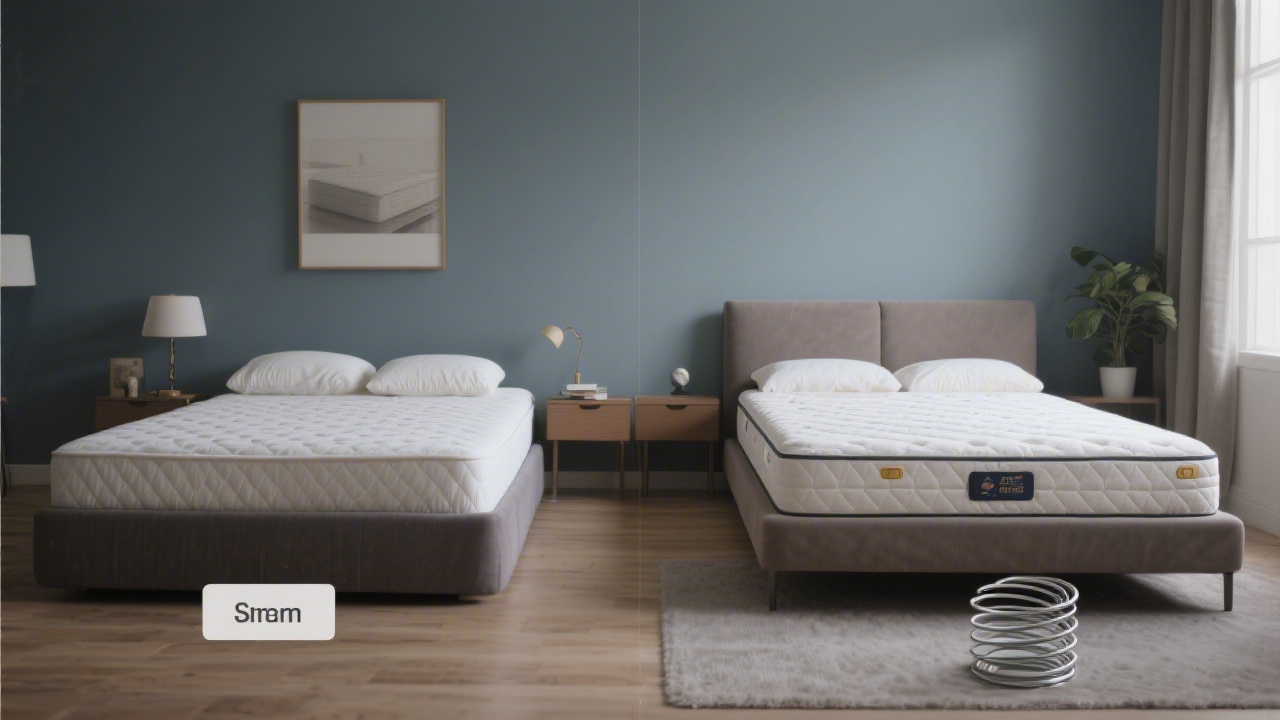
by Foam versus spring is the most fundamental mattress construction choice. Both have been around for decades and continue to improve, but they deliver fundamentally different sleep experiences. Whether foam’s body-conforming pressure relief or spring’s responsive bounce is right for you depends on how you sleep — and who you sleep with. Here is the full comparison.
Best Spring-Based Mattress for 2026
Saatva Classic Mattress
Dual coil-on-coil construction with a Euro pillow top delivers the best of innerspring support and premium comfort. Three firmness options, 365-night home trial, free white-glove delivery.
Affiliate disclosure: We earn a commission at no extra cost to you.
Key Differences: 4 Criteria That Matter Most
1. Support System Philosophy
Foam mattresses work by distributing body weight across the full contact surface — they conform to your shape. The foam compresses where pressure is greatest and supports the surrounding areas, reducing peak pressure at hips and shoulders. Spring mattresses push back. Coils compress individually (in pocketed coil designs) or together (in Bonnell designs), providing a responsive lift. Back and stomach sleepers who want to feel supported rather than cradled typically find spring mattresses more comfortable.
2. Temperature and Breathability
Spring mattresses have a significant thermal advantage. The open space within the coil layer allows air to circulate freely through the mattress. Dense foam acts as an insulator, trapping body heat. Manufacturers have addressed this with gel infusions, copper layers, and open-cell foam structures, but these technologies reduce rather than eliminate the thermal gap. If you sleep warm, spring construction gives you an automatic advantage.
3. Motion Transfer
Foam wins decisively on motion isolation. The viscoelastic properties that make memory foam conforming also absorb and contain movement. When your partner shifts position or gets out of bed, foam attenuates that vibration before it reaches your side. Spring mattresses — particularly older Bonnell coil designs — transfer movement across the entire surface. Modern pocketed coil designs do better, but foam still leads.
4. Edge Support and Practical Durability
Spring mattresses have stronger edges. The coil perimeter resists compression at the sides of the mattress, giving you a stable surface for sitting and sleeping to the very edge — effectively giving you more usable sleep area. Foam mattresses compress at the edges, which feels unstable when sitting and reduces the effective sleeping width over time. For couples, this matters: stronger edges mean better use of the full mattress width.
| Criterion | Foam Mattress | Spring Mattress | Winner |
|---|---|---|---|
| Body Conforming | Excellent — contours to curves | Minimal contouring | Foam |
| Bounce and Ease of Movement | Slow-response, can feel trapping | Responsive, easy repositioning | Spring |
| Cooling | Moderate (gel versions) | Excellent airflow | Spring |
| Motion Isolation | Outstanding | Poor to moderate | Foam |
| Edge Support | Weak, compresses at edges | Strong coil perimeter | Spring |
| Price Entry Point | Low — quality budget options available | Low to moderate | Tie |
Pros and Cons
What We Like
- Luxury innerspring with excellent lumbar support
- Multiple firmness options available
- Free white-glove delivery and mattress removal
- 365-night trial and lifetime warranty
What Could Be Better
- Higher price than many online brands
- Heavier than foam mattresses
- Not compressed in a box
- Some off-gassing possible initially
Who Should Choose Foam?
Side sleepers with hip or shoulder pressure point issues benefit most from foam’s conforming properties. Couples where one partner is a light sleeper will appreciate foam’s superior motion isolation. Those sleeping alone who prioritize a quiet, contouring sleep experience often prefer foam. Budget shoppers also have more high-value options in the foam segment at the $400–$900 range.
Who Should Choose Spring?
Back and stomach sleepers who want responsive support without body-hugging contouring. Hot sleepers who need airflow. Heavier sleepers who benefit from coil support to prevent premature sagging. Those who move and reposition frequently during sleep. And couples who want to use the full width of the mattress benefit from spring’s stronger edge support.
Verdict: The Best Sleep System Combines Both
The foam versus spring debate has largely been resolved by the hybrid mattress category, which layers pocketed coils for support and cooling with foam for pressure relief. The Saatva Classic’s dual coil system delivers spring-level support and cooling with premium comfort layers that eliminate the pressure issues traditional spring mattresses can create.
Best of Both: Hybrid Construction
Saatva Classic Mattress
Dual coil-on-coil construction with a Euro pillow top delivers the best of innerspring support and premium comfort. Three firmness options, 365-night home trial, free white-glove delivery.
Affiliate disclosure: We earn a commission at no extra cost to you.
Continue researching: our Saatva Classic review, best mattress for 2026, best mattress for stomach sleepers, and best mattress for combination sleepers.
Frequently Asked Questions
Are foam mattresses better than spring mattresses?
Neither is universally better. Foam mattresses excel at motion isolation and pressure relief. Spring mattresses excel at cooling, edge support, and responsive bounce. Your sleep position and priorities determine the best fit.
Do foam mattresses sag faster than spring mattresses?
Lower-density foam can sag relatively quickly — within 3–5 years in some cases. High-density foam and quality spring mattresses both last 7–10+ years with a proper support base. Coil gauge and foam density are the key quality indicators to compare.
Which is better for a guest room: foam or spring?
A foam mattress in a medium firmness is often the better guest room choice. It accommodates a range of sleep positions, tends to be quieter, and frequently has a lower cost at comparable quality levels.
Can a spring mattress cause back pain?
A worn-out spring mattress with sagging zones absolutely can contribute to back pain. A new, properly firmness-matched spring mattress with good coil gauge typically supports spinal alignment well, especially for back and stomach sleepers.
Is a hybrid the same as a spring mattress?
Not exactly. A traditional spring mattress has minimal comfort layers — often just fabric or thin padding. A hybrid adds 2–4 inches of foam comfort layers on top of a pocketed coil base, providing meaningfully better pressure relief. Most premium “spring” mattresses sold today are technically hybrids.