
 by
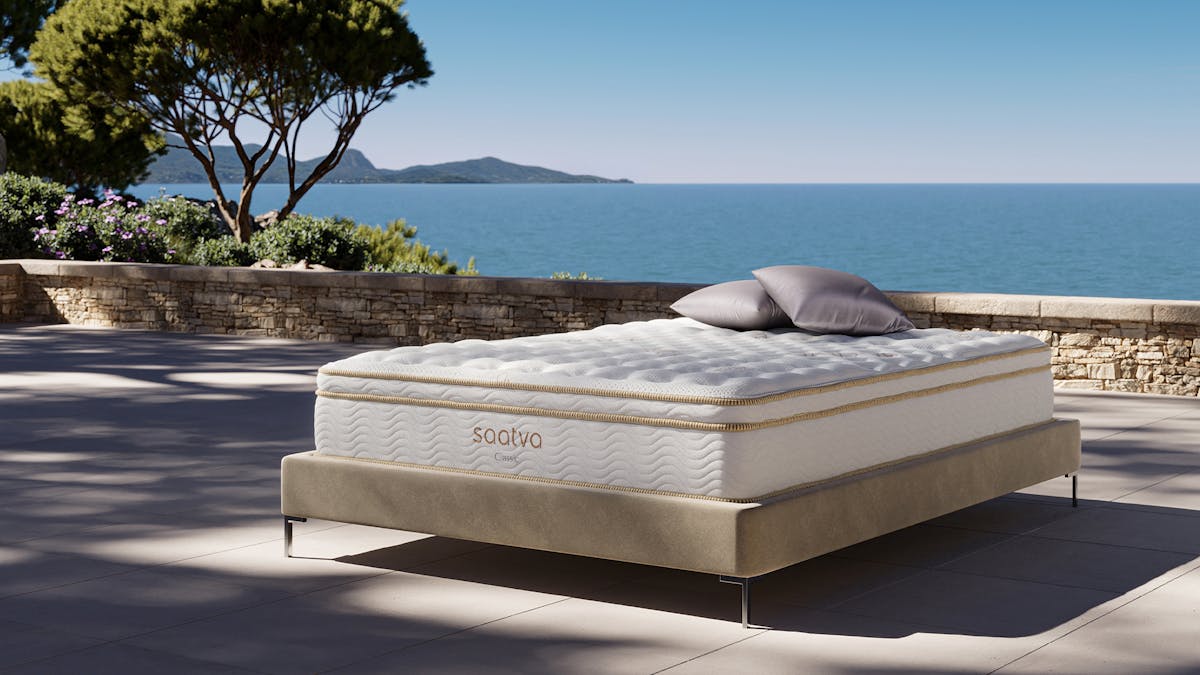
by For most sleepers, memory foam wins on pressure relief and motion isolation; innerspring wins on cooling and responsiveness. Our overall top pick is the Saatva Classic: dual-coil construction, free white-glove delivery, and a 365-night trial that covers both feel types in one hotel-luxury hybrid. For pure memory foam, the Amerisleep AS3 solves the classic heat problem with Bio-Pur open-cell foam and adds HIVE 5-zone lumbar support.
Saatva Classic
9.2/10
- Dual-coil construction: individually wrapped upper coils over a tempered steel Bonnell base, with a zoned lumbar wire reinforcement
- Outstanding cooling: NapLab surface temperature 89.5°F, open coil construction allows full-depth airflow
- Exceptional edge support: NapLab rated 10/10, only 2.25" sitting sinkage
- Free white-glove delivery with in-room setup and old mattress removal
- 365-night trial, lifetime warranty
- Motion isolation rated 7.4/10 by NapLab; higher-than-average transfer with sensitive co-sleepers
- Ships full-size (not compressed in a box), heavy at around 110 lb for a queen
- $99 return fee applies during the trial window
For hot sleepers, stomach sleepers, and back sleepers who want the responsive feel of an innerspring with the comfort of a Euro pillow top, the Saatva Classic in Luxury Firm is the most consistently recommended option at this price point. The 365-night trial gives you enough time to be certain.
How memory foam and innerspring are built differently
The performance gap between the two types comes directly from their construction. Memory foam layers are viscoelastic: they soften under body heat, conform to pressure points, and rebound slowly. That slow recovery is what produces the signature “cradled” feel and what kills motion transfer between partners.
An innerspring mattress replaces those foam layers with a coil system. The coils compress and rebound independently or as a unit depending on the design. Bonnell and offset coils are interconnected, so movement on one side travels across the bed. Individually wrapped pocket coils move more independently, which is why pocket-coil hybrids have better motion isolation than traditional innerspring designs.
The practical result: memory foam concentrates its energy absorbing weight and pressure; innerspring concentrates its energy bouncing it back. That single difference drives most of the performance divergences in the comparison below.
Memory foam vs spring: head-to-head comparison
| Performance category | Memory foam | Innerspring | Hybrid (both) |
|---|---|---|---|
| Pressure relief | Excellent. Conforms to hips and shoulders, distributes weight evenly. | Moderate. Coils push back rather than conform, creating pressure at bony prominences for side sleepers. | Very good. Foam comfort layers above coil core provide contouring without the heat trap. |
| Cooling | Below average for traditional memory foam. Open-cell and plant-based foams (like Bio-Pur) improve this significantly. | Excellent. Coil construction allows constant airflow through the mattress body. | Good. Coils carry heat away; foam surface adds some warmth. |
| Motion isolation | Excellent. Viscoelastic material absorbs movement before it crosses the bed. | Poor with Bonnell coils. Pocket-coil designs are better but still below all-foam. | Good. Pocket coils plus foam layers catch most motion; not quite all-foam level. |
| Edge support | Below average. Foam perimeter compresses under sitting weight. | Good to excellent. Perimeter coil systems hold the edge firm. | Excellent. Reinforced coil perimeter gives a firm, sleep-to-the-edge surface. |
| Responsiveness | Low. Memory foam is slow to rebound, making position changes feel effortful. | High. Coils rebound immediately, making combination sleeping easy. | High. Coil core retains full responsiveness even with foam comfort layers above. |
| Durability | 7-10 years for high-density foam (4+ lb/cu ft). Low-density foam sags within 3-5 years. | 8-12 years for quality coil gauges. Sagging along the perimeter is the typical failure point. | 8-12 years. Coil core outlasts the foam layers, which may need replacement in 7-10 years. |
| Noise | Silent. Zero coil noise. | Squeaky coils in older or worn designs. Quality pocket coil systems are generally quiet. | Minimal noise with individually wrapped coils. |
Who should choose memory foam
Memory foam performs best in three specific scenarios. Side sleepers benefit most because the foam closes the gap between the mattress and the waist, keeping the spine straight without driving the shoulder or hip into a hard surface. Without that pressure relief, side sleeping concentrates weight onto two narrow zones and produces shoulder and hip stiffness by morning.
Couples where one partner is a light sleeper find memory foam eliminates most night-time disturbance. The viscoelastic structure absorbs each movement before it can travel across the bed. This is harder to replicate with a coil system.
People with joint pain at the hips, shoulders, or knees experience less pressure point stiffness on memory foam because the material redistributes contact pressure over a wider surface rather than concentrating it at bony prominences.
The traditional objection to all-foam is heat. Modern open-cell memory foams address this structurally. The Bio-Pur foam in the Amerisleep AS3 has an open-cell structure that allows air to move through the material, unlike the dense closed-cell foam in older memory foam mattresses. NapLab testing rated the AS3 at 9.0/10 for cooling, unusually high for an all-foam construction.
Who should choose innerspring
Hot sleepers have the clearest case for innerspring. The coil system creates airflow channels through the full depth of the mattress, and the sleep surface runs measurably cooler than comparable all-foam beds. NapLab measured the Saatva Classic at 89.5°F maximum surface temperature, placing it in the top tier for thermal performance.
Combination sleepers benefit from the immediate rebound of a coil system. Rolling from the back to the side, or shifting position at 3am, requires less effort when the mattress pushes back quickly. Memory foam’s slow recovery creates a brief resistance that some sleepers find annoying.
Stomach sleepers and heavier sleepers (over 230 lb) often do better on a firmer innerspring or hybrid. Memory foam’s deep contouring can allow the hips to sink too deeply, reversing the lumbar curve and producing lower back pain. A coil system with a thinner foam comfort layer keeps the hips elevated and the spine neutral.
Amerisleep AS3
9.1/10
- Bio-Pur open-cell foam runs cooler than traditional memory foam (NapLab: 9.0/10 cooling for an all-foam)
- Outstanding motion isolation: NapLab measured 2.11 m/s² vs 8.80 m/s² category average
- HIVE 5-zone support layer firms under the lumbar and hips specifically
- Partially plant-based construction, CertiPUR-US certified, made in the USA
- 20-year warranty (full replacement years 1-10)
- Softer edge support than a coil hybrid (rated 8.0/10 lying, softens when sitting on the edge)
- Sleepers over 230 lb generally prefer the AS5 Hybrid for added coil support
- Requires a mandatory 30-night break-in before a return is permitted
The AS3 is the strongest all-foam choice for side and combination sleepers who want genuine pressure relief without the heat trap of traditional memory foam. The HIVE zoning and Bio-Pur construction set it apart from standard slow-response foam.
Why most buyers end up with a hybrid
A hybrid mattress pairs a pocketed coil support core with foam or latex comfort layers above. The result addresses the primary weaknesses of both pure types.
The coil core keeps the sleep surface cooler than all-foam and gives the mattress enough responsiveness for combination sleepers. The foam comfort layers above the coils provide pressure relief at the hips and shoulders that a basic innerspring cannot match. Edge support from a perimeter coil system is typically better than either all-foam or thin mattress designs.
The one area where hybrids cannot fully match all-foam is motion isolation. Pocket coils reduce transfer compared to Bonnell designs, but they cannot absorb movement as completely as a solid foam structure. Couples where one partner is a genuinely disruptive mover will still get better results from an all-foam mattress.
Price ranges: what to expect
Budget all-foam mattresses start around $300 to $500 for a queen. Mid-range all-foam from established brands (Nectar Original at around $700, Casper at around $800) sits between $600 and $1,000. Premium all-foam with higher-density foams or specialized cooling layers (Amerisleep AS3 from $1,049, Tempur-Pedic from $1,600) runs above $1,000.
Basic innerspring mattresses remain among the cheapest options on the market, from $200 to $500, though these typically use interconnected Bonnell coils with minimal comfort layers. Pocket-coil hybrids span the widest range: budget hybrids from $700 to $1,000 (DreamCloud, Helix Midnight), mid-luxury from $1,200 to $1,600 (Saatva Classic, WinkBed), and premium above $1,700 (Helix Midnight Luxe, Tempur-Pedic hybrids).
Trial periods and warranties are worth factoring into the real cost. A 365-night trial on the Saatva is meaningfully different from a 100-night trial on a budget foam mattress, because you have more time to confirm whether the mattress actually works for your body before the return window closes.
Memory foam wins on pressure relief and motion isolation; innerspring wins on cooling and responsiveness. The Saatva Classic is our overall pick, bridging both worlds with dual-coil construction, a 365-night trial, and white-glove delivery. For pure memory foam, the Amerisleep AS3 (Bio-Pur open-cell foam, HIVE zoning, 100-night trial) is the top all-foam choice.
Frequently asked questions
Is memory foam or innerspring better for back pain?
For most back pain sufferers, the mattress type matters less than the firmness and zoning. Medium-firm with lumbar zoning consistently outperforms both soft foam and hard innerspring. A zoned memory foam (Amerisleep AS3 with HIVE) or a coil hybrid with a lumbar reinforcement pad (Saatva Classic) are both good choices. The key is avoiding beds that let the lumbar sag (too soft) or that prevent the pelvis from settling naturally (too firm).
Does memory foam sleep hot?
Traditional dense memory foam does retain body heat. Modern open-cell formulations like Bio-Pur reduce the problem significantly: NapLab’s lab measurement placed the AS3 at 9.0/10 for cooling, which is unusually high for an all-foam construction. If you run very hot, a hybrid is still the safer choice because coil airflow is structurally superior to even the best foam cooling technology.
Which is better for couples: memory foam or innerspring?
Memory foam is better for couples where motion isolation is the priority, because all-foam absorbs movement most completely. If cooling is the priority (both partners sleep hot), an innerspring or hybrid wins. If both matter, a hybrid with individually wrapped pocket coils is the practical compromise.
How long does memory foam last compared to innerspring?
High-density memory foam (4+ lb/cu ft) lasts 7 to 10 years before body impressions develop. Low-density foam (2 to 3 lb/cu ft) can sag within 3 to 5 years. Well-constructed innerspring and hybrid mattresses last 8 to 12 years with regular rotation. The coil core typically outlasts the foam comfort layers in a hybrid, so sagging in a hybrid usually starts at the surface, not the support layer.
Can you use an adjustable base with memory foam and innerspring?
Most all-foam mattresses are compatible with adjustable bases. Many hybrid and innerspring mattresses are also compatible, but check the specific model: some coil constructions (particularly taller dual-coil designs like the 14.5" Saatva Classic) are not rated for adjustable bases. The 11.5" Saatva is adjustable-base compatible.
Saatva Classic
9.2/10
The most versatile answer to the memory foam vs innerspring debate: dual-coil hybrid construction covers both sleep styles, a 365-night trial removes the risk, and free white-glove delivery takes the logistics off your plate. The best single mattress to bridge both types.