
 by
by Gastroesophageal reflux disease (GERD) affects roughly 20% of the US population, and nocturnal reflux — acid traveling up the esophagus during sleep — is its most damaging form. Unlike daytime reflux, nighttime acid exposure lingers because swallowing and saliva production decrease during sleep. The right mattress setup doesn't just improve sleep comfort; it directly reduces esophageal acid contact time.
The Physiology of Nocturnal GERD
During sleep, three mechanisms that normally protect against reflux are suppressed: gravity (if lying flat), swallowing frequency (falls by 80% during NREM sleep), and saliva production. The lower esophageal sphincter (LES) has reduced pressure during deep sleep stages. This combination makes nocturnal reflux more erosive than daytime reflux, and a greater risk for Barrett's esophagus with prolonged exposure.
Mattress and positioning strategies address gravity directly — the only one of the three mechanisms that can be modified through sleep setup.
Pros and Cons
What We Like
- Luxury innerspring with excellent lumbar support
- Multiple firmness options available
- Free white-glove delivery and mattress removal
- 365-night trial and lifetime warranty
What Could Be Better
- Higher price than many online brands
- Heavier than foam mattresses
- Not compressed in a box
- Some off-gassing possible initially
Clinical Elevation Standard: 6–8 Inches at Head
The clinical recommendation from gastroenterology guidelines is 6–8 inches of head-of-bed elevation. This is not pillow elevation — propping the head with pillows actually increases intragastric pressure by bending the body at the stomach. Effective elevation lifts the entire torso from the waist up.
Two methods achieve this reliably:
- Adjustable base: Raises the head section of the mattress, lifting the entire upper body. Allows fine-tuning of angle and can be adjusted during the night.
- Wedge pillow insert: A full-body wedge placed under the mattress or between the mattress and box spring, typically 6–8 inches at the top.
Left-Side Sleeping: The Physiological Advantage
Left lateral positioning consistently outperforms right lateral and supine positioning in GERD studies. The anatomy explains why: the gastroesophageal junction is on the left side of the body, so left-side sleeping positions the junction above the gastric pool. Right-side sleeping positions the junction below the pool, increasing reflux frequency and acid contact time significantly.
This has mattress implications: a mattress that provides good shoulder and hip pressure relief for left-side sleeping is clinically preferable for GERD patients. Mattresses that create shoulder pressure forcing position changes toward the right side are counterproductive.
The Saatva Adjustable Base Plus for GERD
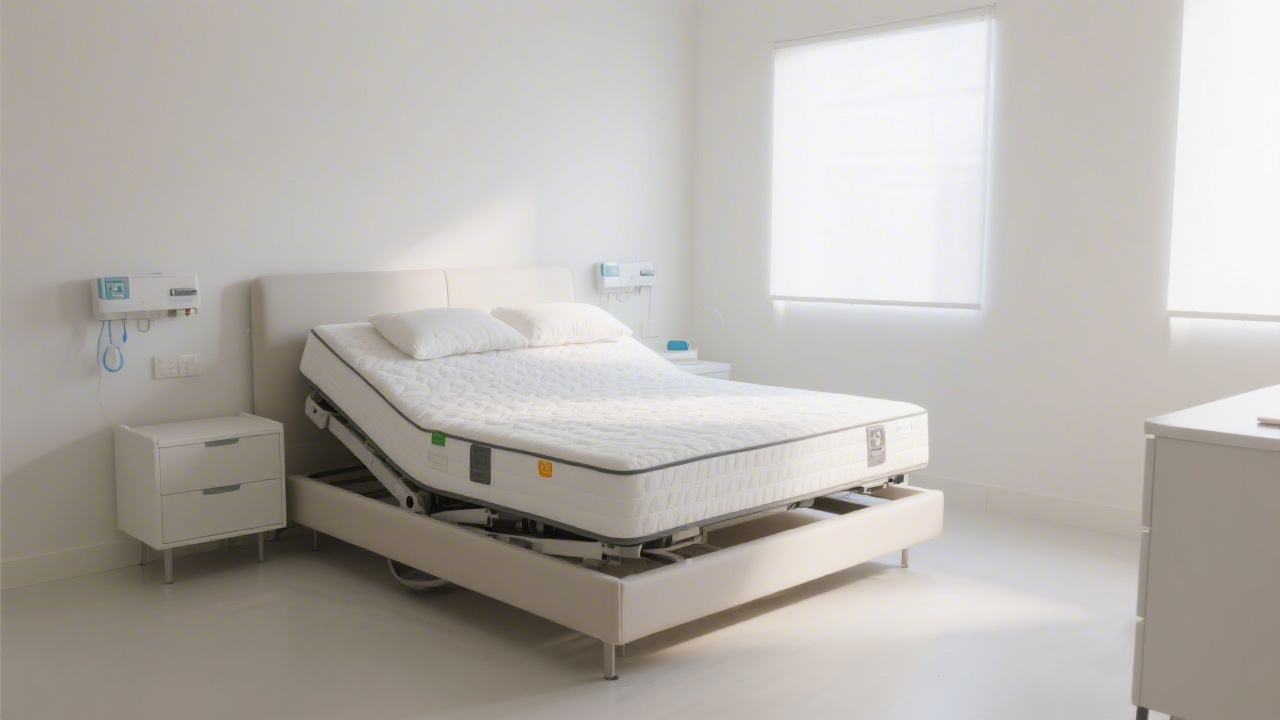
The Saatva Adjustable Base Plus provides the precise head elevation required for GERD management, with programmable presets that allow you to establish a consistent nightly elevation angle without manual adjustment. The split king option allows couples where only one partner has GERD to elevate independently.
For the mattress itself, the Saatva Classic in Luxury Firm works well on an adjustable base because its coil system flexes at the head section without creating structural stress — a problem with thick all-foam mattresses that resist bending. The slight conforming of the Euro pillow top provides the left shoulder relief that encourages side-sleeping maintenance through the night.
Saatva Adjustable Base Plus — check current pricing
Programmable head elevation, split king option, pairs with Saatva Classic for optimal GERD management.
GERD vs. Acid Reflux: Clinical Distinction
GERD (gastroesophageal reflux disease) is the chronic, pathological form of acid reflux — diagnosed when reflux occurs more than twice per week, or when reflux causes measurable esophageal damage. Standard acid reflux is occasional. If you have GERD, the elevation and positioning strategies here are medically relevant. For occasional reflux, the same principles apply but with less clinical urgency. See our related guide to the best mattress for acid reflux for general reflux guidance.
Diet and Timing Interaction With Mattress Setup
The most effective GERD sleep protocol combines mattress elevation with dietary timing: no eating within 3 hours of bedtime, avoidance of high-fat meals in the evening, and reduction of alcohol (which relaxes the LES). Even the best elevated mattress setup will underperform if the gastric load is high at bedtime. Elevation reduces the mechanical reflux problem; dietary timing reduces the volume problem.
For further context on sleep environment optimization, see our sleep optimization guide.
Frequently Asked Questions
Key Takeaways
- The Physiology of Nocturnal GERD: a key factor in making the right sleeping decision.
- Clinical Elevation Standard: 6–8 Inches at Head: a key factor in making the right sleeping decision.
- Unlike daytime reflux, nighttime acid exposure lingers because swallowing and saliva production decrease during sleep.
- The right mattress setup doesn't just improve sleep comfort; it directly reduces esophageal acid contact time.
- The lower esophageal sphincter (LES) has reduced pressure during deep sleep stages.
Our Top Pick: Saatva Classic
Voted best luxury innerspring mattress with exceptional lumbar support and white-glove delivery.
Check Price & AvailabilityHow much elevation do I need for GERD when sleeping?
Clinical guidelines recommend 6-8 inches of head-of-bed elevation measured at the head end. This must be full-body torso elevation — propping your head with pillows does not achieve the required angle and can worsen reflux by increasing abdominal pressure.
Which sleep side is better for GERD?
Left-side sleeping is clinically recommended for GERD. The gastroesophageal junction sits above the gastric pool in left lateral position, reducing acid contact. Right-side sleeping consistently shows higher reflux frequency in studies.
Is an adjustable base better than a wedge pillow for GERD?
An adjustable base provides more consistent and adjustable elevation and is generally more comfortable for long-term use. Wedge pillows are a lower-cost alternative and effective if sized correctly — at least 24 inches long to support the full torso. Both are preferable to standard pillow stacking.
Can mattress firmness affect GERD symptoms?
Indirectly yes. A mattress that creates shoulder or hip pressure during left-side sleeping will cause you to roll to the right, worsening reflux. Medium to medium-firm mattresses with adequate pressure relief at the shoulder promote the left-side position that reduces nocturnal GERD.
Does sleeping elevated help Barrett's esophagus?
Head-of-bed elevation is recommended for patients with Barrett's esophagus to minimize acid contact time during sleep. It is not curative but is part of the standard management protocol to slow disease progression. Discuss with your gastroenterologist for personalized guidance.
Ready to improve your sleep?
Saatva Adjustable Base Plus — Best for GERD Elevation
Check Current Pricing →